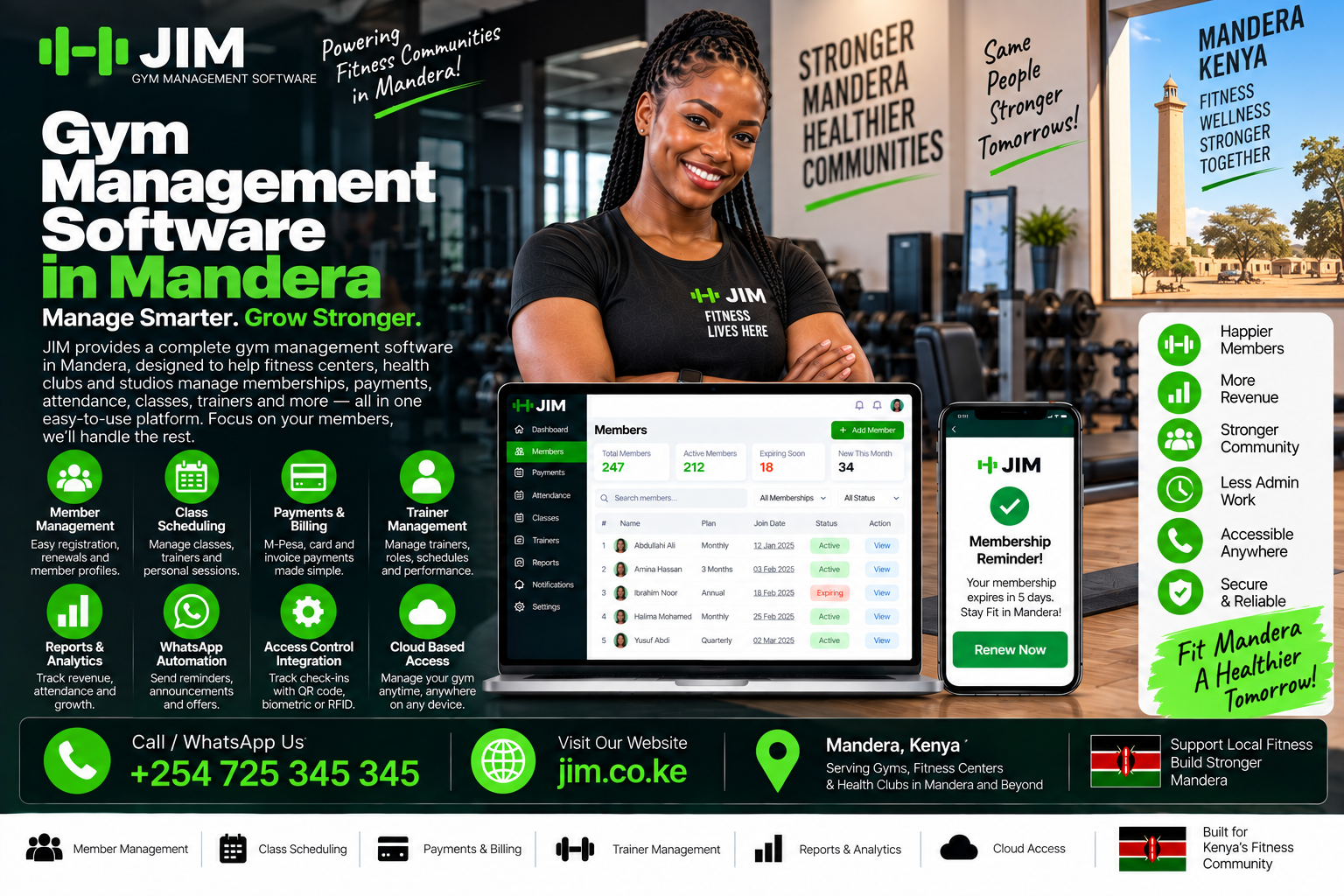
Gym management software in ManderaIt is the final evening of the month. The owner wants one answer: how much did the gym actually earn? Reception has M-Pesa confirmations, a cash notebook, several membership renewals and sales of water, gloves and supplements. Some customers received receipts; others only have chat messages. Until those records are reconciled, turnover, debtors, stock and profit remain uncertain. Gym management software in Mandera brings the financial trail into a more organised workflow.

A gym makes money through more than monthly access. Revenue may come from day passes, personal training, classes, retail products, registration fees and corporate packages. Expenses, discounts, refunds and stock movements complicate the picture. Gym management software in Mandera should connect each transaction to the correct member, product, payment method and reporting period.

Jim is designed to help Kenyan fitness businesses manage memberships alongside the commercial activity behind them. For an owner-operated gym in Mandera Town or a growing multi-branch brand, Gym management software in Mandera can create clearer controls for invoicing, payments, POS sales, expenses and reports.

This guide follows money from the moment a membership or product is sold until management reviews the month-end report. That finance-led structure is different from the earlier location and member-lifecycle articles. It also explains how this page supports the broader gym management system keyword for the Kenyan market.

The Month-End Answer in One Minute

Gym management software in Mandera is a central platform for organising members, memberships, class schedules, capacity, payments, attendance, coaches, reminders and business reports. Its purpose is to reduce repetitive administration, protect coaching quality and give staff accurate information when a member calls, messages or arrives to train.

Create One Financial Source of Truth

Gym management software in Mandera helps fitness businesses organise and automate their daily activities. It functions as a gym management system that stores member information, tracks membership plans, records payments, monitors attendance, sends reminders and produces business reports.

Gym management software in Mandera replaces disconnected manual processes with a structured workflow. When a new member joins, staff can create a profile, select a membership, record payment and activate the plan. When that person attends, the visit is recorded against the same profile. As the membership approaches expiry, Gym management software in Mandera can help the gym send a renewal reminder.

This connected approach reduces duplicated work and makes information easier to find. A manager does not have to search through several spreadsheets to confirm whether a member has paid. Receptionists do not need to rely on memory when checking membership status. Owners can view business performance without waiting for someone to compile a report manually.

For businesses searching for Gym management software in Mandera, the main objective should be simple: choose software that makes the gym easier to run while improving the experience offered to members.

Six Revenue Controls Every Gym Needs

Six controls create a dependable financial trail: every sale has a customer or category, every invoice has a status, every payment has a method and reference, every POS item changes stock, every adjustment identifies the responsible user, and every report can be traced back to transactions.

When these controls exist in separate books, staff repeat work and totals disagree. Gym management software in Mandera can bring them into one connected workflow, subject to the modules and integrations selected by the business.

Gym management software in Mandera helps management distinguish revenue earned, money collected, unpaid balances, refunds and stock sales. That distinction matters because a payment confirmation is not the same record as an invoice, and total collections do not automatically equal profit.

Software is particularly useful when a gym:

  • Has many active, frozen and expired memberships to track.
  • Offers drop-ins, beginner programmes, monthly plans, personal coaching or specialist fitness clinics.
  • Accepts different payment methods.
  • Needs to follow up members before subscriptions expire.
  • Sells products such as water, supplements, clothing or training accessories.
  • Needs invoices, receipts and debtor follow-up.
  • Wants accurate income, expense and stock reports.
  • Works with several receptionists, coaches or managers.
  • Operates more than one location.
  • Has outgrown Excel, notebooks or paper files.

The right Gym management software in Mandera provides structure without making daily tasks complicated.

Where Gym Revenue Leaks

Manual processes may appear inexpensive when a gym is new, but they become increasingly costly as the business grows. The cost is not limited to stationery or staff time. Inaccurate records can cause revenue leakage, poor customer service and missed opportunities. Gym management software in Mandera provides a clearer foundation for replacing these disconnected processes.

Sales are recorded without complete customer details

A receptionist may record a membership total without selecting the customer, package, period, discount or responsible salesperson. Management can see money entered but cannot confirm what was sold. Gym management software in Mandera should preserve these links so reports remain meaningful.

Memberships expire before an invoice or reminder is issued

When staff rely on memory, a renewal can lapse before the member receives a reminder or invoice. The gym loses both cash-flow visibility and an opportunity to retain the customer.

M-Pesa and cash payments remain unmatched

A till number or cash balance may show that money arrived, but management still needs to know which member and invoice it settles. Unmatched payments create incorrect debtors and can activate the wrong membership.

POS sales do not reach the main report

Water, supplements, shirts and accessories can leave the counter without appearing in the membership-payment report. A connected POS records the product, quantity, price, cashier and payment method while reducing the relevant stock balance.

Stock and expenses are reviewed too late

Delayed stock counts make theft, damage and recording errors harder to investigate. Unrecorded expenses exaggerate profit, while uncontrolled discounts and refunds reduce revenue without a clear explanation.

Financial knowledge depends on one employee

If only one cashier understands the books, the owner cannot verify totals independently. Individual user accounts, approvals and activity histories make responsibility clearer without giving every employee full financial access.

The Financial Control Centre: Ten Essential Modules

Not every platform offers the same capabilities. Before choosing software, consider the actual problems it needs to solve. The following features are especially useful for gyms and fitness studios in Kenya.

The strongest Gym management software in Mandera option should connect these capabilities in one practical workflow rather than forcing staff to repeat the same update across separate tools.

1. Member accounts and customer ledgers

Gym management software in Mandera should make it easy to create and update member profiles while preserving the related sales, invoices, payments, credits and balances. A member statement should explain how the current position was reached.

Centralised profiles help staff deliver consistent service. When a member asks about a subscription, an authorised employee can retrieve the correct information quickly rather than checking several files.

2. Package pricing and revenue categories

Gyms rarely sell only one plan. The platform should accommodate monthly memberships, annual plans, day passes, class bundles, personal training, registration fees and corporate packages. Each item needs a consistent price and revenue category.

Clear package configuration reduces mistakes during registration and renewal. It also allows management to see which memberships are most popular.

3. Payment tracking

Payment records should connect directly to member accounts. Staff need to see what was paid, when it was paid and which membership period it covers. This creates a clearer audit trail and reduces dependence on paper receipts.

For Kenyan gyms, payment workflows should reflect local customer habits. Before selecting a platform, ask how it records or integrates with M-Pesa and whether staff can reconcile transactions accurately.

4. Invoices, receipts and credit controls

Invoices establish what the member owes; receipts confirm what the business received. Numbering, dates, line items, discounts, balances and status should be clear. Ask how Gym management software in Mandera handles partial payments, credit notes, cancellations and corrected transactions.

Tax and statutory requirements can change, and software capability does not by itself guarantee compliance. Confirm invoice configuration and any KRA-related integration directly with the provider and a qualified Kenyan tax professional before relying on it.

5. M-Pesa and payment reconciliation

For M-Pesa, bank and cash collections, staff need a repeatable allocation process. Gym management software in Mandera should show how a transaction reference is matched to the correct member and invoice, and how exceptions are corrected.

Ask the provider to demonstrate payments made from a different phone number, duplicate references, reversals and partial settlement. Do not assume automatic M-Pesa reconciliation unless the integration is included and demonstrated.

6. POS sales and inventory movement

A gym POS should record retail products and services without mixing them invisibly into membership revenue. Product codes, selling prices, quantities, payment methods and cashier identity create a usable sales trail.

Inventory controls should show receipts, sales, adjustments and current balances. Ask whether Gym management software in Mandera supports low-stock alerts, stock counts, purchase records and reporting by product or branch.

7. Expenses, discounts and refunds

Expenses should be entered under consistent categories with dates, amounts, payees and supporting references. Discounts and refunds should require a reason and, where appropriate, manager approval.

These controls help Gym management software in Mandera present a more complete commercial picture. They do not replace formal accounting advice or a general ledger when the business needs one; confirm whether exports or accounting integrations are available.

8. Financial dashboards and reports

Dashboards should separate membership sales, collections, POS revenue, expenses, debtors, discounts, refunds and stock. Owners can then compare periods, products, packages, cashiers and branches without rebuilding every report manually.

9. Staff permissions and audit trails

Receptionists, trainers, cashiers and managers need different permissions. Gym management software in Mandera should record who created, edited, approved or reversed sensitive entries. Shared passwords weaken this control because actions cannot be attributed reliably.

10. Multi-branch controls and secure access

A multi-branch gym may need separate cash drawers, stock balances, prices and reports for every site plus consolidated management reporting. Cloud access can help authorised owners review performance away from reception.

Security remains essential. Ask prospective providers how Gym management software in Mandera handles permissions, backups, secure access, exports and support. Confirm what happens when a staff member leaves.

Protect Transactions During Connectivity Interruptions

A cloud platform depends on supported devices, power and internet connectivity. When evaluating Gym management software in Mandera, ask the provider to explain what staff should do during a temporary connection interruption and how incomplete actions are handled after service returns. Do not assume offline capability unless it is explicitly demonstrated.

Create a short continuity procedure for reception. It may include a controlled temporary check-in list, the time of each transaction and the employee responsible for entering verified records later. The goal is to avoid duplicate payments, double activation or lost attendance information.

Mobile-friendly screens can be useful where employees work from phones or tablets, but the complete workflow still needs testing on the devices and network conditions the gym actually uses. A demonstration of Gym management software in Mandera should include member search, payment confirmation and check-in on the intended hardware.

Good continuity planning is not a substitute for secure backups or provider support. It simply gives staff a consistent response when normal access is temporarily unavailable.

Follow the Money Through a Complete Transaction Cycle

The cleanest financial workflow starts with a defined sale and ends with a reviewed report. A membership should create the appropriate charge or invoice. A payment should settle that record. A retail sale should reduce stock. An expense, discount or refund should appear under the correct category and authorised user.

Gym management software in Mandera can connect these steps so the owner sees both operational activity and its financial result. The exact accounting, POS and integration capabilities vary by configuration, so every required workflow should be demonstrated before purchase.

This approach supports several business outcomes:

  • Faster service at reception.
  • More accurate membership records.
  • Consistent renewal follow-up.
  • Better visibility into payments and attendance.
  • Reduced administrative workload.
  • More professional communication.
  • Improved decision-making through reports.
  • A scalable process for growing teams and branches.

Jim is relevant not only to large health clubs. Owner-operated gyms and independent fitness and wellness facilities can also benefit because time saved on administrative work can be redirected toward members, coaching and community building.

Step One: Create the Member Sale and Invoice

The receptionist first identifies the member, package, selling price, applicable discount and service period. Gym management software in Mandera should then create a clear sales record or invoice according to the configured process.

The invoice should answer basic questions: who bought, what was sold, when it was sold, what it cost, what tax treatment applies, how much has been paid and what remains outstanding. A vague lump-sum entry makes later reconciliation difficult.

Corporate and group memberships need particular care because the person using the gym may differ from the organisation paying. Ask whether the system can retain both relationships and produce the documents the customer requires.

Before relying on any tax invoice, confirm configuration with a qualified accountant or tax adviser. Gym management software in Mandera can support record keeping, but the business remains responsible for correct statutory treatment.

Step Two: Receive and Allocate the Payment

The next step records how money was received: M-Pesa, cash, bank, card or another supported method. Staff should capture the amount, date, reference and receiving account, then allocate it to the right invoice or sale.

Gym management software in Mandera should make partial, combined and advance payments understandable. If a customer pays for membership and a retail item together, the system should show how the total is allocated.

M-Pesa deserves a realistic demonstration. Test the normal transaction plus a payment from another person’s phone, an incorrect account reference, a reversal and a duplicate confirmation. Confirm whether reconciliation is automatic, assisted or manual.

After allocation, the member balance and payment status should update according to configured rules. Staff should not activate an account merely because a screenshot was presented without verification.

Step Three: Record POS Sales and Stock Movement

At the counter, the cashier selects a product, confirms quantity and price, chooses the payment method and completes the sale. Gym management software in Mandera should record the cashier and reduce available stock when inventory functionality is enabled.

Every stock reduction needs a reason. Sales, damage, internal use, expiry and count adjustments should not be indistinguishable. A controlled adjustment process helps management investigate differences between expected and physical stock.

Managers can review fast-moving items, slow stock, gross sales and low balances. Purchase or supplier functionality may vary, so a gym that needs full procurement should include it in the requirements document.

POS controls are strongest when cash drawers, shifts and branch locations are clearly separated. The closing total can then be compared with money counted and electronic payment records.

Step Four: Reconcile the Day and Follow Debtors

At closing time, compare system totals with M-Pesa, bank, card and cash evidence. Investigate differences while the staff member and transaction are still easy to identify. Gym management software in Mandera should help the manager review sales by payment method and user.

Debtors require a separate report. An active invoice with an unpaid balance should not disappear inside total sales. Staff can follow up professionally using the invoice number, amount, due date and payment instructions.

Corrections need control. Deleting a transaction can destroy the audit trail; a reversal, refund or credit process is usually clearer. Ask who can perform each action and whether a manager approval is recorded.

The daily close should end with a signed or acknowledged review process. Software produces information, but management discipline turns that information into control.

Why Separate Spreadsheets Distort the Financial Picture

Excel remains useful for many business tasks, but it was not designed to manage the complete member lifecycle of a growing fitness centre.

A spreadsheet can store names, phone numbers and expiry dates. However, staff must maintain formulas, protect cells, manage versions and create reminders through separate tools. Multiple employees may save different copies, producing uncertainty about which file is current.

Purpose-built Gym management software in Mandera connects related activities. Member details, packages, payments, attendance and renewal status can work together. User permissions provide better control than sharing one spreadsheet widely. Dashboards and reports can also update from operational data without being rebuilt every month.

Excel may be adequate for a very small operation with simple needs. The point to adopt dedicated software usually arrives when manual work takes too much time, records become unreliable or management cannot obtain answers quickly.

Financial Workflows for Different Fitness Businesses

Gym management software in Mandera can support different types of fitness, wellness and coaching businesses, including:

  • Independent neighbourhood gyms.
  • Hotel and residential fitness facilities.
  • Women-focused fitness programmes.
  • Youth and sports-development centres.
  • Strength-and-conditioning gyms.
  • Boxing and martial-arts facilities.
  • Small-group coaching facilities.
  • Corporate and institutional wellness programmes.
  • Personal-training businesses.
  • Multi-location gym brands.

Each business has a different workflow. A single-coach gym may prioritise simple member records and payments, while a multi-coach facility may focus on class caps, permissions and branch reporting. A useful product demonstration should therefore reflect the type and size of the prospective customer.

Step Five: Close the Month with Management Reports

Month-end review should compare membership sales, payments received, outstanding balances, POS revenue, expenses, discounts, refunds and stock differences. Gym management software in Mandera gives management a consistent source for these operational figures.

Revenue is not automatically profit. Owners should review the correct accounting reports and work with qualified professionals where necessary. Exports or integrations may be required if formal financial statements are prepared in separate accounting software.

Compare actual results with the prior month and budget. Investigate unusual changes by package, product, cashier, payment method or branch. A good report raises useful questions; management must still interpret and act on the answers.

Local SEO Coverage for Mandera and Kenya

Mandera County is organised into six sub-counties, and a local SEO strategy should recognise the communities a fitness business may serve. Location phrases are useful when the surrounding content is genuinely relevant; they should never be pasted as an unsupported list. A Kenyan gym management system should also fit local payment, communication and support expectations.

Mandera Town and Mandera East

Gym management software in Mandera Town can connect membership invoices, M-Pesa allocations and counter sales for facilities serving the county headquarters. Gym management software in Mandera East can give owners clearer branch, cashier and payment-method reports.

Rhamu and Mandera North

Gym management software in Rhamu gives a local gym a structured way to manage invoices, receipts, debtors and staff access. Gym management software in Mandera North is relevant to operators that want consistent financial procedures across communities in the northern part of the county.

Takaba and Mandera West

Gym management software in Takaba is relevant to gyms replacing cash notebooks with searchable customer and transaction records. Gym management software in Mandera West can support organised payments, expenses, POS activity and routine reports.

El Wak and Mandera South

Gym management software in El Wak can centralise subscription charges, M-Pesa references, POS sales and renewal balances. Gym management software in Mandera South gives facilities a broader multi-location keyword while preserving locally relevant financial content.

Banissa

Gym management software in Banissa can help an owner separate membership revenue, collections, unpaid balances and retail sales while controlling which employees may edit financial records.

Lafey

Gym management software in Lafey can support invoices, payment allocation, receipts and month-end review, subject to the modules and integrations selected by the gym.

Nairobi neighbourhoods

The same platform can target established urban markets through Gym management software in Lavington, Gym management software in Kileleshwa, Gym management software in Westlands, Gym management software in Parklands, Gym management software in Karen, Gym management software in Kilimani, Gym management software in Hurlingham and Gym management software in Ngong Road. Each location page should address its own customer mix rather than repeat identical paragraphs.

Nairobi’s wider metropolitan market

Useful local variations include Gym management software in Kasarani, Gym management software in Embakasi, Gym management software in Umoja, Gym management software in Donholm, Gym management software in Ruaka, Gym management software in Ruiru and Gym management software in Kiambu. Multi-branch brands can use shared procedures while retaining appropriate access and reporting for each site.

Other major Kenyan towns

Beyond Mandera and Nairobi, relevant phrases include Gym management software in Mombasa, Gym management software in Nakuru, Gym management software in Kisumu, Gym management software in Eldoret, Gym management software in Thika, Gym management software in Garissa and Gym management software in Wajir. Every local page should still provide useful, original information for gym owners in that market.

Evaluate Accounting, POS and Payment Controls

The best platform is not necessarily the one with the longest feature list. It is the one that fits the gym’s daily workflow, can be adopted by staff and receives reliable support.

Use the following process when comparing options.

Evaluate Gym management software in Mandera against a normal working day at your gym. A realistic test exposes usability gaps that a generic sales presentation may hide.

Define the problems first

List the issues you want to solve. These may include missed renewals, slow check-ins, inaccurate payment records, limited reporting or difficulty managing branches. Clear priorities make product comparisons more objective.

Request a practical demonstration

Ask the provider to show common tasks rather than only presentation slides. Watch how Gym management software in Mandera registers a member, creates a subscription, records payment, checks attendance and produces a report.

Involve the people who will use it

Receptionists and managers understand daily operational challenges. Their feedback can reveal whether a workflow is practical and which training will be required.

Check local relevance

Confirm how Gym management software in Mandera supports Kenyan payment and communication needs. Ask about M-Pesa, WhatsApp, SMS, local currency, time zone and support availability.

Understand the full price

Request clear information about subscription charges, setup, training, integrations, messaging, devices and support. A lower headline price may not represent the complete cost.

Consider future growth

Choose a solution that can handle more members, staff and branches if expansion is part of the plan. Moving data between systems later can be disruptive.

Review data and support arrangements

Ask who owns the data, how it can be exported, how backups work and what support is available when staff encounter a problem.

A Four-Week Finance-Led Implementation Plan

Week one is for data and financial definitions. Clean member records, confirm package prices, list opening balances, define payment methods and count retail stock. Decide which records will be migrated and retain an approved backup of the source data.

Week two is for configuration. Set invoice and receipt rules, revenue and expense categories, products, discounts, taxes where applicable, branch settings and user permissions in Gym management software in Mandera. Have an accountant or qualified adviser review financial and statutory settings.

Week three is for scenario testing. Let staff create a membership invoice, receive a partial M-Pesa payment, sell a POS item, record an expense, reverse an error and close a cashier shift. Compare reports with the test transactions and document the approved procedure.

Week four is a controlled launch. Reconcile daily, investigate differences immediately and keep provider support available. Restrict old spreadsheets so staff do not create two competing sets of records.

After the first month, assess whether Gym management software in Mandera improved invoice completeness, payment matching, debtor visibility, POS accountability, stock accuracy and reporting time. Software creates value when records are entered consistently and reviewed.

Demonstration Script for Financial Workflows

Prepare questions before attending a demonstration. Useful examples include:

  • Can a receptionist create a member and itemised invoice?
  • Can we configure package prices, discounts and revenue categories?
  • How are M-Pesa, cash, bank and card payments allocated?
  • Can Gym management software in Mandera handle partial payments, reversals and refunds?
  • Does the POS reduce stock and identify the cashier?
  • Can we view unpaid invoices and follow debtors?
  • Which sales, payment, expense, stock and profit-related reports are available?
  • Can sensitive actions require different employee permissions?
  • Does Gym management software in Mandera consolidate several branches?
  • Can we export transaction and financial data for accounting use?
  • What training and ongoing support are included?
  • How are backups and security managed?
  • What is the complete monthly or annual cost?

The answers should be demonstrated where possible. Seeing a workflow in action is more useful than receiving a simple yes.

Frequently Asked Questions

What should I look for in Gym management software in Mandera?

Look for member accounts, invoices, receipts, payment allocation, POS, stock, expenses, permissions and useful reports, alongside the membership and attendance functions your gym requires. Request a demonstration using your real workflow.

Can a small gym use management software?

Yes. Small gyms can benefit from organised records and consistent renewals before administration becomes overwhelming. Starting early also creates a cleaner foundation for growth.

Does gym software replace reception staff or coaches?

No. It gives reception teams and coaches better tools. Employees still welcome members, resolve unusual problems, supervise safe training and provide personal service. The software handles structured records and repetitive administrative processes.

Can Gym management software in Mandera help with invoicing and renewals?

Yes. It can identify memberships nearing expiry, create or support the appropriate renewal record and help staff follow unpaid balances. Exact automation depends on configuration.

Can gym software track attendance?

Yes. Depending on the configuration, member check-ins can be recorded and used in attendance reports. Ask which check-in methods and devices the provider supports.

Is cloud-based Gym management software in Mandera suitable for several branches?

It can be. A multi-branch platform may allow authorised owners and managers to monitor several locations centrally. Confirm how branch permissions, reports and membership access work.

Can Jim support gyms outside Mandera Town?

Yes. Gym management software in Mandera can be relevant to facilities in other parts of Mandera County and elsewhere in Kenya, subject to the selected setup and business requirements.

Is gym software better than Excel?

Dedicated software is generally better when several staff members manage memberships, payments, attendance and renewals. Excel can store data, but a gym platform connects operational workflows and provides controlled access.

How much does Gym management software in Mandera cost?

Pricing depends on the provider, features, member capacity, number of branches, integrations, messaging and support. Request a written quotation covering both recurring and setup costs.

How long does implementation take?

The timeline depends on the quality of existing records, number of members, required integrations, staff availability and training needs. A clean single-location setup may be faster than a complex multi-branch migration.

What information should a gym prepare before setup?

Prepare member records, membership packages, current subscription dates, staff roles, payment processes and communication templates. Clean, consistent data makes implementation easier.

How can I book a Jim demonstration?

Visit jim.co.ke or contact the Jim team through +254 795 280 062 to discuss your gym and request a product demonstration.

Turn Every Gym Transaction into a Reliable Record

A growing fitness business should not depend on scattered spreadsheets, paper receipts, payment screenshots and memory. These methods make it difficult to reconcile income, control stock, follow debtors and understand performance.

Jim provides a more organised foundation. By bringing member profiles, packages, invoices, payments, POS sales, attendance and reports together, Gym management software in Mandera helps teams create a clearer financial trail. The platform supports the core functions expected from a modern gym management system and gives owners better operational visibility.

If you are evaluating Gym management software in Mandera for your fitness business, focus on practical value. Look for simple staff workflows, relevant Kenyan payment and communication support, reliable reporting, appropriate permissions and room to grow.

The same platform can support fitness businesses serving Mandera Town, Rhamu, Takaba, El Wak, Banissa, Lafey and other Kenyan locations. Each gym may serve a different market, but all benefit from an organised gym management system, accurate records and consistent member service.

Ready to modernise your gym? Visit jim.co.ke or call +254 795 280 062 to request a demonstration of Jim Gym Management Software in Mandera.

Gym Management System in ManderaAt 5:30 in the morning, a member messages to confirm whether a package is still active. The receptionist is opening the gym, a trainer is preparing the first session and the owner may be reviewing the business from somewhere else. If the answer exists only in a notebook or yesterday’s WhatsApp chat, the day begins with uncertainty. A Gym management system in Mandera gives authorised staff one current membership record to check.

That simple answer represents a larger operating model. Registration, M-Pesa payments, attendance, packages, trainers, renewal reminders and reports should not function as separate islands. A reliable Gym management system in Mandera connects them so one action updates the information needed for the next.

Jim is designed for Kenyan fitness businesses that want structured administration without losing personal member service. It can support an owner-operated facility in Mandera Town, a gym serving another county centre or a brand coordinating more than one location. Gym management system in Mandera becomes the shared workspace behind reception, coaching and management.

Unlike the previous articles in this series, this guide is organised as a local operations map. It starts with the records a Mandera gym must control, follows the complete member lifecycle, addresses practical connectivity and staff-adoption questions, and finishes with location-specific SEO phrases. It also strengthens the wider gym management system topic for the Kenyan market.

A Quick Definition for Mandera Gym Owners

Gym management system in Mandera is a central platform for organising members, memberships, class schedules, capacity, payments, attendance, coaches, reminders and business reports. Its purpose is to reduce repetitive administration, protect coaching quality and give staff accurate information when a member calls, messages or arrives to train.

Build One Source of Truth for Daily Operations

Gym management system in Mandera helps fitness businesses organise and automate their daily activities. It functions as a gym management system that stores member information, tracks membership plans, records payments, monitors attendance, sends reminders and produces business reports.

Gym management system in Mandera replaces disconnected manual processes with a structured workflow. When a new member joins, staff can create a profile, select a membership, record payment and activate the plan. When that person attends, the visit is recorded against the same profile. As the membership approaches expiry, Gym management system in Mandera can help the gym send a renewal reminder.

This connected approach reduces duplicated work and makes information easier to find. A manager does not have to search through several spreadsheets to confirm whether a member has paid. Receptionists do not need to rely on memory when checking membership status. Owners can view business performance without waiting for someone to compile a report manually.

For businesses searching for Gym management system in Mandera, the main objective should be simple: choose software that makes the gym easier to run while improving the experience offered to members.

Six Workflows That Should Connect

Mandera’s fitness market can include independent gyms, hotel facilities, personal-training services, sports clubs and institutional wellness programmes. These businesses may serve beginners, experienced members, professionals, students and community groups. Each audience can require different packages, schedules, coaching attention and communication.

The six connected workflows are registration, membership activation, payment confirmation, attendance, renewal communication and reporting. When each workflow uses a different spreadsheet or chat, staff lose time and members receive inconsistent answers. Efficient administration therefore becomes a competitive advantage.

Gym management system in Mandera helps a local gym maintain consistent service as its timetable and member base grow. It can reduce booking confusion, protect class capacity, prevent missed renewal opportunities and give management a clearer picture of the business.

Software is particularly useful when a gym:

  • Has many active, frozen and expired memberships to track.
  • Offers drop-ins, beginner programmes, monthly plans, personal coaching or specialist fitness clinics.
  • Accepts different payment methods.
  • Needs to follow up members before subscriptions expire.
  • Wants accurate attendance records.
  • Works with several receptionists, coaches or managers.
  • Operates more than one location.
  • Has outgrown Excel, notebooks or paper files.

The right Gym management system in Mandera provides structure without making daily tasks complicated.

Where Manual Records Begin to Break

Manual processes may appear inexpensive when a gym is new, but they become increasingly costly as the business grows. The cost is not limited to stationery or staff time. Inaccurate records can cause revenue leakage, poor customer service and missed opportunities. Gym management system in Mandera provides a clearer foundation for replacing these disconnected processes.

Leads disappear before they try a first class

Prospects may arrive through Instagram, WhatsApp, a referral or a walk-in visit. If their names and preferred programmes remain in personal chats, nobody owns the next step. A promising beginner can wait too long for a reply, miss the trial session and choose another facility. A shared lead record helps staff capture the enquiry, schedule an introduction and follow up consistently.

Memberships expire without timely follow-up

If staff must check expiry dates manually, reminders may be sent too late or not sent at all. A member whose package expires without a follow-up may simply move to another fitness provider.

Payment confirmation interrupts coaching and reception

Searching through messages or statements to confirm a transaction slows down the front desk. It can also create disagreements when records are incomplete.

Coaches cannot see reliable class capacity

Paper sign-in books are hard to analyse. Names may be illegible, members may forget to sign in and managers cannot easily identify attendance trends. Uncertain capacity also affects service quality because equipment, training space and coach attention are limited.

Monthly reports require detective work

Compiling monthly income, active memberships or renewal figures manually consumes time. By the time a report is complete, some of the information may already be outdated.

When essential knowledge depends on one person

When information exists only in one employee’s notebook or personal messages, operations suffer when that person is absent. A central system keeps authorised information accessible to the business.

The Mandera Gym Operations Hub: Ten Core Modules

Not every platform offers the same capabilities. Before choosing software, consider the actual problems it needs to solve. The following features are especially useful for gyms and fitness studios in Kenya.

The strongest Gym management system in Mandera option should connect these capabilities in one practical workflow rather than forcing staff to repeat the same update across separate tools.

1. Member registration and profile management

Gym management system in Mandera should make it easy to create and update member profiles. Useful records include contact details, membership package, activation date, expiry date, payment history and attendance activity.

Centralised profiles help staff deliver consistent service. When a member asks about a subscription, an authorised employee can retrieve the correct information quickly rather than checking several files.

2. Fitness programmes, drop-ins and membership plans

Gyms rarely sell only one plan. A platform should accommodate the products the business actually offers, including trial sessions, beginner courses, junior fitness, fitness fitness, competitive training, limited-class plans, unlimited memberships, drop-ins, personal coaching and corporate packages.

Clear package configuration reduces mistakes during registration and renewal. It also allows management to see which memberships are most popular.

3. Payment tracking

Payment records should connect directly to member accounts. Staff need to see what was paid, when it was paid and which membership period it covers. This creates a clearer audit trail and reduces dependence on paper receipts.

For Kenyan gyms, payment workflows should reflect local customer habits. Before selecting a platform, ask how it records or integrates with M-Pesa and whether staff can reconcile transactions accurately.

4. Automated renewal reminders

Renewals are central to predictable gym revenue. Reminder tools help staff contact members before or when packages expire. Messages should be timely, professional and relevant.

Automation does not replace personal service. It ensures that routine follow-ups happen consistently, allowing staff to focus their personal attention on members who need extra support.

5. WhatsApp communication

WhatsApp is an important communication channel for many Kenyan businesses and customers. Gym management system in Mandera with WhatsApp automation can support renewal notices, payment follow-ups, welcome messages and other useful updates.

Messages should be sent responsibly. Gyms should obtain appropriate consent, keep communication relevant and avoid overwhelming members with unnecessary promotions.

6. Class booking, class capacity and attendance

Digital attendance provides more useful information than a paper register. It can help a gym understand popular class times, identify consistently active members and notice when previously regular members stop attending. Where booking functionality is included, capacity limits can reduce overcrowding and help coaches protect movement space and attention.

Depending on the gym, attendance may be confirmed by reception, a coach, a member number, QR code or another supported method. The most suitable approach depends on class size, staffing, facility layout and the member experience the business wants to create.

7. Dashboards and reports

Good software turns operational records into useful insights. A gym owner should be able to view active members, expired packages, upcoming renewals, collections and attendance without manually combining data.

Reports help management answer practical questions: Which plan produces the most revenue? When is the gym busiest? How many memberships expired this month? Which members require follow-up? Decisions become easier when the underlying data is organised.

8. Coach and staff coordination

Different team members need different levels of access. A receptionist may register members and record payments, a coach may need class information, and a manager may view reports or edit packages. Role-based permissions protect sensitive information and support accountability.

9. Multi-branch management

A growing fitness brand may expand from Kilimani to Lavington, Westlands, Karen or another part of Kenya. Multi-branch Gym management system in Mandera allows owners to monitor locations from one gym management system while maintaining appropriate schedules, coaches, packages and member records for each gym.

10. Cloud access and data protection

A cloud-based Gym management system in Mandera platform allows authorised users to access the service through supported devices and locations. Owners can monitor the business even when they are away from the reception desk.

Security remains essential. Ask prospective providers about user permissions, backups, secure access, support and how they protect business and member data.

Plan for Real-World Connectivity

A cloud platform depends on supported devices, power and internet connectivity. When evaluating Gym management system in Mandera, ask the provider to explain what staff should do during a temporary connection interruption and how incomplete actions are handled after service returns. Do not assume offline capability unless it is explicitly demonstrated.

Create a short continuity procedure for reception. It may include a controlled temporary check-in list, the time of each transaction and the employee responsible for entering verified records later. The goal is to avoid duplicate payments, double activation or lost attendance information.

Mobile-friendly screens can be useful where employees work from phones or tablets, but the complete workflow still needs testing on the devices and network conditions the gym actually uses. A demonstration of Gym management system in Mandera should include member search, payment confirmation and check-in on the intended hardware.

Good continuity planning is not a substitute for secure backups or provider support. It simply gives staff a consistent response when normal access is temporarily unavailable.

A Member Lifecycle Designed for Retention

Jim brings important gym operations into one platform. The objective is to give gym teams a simpler way to manage members, programmes and memberships while giving owners better visibility into performance.

With an organised system, the member journey becomes easier to manage. A prospect can be registered, assigned a beginner assessment and converted into an active member. Staff can confirm membership status, record payments and monitor attendance. As a plan approaches expiry, the gym can follow up rather than waiting for the member to remember.

This approach supports several business outcomes:

  • Faster service at reception.
  • More accurate membership records.
  • Consistent renewal follow-up.
  • Better visibility into payments and attendance.
  • Reduced administrative workload.
  • More professional communication.
  • Improved decision-making through reports.
  • A scalable process for growing teams and branches.

Jim is relevant not only to large health clubs. Owner-operated gyms and independent fitness and wellness facilities can also benefit because time saved on administrative work can be redirected toward members, coaching and community building.

Stage One: Capture the Enquiry and Book a Trial

The lifecycle begins when a prospect asks about pricing, class level, required equipment or the best time to start. Gym management system in Mandera can reduce friction by giving staff a clear place to record the enquiry and the next action.

New members can be registered accurately. Existing members receive clearer information about their subscriptions. Check-in becomes faster, and renewal communication is less likely to arrive unexpectedly after access has already expired. Staff can answer account questions with confidence because records are available in one place.

Consistency builds trust. When every receptionist follows the same process, members receive a similar standard of service regardless of who is on duty. This matters across Kenya’s competitive fitness market, where customers compare convenience and service as well as equipment and pricing.

Technology should not make the gym feel impersonal. Used well, it removes repetitive administrative tasks so staff have more time for meaningful interactions, facility care and member support.

Stage Two: Activate the Right Membership

A receptionist should be able to select the correct package, activation date, expiry rule and payment record without rebuilding the calculation manually. Gym management system in Mandera gives authorised staff a consistent activation process and a clear account status.

Package names and rules should match what the gym actually sells: monthly access, session bundles, student plans, corporate arrangements, personal training or class passes. Written rules reduce disputes about expiry dates, freezes, transfers and unused sessions.

Staff permissions matter at this stage. A receptionist may register a member and record payment, while only a manager may change prices, backdate activation or issue a correction. This division protects records and creates accountability.

Before launch, test normal activation, a discounted plan, a frozen membership and an incorrect entry. Training on real exceptions makes the new process more dependable.

Stage Three: Turn Attendance into Useful Action

Attendance information is valuable when it leads to action. With Gym management system in Mandera, a gym can use check-in data to understand which class times members attend and where timetable improvements may be needed.

Peak-hour data can guide staffing and class scheduling. If weekday evening classes are consistently full, management may add another session or introduce a waitlist. If a class has low attendance, the time, coach, level or training format may need review.

Attendance patterns can also support retention. A member who used to visit four times per week but has not checked in recently may benefit from a friendly message. This should be handled sensitively, but a well-timed check-in from the gym can help a member reconnect with their goals.

For multi-branch operators, attendance reports can show differences between locations. Owners can compare activity patterns without relying solely on informal updates from branch managers.

Stage Four: Confirm Payments and Prepare Renewals

Financial clarity is essential for any fitness business. Gym management system in Mandera should help authorised staff distinguish paid, unpaid, active and expired accounts. Payments should be connected to the correct member and membership period.

An organised payment workflow reduces common problems such as duplicated entries, missing receipts or memberships activated for the wrong period. It also makes reconciliation and reporting easier.

When evaluating Gym management system in Mandera, ask the provider to demonstrate the complete payment journey. Do not look only at a feature list. See how a receptionist records a transaction, how a manager verifies it and how the payment appears in reports.

If M-Pesa functionality is important, clarify whether integration is automatic or whether payments are entered manually. Ask what happens when a member uses a different phone number, enters an incorrect account reference or requests a correction. Practical workflow details matter as much as the headline feature.

Why Excel Eventually Reaches Its Limit

Excel remains useful for many business tasks, but it was not designed to manage the complete member lifecycle of a growing fitness centre.

A spreadsheet can store names, phone numbers and expiry dates. However, staff must maintain formulas, protect cells, manage versions and create reminders through separate tools. Multiple employees may save different copies, producing uncertainty about which file is current.

Purpose-built Gym management system in Mandera connects related activities. Member details, packages, payments, attendance and renewal status can work together. User permissions provide better control than sharing one spreadsheet widely. Dashboards and reports can also update from operational data without being rebuilt every month.

Excel may be adequate for a very small operation with simple needs. The point to adopt dedicated software usually arrives when manual work takes too much time, records become unreliable or management cannot obtain answers quickly.

Fitness Businesses the Platform Can Support

Gym management system in Mandera can support different types of fitness, wellness and coaching businesses, including:

  • Independent neighbourhood gyms.
  • Hotel and residential fitness facilities.
  • Women-focused fitness programmes.
  • Youth and sports-development centres.
  • Strength-and-conditioning gyms.
  • Boxing and martial-arts facilities.
  • Small-group coaching facilities.
  • Corporate and institutional wellness programmes.
  • Personal-training businesses.
  • Multi-location gym brands.

Each business has a different workflow. A single-coach gym may prioritise simple member records and payments, while a multi-coach facility may focus on class caps, permissions and branch reporting. A useful product demonstration should therefore reflect the type and size of the prospective customer.

Stage Five: Review the Business and Improve

Coaches create the training experience, while reception and management keep the timetable commercially sustainable. Gym management system in Mandera gives the team a shared reference for class times, member status and operational responsibilities. When a schedule changes, staff should know which records and communications need attention.

The practical value of Gym management system in Mandera is consistency. A member should receive accurate information whether they speak to the owner, a coach or the front desk. Clear permissions also ensure that each person sees the information required for their role without gaining unnecessary access to sensitive business records.

A Mandera County and Kenya Local Search Map

Mandera County is organised into six sub-counties, and a local SEO strategy should recognise the communities a fitness business may serve. Location phrases are useful when the surrounding content is genuinely relevant; they should never be pasted as an unsupported list. A Kenyan gym management system should also fit local payment, communication and support expectations.

Mandera Town and Mandera East

Gym management system in Mandera Town targets facilities serving the county headquarters and surrounding neighbourhoods. Gym management system in Mandera East can help owners maintain clear member, payment and attendance records as services expand beyond one reception desk.

Rhamu and Mandera North

Gym management system in Rhamu gives a local gym a structured way to manage packages, renewals and staff access. Gym management system in Mandera North is a broader phrase for fitness operators that want consistent administration across communities in the northern part of the county.

Takaba and Mandera West

Gym management system in Takaba is relevant to gyms that want to replace notebooks with searchable digital profiles. Gym management system in Mandera West can support owners who need cloud visibility, organised payments and routine reports.

El Wak and Mandera South

Gym management system in El Wak can centralise subscriptions, check-ins and renewal reminders. Gym management system in Mandera South helps frame the same operational value for facilities serving the wider sub-county.

Banissa

Gym management system in Banissa can help an owner keep active, expired and frozen memberships separate while giving authorised employees the information required for daily service.

Lafey

Gym management system in Lafey supports a professional member journey from first enquiry through payment, attendance and renewal, subject to the gym’s selected configuration.

Nairobi neighbourhoods

The same platform can target established urban markets through Gym management system in Lavington, Gym management system in Kileleshwa, Gym management system in Westlands, Gym management system in Parklands, Gym management system in Karen, Gym management system in Kilimani, Gym management system in Hurlingham and Gym management system in Ngong Road. Each location page should address its own customer mix rather than repeat identical paragraphs.

Nairobi’s wider metropolitan market

Useful local variations include Gym management system in Kasarani, Gym management system in Embakasi, Gym management system in Umoja, Gym management system in Donholm, Gym management system in Ruaka, Gym management system in Ruiru and Gym management system in Kiambu. Multi-branch brands can use shared procedures while retaining appropriate access and reporting for each site.

Other major Kenyan towns

Beyond Mandera and Nairobi, relevant phrases include Gym management system in Mombasa, Gym management system in Nakuru, Gym management system in Kisumu, Gym management system in Eldoret, Gym management system in Thika, Gym management system in Garissa and Gym management system in Wajir. Every local page should still provide useful, original information for gym owners in that market.

A Practical Selection Matrix for Gym Owners

The best platform is not necessarily the one with the longest feature list. It is the one that fits the gym’s daily workflow, can be adopted by staff and receives reliable support.

Use the following process when comparing options.

Evaluate Gym management system in Mandera against a normal working day at your gym. A realistic test exposes usability gaps that a generic sales presentation may hide.

Define the problems first

List the issues you want to solve. These may include missed renewals, slow check-ins, inaccurate payment records, limited reporting or difficulty managing branches. Clear priorities make product comparisons more objective.

Request a practical demonstration

Ask the provider to show common tasks rather than only presentation slides. Watch how Gym management system in Mandera registers a member, creates a subscription, records payment, checks attendance and produces a report.

Involve the people who will use it

Receptionists and managers understand daily operational challenges. Their feedback can reveal whether a workflow is practical and which training will be required.

Check local relevance

Confirm how Gym management system in Mandera supports Kenyan payment and communication needs. Ask about M-Pesa, WhatsApp, SMS, local currency, time zone and support availability.

Understand the full price

Request clear information about subscription charges, setup, training, integrations, messaging, devices and support. A lower headline price may not represent the complete cost.

Consider future growth

Choose a solution that can handle more members, staff and branches if expansion is part of the plan. Moving data between systems later can be disruptive.

Review data and support arrangements

Ask who owns the data, how it can be exported, how backups work and what support is available when staff encounter a problem.

A Four-Week Rollout That Staff Can Follow

Introducing new software is easier with a structured plan. Start by cleaning the existing member records. Remove obvious duplicates, confirm phone numbers and identify active, expired and frozen memberships.

Next, define the packages and business rules that will be configured in Gym management system in Mandera. Decide who may register members, edit payments, view reports and manage settings. Permissions should reflect staff responsibilities.

Training should use real scenarios. Let staff practise registering a new member, renewing a package, correcting an error and finding an account. Written procedures can help employees follow the same workflow after training.

It may be useful to select a clear go-live date. Communicate the change internally and ensure support is available during the first days of use. Review the records after implementation to catch inconsistencies early.

Finally, measure whether Gym management system in Mandera is delivering the expected improvements. Look at time spent at reception, accuracy of membership status, renewal follow-up and report availability. Software creates value when the team uses it consistently.

Test the Platform with Real Reception Tasks

Prepare questions before attending a demonstration. Useful examples include:

  • How quickly can a receptionist register a new member?
  • Can we configure our existing membership packages?
  • How are M-Pesa and other payments handled?
  • Can Gym management system in Mandera send WhatsApp or SMS renewal reminders?
  • How does member check-in work?
  • Can we identify memberships expiring this week?
  • Which revenue and attendance reports are available?
  • Can different employees receive different permissions?
  • Does Gym management system in Mandera support multiple branches?
  • Can we export our business data?
  • What training and ongoing support are included?
  • How are backups and security managed?
  • What is the complete monthly or annual cost?

The answers should be demonstrated where possible. Seeing a workflow in action is more useful than receiving a simple yes.

Frequently Asked Questions

What should I look for in a Gym management system in Mandera?

The best system is one that matches your gym’s size, membership packages, payment methods, attendance process and growth plans. Jim is designed to centralise member management, payments, attendance, reminders and reporting for Kenyan fitness businesses. Request a demonstration to evaluate the workflow against your needs.

Can a small gym use management software?

Yes. Small gyms can benefit from organised records and consistent renewals before administration becomes overwhelming. Starting early also creates a cleaner foundation for growth.

Does gym software replace reception staff or coaches?

No. It gives reception teams and coaches better tools. Employees still welcome members, resolve unusual problems, supervise safe training and provide personal service. The software handles structured records and repetitive administrative processes.

Can a Gym management system in Mandera help with renewals?

Yes. It can identify memberships nearing expiry and support timely reminders. Staff can then focus personal follow-up on members who have not renewed.

Can gym software track attendance?

Yes. Depending on the configuration, member check-ins can be recorded and used in attendance reports. Ask which check-in methods and devices the provider supports.

Is a cloud-based Gym management system in Mandera suitable for several branches?

It can be. A multi-branch platform may allow authorised owners and managers to monitor several locations centrally. Confirm how branch permissions, reports and membership access work.

Can Jim support gyms outside Mandera Town?

Yes. Gym management system in Mandera can be relevant to facilities in other parts of Mandera County and elsewhere in Kenya, subject to the selected setup and business requirements.

Is gym software better than Excel?

Dedicated software is generally better when several staff members manage memberships, payments, attendance and renewals. Excel can store data, but a gym platform connects operational workflows and provides controlled access.

How much does a Gym management system in Mandera cost?

Pricing depends on the provider, features, member capacity, number of branches, integrations, messaging and support. Request a written quotation covering both recurring and setup costs.

How long does implementation take?

The timeline depends on the quality of existing records, number of members, required integrations, staff availability and training needs. A clean single-location setup may be faster than a complex multi-branch migration.

What information should a gym prepare before setup?

Prepare member records, membership packages, current subscription dates, staff roles, payment processes and communication templates. Clean, consistent data makes implementation easier.

How can I book a Jim demonstration?

Visit jim.co.ke or contact the Jim team through +254 795 280 062 to discuss your gym and request a product demonstration.

The Next Step for a Better-Organised Mandera Gym

A growing fitness business should not depend on scattered spreadsheets, paper registers and memory. These methods make it difficult to maintain accurate memberships, follow up renewals and understand performance.

Jim provides a more organised foundation. By bringing member profiles, packages, payments, attendance, reminders and reports together, Gym management system in Mandera helps teams work efficiently. The platform supports the core functions expected from a modern gym management system and gives owners clearer operational visibility.

If you are evaluating Gym management system in Mandera for your fitness business, focus on practical value. Look for simple staff workflows, relevant Kenyan payment and communication support, reliable reporting, appropriate permissions and room to grow.

The same platform can support fitness businesses serving Mandera Town, Rhamu, Takaba, El Wak, Banissa, Lafey and other Kenyan locations. Each gym may serve a different market, but all benefit from an organised gym management system, accurate records and consistent member service.

Ready to modernise your gym? Visit jim.co.ke or call +254 795 280 062 to request a demonstration of Jim Gym Management Software.

Gym management system cost in Kenya The quotation arrives, and the first number a Kenyan gym owner notices is the monthly subscription. That figure matters—but it is only one line in the real budget. Setup, data migration, staff training, M-Pesa connectivity, messages, access-control hardware, additional branches and support can all change what the gym ultimately pays. Understanding Gym management system cost in Kenya therefore begins with total ownership, not a tempting headline price.

The other side of the calculation is value. A system may reduce missed renewals, shorten reception work, improve payment records and reveal members whose attendance is falling. Those gains can outweigh the subscription, while cheap software that staff cannot use may become expensive through lost time and revenue. A sensible review of Gym management system cost in Kenya compares money paid with problems solved.

Jim gives Kenyan fitness businesses one place to manage memberships, payments, attendance, communication and reporting. This guide does not publish invented price bands or promise that every gym receives the same quote. Instead, it explains the variables providers assess and the questions owners should ask when evaluating Gym management system cost in Kenya.

You will build a twelve-month budget, identify hidden fees, compare pricing models and estimate return on investment. The guide also connects this commercial topic to the broader gym management system pillar page.

The Short Answer: What Does Gym Software Cost?

There is no responsible one-price answer. Gym management system cost in Kenya depends on membership volume, number of staff accounts, branches, features, payment integrations, messaging usage, hardware and implementation support. Providers may use a fixed subscription, tiered pricing, usage charges or a combination. Ask for a written twelve-month estimate built around your actual operation.

Why There Is No Single Price for Every Kenyan Gym

Two facilities can request the same product and receive different quotations because their requirements differ. A single-site studio with 120 members, two staff users and manual check-in is simpler than a 24-hour chain needing biometric access, several branches, thousands of SMS reminders and detailed permissions. This is why Gym management system cost in Kenya must be evaluated against a documented scope.

The underlying gym management system may store member profiles, track plans, record payments, monitor attendance, send reminders and produce reports. Each additional capability has a development, hosting, integration or support requirement. Gym management system cost in Kenya reflects both the breadth of those tools and the scale at which the gym uses them.

Price also depends on service. Data cleaning, configuration, employee training and responsive local support may be included, optional or charged separately. A quotation that looks higher may cover more of the work required to launch successfully.

For owners researching Gym management system cost in Kenya, the objective is not simply to find the lowest figure. It is to compare equal scopes and choose a platform whose total value justifies its total cost.

Start with the Cost Equation, Not the Sales Package

Use a simple equation: annual subscription plus implementation plus integrations plus usage charges plus hardware plus internal staff time. Then subtract measurable savings and additional revenue. This creates a more honest view of Gym management system cost in Kenya than comparing monthly subscription figures alone.

Document the size of the operation before requesting quotes: active members, monthly registrations, staff users, branches, messages, payments, check-ins and expected growth. Also list required features and separate them from features that would merely be convenient.

Documenting these volumes makes Gym management system cost in Kenya easier to forecast and gives providers fewer reasons to rely on vague assumptions.

When assessing Gym management system cost in Kenya, use the same requirements for every provider. Otherwise one quote may include migration, training and messaging while another excludes them, making the cheaper-looking offer impossible to compare fairly.

Software is particularly useful when a gym:

  • Has many active, frozen and expired memberships to track.
  • Offers drop-ins, beginner programmes, monthly plans, personal coaching or specialist fitness clinics.
  • Accepts different payment methods.
  • Needs to follow up members before subscriptions expire.
  • Wants accurate attendance records.
  • Works with several receptionists, coaches or managers.
  • Operates more than one location.
  • Has outgrown Excel, notebooks or paper files.

The right approach to Gym management system cost in Kenya keeps the platform affordable at today’s scale and predictable as the business grows.

Seven Costs That Should Appear in Your Budget

Manual processes may appear inexpensive when a gym is new, but they become increasingly costly as the business grows. The cost is not limited to stationery or staff time. Inaccurate records can cause revenue leakage, poor customer service and missed opportunities. These losses belong in any comparison of Gym management system cost in Kenya with the status quo.

1. Subscription or licence cost

Confirm whether billing is monthly or annual, whether tax is included and what happens at renewal. An annual commitment may offer a discount but reduces flexibility. Ask whether the quoted Gym management system cost in Kenya is protected for the contract term.

2. Setup, configuration and migration

Initial work can include importing member records, configuring packages, assigning permissions and preparing message templates. Establish which tasks the provider performs, which tasks your team performs and how data cleanup is charged.

3. Payment processing and M-Pesa integration

Ask whether M-Pesa connectivity is included, whether transaction charges apply and how reconciliation works. Payment-processor fees may be separate from the software subscription, so include them when comparing Gym management system cost in Kenya.

4. SMS, WhatsApp and email usage

Some plans bundle a message allowance; others charge for every SMS or WhatsApp conversation. Estimate monthly reminders, payment notices and promotions using realistic member volumes. A low subscription can become costly when communication grows.

5. Check-in and access-control hardware

QR check-in may require little additional equipment, while biometric readers, turnstiles or controlled doors add devices, installation and maintenance. Confirm compatibility before buying hardware and separate once-off costs from recurring support.

6. Training and ongoing support

Find out how many training sessions are included, whether new staff can be trained later and which support channels are available. Slow support has an operational cost when reception cannot complete a payment or check-in.

7. Growth, extra branches and premium features

Pricing may change when membership passes a threshold, another location opens or advanced reports are activated. Model the next twelve to twenty-four months so Gym management system cost in Kenya remains sustainable after growth.

What You Are Actually Paying For

Not every platform offers the same capabilities. Before choosing software, consider the actual problems it needs to solve. The following features are especially useful for gyms and fitness studios in Kenya.

A quotation for Gym management system cost in Kenya should state which capabilities connect in one practical workflow and which require separate tools or charges.

1. Member registration and profile management

When evaluating Gym management system cost in Kenya, confirm that the quoted membership module makes it easy to create and update profiles. Useful records include contact details, membership package, activation date, expiry date, payment history and attendance activity.

Centralised profiles help staff deliver consistent service. When a member asks about a subscription, an authorised employee can retrieve the correct information quickly rather than checking several files.

2. Fitness programmes, drop-ins and membership plans

Gyms rarely sell only one plan. A platform should accommodate the products the business actually offers, including trial sessions, beginner courses, junior fitness, fitness fitness, competitive training, limited-class plans, unlimited memberships, drop-ins, personal coaching and corporate packages.

Clear package configuration reduces mistakes during registration and renewal. It also allows management to see which memberships are most popular.

3. Payment tracking

Payment records should connect directly to member accounts. Staff need to see what was paid, when it was paid and which membership period it covers. This creates a clearer audit trail and reduces dependence on paper receipts.

For Kenyan gyms, payment workflows should reflect local customer habits. Before selecting a platform, ask how it records or integrates with M-Pesa and whether staff can reconcile transactions accurately.

4. Automated renewal reminders

Renewals are central to predictable gym revenue. Reminder tools help staff contact members before or when packages expire. Messages should be timely, professional and relevant.

Automation does not replace personal service. It ensures that routine follow-ups happen consistently, allowing staff to focus their personal attention on members who need extra support.

5. WhatsApp communication

WhatsApp is an important communication channel for many Kenyan businesses and customers. A review of Gym management system cost in Kenya should establish whether WhatsApp automation for renewal notices, payment follow-ups and welcome messages is included or separately billed.

Messages should be sent responsibly. Gyms should obtain appropriate consent, keep communication relevant and avoid overwhelming members with unnecessary promotions.

6. Class booking, class capacity and attendance

Digital attendance provides more useful information than a paper register. It can help a gym understand popular class times, identify consistently active members and notice when previously regular members stop attending. Where booking functionality is included, capacity limits can reduce overcrowding and help coaches protect movement space and attention.

Depending on the gym, attendance may be confirmed by reception, a coach, a member number, QR code or another supported method. The most suitable approach depends on class size, staffing, facility layout and the member experience the business wants to create.

7. Dashboards and reports

Good software turns operational records into useful insights. A gym owner should be able to view active members, expired packages, upcoming renewals, collections and attendance without manually combining data.

Reports help management answer practical questions: Which plan produces the most revenue? When is the gym busiest? How many memberships expired this month? Which members require follow-up? Decisions become easier when the underlying data is organised.

8. Coach and staff coordination

Different team members need different levels of access. A receptionist may register members and record payments, a coach may need class information, and a manager may view reports or edit packages. Role-based permissions protect sensitive information and support accountability.

9. Multi-branch management

A growing fitness brand may expand from Kilimani to Lavington, Westlands, Karen or another part of Kenya. When comparing Gym management system cost in Kenya, owners should confirm the price of multi-branch monitoring, location-specific schedules, packages and reports within one gym management system.

10. Cloud access and data protection

Cloud hosting is another component of Gym management system cost in Kenya. It can allow authorised users to access the service through supported devices and locations while the provider manages infrastructure and updates.

Security remains essential. Ask prospective providers about user permissions, backups, secure access, support and how they protect business and member data.

Three Common Gym Software Pricing Models

Providers package software in different ways. The model determines how predictable the bill is and how quickly it rises as the gym grows. When comparing Gym management system cost in Kenya, convert every offer into the same twelve-month format and note what triggers an increase.

The three models below are not mutually exclusive. A provider may combine a base subscription with membership tiers, message charges and one-time implementation fees. The contract and written quotation—not the sales headline—should define the real obligation.

Model One: A Fixed Monthly or Annual Subscription

A fixed plan charges the same core fee throughout the billing period, usually monthly or annually. It is easy to budget when the included features, user seats, member limit and support level are clearly stated. Annual billing may reduce the effective monthly price, but the gym should understand cancellation and refund terms before committing.

Ask whether upgrades are automatic when usage rises and whether downgrades are allowed. The apparent simplicity of fixed pricing disappears if essential functions sit behind separate add-ons. For a fair assessment of Gym management system cost in Kenya, list every included module beside the quoted fee.

Model Two: Pricing Based on Members, Users or Branches

Tiered systems link price to scale. A starter tier may cover one branch, a limited number of members and a few staff accounts; higher tiers unlock larger volumes or advanced tools. This structure can lower Gym management system cost in Kenya for small facilities while allowing the platform to grow with them.

The risk is a sharp price jump at a threshold. Ask for the price at your current size, expected size in twelve months and a realistic expansion case. Clarify how inactive, frozen, trial and archived members are counted. If the fee is based on users, distinguish named users from employees who may share a shift but should still have individual accounts for accountability.

Branch-based pricing needs similar care. Confirm whether a multi-location dashboard, consolidated reporting and cross-branch memberships are included. A branch charge may be reasonable when it adds separate configuration and support, but it should be visible in the growth budget.

Model Three: Subscription Plus Usage or Transaction Charges

Usage pricing connects part of the bill to transactions or consumption. Examples include SMS units, WhatsApp conversations, payment processing, email volume, API calls or access-control activity. The model can be fair because the gym pays more only when it uses more, but it makes the monthly bill less predictable.

Estimate usage from real data. Multiply active members by the expected number of reminders, receipts and campaigns. Review transaction volume and average payment value. Add a buffer for seasonal campaigns. When researching Gym management system cost in Kenya, ask whether unused units expire, whether bundles can be purchased and what happens when a limit is reached.

Transaction charges require special attention. Confirm whether the percentage or fixed fee comes from the software provider, payment processor or both. Also ask about reversals, refunds, settlement timing and reconciliation. A small charge repeated across thousands of payments can materially change the annual total.

Build a Twelve-Month Total-Cost Estimate

Create a spreadsheet with twelve columns for the months and separate rows for every charge. Include subscription, setup, data migration, training, M-Pesa or other payment fees, messaging, hardware, maintenance, premium support, extra users and additional branches. Record whether tax is included.

Next, add internal costs. Staff may spend time cleaning records, learning the system, testing processes and supporting members during launch. These hours matter even if no invoice is issued. A complete Gym management system cost in Kenya estimate should recognise the resources the gym itself contributes.

Finally, add a contingency for growth and unexpected configuration. Do not disguise uncertainty; label assumptions clearly. When two providers use different billing models, compare the twelve-month total, the cost in year two and the amount due before go-live.

The exercise should produce three scenarios: current operations, expected growth and high-growth. This prevents a decision that is affordable only while the gym remains small.

Revisit Gym management system cost in Kenya before renewal using the gym’s actual usage, support history and measurable results from the previous year.

The Cost of Keeping Spreadsheets and Manual Processes

Excel remains useful for many business tasks, but it was not designed to manage the complete member lifecycle of a growing fitness centre.

A spreadsheet can store names, phone numbers and expiry dates. However, staff must maintain formulas, protect cells, manage versions and create reminders through separate tools. Multiple employees may save different copies, producing uncertainty about which file is current.

The business case for Gym management system cost in Kenya becomes stronger when purpose-built software connects member details, packages, payments, attendance and renewals. User permissions provide better control than sharing one spreadsheet widely, while dashboards can update without being rebuilt every month.

Excel may be adequate for a very small operation with simple needs. The point to adopt dedicated software usually arrives when manual work takes too much time, records become unreliable or management cannot obtain answers quickly.

How Gym Type Changes the Required Budget

Requirements behind Gym management system cost in Kenya differ across fitness, wellness and coaching businesses, including:

  • Independent neighbourhood gyms.
  • Large health clubs.
  • Boutique fitness studios.
  • Yoga and Pilates studios.
  • Cross-training facilities.
  • Boxing and martial-arts gyms.
  • Strength-and-conditioning gyms.
  • Hotel and residential gyms.
  • Corporate fitness centres.
  • Personal-training facilities.
  • Twenty-four-hour access gyms.
  • Multi-location gym brands.

Each business has a different workflow. A single-coach gym may prioritise simple member records and payments, while a multi-coach facility may focus on class caps, permissions and branch reporting. A useful product demonstration should therefore reflect the type and size of the prospective customer.

Calculate ROI Before You Buy

Return on investment is the value gained minus total cost, viewed over a defined period. Start with outcomes that can be measured: fewer unrenewed memberships, less reception time, fewer payment-record errors, improved lead follow-up and better use of class capacity. Avoid claiming that software alone creates every improvement; staff adoption and service quality remain essential.

For example, estimate the staff hours currently spent compiling reports and checking payment messages. Apply a reasonable internal hourly cost. Then estimate the value of renewals that could be recovered through timely reminders. Compare these conservative benefits with Gym management system cost in Kenya over twelve months.

Use low, expected and high benefit scenarios. If the purchase only appears worthwhile under an unrealistic best case, the business case is weak. If conservative savings cover the cost while operations also become clearer, the investment is easier to defend.

Gym Management System Cost by Area in Kenya

Kenya is the primary focus of this article, and Jim can serve fitness businesses in Nairobi and other major towns. Location-specific searches are useful because owners often prefer a gym management system that understands Kenyan payment methods, communication habits and support expectations.

Kileleshwa

Gym management system cost in Kileleshwa depends on the facility’s membership volume, premium services, staff users and communication needs. Owners should request a quotation based on actual usage rather than neighbourhood assumptions.

Lavington

Gym management system cost in Lavington may reflect boutique memberships, personal-training appointments and higher-touch communication. Compare the cost with revenue protection from organised renewals and accurate package balances.

Hurlingham and Ngong Road

Gym management system cost in Hurlingham should account for member numbers, class schedules and staff access. Gym management system cost in Ngong Road may also include check-in devices or payment integration for facilities handling busy commuter periods.

Westlands and Parklands

Gym management system cost in Westlands may rise when a facility requires corporate billing, multiple departments or advanced reporting. Gym management system cost in Parklands should include any branch controls, access hardware and additional user permissions required by the operation.

Karen and Lang’ata

Gym management system cost in Karen should be assessed against the mix of memberships, classes and personal training offered. Gym management system cost in Langata may be influenced by message volume, digital renewals and the number of employees using the platform.

Upper Hill and Nairobi CBD

Gym management system cost in Upper Hill may include scheduling and capacity tools for concentrated morning, lunch and evening traffic. Gym management system cost in Nairobi CBD should be compared with the value of faster reception and accurate corporate or commuter memberships.

South B, South C and Industrial Area

Gym management system cost in South B, Gym management system cost in South C and Gym management system cost in Industrial Area will vary with member volume, payment workflow and shift-based staff access. Each gym should compare the same twelve-month cost categories.

Embakasi, Donholm and Umoja

Gym management system cost in Embakasi, Gym management system cost in Donholm and Gym management system cost in Umoja can be sensitive to high member volumes and frequent renewal messages. Tier limits and communication charges deserve particular attention.

Kasarani, Roysambu and Zimmerman

Gym management system cost in Kasarani, Gym management system cost in Roysambu and Gym management system cost in Zimmerman should be modelled at current and expected membership levels so a growing residential gym can anticipate its next pricing tier.

Ruaka, Ruiru and Kiambu

Gym management system cost in Ruaka, Gym management system cost in Ruiru and Gym management system cost in Kiambu may include multi-location administration as brands expand across the metropolitan region. Ask how each new branch changes subscription and setup charges.

Thika and Other Kenyan Towns

The same principles apply beyond Nairobi. Gym management system cost in Thika, Gym management system cost in Mombasa, Gym management system cost in Nakuru, Gym management system cost in Kisumu and Gym management system cost in Eldoret depend on local business scale rather than town name alone. Remote onboarding, site visits, hardware delivery and branch support should be stated clearly in the quote.

Compare Quotations with a Weighted Scorecard

The best platform is not necessarily the one with the longest feature list. It is the one that fits the gym’s daily workflow, can be adopted by staff and receives reliable support.

Use the following process when comparing options.

Evaluate Gym management system cost in Kenya against a normal working day at your gym. A realistic test exposes usability gaps that a generic sales presentation may hide.

Define the problems first

List the issues you want to solve. These may include missed renewals, slow check-ins, inaccurate payment records, limited reporting or difficulty managing branches. Clear priorities make product comparisons more objective.

Request a practical demonstration

Ask the provider to show common tasks rather than only presentation slides. Test member registration, subscription creation, payment recording, attendance and reporting, then decide whether the quoted Gym management system cost in Kenya covers a workflow staff can use efficiently.

Involve the people who will use it

Receptionists and managers understand daily operational challenges. Their feedback can reveal whether a workflow is practical and which training will be required.

Check local relevance

Confirm whether the quoted Gym management system cost in Kenya includes Kenyan payment and communication needs. Ask about M-Pesa, WhatsApp, SMS, local currency, time zone and support availability.

Understand the full price

Request clear information about subscription charges, setup, training, integrations, messaging, devices and support. A lower headline price may not represent the complete cost.

Consider future growth

Choose a solution that can handle more members, staff and branches if expansion is part of the plan. Moving data between systems later can be disruptive.

Review data and support arrangements

Ask who owns the data, how it can be exported, how backups work and what support is available when staff encounter a problem.

A Cost-Controlled 30-Day Implementation Plan

Introducing new software is easier with a structured plan. Start by cleaning the existing member records. Remove obvious duplicates, confirm phone numbers and identify active, expired and frozen memberships.

Next, define packages and business rules before finalising Gym management system cost in Kenya. Decide who may register members, edit payments, view reports and manage settings. Permissions should reflect staff responsibilities.

Training should use real scenarios. Let staff practise registering a new member, renewing a package, correcting an error and finding an account. Written procedures can help employees follow the same workflow after training.

It may be useful to select a clear go-live date. Communicate the change internally and ensure support is available during the first days of use. Review the records after implementation to catch inconsistencies early.

Finally, measure whether the benefits justify Gym management system cost in Kenya. Look at time spent at reception, accuracy of membership status, renewal follow-up and report availability. Software creates value when the team uses it consistently.

Questions to Ask Before Accepting a Quotation

Prepare questions before attending a demonstration. Useful examples include:

  • How quickly can a receptionist register a new member?
  • Can we configure our existing membership packages?
  • How are M-Pesa and other payments handled?
  • Does the quotation for Gym management system cost in Kenya include WhatsApp or SMS renewal reminders?
  • How does member check-in work?
  • Can we identify memberships expiring this week?
  • Which revenue and attendance reports are available?
  • Can different employees receive different permissions?
  • How does Gym management system cost in Kenya change when we add another branch?
  • Can we export our business data?
  • What training and ongoing support are included?
  • How are backups and security managed?
  • What is the complete monthly or annual cost?

The answers should be demonstrated where possible. Seeing a workflow in action is more useful than receiving a simple yes.

Frequently Asked Questions

What affects Gym management system cost in Kenya?

The main factors are member volume, users, branches, features, integrations, messages, payment transactions, hardware, migration, training and support. Request a quotation based on your real operating volumes.

Can a small gym use management software?

Yes. Small gyms can benefit from organised records and consistent renewals before administration becomes overwhelming. Starting early also creates a cleaner foundation for growth.

Does gym software replace reception staff or coaches?

No. It gives reception teams and coaches better tools. Employees still welcome members, resolve unusual problems, supervise safe training and provide personal service. The software handles structured records and repetitive administrative processes.

Are renewal reminders normally included in the price?

They may be included, limited by a plan or charged according to message usage. When comparing Gym management system cost in Kenya, ask whether reminder automation and delivery charges are separate.

Can gym software track attendance?

Yes. Depending on the configuration, member check-ins can be recorded and used in attendance reports. Ask which check-in methods and devices the provider supports.

How does multi-branch operation affect pricing?

A provider may charge per location or place multi-branch tools in a higher tier. Confirm branch setup, consolidated reports, permissions and whether members can access several locations.

Can Jim support gyms outside Nairobi?

Yes. When comparing Gym management system cost in Kenya, facilities outside Nairobi should ask whether remote onboarding, travel, hardware delivery or support creates any additional charge.

Is gym software better than Excel?

Dedicated software is generally better when several staff members manage memberships, payments, attendance and renewals. Excel can store data, but a gym platform connects operational workflows and provides controlled access.

How much is the Gym management system cost in Kenya?

Pricing depends on the provider, features, member capacity, number of branches, integrations, messaging and support. Request a written quotation covering once-off and recurring charges rather than relying on a general figure.

How long does implementation take?

The timeline depends on the quality of existing records, number of members, required integrations, staff availability and training needs. A clean single-location setup may be faster than a complex multi-branch migration.

What information should a gym prepare before setup?

Prepare member records, membership packages, current subscription dates, staff roles, payment processes and communication templates. Clean, consistent data makes implementation easier.

How can I book a Jim demonstration?

Visit jim.co.ke or contact the Jim team through +254 795 280 062 to discuss your gym and request a product demonstration.

Make the Decision on Value, Not Price Alone

A growing fitness business should not depend on scattered spreadsheets, paper registers and memory. These methods make it difficult to maintain accurate memberships, follow up renewals and understand performance.

Jim provides a more organised foundation by bringing member profiles, packages, payments, attendance, reminders and reports together. When reviewing Gym management system cost in Kenya, owners should measure the platform against saved administration time, protected renewals, better records and clearer operational visibility.

If you are evaluating Gym management system cost in Kenya for your fitness business, focus on practical value. Look for simple staff workflows, relevant Kenyan payment and communication support, reliable reporting, appropriate permissions and room to grow.

The same platform can support fitness businesses across Umoja, Donholm, Buruburu, Embakasi, Kayole, Komarock, Tena, Kileleshwa, Lavington, Hurlingham, Westlands, Parklands, Karen, Lang’ata, Upper Hill, South B, South C, Kasarani, Ruaka, Ruiru, Kiambu, Thika and other locations. Each gym may serve a different market, but all benefit from an organised gym management system, accurate records and consistent member service.

Ready to compare value for your gym? Visit jim.co.ke or call +254 795 280 062 to request a demonstration and tailored quotation for Jim Gym Management Software.

Boxing Gym Management System NairobiAt 6:45 on a Friday evening, the ring is ready, bags are swinging and the final beginner class is checking in. One coach needs the sparring-group list. Reception is confirming an M-Pesa payment. A parent wants to know when a junior package expires, while the owner is trying to see whether tomorrow’s conditioning class is full. The punches are not the complicated part; the information is. Boxing gym management system Nairobi puts those answers in one organised place.

A boxing business may combine beginner classes, competitive squads, junior programmes, women-only sessions, personal coaching, open-gym access and strength work. Each service has its own timetable, price, capacity and coach. Reliable Boxing gym management system Nairobi connects those moving parts so the front desk and coaching team work from the same current records.

Jim helps Kenyan fitness businesses manage the commercial work behind great coaching. Whether the facility is a neighbourhood boxing club in Nairobi, a combat gym in Mombasa or a growing brand with several branches, Boxing gym management system Nairobi can structure the journey from first enquiry to long-term membership.

This guide follows a boxing member through five operational rounds: enquiry, onboarding, training, payment and retention. It then examines the software features, local-area keywords and selection questions that support a broader gym management system SEO strategy.

Fight Night Starts at the Front Desk

Boxing gym management system Nairobi is a central platform for organising members, memberships, class schedules, capacity, payments, attendance, coaches, reminders and business reports. Its purpose is to reduce repetitive administration, protect coaching quality and give staff accurate information when a member calls, messages or arrives to train.

What Is Boxing Gym Management System Nairobi?

Boxing gym management system Nairobi helps fitness businesses organise and automate their daily activities. It functions as a gym management system that stores member information, tracks membership plans, records payments, monitors attendance, sends reminders and produces business reports.

Boxing gym management system Nairobi replaces disconnected manual processes with a structured workflow. When a new member joins, staff can create a profile, select a membership, record payment and activate the plan. When that person attends, the visit is recorded against the same profile. As the membership approaches expiry, Boxing gym management system Nairobi can help the gym send a renewal reminder.

This connected approach reduces duplicated work and makes information easier to find. A manager does not have to search through several spreadsheets to confirm whether a member has paid. Receptionists do not need to rely on memory when checking membership status. Owners can view business performance without waiting for someone to compile a report manually.

For businesses searching for Boxing gym management system Nairobi, the main objective should be simple: choose software that makes the gym easier to run while improving the experience offered to members.

Seven Moving Parts in a Nairobi Boxing Business

Kenya’s boxing and combat-fitness market includes independent gyms, strength-and-conditioning facilities, hotel gyms, personal-training studios and multi-location brands. These businesses serve beginners, experienced members, professionals, students, corporate groups and visitors. Each audience may require different class times, membership options, coaching attention and communication.

The seven recurring decisions are straightforward: how to capture a lead, place a beginner, cap a class, assign a coach, confirm payment, follow declining attendance and prompt a renewal. When each decision uses a different spreadsheet or chat, staff lose time and members receive inconsistent answers. Efficient administration therefore becomes a competitive advantage.

Boxing gym management system Nairobi helps a local gym maintain consistent service as its timetable and member base grow. It can reduce booking confusion, protect class capacity, prevent missed renewal opportunities and give management a clearer picture of the business.

Software is particularly useful when a gym:

  • Has many active, frozen and expired memberships to track.
  • Offers drop-ins, beginner programmes, monthly plans, personal coaching or specialist boxing clinics.
  • Accepts different payment methods.
  • Needs to follow up members before subscriptions expire.
  • Wants accurate attendance records.
  • Works with several receptionists, coaches or managers.
  • Operates more than one location.
  • Has outgrown Excel, notebooks or paper files.

The right Boxing gym management system Nairobi provides structure without making daily tasks complicated.

The Hidden Cost of Running a Boxing Gym from Memory

Manual processes may appear inexpensive when a gym is new, but they become increasingly costly as the business grows. The cost is not limited to stationery or staff time. Inaccurate records can cause revenue leakage, poor customer service and missed opportunities. Boxing gym management system Nairobi provides a clearer foundation for replacing these disconnected processes.

Leads disappear before they try a first class

Prospects may arrive through Instagram, WhatsApp, a referral or a walk-in visit. If their names and preferred programmes remain in personal chats, nobody owns the next step. A promising beginner can wait too long for a reply, miss the trial session and choose another facility. A shared lead record helps staff capture the enquiry, schedule an introduction and follow up consistently.

Memberships expire without timely follow-up

If staff must check expiry dates manually, reminders may be sent too late or not sent at all. A member whose package expires without a follow-up may simply move to another fitness provider.

Payment confirmation interrupts coaching and reception

Searching through messages or statements to confirm a transaction slows down the front desk. It can also create disagreements when records are incomplete.

Coaches cannot see reliable class capacity

Paper sign-in books are hard to analyse. Names may be illegible, members may forget to sign in and managers cannot easily identify attendance trends. In boxing, uncertain capacity also affects safety: the number of beginners, available bags, ring space and coach attention all influence how a session should run.

Monthly reports require detective work

Compiling monthly income, active memberships or renewal figures manually consumes time. By the time a report is complete, some of the information may already be outdated.

When essential knowledge depends on one person

When information exists only in one employee’s notebook or personal messages, operations suffer when that person is absent. A central system keeps authorised information accessible to the business.

The Ringside Operations Toolkit: Ten Essential Capabilities

Not every platform offers the same capabilities. Before choosing software, consider the actual problems it needs to solve. The following features are especially useful for gyms and fitness studios in Kenya.

The strongest Boxing gym management system Nairobi option should connect these capabilities in one practical workflow rather than forcing staff to repeat the same update across separate tools.

1. Member registration and profile management

Boxing gym management system Nairobi should make it easy to create and update member profiles. Useful records include contact details, membership package, activation date, expiry date, payment history and attendance activity.

Centralised profiles help staff deliver consistent service. When a member asks about a subscription, an authorised employee can retrieve the correct information quickly rather than checking several files.

2. Boxing programmes, drop-ins and membership plans

Boxing gyms rarely sell only one plan. A platform should accommodate the products the business actually offers, including trial sessions, beginner courses, junior boxing, fitness boxing, competitive training, limited-class plans, unlimited memberships, drop-ins, personal coaching and corporate packages.

Clear package configuration reduces mistakes during registration and renewal. It also allows management to see which memberships are most popular.

3. Payment tracking

Payment records should connect directly to member accounts. Staff need to see what was paid, when it was paid and which membership period it covers. This creates a clearer audit trail and reduces dependence on paper receipts.

For Kenyan gyms, payment workflows should reflect local customer habits. Before selecting a platform, ask how it records or integrates with M-Pesa and whether staff can reconcile transactions accurately.

4. Automated renewal reminders

Renewals are central to predictable gym revenue. Reminder tools help staff contact members before or when packages expire. Messages should be timely, professional and relevant.

Automation does not replace personal service. It ensures that routine follow-ups happen consistently, allowing staff to focus their personal attention on members who need extra support.

5. WhatsApp communication

WhatsApp is an important communication channel for many Kenyan businesses and customers. Boxing gym management system Nairobi with WhatsApp automation can support renewal notices, payment follow-ups, welcome messages and other useful updates.

Messages should be sent responsibly. Gyms should obtain appropriate consent, keep communication relevant and avoid overwhelming members with unnecessary promotions.

6. Class booking, class capacity and attendance

Digital attendance provides more useful information than a paper register. It can help a gym understand popular class times, identify consistently active members and notice when previously regular members stop attending. Where booking functionality is included, capacity limits can reduce overcrowding and help coaches protect movement space and attention.

Depending on the gym, attendance may be confirmed by reception, a coach, a member number, QR code or another supported method. The most suitable approach depends on class size, staffing, facility layout and the member experience the business wants to create.

7. Dashboards and reports

Good software turns operational records into useful insights. A gym owner should be able to view active members, expired packages, upcoming renewals, collections and attendance without manually combining data.

Reports help management answer practical questions: Which plan produces the most revenue? When is the gym busiest? How many memberships expired this month? Which members require follow-up? Decisions become easier when the underlying data is organised.

8. Coach and staff coordination

Different team members need different levels of access. A receptionist may register members and record payments, a coach may need class information, and a manager may view reports or edit packages. Role-based permissions protect sensitive information and support accountability.

9. Multi-branch management

A growing boxing brand may expand from Kilimani to Lavington, Westlands, Karen or another part of Kenya. Multi-branch Boxing gym management system Nairobi allows owners to monitor locations from one gym management system while maintaining appropriate schedules, coaches, packages and member records for each gym.

10. Cloud access and data protection

A cloud-based Boxing gym management system Nairobi platform allows authorised users to access the service through supported devices and locations. Owners can monitor the business even when they are away from the reception desk.

Security remains essential. Ask prospective providers about user permissions, backups, secure access, support and how they protect business and member data.

The Five-Round Member Journey

Jim brings important gym operations into one platform. The objective is to give boxing teams a simpler way to manage members, programmes and memberships while giving owners better visibility into performance.

With an organised system, the member journey becomes easier to manage. A prospect can be registered, assigned a beginner assessment and converted into an active member. Staff can confirm membership status, record payments and monitor attendance. As a plan approaches expiry, the gym can follow up rather than waiting for the member to remember.

This approach supports several business outcomes:

  • Faster service at reception.
  • More accurate membership records.
  • Consistent renewal follow-up.
  • Better visibility into payments and attendance.
  • Reduced administrative workload.
  • More professional communication.
  • Improved decision-making through reports.
  • A scalable process for growing teams and branches.

Jim is relevant not only to large health clubs. Owner-operated gyms and independent boxing and combat-fitness facilities can also benefit because time saved on administrative work can be redirected toward members, coaching and community building.

Round One: An Enquiry Becomes a Trial Session

The first round begins before a person wraps their hands. A prospect asks about pricing, class level, required equipment and the best time to start. Boxing gym management system Nairobi can reduce friction by giving staff a clear place to record the enquiry and the next action.

New members can be registered accurately. Existing members receive clearer information about their subscriptions. Check-in becomes faster, and renewal communication is less likely to arrive unexpectedly after access has already expired. Staff can answer account questions with confidence because records are available in one place.

Consistency builds trust. When every receptionist follows the same process, members receive a similar standard of service regardless of who is on duty. This matters across Kenya’s competitive fitness market, where customers compare convenience and service as well as equipment and pricing.

Technology should not make the gym feel impersonal. Used well, it removes repetitive administrative tasks so staff have more time for meaningful interactions, facility care and member support.

Round Two: Onboarding Matches the Member to the Right Programme

A coach opens the day with an accurate class list, programme information and capacity data rather than piecing the session together from messages. That shared view helps the team prepare for first-timers, fitness members, competitive boxers and drop-ins while protecting the class cap. Boxing gym management system Nairobi gives coaches timely operational information without exposing financial or administrative settings they do not need.

Boxing gym management system Nairobi supports retention by giving the team timely information. Staff can identify packages nearing expiry and communicate before access lapses. Attendance data may also reveal members who have become inactive.

An effective renewal process can include:

  1. A friendly reminder before the membership expires.
  2. Clear information about the expiry date and renewal options.
  3. A convenient payment process.
  4. Confirmation after renewal.
  5. Personal follow-up when a valuable or previously active member does not renew.

The message itself should feel helpful rather than aggressive. For example, remind the member of the expiry date, explain how to renew and provide a direct contact channel for questions.

Software creates consistency, while staff add empathy and judgement. Together, these elements can strengthen member relationships.

Round Three: Attendance Shows Who Is Drifting Away

Attendance information is valuable when it leads to action. With Boxing gym management system Nairobi, a gym can use check-in data to understand which class times members attend and where timetable improvements may be needed.

Peak-hour data can guide staffing and class scheduling. If weekday evening classes are consistently full, management may add another session or introduce a waitlist. If a class has low attendance, the time, coach, level or training format may need review.

Attendance patterns can also support retention. A member who used to visit four times per week but has not checked in recently may benefit from a friendly message. This should be handled sensitively, but a well-timed check-in from the gym can help a member reconnect with their goals.

For multi-branch operators, attendance reports can show differences between locations. Owners can compare activity patterns without relying solely on informal updates from branch managers.

Round Four: Payments Clear Without Stopping the Session

Financial clarity is essential for any fitness business. Boxing gym management system Nairobi should help authorised staff distinguish paid, unpaid, active and expired accounts. Payments should be connected to the correct member and membership period.

An organised payment workflow reduces common problems such as duplicated entries, missing receipts or memberships activated for the wrong period. It also makes reconciliation and reporting easier.

When evaluating Boxing gym management system Nairobi, ask the provider to demonstrate the complete payment journey. Do not look only at a feature list. See how a receptionist records a transaction, how a manager verifies it and how the payment appears in reports.

If M-Pesa functionality is important, clarify whether integration is automatic or whether payments are entered manually. Ask what happens when a member uses a different phone number, enters an incorrect account reference or requests a correction. Practical workflow details matter as much as the headline feature.

When the Spreadsheet Throws in the Towel

Excel remains useful for many business tasks, but it was not designed to manage the complete member lifecycle of a growing fitness centre.

A spreadsheet can store names, phone numbers and expiry dates. However, staff must maintain formulas, protect cells, manage versions and create reminders through separate tools. Multiple employees may save different copies, producing uncertainty about which file is current.

Purpose-built Boxing gym management system Nairobi connects related activities. Member details, packages, payments, attendance and renewal status can work together. User permissions provide better control than sharing one spreadsheet widely. Dashboards and reports can also update from operational data without being rebuilt every month.

Excel may be adequate for a very small operation with simple needs. The point to adopt dedicated software usually arrives when manual work takes too much time, records become unreliable or management cannot obtain answers quickly.

Boxing and Combat-Fitness Models This Workflow Supports

Boxing gym management system Nairobi can support different types of boxing, combat-sport and coaching businesses, including:

  • Amateur boxing clubs.
  • Professional boxing gyms.
  • Fitness-boxing centres.
  • Junior boxing academies.
  • Women-focused boxing programmes.
  • Boxing and mixed combat-sport facilities.
  • Strength-and-conditioning gyms.
  • Small-group coaching facilities.
  • Corporate boxing-fitness programmes.
  • Competition-preparation camps.
  • Personal-training facilities.
  • Multi-location gym brands.

Each business has a different workflow. A single-coach gym may prioritise simple member records and payments, while a multi-coach facility may focus on class caps, permissions and branch reporting. A useful product demonstration should therefore reflect the type and size of the prospective customer.

Round Five: Coaches and Management Review Performance

Coaches create the training experience, while reception and management keep the timetable commercially sustainable. Boxing gym management system Nairobi gives the team a shared reference for class times, member status and operational responsibilities. When a schedule changes, staff should know which records and communications need attention.

The practical value of Boxing gym management system Nairobi is consistency. A member should receive accurate information whether they speak to the owner, a coach or the front desk. Clear permissions also ensure that each person sees the information required for their role without gaining unnecessary access to sensitive business records.

Area-by-Area Keywords for Kenya’s Boxing Market

Kenya is the primary focus of this article, and Jim can serve fitness businesses in Nairobi and other major towns. Location-specific searches are useful because owners often prefer a gym management system that understands Kenyan payment methods, communication habits and support expectations.

Kileleshwa

Boxing gym management system Kileleshwa helps gyms and private training facilities manage flexible packages, personal-training members and renewal communication. The area is also relevant to fitness brands building a network across Nairobi’s western neighbourhoods.

Lavington

Boxing gym management system Lavington can support boutique gyms, strength facilities and premium coaching services. Clear member records, convenient payments and professional communication reinforce service quality.

Hurlingham and Ngong Road

Boxing gym management system Hurlingham can help facilities serve residents, office workers and commuters efficiently. Boxing gym management system Ngong Road can support digital check-ins and faster payment confirmation during busy periods.

Westlands and Parklands

Boxing gym management system Westlands is relevant to fitness centres serving offices, residences, hotels and corporate customers. Boxing gym management system Parklands can provide multi-branch tools, reporting and staff permissions for established operations in the area.

Karen and Lang’ata

Boxing gym management system Karen can help gyms serve members across a broad geographical area. Boxing gym management system Langata supports timely digital reminders, allowing customers to manage renewals without making an unnecessary trip to the facility.

Upper Hill and Nairobi CBD

Boxing gym management system Upper Hill can help facilities manage concentrated traffic before work, during lunch and in the evening. Boxing gym management system Nairobi CBD gives managers attendance reports that can help align coaches, class times and services with commuter and office-worker patterns.

South B, South C and Industrial Area

Boxing gym management system South B, Boxing gym management system South C and Boxing gym management system Industrial Area can streamline member registration, recurring payments and front-desk activities through one shared platform.

Embakasi, Donholm and Umoja

Boxing gym management system Embakasi, Boxing gym management system Donholm and Boxing gym management system Umoja address the needs of high-volume neighbourhood gyms. An organised platform helps receptionists confirm membership status and helps owners follow renewals across a large customer base.

Kasarani, Roysambu and Zimmerman

Boxing gym management system Kasarani, Boxing gym management system Roysambu and Boxing gym management system Zimmerman extend relevance to growing residential areas where gyms need software that can scale with membership and staff numbers.

Ruaka, Ruiru and Kiambu

Boxing gym management system Ruaka, Boxing gym management system Ruiru and Boxing gym management system Kiambu target Nairobi’s wider metropolitan market. Gyms in these areas can use cloud-based management to maintain professional operations and connect several locations where applicable.

Thika and Other Kenyan Towns

The same principles apply beyond Nairobi. Boxing gym management system Thika, Boxing gym management system Mombasa, Boxing gym management system Nakuru, Boxing gym management system Kisumu and Boxing gym management system Eldoret are useful local phrases for fitness businesses that need accurate memberships, payment visibility, attendance records and reliable communication. A scalable platform allows a fitness brand to retain consistent procedures as it enters new markets.

The Promoter’s Scorecard for Choosing Software

The best platform is not necessarily the one with the longest feature list. It is the one that fits the gym’s daily workflow, can be adopted by staff and receives reliable support.

Use the following process when comparing options.

Evaluate Boxing gym management system Nairobi against a normal working day at your gym. A realistic test exposes usability gaps that a generic sales presentation may hide.

Define the problems first

List the issues you want to solve. These may include missed renewals, slow check-ins, inaccurate payment records, limited reporting or difficulty managing branches. Clear priorities make product comparisons more objective.

Request a practical demonstration

Ask the provider to show common tasks rather than only presentation slides. Watch how Boxing gym management system Nairobi registers a member, creates a subscription, records payment, checks attendance and produces a report.

Involve the people who will use it

Receptionists and managers understand daily operational challenges. Their feedback can reveal whether a workflow is practical and which training will be required.

Check local relevance

Confirm how Boxing gym management system Nairobi supports Kenyan payment and communication needs. Ask about M-Pesa, WhatsApp, SMS, local currency, time zone and support availability.

Understand the full price

Request clear information about subscription charges, setup, training, integrations, messaging, devices and support. A lower headline price may not represent the complete cost.

Consider future growth

Choose a solution that can handle more members, staff and branches if expansion is part of the plan. Moving data between systems later can be disruptive.

Review data and support arrangements

Ask who owns the data, how it can be exported, how backups work and what support is available when staff encounter a problem.

A 30-Day Implementation Training Camp

Introducing new software is easier with a structured plan. Start by cleaning the existing member records. Remove obvious duplicates, confirm phone numbers and identify active, expired and frozen memberships.

Next, define the packages and business rules that will be configured in Boxing gym management system Nairobi. Decide who may register members, edit payments, view reports and manage settings. Permissions should reflect staff responsibilities.

Training should use real scenarios. Let staff practise registering a new member, renewing a package, correcting an error and finding an account. Written procedures can help employees follow the same workflow after training.

It may be useful to select a clear go-live date. Communicate the change internally and ensure support is available during the first days of use. Review the records after implementation to catch inconsistencies early.

Finally, measure whether Boxing gym management system Nairobi is delivering the expected improvements. Look at time spent at reception, accuracy of membership status, renewal follow-up and report availability. Software creates value when the team uses it consistently.

Put the Software Through a Live Demonstration

Prepare questions before attending a demonstration. Useful examples include:

  • How quickly can a receptionist register a new member?
  • Can we configure our existing membership packages?
  • How are M-Pesa and other payments handled?
  • Can Boxing gym management system Nairobi send WhatsApp or SMS renewal reminders?
  • How does member check-in work?
  • Can we identify memberships expiring this week?
  • Which revenue and attendance reports are available?
  • Can different employees receive different permissions?
  • Does Boxing gym management system Nairobi support multiple branches?
  • Can we export our business data?
  • What training and ongoing support are included?
  • How are backups and security managed?
  • What is the complete monthly or annual cost?

The answers should be demonstrated where possible. Seeing a workflow in action is more useful than receiving a simple yes.

Frequently Asked Questions

What is the best Boxing gym management system Nairobi option?

The best system is one that matches your gym’s size, membership packages, payment methods, attendance process and growth plans. Jim is designed to centralise member management, payments, attendance, reminders and reporting for Kenyan fitness businesses. Request a demonstration to evaluate the workflow against your needs.

Can a small boxing gym use management software?

Yes. Small gyms can benefit from organised records and consistent renewals before administration becomes overwhelming. Starting early also creates a cleaner foundation for growth.

Does boxing gym software replace reception staff or coaches?

No. It gives reception teams and coaches better tools. Employees still welcome members, resolve unusual problems, supervise safe training and provide personal service. The software handles structured records and repetitive administrative processes.

Can Boxing gym management system Nairobi help with membership renewals?

Yes. It can identify memberships nearing expiry and support timely reminders. Staff can then focus personal follow-up on members who have not renewed.

Can gym software track attendance?

Yes. Depending on the configuration, member check-ins can be recorded and used in attendance reports. Ask which check-in methods and devices the provider supports.

Is cloud-based Boxing gym management system Nairobi suitable for multiple branches?

It can be. A multi-branch platform may allow authorised owners and managers to monitor several locations centrally. Confirm how branch permissions, reports and membership access work.

Can Jim support boxing gyms outside Nairobi?

Yes. Boxing gym management system Nairobi is relevant to gyms across Nairobi and other parts of Kenya, subject to the selected setup and business requirements.

Is gym software better than Excel?

Dedicated software is generally better when several staff members manage memberships, payments, attendance and renewals. Excel can store data, but a gym platform connects operational workflows and provides controlled access.

How much does Boxing gym management system Nairobi cost?

Pricing depends on the provider, features, member capacity, number of branches, integrations, messaging and support. Request a written quotation covering both recurring and setup costs.

How long does implementation take?

The timeline depends on the quality of existing records, number of members, required integrations, staff availability and training needs. A clean single-location setup may be faster than a complex multi-branch migration.

What information should a gym prepare before setup?

Prepare member records, membership packages, current subscription dates, staff roles, payment processes and communication templates. Clean, consistent data makes implementation easier.

How can I book a Jim demonstration?

Visit jim.co.ke or contact the Jim team through +254 725 345 345 to discuss your gym and request a product demonstration.

The Final Bell: Build a Boxing Gym That Can Scale

A growing fitness business should not depend on scattered spreadsheets, paper registers and memory. These methods make it difficult to maintain accurate memberships, follow up renewals and understand performance.

Jim provides a more organised foundation. By bringing member profiles, packages, payments, attendance, reminders and reports together, Boxing gym management system Nairobi helps teams work efficiently. The platform supports the core functions expected from a modern gym management system and gives owners clearer operational visibility.

If you are evaluating Boxing gym management system Nairobi for your fitness business, focus on practical value. Look for simple staff workflows, relevant Kenyan payment and communication support, reliable reporting, appropriate permissions and room to grow.

The same platform can support fitness businesses across Umoja, Donholm, Buruburu, Embakasi, Kayole, Komarock, Tena, Kileleshwa, Lavington, Hurlingham, Westlands, Parklands, Karen, Lang’ata, Upper Hill, South B, South C, Kasarani, Ruaka, Ruiru, Kiambu, Thika and other locations. Each gym may serve a different market, but all benefit from an organised gym management system, accurate records and consistent member service.

Ready to modernise your gym? Visit jim.co.ke or call/WhatsApp +254 725 345 345 to request a demonstration of Jim Gym Management Software.

CrossFit Gym Management Software KenyaA CrossFit box can look beautifully simple from the training floor: a whiteboard, a clock, equipment, a coach and athletes working through the same session together. Behind that hour, however, sits a demanding operation. Someone must manage bookings, class limits, memberships, drop-ins, coach assignments, payments, attendance and follow-up. CrossFit gym management software Kenya turns those moving parts into a repeatable operating system.

A functional-fitness business sells coaching, community, safe capacity and consistent progress. Every class has a practical limit, every session needs the right coach and every athlete belongs to a plan. When those details live in notebooks, spreadsheets and personal chats, simple questions take too long to answer. Reliable CrossFit gym management software Kenya brings athlete and operational information into a more organised workflow.

Jim is designed to help fitness businesses simplify daily operations without weakening the community that makes a box distinctive. Whether you run one Nairobi location, a growing facility in Mombasa or several branches across Kenya, CrossFit gym management software Kenya gives your team a structured way to manage the journey from first enquiry to long-term membership.

This guide is organised around the decisions a box owner makes every week: who can book, how many athletes a coach can serve, which memberships are active, who has stopped attending and where revenue may be leaking. It also shows how this specialist page supports your broader gym management system SEO strategy.

The 60-Second Answer for Box Owners

CrossFit gym management software Kenya is a central platform for organising athletes, memberships, class schedules, capacity, payments, attendance, coaches, reminders and business reports. Its purpose is to reduce repetitive administration, protect coaching quality and give staff accurate information when an athlete calls, messages or arrives to train.

What Is CrossFit Gym Management Software Kenya?

CrossFit gym management software Kenya helps fitness businesses organise and automate their daily activities. It functions as a gym management system that stores member information, tracks membership plans, records payments, monitors attendance, sends reminders and produces business reports.

CrossFit gym management software Kenya replaces disconnected manual processes with a structured workflow. When a new athlete joins, staff can create a profile, select a membership, record payment and activate the plan. When that person attends, the visit is recorded against the same profile. As the membership approaches expiry, CrossFit gym management software Kenya can help the box send a renewal reminder.

This connected approach reduces duplicated work and makes information easier to find. A manager does not have to search through several spreadsheets to confirm whether a member has paid. Receptionists do not need to rely on memory when checking membership status. Owners can view business performance without waiting for someone to compile a report manually.

For businesses searching for CrossFit gym management software Kenya, the main objective should be simple: choose software that makes the gym easier to run while improving the experience offered to members.

Seven Decisions That Define a Well-Run CrossFit Box

Kenya’s functional-fitness market includes independent boxes, strength-and-conditioning facilities, hotel gyms, personal-training studios and multi-location brands. These businesses serve beginners, experienced athletes, professionals, students, corporate groups and visitors. Each audience may require different class times, membership options, coaching attention and communication.

The seven recurring decisions are straightforward: how to capture a lead, place a beginner, cap a class, assign a coach, confirm payment, follow declining attendance and prompt a renewal. When each decision uses a different spreadsheet or chat, staff lose time and athletes receive inconsistent answers. Efficient administration therefore becomes a competitive advantage.

CrossFit gym management software Kenya helps a local box maintain consistent service as its timetable and athlete base grow. It can reduce booking confusion, protect class capacity, prevent missed renewal opportunities and give management a clearer picture of the business.

Software is particularly useful when a box:

  • Has many active, frozen and expired memberships to track.
  • Offers drop-ins, on-ramp programmes, monthly plans, personal training or specialty clinics.
  • Accepts different payment methods.
  • Needs to follow up members before subscriptions expire.
  • Wants accurate attendance records.
  • Works with several receptionists, coaches or managers.
  • Operates more than one location.
  • Has outgrown Excel, notebooks or paper files.

The right CrossFit gym management software Kenya provides structure without making daily tasks complicated.

Where Box Operations Break Under Manual Administration

Manual processes may appear inexpensive when a gym is new, but they become increasingly costly as the business grows. The cost is not limited to stationery or staff time. Inaccurate records can cause revenue leakage, poor customer service and missed opportunities. CrossFit gym management software Kenya provides a clearer foundation for replacing these disconnected processes.

Leads disappear before they try a first class

Members join on different dates and select different plans. Some renew early, some renew late and others freeze their memberships. Tracking these changes in a basic spreadsheet requires continuous attention. A single incorrect formula or deleted row may affect several records.

Memberships expire without timely follow-up

If staff must check expiry dates manually, reminders may be sent too late or not sent at all. A member whose package expires without a follow-up may simply move to another fitness provider.

Payment confirmation interrupts coaching and reception

Searching through messages or statements to confirm a transaction slows down the front desk. It can also create disagreements when records are incomplete.

Coaches cannot see reliable class capacity

Paper sign-in books are hard to analyse. Names may be illegible, members may forget to sign in and managers cannot easily identify attendance trends.

Monthly reports require detective work

Compiling monthly income, active memberships or renewal figures manually consumes time. By the time a report is complete, some of the information may already be outdated.

When essential knowledge depends on one person

When information exists only in one employee’s notebook or personal messages, operations suffer when that person is absent. A central system keeps authorised information accessible to the business.

The CrossFit Box Operations Stack: Ten Essential Capabilities

Not every platform offers the same capabilities. Before choosing software, consider the actual problems it needs to solve. The following features are especially useful for gyms and fitness studios in Kenya.

The strongest CrossFit gym management software Kenya option should connect these capabilities in one practical workflow rather than forcing staff to repeat the same update across separate tools.

1. Athlete registration and profile management

CrossFit gym management software Kenya should make it easy to create and update member profiles. Useful records include contact details, membership package, activation date, expiry date, payment history and attendance activity.

Centralised profiles help staff deliver consistent service. When a member asks about a subscription, an authorised employee can retrieve the correct information quickly rather than checking several files.

2. Foundations, drop-ins and membership plans

CrossFit boxes rarely sell only one plan. A platform should accommodate the products the business actually offers, including trial sessions, foundations or on-ramp programmes, limited-class plans, unlimited memberships, drop-ins, personal training, specialty clinics and corporate packages.

Clear package configuration reduces mistakes during registration and renewal. It also allows management to see which memberships are most popular.

3. Payment tracking

Payment records should connect directly to member accounts. Staff need to see what was paid, when it was paid and which membership period it covers. This creates a clearer audit trail and reduces dependence on paper receipts.

For Kenyan gyms, payment workflows should reflect local customer habits. Before selecting a platform, ask how it records or integrates with M-Pesa and whether staff can reconcile transactions accurately.

4. Automated renewal reminders

Renewals are central to predictable gym revenue. Reminder tools help staff contact members before or when packages expire. Messages should be timely, professional and relevant.

Automation does not replace personal service. It ensures that routine follow-ups happen consistently, allowing staff to focus their personal attention on members who need extra support.

5. WhatsApp communication

WhatsApp is an important communication channel for many Kenyan businesses and customers. CrossFit gym management software Kenya with WhatsApp automation can support renewal notices, payment follow-ups, welcome messages and other useful updates.

Messages should be sent responsibly. Gyms should obtain appropriate consent, keep communication relevant and avoid overwhelming members with unnecessary promotions.

6. WOD booking, class capacity and attendance

Digital attendance provides more useful information than a paper register. It can help a box understand popular WOD times, identify consistently active athletes and notice when previously regular members stop attending. Where booking functionality is included, capacity limits can reduce overcrowding and help coaches protect movement space and attention.

Depending on the box, attendance may be confirmed by reception, a coach, a member number, QR code or another supported method. The most suitable approach depends on class size, staffing, facility layout and the athlete experience the business wants to create.

7. Dashboards and reports

Good software turns operational records into useful insights. A gym owner should be able to view active members, expired packages, upcoming renewals, collections and attendance without manually combining data.

Reports help management answer practical questions: Which plan produces the most revenue? When is the gym busiest? How many memberships expired this month? Which members require follow-up? Decisions become easier when the underlying data is organised.

8. Coach and staff coordination

Different team members need different levels of access. A receptionist may register athletes and record payments, a coach may need class information, and a manager may view reports or edit packages. Role-based permissions protect sensitive information and support accountability.

9. Multi-branch management

A growing CrossFit brand may expand from Kilimani to Lavington, Westlands, Karen or another part of Kenya. Multi-branch CrossFit gym management software Kenya allows owners to monitor locations from one gym management system while maintaining appropriate schedules, coaches, packages and athlete records for each box.

10. Cloud access and data protection

A cloud-based CrossFit gym management software Kenya platform allows authorised users to access the service through supported devices and locations. Owners can monitor the business even when they are away from the reception desk.

Security remains essential. Ask prospective providers about user permissions, backups, secure access, support and how they protect business and member data.

A Week in the Life of a Digitally Managed Box

Jim brings important box operations into one platform. The objective is to give CrossFit teams a simpler way to manage athletes, classes and memberships while giving owners better visibility into performance.

With an organised system, the athlete journey becomes easier to manage. A prospect can be registered, assigned an introductory programme and converted into an active member. Staff can confirm membership status, record relevant payments and monitor attendance. As a plan approaches expiry, the box can follow up rather than waiting for the athlete to remember.

This approach supports several business outcomes:

  • Faster service at reception.
  • More accurate membership records.
  • Consistent renewal follow-up.
  • Better visibility into payments and attendance.
  • Reduced administrative workload.
  • More professional communication.
  • Improved decision-making through reports.
  • A scalable process for growing teams and branches.

Jim is relevant not only to large health clubs. Owner-operated boxes and independent functional-fitness facilities can also benefit because time saved on administrative work can be redirected toward athletes, coaching and community building.

Monday: A Prospect Books the First Session

Management software is often discussed from the owner’s perspective, but members also benefit. CrossFit gym management software Kenya can reduce friction at every stage of the relationship when staff use it consistently.

New members can be registered accurately. Existing members receive clearer information about their subscriptions. Check-in becomes faster, and renewal communication is less likely to arrive unexpectedly after access has already expired. Staff can answer account questions with confidence because records are available in one place.

Consistency builds trust. When every receptionist follows the same process, members receive a similar standard of service regardless of who is on duty. This matters across Kenya’s competitive fitness market, where customers compare convenience and service as well as equipment and pricing.

Technology should not make the gym feel impersonal. Used well, it removes repetitive administrative tasks so staff have more time for meaningful interactions, facility care and member support.

Tuesday: Coaches See the Right Class Information

A coach opens the day with an accurate class list, athlete notes and capacity information rather than piecing the session together from messages. That shared view helps the team prepare for beginners, returning athletes and drop-ins while protecting the class cap. CrossFit gym management software Kenya gives coaches timely operational information without exposing financial or administrative settings they do not need.

CrossFit gym management software Kenya supports retention by giving the team timely information. Staff can identify packages nearing expiry and communicate before access lapses. Attendance data may also reveal members who have become inactive.

An effective renewal process can include:

  1. A friendly reminder before the membership expires.
  2. Clear information about the expiry date and renewal options.
  3. A convenient payment process.
  4. Confirmation after renewal.
  5. Personal follow-up when a valuable or previously active member does not renew.

The message itself should feel helpful rather than aggressive. For example, remind the member of the expiry date, explain how to renew and provide a direct contact channel for questions.

Software creates consistency, while staff add empathy and judgement. Together, these elements can strengthen member relationships.

Wednesday: Attendance Reveals a Retention Risk

Attendance information is valuable when it leads to action. With CrossFit gym management software Kenya, a box can use check-in data to understand which WOD times athletes attend and where timetable improvements may be needed.

Peak-hour data can guide staffing and class scheduling. If weekday evening WODs are consistently full, management may add another session or introduce a waitlist. If a class has low attendance, the time, coach, level or training format may need review.

Attendance patterns can also support retention. A member who used to visit four times per week but has not checked in recently may benefit from a friendly message. This should be handled sensitively, but a well-timed check-in from the gym can help a member reconnect with their goals.

For multi-branch operators, attendance reports can show differences between locations. Owners can compare activity patterns without relying solely on informal updates from branch managers.

Thursday: Payments Are Confirmed Without Interrupting Class

Financial clarity is essential for any fitness business. CrossFit gym management software Kenya should help authorised staff distinguish paid, unpaid, active and expired accounts. Payments should be connected to the correct member and membership period.

An organised payment workflow reduces common problems such as duplicated entries, missing receipts or memberships activated for the wrong period. It also makes reconciliation and reporting easier.

When evaluating CrossFit gym management software Kenya, ask the provider to demonstrate the complete payment journey. Do not look only at a feature list. See how a receptionist records a transaction, how a manager verifies it and how the payment appears in reports.

If M-Pesa functionality is important, clarify whether integration is automatic or whether payments are entered manually. Ask what happens when a member uses a different phone number, enters an incorrect account reference or requests a correction. Practical workflow details matter as much as the headline feature.

The Point Where Spreadsheets Stop Helping

Excel remains useful for many business tasks, but it was not designed to manage the complete member lifecycle of a growing fitness centre.

A spreadsheet can store names, phone numbers and expiry dates. However, staff must maintain formulas, protect cells, manage versions and create reminders through separate tools. Multiple employees may save different copies, producing uncertainty about which file is current.

Purpose-built CrossFit gym management software Kenya connects related activities. Member details, packages, payments, attendance and renewal status can work together. User permissions provide better control than sharing one spreadsheet widely. Dashboards and reports can also update from operational data without being rebuilt every month.

Excel may be adequate for a very small operation with simple needs. The point to adopt dedicated software usually arrives when manual work takes too much time, records become unreliable or management cannot obtain answers quickly.

CrossFit and Functional-Fitness Models This Workflow Supports

CrossFit gym management software Kenya can support different types of functional-fitness and coaching businesses, including:

  • CrossFit-affiliated boxes.
  • Independent functional-fitness gyms.
  • Strength-and-conditioning facilities.
  • Olympic-weightlifting clubs.
  • Small-group coaching studios.
  • Bootcamp and conditioning programmes.
  • Hotel and residential training facilities.
  • Corporate fitness programmes.
  • Competition-preparation groups.
  • Personal-training facilities.
  • Multi-location gym brands.

Each business has a different workflow. A single-coach box may prioritise simple athlete records and payments, while a multi-coach facility may focus on class caps, permissions and branch reporting. A useful product demonstration should therefore reflect the type and size of the prospective customer.

Friday: Coaches, Reception and Management Review the Week

Coaches create the training experience, while reception and management keep the timetable commercially sustainable. CrossFit gym management software Kenya gives the team a shared reference for class times, athlete status and operational responsibilities. When a schedule changes, staff should know which records and communications need attention.

The practical value of CrossFit gym management software Kenya is consistency. An athlete should receive accurate information whether they speak to the owner, a coach or the front desk. Clear permissions also ensure that each person sees the information required for their role without gaining unnecessary access to sensitive business records.

CrossFit Gym Management Software Kenya and Other Service Areas

Kenya is the primary focus of this article, and Jim can serve fitness businesses in Nairobi and other major towns. Location-specific searches are useful because owners often prefer a gym management system that understands Kenyan payment methods, communication habits and support expectations.

Kileleshwa

CrossFit gym management software Kileleshwa helps boxes and private training facilities manage flexible packages, personal-training athletes and renewal communication. The area is also relevant to fitness brands building a network across Nairobi’s western neighbourhoods.

Lavington

CrossFit gym management software Lavington can support boutique boxes, strength facilities and premium coaching services. Clear athlete records, convenient payments and professional communication reinforce service quality.

Hurlingham and Ngong Road

CrossFit gym management software Hurlingham can help facilities serve residents, office workers and commuters efficiently. CrossFit gym management software Ngong Road can support digital check-ins and faster payment confirmation during busy periods.

Westlands and Parklands

CrossFit gym management software Westlands is relevant to fitness centres serving offices, residences, hotels and corporate customers. CrossFit gym management software Parklands can provide multi-branch tools, reporting and staff permissions for established operations in the area.

Karen and Lang’ata

CrossFit gym management software Karen can help gyms serve members across a broad geographical area. CrossFit gym management software Langata supports timely digital reminders, allowing customers to manage renewals without making an unnecessary trip to the facility.

Upper Hill and Nairobi CBD

CrossFit gym management software Upper Hill can help facilities manage concentrated traffic before work, during lunch and in the evening. CrossFit gym management software Nairobi CBD gives managers attendance reports that can help align coaches, class times and services with commuter and office-worker patterns.

South B, South C and Industrial Area

CrossFit gym management software South B, CrossFit gym management software South C and CrossFit gym management software Industrial Area can streamline member registration, recurring payments and front-desk activities through one shared platform.

Embakasi, Donholm and Umoja

CrossFit gym management software Embakasi, CrossFit gym management software Donholm and CrossFit gym management software Umoja address the needs of high-volume neighbourhood gyms. An organised platform helps receptionists confirm membership status and helps owners follow renewals across a large customer base.

Kasarani, Roysambu and Zimmerman

CrossFit gym management software Kasarani, CrossFit gym management software Roysambu and CrossFit gym management software Zimmerman extend relevance to growing residential areas where gyms need software that can scale with membership and staff numbers.

Ruaka, Ruiru and Kiambu

CrossFit gym management software Ruaka, CrossFit gym management software Ruiru and CrossFit gym management software Kiambu target Nairobi’s wider metropolitan market. Gyms in these areas can use cloud-based management to maintain professional operations and connect several locations where applicable.

Thika and Other Kenyan Towns

The same principles apply beyond Nairobi. CrossFit gym management software Thika, CrossFit gym management software Mombasa, CrossFit gym management software Nakuru, CrossFit gym management software Kisumu and CrossFit gym management software Eldoret are useful local phrases for fitness businesses that need accurate memberships, payment visibility, attendance records and reliable communication. A scalable platform allows a fitness brand to retain consistent procedures as it enters new markets.

The Box Owner’s Software Scorecard

The best platform is not necessarily the one with the longest feature list. It is the one that fits the gym’s daily workflow, can be adopted by staff and receives reliable support.

Use the following process when comparing options.

Evaluate CrossFit gym management software Kenya against a normal working day at your box. A realistic test exposes usability gaps that a generic sales presentation may hide.

Define the problems first

List the issues you want to solve. These may include missed renewals, slow check-ins, inaccurate payment records, limited reporting or difficulty managing branches. Clear priorities make product comparisons more objective.

Request a practical demonstration

Ask the provider to show common tasks rather than only presentation slides. Watch how CrossFit gym management software Kenya registers a member, creates a subscription, records payment, checks attendance and produces a report.

Involve the people who will use it

Receptionists and managers understand daily operational challenges. Their feedback can reveal whether a workflow is practical and which training will be required.

Check local relevance

Confirm how CrossFit gym management software Kenya supports Kenyan payment and communication needs. Ask about M-Pesa, WhatsApp, SMS, local currency, time zone and support availability.

Understand the full price

Request clear information about subscription charges, setup, training, integrations, messaging, devices and support. A lower headline price may not represent the complete cost.

Consider future growth

Choose a solution that can handle more members, staff and branches if expansion is part of the plan. Moving data between systems later can be disruptive.

Review data and support arrangements

Ask who owns the data, how it can be exported, how backups work and what support is available when staff encounter a problem.

A Practical 30-Day Rollout Plan

Introducing new software is easier with a structured plan. Start by cleaning the existing member records. Remove obvious duplicates, confirm phone numbers and identify active, expired and frozen memberships.

Next, define the packages and business rules that will be configured in CrossFit gym management software Kenya. Decide who may register members, edit payments, view reports and manage settings. Permissions should reflect staff responsibilities.

Training should use real scenarios. Let staff practise registering a new member, renewing a package, correcting an error and finding an account. Written procedures can help employees follow the same workflow after training.

It may be useful to select a clear go-live date. Communicate the change internally and ensure support is available during the first days of use. Review the records after implementation to catch inconsistencies early.

Finally, measure whether CrossFit gym management software Kenya is delivering the expected improvements. Look at time spent at reception, accuracy of membership status, renewal follow-up and report availability. Software creates value when the team uses it consistently.

Demo Script: Ask the Provider to Show These Tasks

Prepare questions before attending a demonstration. Useful examples include:

  • How quickly can a receptionist register a new member?
  • Can we configure our existing membership packages?
  • How are M-Pesa and other payments handled?
  • Can CrossFit gym management software Kenya send WhatsApp or SMS renewal reminders?
  • How does member check-in work?
  • Can we identify memberships expiring this week?
  • Which revenue and attendance reports are available?
  • Can different employees receive different permissions?
  • Does CrossFit gym management software Kenya support multiple branches?
  • Can we export our business data?
  • What training and ongoing support are included?
  • How are backups and security managed?
  • What is the complete monthly or annual cost?

The answers should be demonstrated where possible. Seeing a workflow in action is more useful than receiving a simple yes.

Frequently Asked Questions

What is the best CrossFit gym management software Kenya option?

The best system is one that matches your gym’s size, membership packages, payment methods, attendance process and growth plans. Jim is designed to centralise member management, payments, attendance, reminders and reporting for Kenyan fitness businesses. Request a demonstration to evaluate the workflow against your needs.

Can a small CrossFit box use management software?

Yes. Small gyms can benefit from organised records and consistent renewals before administration becomes overwhelming. Starting early also creates a cleaner foundation for growth.

Does CrossFit software replace reception staff or coaches?

No. It gives reception teams and coaches better tools. Employees still welcome athletes, resolve unusual problems, supervise safe training and provide personal service. The software handles structured records and repetitive administrative processes.

Can CrossFit gym management software Kenya help with membership renewals?

Yes. It can identify memberships nearing expiry and support timely reminders. Staff can then focus personal follow-up on members who have not renewed.

Can gym software track attendance?

Yes. Depending on the configuration, member check-ins can be recorded and used in attendance reports. Ask which check-in methods and devices the provider supports.

Is cloud-based CrossFit gym management software Kenya suitable for multiple branches?

It can be. A multi-branch platform may allow authorised owners and managers to monitor several locations centrally. Confirm how branch permissions, reports and membership access work.

Can Jim support CrossFit boxes outside Nairobi?

Yes. CrossFit gym management software Kenya is relevant to gyms across Nairobi and other parts of Kenya, subject to the selected setup and business requirements.

Is gym software better than Excel?

Dedicated software is generally better when several staff members manage memberships, payments, attendance and renewals. Excel can store data, but a gym platform connects operational workflows and provides controlled access.

How much does CrossFit gym management software Kenya cost?

Pricing depends on the provider, features, member capacity, number of branches, integrations, messaging and support. Request a written quotation covering both recurring and setup costs.

How long does implementation take?

The timeline depends on the quality of existing records, number of members, required integrations, staff availability and training needs. A clean single-location setup may be faster than a complex multi-branch migration.

What information should a gym prepare before setup?

Prepare member records, membership packages, current subscription dates, staff roles, payment processes and communication templates. Clean, consistent data makes implementation easier.

How can I book a Jim demonstration?

Visit jim.co.ke or contact the Jim team through +254 725 345 345 to discuss your gym and request a product demonstration.

Finish the Week with a Box You Can See Clearly

A growing fitness business should not depend on scattered spreadsheets, paper registers and memory. These methods make it difficult to maintain accurate memberships, follow up renewals and understand performance.

Jim provides a more organised foundation. By bringing member profiles, packages, payments, attendance, reminders and reports together, CrossFit gym management software Kenya helps teams work efficiently. The platform supports the core functions expected from a modern gym management system and gives owners clearer operational visibility.

If you are evaluating CrossFit gym management software Kenya for your fitness business, focus on practical value. Look for simple staff workflows, relevant Kenyan payment and communication support, reliable reporting, appropriate permissions and room to grow.

The same platform can support fitness businesses across Umoja, Donholm, Buruburu, Embakasi, Kayole, Komarock, Tena, Kileleshwa, Lavington, Hurlingham, Westlands, Parklands, Karen, Lang’ata, Upper Hill, South B, South C, Kasarani, Ruaka, Ruiru, Kiambu, Thika and other locations. Each gym may serve a different market, but all benefit from an organised gym management system, accurate records and consistent member service.

Ready to modernise your gym? Visit jim.co.ke or call/WhatsApp +254 725 345 345 to request a demonstration of Jim Gym Management Software.

Yoga Studio Management Software NairobiIt is 6:15 a.m. in Nairobi. The first yoga class begins soon, one instructor has changed rooms, two members want to confirm their remaining sessions, a new client is asking about a beginner package and another participant has sent an M-Pesa payment. The studio is calm, but the administration behind the class is not. This is the moment when Yoga studio management software Nairobi becomes more than a database: it becomes the operating rhythm behind the studio.
A yoga business sells time, space, instruction and continuity. Every mat has a capacity implication, every class belongs to an instructor, every pass has a balance and every regular participant has a relationship with the studio. When those details live in notebooks, spreadsheets and personal chats, simple questions take too long to answer. Reliable Yoga studio management software Nairobi brings class and member information into a more organised workflow.

Jim is designed to help wellness businesses simplify daily operations without losing the personal atmosphere that makes a yoga studio distinctive. Whether you offer sunrise flow sessions in Kilimani, restorative classes in Lavington, lunchtime yoga in Upper Hill or weekend workshops in Karen, Yoga studio management software Nairobi gives your team a structured way to manage the journey from enquiry to renewal.

This guide follows that journey step by step. It explains bookings, packages, instructor coordination, attendance, payments, reminders and reporting before examining local opportunities across Nairobi and Kenya. It also shows how the studio-specific page supports your broader gym management system SEO strategy.

The Quick Answer for Nairobi Studio Owners

Yoga studio management software Nairobi is a central platform for organising clients, class schedules, session passes, payments, attendance, instructors, reminders and business reports. Its purpose is to reduce repetitive administration, protect class capacity and give staff accurate information when a client calls, messages or arrives for practice.

What Is Yoga Studio Management Software Nairobi?

Yoga studio management software Nairobi helps fitness businesses organise and automate their daily activities. It functions as a gym management system that stores member information, tracks membership plans, records payments, monitors attendance, sends reminders and produces business reports.

Yoga studio management software Nairobi replaces disconnected manual processes with a structured workflow. When a new client joins, reception staff can create a profile, select a class package, record payment and activate the plan. When that person attends, the visit is recorded against the same profile. As the package approaches expiry, Yoga studio management software Nairobi can help the studio send a renewal reminder.

This connected approach reduces duplicated work and makes information easier to find. A manager does not have to search through several spreadsheets to confirm whether a member has paid. Receptionists do not need to rely on memory when checking membership status. Owners can view business performance without waiting for someone to compile a report manually.

For businesses searching for Yoga studio management software Nairobi, the main objective should be simple: choose software that makes the gym easier to run while improving the experience offered to members.

Where a Nairobi Yoga Studio Loses Time

Nairobi’s yoga market includes independent teachers, boutique studios, wellness centres, hotel programmes, residential clubs and multi-location fitness brands. These businesses serve beginners, experienced practitioners, professionals, families, corporate groups and visitors. Each audience may prefer different class times, package lengths, instructors and communication channels.

Time is often lost between the visible moments of service. Staff answer the same package questions repeatedly, count sessions manually, confirm payments from messages, contact instructors separately and rebuild attendance reports at the end of the month. Efficient administration can therefore become an important competitive advantage.

Yoga studio management software Nairobi helps a local wellness business maintain consistent service as the timetable and client base grow. It can reduce booking confusion, protect class capacity, prevent missed renewal opportunities and give management a clearer picture of the business.

Software is particularly useful when a studio:

  • Has many active, frozen and expired memberships to track.
  • Offers drop-ins, session packs, monthly plans, private lessons or workshops.
  • Accepts different payment methods.
  • Needs to follow up members before subscriptions expire.
  • Wants accurate attendance records.
  • Works with several receptionists, instructors or managers.
  • Operates more than one location.
  • Has outgrown Excel, notebooks or paper files.

The right Yoga studio management software Nairobi provides structure without making daily tasks complicated.

Five Friction Points Along the Yoga Member Journey

Manual processes may appear inexpensive when a gym is new, but they become increasingly costly as the business grows. The cost is not limited to stationery or staff time. Inaccurate records can cause revenue leakage, poor customer service and missed opportunities. Yoga studio management software Nairobi provides a clearer foundation for replacing these disconnected processes.

1. The enquiry is not converted into a clear client record

Members join on different dates and select different plans. Some renew early, some renew late and others freeze their memberships. Tracking these changes in a basic spreadsheet requires continuous attention. A single incorrect formula or deleted row may affect several records.

2. A class pass expires without a timely reminder

If staff must check expiry dates manually, reminders may be sent too late or not sent at all. A member whose package expires without a follow-up may simply move to another fitness provider.

3. Payment confirmation interrupts the front desk

Searching through messages or statements to confirm a transaction slows down the front desk. It can also create disagreements when records are incomplete.

4. Class attendance and available capacity are unclear

Paper sign-in books are hard to analyse. Names may be illegible, members may forget to sign in and managers cannot easily identify attendance trends.

5. Studio reports require end-of-month detective work

Compiling monthly income, active memberships or renewal figures manually consumes time. By the time a report is complete, some of the information may already be outdated.

When essential knowledge depends on one person

When information exists only in one employee’s notebook or personal messages, operations suffer when that person is absent. A central system keeps authorised information accessible to the business.

Build the Ideal Studio Workflow: Ten Essential Capabilities

Not every platform offers the same capabilities. Before choosing software, consider the actual problems it needs to solve. The following features are especially useful for gyms and fitness studios in Kenya.

1. Client registration and profile management

Yoga studio management software Nairobi should make it easy to create and update member profiles. Useful records include contact details, membership package, activation date, expiry date, payment history and attendance activity.

Centralised profiles help staff deliver consistent service. When a member asks about a subscription, an authorised employee can retrieve the correct information quickly rather than checking several files.

2. Drop-ins, class packs and membership plans

Yoga studios rarely sell only one plan. A platform should accommodate the products the business actually offers, including drop-in classes, introductory offers, five- or ten-session packs, monthly memberships, private sessions, workshops, retreats and corporate programmes.

Clear package configuration reduces mistakes during registration and renewal. It also allows management to see which memberships are most popular.

3. Payment tracking

Payment records should connect directly to member accounts. Staff need to see what was paid, when it was paid and which membership period it covers. This creates a clearer audit trail and reduces dependence on paper receipts.

For Kenyan gyms, payment workflows should reflect local customer habits. Before selecting a platform, ask how it records or integrates with M-Pesa and whether staff can reconcile transactions accurately.

4. Automated renewal reminders

Renewals are central to predictable gym revenue. Reminder tools help staff contact members before or when packages expire. Messages should be timely, professional and relevant.

Automation does not replace personal service. It ensures that routine follow-ups happen consistently, allowing staff to focus their personal attention on members who need extra support.

5. WhatsApp communication

WhatsApp is an important communication channel for many Kenyan businesses and customers. Yoga studio management software Nairobi with WhatsApp automation can support renewal notices, payment follow-ups, welcome messages and other useful updates.

Messages should be sent responsibly. Gyms should obtain appropriate consent, keep communication relevant and avoid overwhelming members with unnecessary promotions.

6. Class booking, capacity and attendance

Digital attendance provides more useful information than a paper register. It can help a studio understand popular class times, identify consistently active clients and notice when previously regular participants stop attending. Where booking functionality is included, capacity limits can also reduce overcrowding and clarify whether another participant can join.

Depending on the studio, attendance may be confirmed by reception, an instructor, a member number, QR code or another supported method. The most suitable approach depends on class size, staffing, facility layout and the client experience the studio wants to create.

7. Dashboards and reports

Good software turns operational records into useful insights. A gym owner should be able to view active members, expired packages, upcoming renewals, collections and attendance without manually combining data.

Reports help management answer practical questions: Which plan produces the most revenue? When is the gym busiest? How many memberships expired this month? Which members require follow-up? Decisions become easier when the underlying data is organised.

8. Instructor and staff coordination

Different team members need different levels of access. A receptionist may register clients and record payments, an instructor may need class information, and a manager may view reports or edit packages. Role-based permissions protect sensitive information and support accountability.

9. Multi-branch management

A growing yoga brand may expand from Kilimani to Lavington, Westlands, Karen or another part of Nairobi. Multi-branch Yoga studio management software Nairobi allows owners to monitor locations from one gym management system while maintaining appropriate schedules, packages and records for each studio.

10. Cloud access and data protection

A cloud-based Yoga studio management software Nairobi platform allows authorised users to access the service through supported devices and locations. Owners can monitor the business even when they are away from the reception desk.

Security remains essential. Ask prospective providers about user permissions, backups, secure access, support and how they protect business and member data.

The Studio Member Journey in Jim: Five Connected Moments

Jim brings important studio operations into one platform. The objective is to give yoga teams a simpler way to manage clients, classes and packages while giving owners better visibility into performance.

With an organised system, the client journey becomes easier to manage. A prospect can be registered, assigned an introductory package and converted into an active member. Staff can confirm the remaining sessions, record relevant payments and monitor attendance. As a pass or membership approaches expiry, the studio can follow up rather than waiting for the client to remember.

This approach supports several business outcomes:

  • Faster service at reception.
  • More accurate membership records.
  • Consistent renewal follow-up.
  • Better visibility into payments and attendance.
  • Reduced administrative workload.
  • More professional communication.
  • Improved decision-making through reports.
  • A scalable process for growing teams and branches.

Jim is relevant not only to large wellness clubs. Independent teachers and boutique studios can also benefit because time saved on administrative work can be redirected toward clients, instruction and community building.

Moment One: A Smoother First Booking

Management software is often discussed from the owner’s perspective, but members also benefit. Yoga studio management software Nairobi can reduce friction at every stage of the relationship when staff use it consistently.

New members can be registered accurately. Existing members receive clearer information about their subscriptions. Check-in becomes faster, and renewal communication is less likely to arrive unexpectedly after access has already expired. Staff can answer account questions with confidence because records are available in one place.

Consistency builds trust. When every receptionist follows the same process, members receive a similar standard of service regardless of who is on duty. This matters across Kenya’s competitive fitness market, where customers compare convenience and service as well as equipment and pricing.

Technology should not make the gym feel impersonal. Used well, it removes repetitive administrative tasks so staff have more time for meaningful interactions, facility care and member support.

Moment Two: Turning Class Packs into Renewals

Acquiring a new member generally requires marketing, tours, sales conversations and onboarding. Retaining a satisfied member can be more efficient, but retention does not happen automatically. Yoga studio management software Nairobi gives the team timely records for structured follow-up.

Yoga studio management software Nairobi supports retention by giving the team timely information. Staff can identify packages nearing expiry and communicate before access lapses. Attendance data may also reveal members who have become inactive.

An effective renewal process can include:

  1. A friendly reminder before the membership expires.
  2. Clear information about the expiry date and renewal options.
  3. A convenient payment process.
  4. Confirmation after renewal.
  5. Personal follow-up when a valuable or previously active member does not renew.

The message itself should feel helpful rather than aggressive. For example, remind the member of the expiry date, explain how to renew and provide a direct contact channel for questions.

Software creates consistency, while staff add empathy and judgement. Together, these elements can strengthen member relationships.

Moment Three: Learning from Class Attendance

Attendance information is valuable when it leads to action. With Yoga studio management software Nairobi, a studio can use check-in data to understand which sessions clients attend and where timetable improvements may be needed.

Peak-hour data can guide staffing and class scheduling. If weekday evening flows are consistently full, management may add another session or introduce a waitlist. If a class has low attendance, the time, instructor, level or format may need review.

Attendance patterns can also support retention. A member who used to visit four times per week but has not checked in recently may benefit from a friendly message. This should be handled sensitively, but a well-timed check-in from the gym can help a member reconnect with their goals.

For multi-branch operators, attendance reports can show differences between locations. Owners can compare activity patterns without relying solely on informal updates from branch managers.

Moment Four: Confirming Payments Without Disrupting Class

Financial clarity is essential for any fitness business. Yoga studio management software Nairobi should help authorised staff distinguish paid, unpaid, active and expired accounts. Payments should be connected to the correct member and membership period.

An organised payment workflow reduces common problems such as duplicated entries, missing receipts or memberships activated for the wrong period. It also makes reconciliation and reporting easier.

When evaluating Yoga studio management software Nairobi, ask the provider to demonstrate the complete payment journey. Do not look only at a feature list. See how a receptionist records a transaction, how a manager verifies it and how the payment appears in reports.

If M-Pesa functionality is important, clarify whether integration is automatic or whether payments are entered manually. Ask what happens when a member uses a different phone number, enters an incorrect account reference or requests a correction. Practical workflow details matter as much as the headline feature.

The Point Where Spreadsheets Stop Helping

Excel remains useful for many business tasks, but it was not designed to manage the complete member lifecycle of a growing fitness centre.

A spreadsheet can store names, phone numbers and expiry dates. However, staff must maintain formulas, protect cells, manage versions and create reminders through separate tools. Multiple employees may save different copies, producing uncertainty about which file is current.

Purpose-built Yoga studio management software Nairobi connects related activities. Member details, packages, payments, attendance and renewal status can work together. User permissions provide better control than sharing one spreadsheet widely. Dashboards and reports can also update from operational data without being rebuilt every month.

Excel may be adequate for a very small operation with simple needs. The point to adopt dedicated software usually arrives when manual work takes too much time, records become unreliable or management cannot obtain answers quickly.

Studio Formats This Workflow Can Support

Yoga studio management software Nairobi can support different types of yoga, wellness and movement businesses, including:

  • Independent yoga teachers.
  • Boutique yoga studios.
  • Hot-yoga and power-yoga studios.
  • Restorative and therapeutic yoga programmes.
  • Yoga and Pilates studios.
  • Meditation and breathwork centres.
  • Wellness clubs.
  • Hotel and residential yoga facilities.
  • Corporate wellness programmes.
  • Retreat and workshop organisers.
  • Multi-location studio brands.

Each business has a different workflow. An independent teacher may prioritise simple client records and payments, while a multi-room studio may focus on capacity, instructor coordination and branch reporting. A useful product demonstration should therefore reflect the type and size of the prospective customer.

Moment Five: Keeping Instructors and Reception Aligned

Instructors create the experience, while reception and management keep the timetable commercially sustainable. Yoga studio management software Nairobi gives the team a shared reference for class times, client status and operational responsibilities. When a schedule changes, staff should know which records and communications need attention.

The practical value of Yoga studio management software Nairobi is consistency. A client should receive accurate information whether they speak to the owner, an instructor or the front desk. Clear permissions also ensure that each person sees the information required for their role without gaining unnecessary access to sensitive business records.

Yoga Studio Management Software Nairobi and Other Service Areas

Kenya is the primary focus of this article, and Jim can serve fitness businesses in Nairobi and other major towns. Location-specific searches are useful because owners often prefer a gym management system that understands Kenyan payment methods, communication habits and support expectations.

Kileleshwa

Yoga studio management software Kileleshwa helps gyms and private studios manage flexible packages, personal-training clients and renewal communication. The area is also relevant to fitness brands building a network across Nairobi’s western neighbourhoods.

Lavington

Yoga studio management software Lavington can support boutique facilities, wellness centres and premium membership services. Clear member records, convenient payments and professional communication reinforce service quality.

Hurlingham and Ngong Road

Yoga studio management software Hurlingham can help facilities serve residents, office workers and commuters efficiently. Yoga studio management software Ngong Road can support digital check-ins and faster payment confirmation during busy periods.

Westlands and Parklands

Yoga studio management software Westlands is relevant to fitness centres serving offices, residences, hotels and corporate customers. Yoga studio management software Parklands can provide multi-branch tools, reporting and staff permissions for established operations in the area.

Karen and Lang’ata

Yoga studio management software Karen can help gyms serve members across a broad geographical area. Yoga studio management software Langata supports timely digital reminders, allowing customers to manage renewals without making an unnecessary trip to the facility.

Upper Hill and Nairobi CBD

Yoga studio management software Upper Hill can help facilities manage concentrated traffic before work, during lunch and in the evening. Yoga studio management software Nairobi CBD gives managers attendance reports that can help align staff and services with commuter and office-worker patterns.

South B, South C and Industrial Area

Yoga studio management software South B, Yoga studio management software South C and Yoga studio management software Industrial Area can streamline member registration, recurring payments and front-desk activities through one shared platform.

Embakasi, Donholm and Umoja

Yoga studio management software Embakasi, Yoga studio management software Donholm and Yoga studio management software Umoja address the needs of high-volume neighbourhood gyms. An organised platform helps receptionists confirm membership status and helps owners follow renewals across a large customer base.

Kasarani, Roysambu and Zimmerman

Yoga studio management software Kasarani, Yoga studio management software Roysambu and Yoga studio management software Zimmerman extend relevance to growing residential areas where gyms need software that can scale with membership and staff numbers.

Ruaka, Ruiru and Kiambu

Yoga studio management software Ruaka, Yoga studio management software Ruiru and Yoga studio management software Kiambu target Nairobi’s wider metropolitan market. Gyms in these areas can use cloud-based management to maintain professional operations and connect several locations where applicable.

Thika and Other Kenyan Towns

The same principles apply beyond Nairobi. Yoga studio management software Thika, Yoga studio management software Mombasa, Yoga studio management software Nakuru, Yoga studio management software Kisumu and Yoga studio management software Eldoret are useful local phrases for fitness businesses that need accurate memberships, payment visibility, attendance records and reliable communication. A scalable platform allows a fitness brand to retain consistent procedures as it enters new markets.

A Yoga Studio Owner’s Buying Scorecard

The best platform is not necessarily the one with the longest feature list. It is the one that fits the gym’s daily workflow, can be adopted by staff and receives reliable support.

Use the following process when comparing options.

Define the problems first

List the issues you want to solve. These may include missed renewals, slow check-ins, inaccurate payment records, limited reporting or difficulty managing branches. Clear priorities make product comparisons more objective.

Request a practical demonstration

Ask the provider to show common tasks rather than only presentation slides. Watch how Yoga studio management software Nairobi registers a member, creates a subscription, records payment, checks attendance and produces a report.

Involve the people who will use it

Receptionists and managers understand daily operational challenges. Their feedback can reveal whether a workflow is practical and which training will be required.

Check local relevance

Confirm how Yoga studio management software Nairobi supports Kenyan payment and communication needs. Ask about M-Pesa, WhatsApp, SMS, local currency, time zone and support availability.

Understand the full price

Request clear information about subscription charges, setup, training, integrations, messaging, devices and support. A lower headline price may not represent the complete cost.

Consider future growth

Choose a solution that can handle more members, staff and branches if expansion is part of the plan. Moving data between systems later can be disruptive.

Review data and support arrangements

Ask who owns the data, how it can be exported, how backups work and what support is available when staff encounter a problem.

A Practical 30-Day Rollout Plan

Introducing new software is easier with a structured plan. Start by cleaning the existing member records. Remove obvious duplicates, confirm phone numbers and identify active, expired and frozen memberships.

Next, define the packages and business rules that will be configured in Yoga studio management software Nairobi. Decide who may register members, edit payments, view reports and manage settings. Permissions should reflect staff responsibilities.

Training should use real scenarios. Let staff practise registering a new member, renewing a package, correcting an error and finding an account. Written procedures can help employees follow the same workflow after training.

It may be useful to select a clear go-live date. Communicate the change internally and ensure support is available during the first days of use. Review the records after implementation to catch inconsistencies early.

Finally, measure whether Yoga studio management software Nairobi is delivering the expected improvements. Look at time spent at reception, accuracy of membership status, renewal follow-up and report availability. Software creates value when the team uses it consistently.

Demo Script: Ask the Provider to Show These Tasks

Prepare questions before attending a demonstration. Useful examples include:

  • How quickly can a receptionist register a new member?
  • Can we configure our existing membership packages?
  • How are M-Pesa and other payments handled?
  • Can Yoga studio management software Nairobi send WhatsApp or SMS renewal reminders?
  • How does member check-in work?
  • Can we identify memberships expiring this week?
  • Which revenue and attendance reports are available?
  • Can different employees receive different permissions?
  • Does Yoga studio management software Nairobi support multiple branches?
  • Can we export our business data?
  • What training and ongoing support are included?
  • How are backups and security managed?
  • What is the complete monthly or annual cost?

The answers should be demonstrated where possible. Seeing a workflow in action is more useful than receiving a simple yes.

Frequently Asked Questions

What is the best Yoga studio management software Nairobi option?

The best system is one that matches your gym’s size, membership packages, payment methods, attendance process and growth plans. Jim is designed to centralise member management, payments, attendance, reminders and reporting for Kenyan fitness businesses. Request a demonstration to evaluate the workflow against your needs.

Can a small yoga studio use management software?

Yes. Small gyms can benefit from organised records and consistent renewals before administration becomes overwhelming. Starting early also creates a cleaner foundation for growth.

Does yoga studio software replace reception staff?

No. It gives reception staff better tools. Employees still welcome members, solve unusual problems and provide personal service. The software handles structured records and repetitive processes.

Can Yoga studio management software Nairobi help with membership renewals?

Yes. It can identify memberships nearing expiry and support timely reminders. Staff can then focus personal follow-up on members who have not renewed.

Can gym software track attendance?

Yes. Depending on the configuration, member check-ins can be recorded and used in attendance reports. Ask which check-in methods and devices the provider supports.

Is cloud-based Yoga studio management software Nairobi suitable for multiple branches?

It can be. A multi-branch platform may allow authorised owners and managers to monitor several locations centrally. Confirm how branch permissions, reports and membership access work.

Can Jim support yoga studios outside Nairobi?

Yes. Yoga studio management software Nairobi is relevant to gyms across Nairobi and other parts of Kenya, subject to the selected setup and business requirements.

Is gym software better than Excel?

Dedicated software is generally better when several staff members manage memberships, payments, attendance and renewals. Excel can store data, but a gym platform connects operational workflows and provides controlled access.

How much does Yoga studio management software Nairobi cost?

Pricing depends on the provider, features, member capacity, number of branches, integrations, messaging and support. Request a written quotation covering both recurring and setup costs.

How long does implementation take?

The timeline depends on the quality of existing records, number of members, required integrations, staff availability and training needs. A clean single-location setup may be faster than a complex multi-branch migration.

What information should a gym prepare before setup?

Prepare member records, membership packages, current subscription dates, staff roles, payment processes and communication templates. Clean, consistent data makes implementation easier.

How can I book a Jim demonstration?

Visit jim.co.ke or contact the Jim team through +254 725 345 345 to discuss your gym and request a product demonstration.

From Calm Classes to Calmer Administration

A growing fitness business should not depend on scattered spreadsheets, paper registers and memory. These methods make it difficult to maintain accurate memberships, follow up renewals and understand performance.

Jim provides a more organised foundation. By bringing member profiles, packages, payments, attendance, reminders and reports together, Yoga studio management software Nairobi helps teams work efficiently. The platform supports the core functions expected from a modern gym management system and gives owners clearer operational visibility.

If you are evaluating Yoga studio management software Nairobi for your fitness business, focus on practical value. Look for simple staff workflows, relevant Kenyan payment and communication support, reliable reporting, appropriate permissions and room to grow.

The same platform can support fitness businesses across Umoja, Donholm, Buruburu, Embakasi, Kayole, Komarock, Tena, Kileleshwa, Lavington, Hurlingham, Westlands, Parklands, Karen, Lang’ata, Upper Hill, South B, South C, Kasarani, Ruaka, Ruiru, Kiambu, Thika and other locations. Each gym may serve a different market, but all benefit from an organised gym management system, accurate records and consistent member service.

Ready to modernise your gym? Visit jim.co.ke or call/WhatsApp +254 725 345 345 to request a demonstration of Jim Gym Management Software.

Best Fitness club management software Kenya

Running a successful fitness club in Kenya requires more than excellent equipment, qualified trainers and an attractive workout space. Members expect quick registration, convenient payments, accurate membership records, timely renewal reminders and a smooth check-in experience. Owners also need reliable information about revenue, attendance, expired memberships and daily operations. A connected gym management system brings these activities together, while notebooks, spreadsheets and scattered WhatsApp conversations quickly become difficult to manage.
Reliable Fitness club management software Kenya brings these responsibilities together in one organised platform. Instead of switching between manual registers, Excel files, payment messages and paper receipts, a gym can use its gym management system to manage members, subscriptions, attendance, communication and reports from a central dashboard.

Jim is designed to help modern fitness businesses simplify their operations. Whether you operate a neighbourhood gym in Nairobi, a busy fitness centre in Mombasa or several branches across the country, Fitness club management software Kenya gives your team the tools required to work efficiently and deliver a better member experience.

This guide explains what Fitness club management software Kenya does, why local gyms need it, how it supports a broader gym management system strategy and how the right platform can support growth throughout the country.

What Is Fitness Club Management Software Kenya?

Fitness club management software Kenya helps fitness businesses organise and automate their daily activities. It functions as a gym management system that stores member information, tracks membership plans, records payments, monitors attendance, sends reminders and produces business reports.

Fitness club management software Kenya replaces disconnected manual processes with a structured workflow. When a new member joins, reception staff can create a profile, select a package, record payment and activate the membership. When that person checks in, their attendance is recorded against the same profile. As the expiry date approaches, Fitness club management software Kenya can help the gym send a renewal reminder.

This connected approach reduces duplicated work and makes information easier to find. A manager does not have to search through several spreadsheets to confirm whether a member has paid. Receptionists do not need to rely on memory when checking membership status. Owners can view business performance without waiting for someone to compile a report manually.

For businesses searching for Fitness club management software Kenya, the main objective should be simple: choose software that makes the gym easier to run while improving the experience offered to members.

Why Fitness Clubs Across Kenya Need Management Software

Kenya has a diverse fitness market that includes neighbourhood gyms, premium health clubs, hotel facilities, wellness centres, personal-training studios and multi-branch brands. These businesses operate in Nairobi, Mombasa, Nakuru, Kisumu, Eldoret and many growing towns. They serve professionals, families, students, athletes, corporate clients and visitors who value convenient payments, clear communication and efficient service.

At the same time, local gyms operate in a competitive market. Members can choose between traditional gyms, personal-training studios, yoga centres, Pilates studios, boxing facilities and specialised wellness clubs. Efficient management can therefore become an important competitive advantage.

Fitness club management software Kenya helps a local fitness business maintain consistent service even as membership numbers increase. It can reduce queues at reception, prevent missed renewal opportunities and give management a clearer picture of the business.

Software is particularly useful when a gym:

  • Has many active, frozen and expired memberships to track.
  • Offers daily, weekly, monthly, quarterly or annual packages.
  • Accepts different payment methods.
  • Needs to follow up members before subscriptions expire.
  • Wants accurate attendance records.
  • Employs several receptionists, trainers or managers.
  • Operates more than one location.
  • Has outgrown Excel, notebooks or paper files.

The right Fitness club management software Kenya provides structure without making daily tasks complicated.

Common Problems with Manual Gym Management

Manual processes may appear inexpensive when a gym is new, but they become increasingly costly as the business grows. The cost is not limited to stationery or staff time. Inaccurate records can cause revenue leakage, poor customer service and missed opportunities. Fitness club management software Kenya provides a clearer foundation for replacing these disconnected processes.

Membership records become difficult to maintain

Members join on different dates and select different plans. Some renew early, some renew late and others freeze their memberships. Tracking these changes in a basic spreadsheet requires continuous attention. A single incorrect formula or deleted row may affect several records.

Renewals are easily missed

If staff must check expiry dates manually, reminders may be sent too late or not sent at all. A member whose package expires without a follow-up may simply move to another fitness provider.

Payment confirmation takes too long

Searching through messages or statements to confirm a transaction slows down the front desk. It can also create disagreements when records are incomplete.

Attendance information is unreliable

Paper sign-in books are hard to analyse. Names may be illegible, members may forget to sign in and managers cannot easily identify attendance trends.

Reports require extra work

Compiling monthly income, active memberships or renewal figures manually consumes time. By the time a report is complete, some of the information may already be outdated.

Important knowledge depends on individuals

When information exists only in one employee’s notebook or personal messages, operations suffer when that person is absent. A central system keeps authorised information accessible to the business.

Essential Features Fitness Club Management Software Kenya Should Include

Not every platform offers the same capabilities. Before choosing software, consider the actual problems it needs to solve. The following features are especially useful for gyms and fitness studios in Kenya.

1. Member registration and profile management

Fitness club management software Kenya should make it easy to create and update member profiles. Useful records include contact details, membership package, activation date, expiry date, payment history and attendance activity.

Centralised profiles help staff deliver consistent service. When a member asks about a subscription, an authorised employee can retrieve the correct information quickly rather than checking several files.

2. Membership package management

Gyms rarely sell only one plan. A platform should accommodate the packages the business actually offers, including day passes, weekly plans, monthly packages, couple memberships, corporate plans, personal-training packages and longer subscriptions.

Clear package configuration reduces mistakes during registration and renewal. It also allows management to see which memberships are most popular.

3. Payment tracking

Payment records should connect directly to member accounts. Staff need to see what was paid, when it was paid and which membership period it covers. This creates a clearer audit trail and reduces dependence on paper receipts.

For Kenyan gyms, payment workflows should reflect local customer habits. Before selecting a platform, ask how it records or integrates with M-Pesa and whether staff can reconcile transactions accurately.

4. Automated renewal reminders

Renewals are central to predictable gym revenue. Reminder tools help staff contact members before or when packages expire. Messages should be timely, professional and relevant.

Automation does not replace personal service. It ensures that routine follow-ups happen consistently, allowing staff to focus their personal attention on members who need extra support.

5. WhatsApp communication

WhatsApp is an important communication channel for many Kenyan businesses and customers. Fitness club management software Kenya with WhatsApp automation can support renewal notices, payment follow-ups, welcome messages and other useful updates.

Messages should be sent responsibly. Gyms should obtain appropriate consent, keep communication relevant and avoid overwhelming members with unnecessary promotions.

6. Attendance and check-in tracking

Digital attendance provides more useful information than a paper register. It can help a gym understand peak hours, identify consistently active members and notice when previously regular customers stop attending.

Depending on the business, check-in may use a member number, QR code, biometric device or another access method. The most suitable approach depends on budget, traffic and security requirements.

7. Dashboards and reports

Good software turns operational records into useful insights. A gym owner should be able to view active members, expired packages, upcoming renewals, collections and attendance without manually combining data.

Reports help management answer practical questions: Which plan produces the most revenue? When is the gym busiest? How many memberships expired this month? Which members require follow-up? Decisions become easier when the underlying data is organised.

8. Staff access and accountability

Different employees need different levels of access. A receptionist may register members and record payments, while a manager may view reports or edit packages. Role-based permissions protect sensitive information and support accountability.

9. Multi-branch management

A growing fitness brand may expand from Umoja to Donholm, Embakasi, Buruburu, Kayole or another part of Nairobi. Multi-branch Fitness club management software Kenya allows owners to monitor locations from one gym management system while maintaining appropriate records for each branch.

10. Cloud access and data protection

A cloud-based Fitness club management software Kenya platform allows authorised users to access the service through supported devices and locations. Owners can monitor the business even when they are away from the reception desk.

Security remains essential. Ask prospective providers about user permissions, backups, secure access, support and how they protect business and member data.

How Jim Helps Kenyan Fitness Clubs Operate Efficiently

Jim brings important gym operations into one platform. The objective is to give fitness-business teams a simpler way to manage members while giving owners better visibility into performance.

With an organised system, the member journey becomes easier to manage. A prospect can be registered, assigned a package and converted into an active member. Staff can confirm subscription status, record relevant payments and monitor attendance. As renewal approaches, the gym can follow up rather than waiting for the member to remember.

This approach supports several business outcomes:

  • Faster service at reception.
  • More accurate membership records.
  • Consistent renewal follow-up.
  • Better visibility into payments and attendance.
  • Reduced administrative workload.
  • More professional communication.
  • Improved decision-making through reports.
  • A scalable process for growing teams and branches.

Jim is relevant not only to large health clubs. Smaller gyms and boutique studios can also benefit because time saved on administrative work can be redirected toward members, coaching and sales.

A Better Experience for Gym Members

Management software is often discussed from the owner’s perspective, but members also benefit. Fitness club management software Kenya can reduce friction at every stage of the relationship when staff use it consistently.

New members can be registered accurately. Existing members receive clearer information about their subscriptions. Check-in becomes faster, and renewal communication is less likely to arrive unexpectedly after access has already expired. Staff can answer account questions with confidence because records are available in one place.

Consistency builds trust. When every receptionist follows the same process, members receive a similar standard of service regardless of who is on duty. This matters across Kenya’s competitive fitness market, where customers compare convenience and service as well as equipment and pricing.

Technology should not make the gym feel impersonal. Used well, it removes repetitive administrative tasks so staff have more time for meaningful interactions, facility care and member support.

Improving Membership Renewals and Retention

Acquiring a new member generally requires marketing, tours, sales conversations and onboarding. Retaining a satisfied member can be more efficient, but retention does not happen automatically. Fitness club management software Kenya gives the team timely records for structured follow-up.

Fitness club management software Kenya supports retention by giving the team timely information. Staff can identify packages nearing expiry and communicate before access lapses. Attendance data may also reveal members who have become inactive.

An effective renewal process can include:

  1. A friendly reminder before the membership expires.
  2. Clear information about the expiry date and renewal options.
  3. A convenient payment process.
  4. Confirmation after renewal.
  5. Personal follow-up when a valuable or previously active member does not renew.

The message itself should feel helpful rather than aggressive. For example, remind the member of the expiry date, explain how to renew and provide a direct contact channel for questions.

Software creates consistency, while staff add empathy and judgement. Together, these elements can strengthen member relationships.

Using Attendance Data to Make Better Decisions

Attendance information is valuable when it leads to action. With Fitness club management software Kenya, a gym can use check-in data to understand how members use the facility and where operational improvements may be needed.

Peak-hour data can guide staffing and class scheduling. If weekday evenings are consistently busy, management may schedule additional staff or adjust equipment layouts. If a class has low attendance, the time, instructor or format may need review.

Attendance patterns can also support retention. A member who used to visit four times per week but has not checked in recently may benefit from a friendly message. This should be handled sensitively, but a well-timed check-in from the gym can help a member reconnect with their goals.

For multi-branch operators, attendance reports can show differences between locations. Owners can compare activity patterns without relying solely on informal updates from branch managers.

Managing Gym Payments More Professionally

Financial clarity is essential for any fitness business. Fitness club management software Kenya should help authorised staff distinguish paid, unpaid, active and expired accounts. Payments should be connected to the correct member and membership period.

An organised payment workflow reduces common problems such as duplicated entries, missing receipts or memberships activated for the wrong period. It also makes reconciliation and reporting easier.

When evaluating Fitness club management software Kenya, ask the provider to demonstrate the complete payment journey. Do not look only at a feature list. See how a receptionist records a transaction, how a manager verifies it and how the payment appears in reports.

If M-Pesa functionality is important, clarify whether integration is automatic or whether payments are entered manually. Ask what happens when a member uses a different phone number, enters an incorrect account reference or requests a correction. Practical workflow details matter as much as the headline feature.

Gym Management Software Versus Excel

Excel remains useful for many business tasks, but it was not designed to manage the complete member lifecycle of a growing fitness centre.

A spreadsheet can store names, phone numbers and expiry dates. However, staff must maintain formulas, protect cells, manage versions and create reminders through separate tools. Multiple employees may save different copies, producing uncertainty about which file is current.

Purpose-built Fitness club management software Kenya connects related activities. Member details, packages, payments, attendance and renewal status can work together. User permissions provide better control than sharing one spreadsheet widely. Dashboards and reports can also update from operational data without being rebuilt every month.

Excel may be adequate for a very small operation with simple needs. The point to adopt dedicated software usually arrives when manual work takes too much time, records become unreliable or management cannot obtain answers quickly.

Who Can Use Jim Gym Management Software?

Fitness club management software Kenya can support different types of fitness and membership-based businesses, including:

  • Commercial gyms.
  • Boutique fitness studios.
  • Women-only gyms.
  • Personal-training studios.
  • Yoga and Pilates studios.
  • Boxing and martial-arts facilities.
  • Cross-training and strength centres.
  • Wellness clubs.
  • Hotel and residential fitness facilities.
  • Corporate gyms.
  • Multi-location fitness brands.

Each business has a different workflow. A yoga studio may prioritise class scheduling, while a large gym may focus on access control and high-volume check-ins. A useful product demonstration should therefore reflect the type and size of the prospective customer.

Fitness Club Management Software Kenya and Other Service Areas

Kenya is the primary focus of this article, and Jim can serve fitness businesses in Nairobi and other major towns. Location-specific searches are useful because owners often prefer a gym management system that understands Kenyan payment methods, communication habits and support expectations.

Kileleshwa

Fitness club management software Kileleshwa helps gyms and private studios manage flexible packages, personal-training clients and renewal communication. The area is also relevant to fitness brands building a network across Nairobi’s western neighbourhoods.

Lavington

Fitness club management software Lavington can support boutique facilities, wellness centres and premium membership services. Clear member records, convenient payments and professional communication reinforce service quality.

Hurlingham and Ngong Road

Fitness club management software Hurlingham can help facilities serve residents, office workers and commuters efficiently. Fitness club management software Ngong Road can support digital check-ins and faster payment confirmation during busy periods.

Westlands and Parklands

Fitness club management software Westlands is relevant to fitness centres serving offices, residences, hotels and corporate customers. Fitness club management software Parklands can provide multi-branch tools, reporting and staff permissions for established operations in the area.

Karen and Lang’ata

Fitness club management software Karen can help gyms serve members across a broad geographical area. Fitness club management software Langata supports timely digital reminders, allowing customers to manage renewals without making an unnecessary trip to the facility.

Upper Hill and Nairobi CBD

Fitness club management software Upper Hill can help facilities manage concentrated traffic before work, during lunch and in the evening. Fitness club management software Nairobi CBD gives managers attendance reports that can help align staff and services with commuter and office-worker patterns.

South B, South C and Industrial Area

Fitness club management software South B, Fitness club management software South C and Fitness club management software Industrial Area can streamline member registration, recurring payments and front-desk activities through one shared platform.

Embakasi, Donholm and Umoja

Fitness club management software Embakasi, Fitness club management software Donholm and Fitness club management software Umoja address the needs of high-volume neighbourhood gyms. An organised platform helps receptionists confirm membership status and helps owners follow renewals across a large customer base.

Kasarani, Roysambu and Zimmerman

Fitness club management software Kasarani, Fitness club management software Roysambu and Fitness club management software Zimmerman extend relevance to growing residential areas where gyms need software that can scale with membership and staff numbers.

Ruaka, Ruiru and Kiambu

Fitness club management software Ruaka, Fitness club management software Ruiru and Fitness club management software Kiambu target Nairobi’s wider metropolitan market. Gyms in these areas can use cloud-based management to maintain professional operations and connect several locations where applicable.

Thika and Other Kenyan Towns

The same principles apply beyond Nairobi. Fitness club management software Thika, Fitness club management software Mombasa, Fitness club management software Nakuru, Fitness club management software Kisumu and Fitness club management software Eldoret are useful local phrases for fitness businesses that need accurate memberships, payment visibility, attendance records and reliable communication. A scalable platform allows a fitness brand to retain consistent procedures as it enters new markets.

Choosing the Best Gym Management System in Kenya

The best platform is not necessarily the one with the longest feature list. It is the one that fits the gym’s daily workflow, can be adopted by staff and receives reliable support.

Use the following process when comparing options.

Define the problems first

List the issues you want to solve. These may include missed renewals, slow check-ins, inaccurate payment records, limited reporting or difficulty managing branches. Clear priorities make product comparisons more objective.

Request a practical demonstration

Ask the provider to show common tasks rather than only presentation slides. Watch how Fitness club management software Kenya registers a member, creates a subscription, records payment, checks attendance and produces a report.

Involve the people who will use it

Receptionists and managers understand daily operational challenges. Their feedback can reveal whether a workflow is practical and which training will be required.

Check local relevance

Confirm how Fitness club management software Kenya supports Kenyan payment and communication needs. Ask about M-Pesa, WhatsApp, SMS, local currency, time zone and support availability.

Understand the full price

Request clear information about subscription charges, setup, training, integrations, messaging, devices and support. A lower headline price may not represent the complete cost.

Consider future growth

Choose a solution that can handle more members, staff and branches if expansion is part of the plan. Moving data between systems later can be disruptive.

Review data and support arrangements

Ask who owns the data, how it can be exported, how backups work and what support is available when staff encounter a problem.

Implementation: Moving from Manual Records to Jim

Introducing new software is easier with a structured plan. Start by cleaning the existing member records. Remove obvious duplicates, confirm phone numbers and identify active, expired and frozen memberships.

Next, define the packages and business rules that will be configured in Fitness club management software Kenya. Decide who may register members, edit payments, view reports and manage settings. Permissions should reflect staff responsibilities.

Training should use real scenarios. Let staff practise registering a new member, renewing a package, correcting an error and finding an account. Written procedures can help employees follow the same workflow after training.

It may be useful to select a clear go-live date. Communicate the change internally and ensure support is available during the first days of use. Review the records after implementation to catch inconsistencies early.

Finally, measure whether Fitness club management software Kenya is delivering the expected improvements. Look at time spent at reception, accuracy of membership status, renewal follow-up and report availability. Software creates value when the team uses it consistently.

Questions to Ask During a Gym Software Demo

Prepare questions before attending a demonstration. Useful examples include:

  • How quickly can a receptionist register a new member?
  • Can we configure our existing membership packages?
  • How are M-Pesa and other payments handled?
  • Can Fitness club management software Kenya send WhatsApp or SMS renewal reminders?
  • How does member check-in work?
  • Can we identify memberships expiring this week?
  • Which revenue and attendance reports are available?
  • Can different employees receive different permissions?
  • Does Fitness club management software Kenya support multiple branches?
  • Can we export our business data?
  • What training and ongoing support are included?
  • How are backups and security managed?
  • What is the complete monthly or annual cost?

The answers should be demonstrated where possible. Seeing a workflow in action is more useful than receiving a simple yes.

Frequently Asked Questions

What is the best Fitness club management software Kenya option?

The best system is one that matches your gym’s size, membership packages, payment methods, attendance process and growth plans. Jim is designed to centralise member management, payments, attendance, reminders and reporting for Kenyan fitness businesses. Request a demonstration to evaluate the workflow against your needs.

Can a small gym use management software?

Yes. Small gyms can benefit from organised records and consistent renewals before administration becomes overwhelming. Starting early also creates a cleaner foundation for growth.

Does gym management software replace reception staff?

No. It gives reception staff better tools. Employees still welcome members, solve unusual problems and provide personal service. The software handles structured records and repetitive processes.

Can Fitness club management software Kenya help with membership renewals?

Yes. It can identify memberships nearing expiry and support timely reminders. Staff can then focus personal follow-up on members who have not renewed.

Can gym software track attendance?

Yes. Depending on the configuration, member check-ins can be recorded and used in attendance reports. Ask which check-in methods and devices the provider supports.

Is cloud-based Fitness club management software Kenya suitable for multiple branches?

It can be. A multi-branch platform may allow authorised owners and managers to monitor several locations centrally. Confirm how branch permissions, reports and membership access work.

Can Jim support fitness clubs outside Nairobi?

Yes. Fitness club management software Kenya is relevant to gyms across Nairobi and other parts of Kenya, subject to the selected setup and business requirements.

Is gym software better than Excel?

Dedicated software is generally better when several staff members manage memberships, payments, attendance and renewals. Excel can store data, but a gym platform connects operational workflows and provides controlled access.

How much does Fitness club management software Kenya cost?

Pricing depends on the provider, features, member capacity, number of branches, integrations, messaging and support. Request a written quotation covering both recurring and setup costs.

How long does implementation take?

The timeline depends on the quality of existing records, number of members, required integrations, staff availability and training needs. A clean single-location setup may be faster than a complex multi-branch migration.

What information should a gym prepare before setup?

Prepare member records, membership packages, current subscription dates, staff roles, payment processes and communication templates. Clean, consistent data makes implementation easier.

How can I book a Jim demonstration?

Visit jim.co.ke or contact the Jim team through +254 725 345 345 to discuss your gym and request a product demonstration.

Start Managing Your Kenyan Fitness Club More Efficiently

A growing fitness business should not depend on scattered spreadsheets, paper registers and memory. These methods make it difficult to maintain accurate memberships, follow up renewals and understand performance.

Jim provides a more organised foundation. By bringing member profiles, packages, payments, attendance, reminders and reports together, Fitness club management software Kenya helps teams work efficiently. The platform supports the core functions expected from a modern gym management system and gives owners clearer operational visibility.

If you are evaluating Fitness club management software Kenya for your fitness business, focus on practical value. Look for simple staff workflows, relevant Kenyan payment and communication support, reliable reporting, appropriate permissions and room to grow.

The same platform can support fitness businesses across Umoja, Donholm, Buruburu, Embakasi, Kayole, Komarock, Tena, Kileleshwa, Lavington, Hurlingham, Westlands, Parklands, Karen, Lang’ata, Upper Hill, South B, South C, Kasarani, Ruaka, Ruiru, Kiambu, Thika and other locations. Each gym may serve a different market, but all benefit from an organised gym management system, accurate records and consistent member service.

Ready to modernise your gym? Visit jim.co.ke or call/WhatsApp +254 725 345 345 to request a demonstration of Jim Gym Management Software.

Best Health club management system NairobiRunning a successful health club in Nairobi requires more than excellent equipment, qualified trainers and an attractive workout space. Members expect quick registration, convenient payments, accurate membership records, timely renewal reminders and a smooth check-in experience. Owners also need reliable information about revenue, attendance, expired memberships and daily operations. A connected gym management system brings these activities together, while notebooks, spreadsheets and scattered WhatsApp conversations quickly become difficult to manage.
Reliable Health club management system Nairobi brings these responsibilities together in one organised platform. Instead of switching between manual registers, Excel files, payment messages and paper receipts, a gym can use its gym management system to manage members, subscriptions, attendance, communication and reports from a central dashboard.

Jim is designed to help modern fitness businesses simplify their operations. Whether you operate a neighbourhood gym in Umoja, a busy fitness centre in Donholm or several branches across Nairobi, Health club management system Nairobi gives your team the tools required to work efficiently and deliver a better member experience.

This guide explains what Health club management system Nairobi does, why local gyms need it, how it supports a broader gym management system strategy and how the right platform can support growth throughout Nairobi and Kenya.

What Is Health Club Management System Nairobi?

Health club management system Nairobi helps fitness businesses organise and automate their daily activities. It functions as a gym management system that stores member information, tracks membership plans, records payments, monitors attendance, sends reminders and produces business reports.

Health club management system Nairobi replaces disconnected manual processes with a structured workflow. When a new member joins, reception staff can create a profile, select a package, record payment and activate the membership. When that person checks in, their attendance is recorded against the same profile. As the expiry date approaches, Health club management system Nairobi can help the gym send a renewal reminder.

This connected approach reduces duplicated work and makes information easier to find. A manager does not have to search through several spreadsheets to confirm whether a member has paid. Receptionists do not need to rely on memory when checking membership status. Owners can view business performance without waiting for someone to compile a report manually.

For businesses searching for Health club management system Nairobi, the main objective should be simple: choose software that makes the gym easier to run while improving the experience offered to members.

Why Health Clubs Across Nairobi Need Management Software

Nairobi has a diverse fitness market that includes neighbourhood gyms, premium health clubs, hotel facilities, wellness centres, personal-training studios and multi-branch brands. These businesses serve professionals, families, students, athletes, corporate clients and visitors. Their customers value convenience: they want to register quickly, pay through familiar channels, receive clear communication and enter the facility without unnecessary delays.

At the same time, local gyms operate in a competitive market. Members can choose between traditional gyms, personal-training studios, yoga centres, Pilates studios, boxing facilities and specialised wellness clubs. Efficient management can therefore become an important competitive advantage.

Health club management system Nairobi helps a local fitness business maintain consistent service even as membership numbers increase. It can reduce queues at reception, prevent missed renewal opportunities and give management a clearer picture of the business.

Software is particularly useful when a gym:

  • Has many active, frozen and expired memberships to track.
  • Offers daily, weekly, monthly, quarterly or annual packages.
  • Accepts different payment methods.
  • Needs to follow up members before subscriptions expire.
  • Wants accurate attendance records.
  • Employs several receptionists, trainers or managers.
  • Operates more than one location.
  • Has outgrown Excel, notebooks or paper files.

The right Health club management system Nairobi provides structure without making daily tasks complicated.

Common Problems with Manual Gym Management

Manual processes may appear inexpensive when a gym is new, but they become increasingly costly as the business grows. The cost is not limited to stationery or staff time. Inaccurate records can cause revenue leakage, poor customer service and missed opportunities. Health club management system Nairobi provides a clearer foundation for replacing these disconnected processes.

Membership records become difficult to maintain

Members join on different dates and select different plans. Some renew early, some renew late and others freeze their memberships. Tracking these changes in a basic spreadsheet requires continuous attention. A single incorrect formula or deleted row may affect several records.

Renewals are easily missed

If staff must check expiry dates manually, reminders may be sent too late or not sent at all. A member whose package expires without a follow-up may simply move to another fitness provider.

Payment confirmation takes too long

Searching through messages or statements to confirm a transaction slows down the front desk. It can also create disagreements when records are incomplete.

Attendance information is unreliable

Paper sign-in books are hard to analyse. Names may be illegible, members may forget to sign in and managers cannot easily identify attendance trends.

Reports require extra work

Compiling monthly income, active memberships or renewal figures manually consumes time. By the time a report is complete, some of the information may already be outdated.

Important knowledge depends on individuals

When information exists only in one employee’s notebook or personal messages, operations suffer when that person is absent. A central system keeps authorised information accessible to the business.

Essential Features of a Health Club Management System Nairobi Businesses Should Choose

Not every platform offers the same capabilities. Before choosing software, consider the actual problems it needs to solve. The following features are especially useful for gyms and fitness studios in Nairobi.

1. Member registration and profile management

Health club management system Nairobi should make it easy to create and update member profiles. Useful records include contact details, membership package, activation date, expiry date, payment history and attendance activity.

Centralised profiles help staff deliver consistent service. When a member asks about a subscription, an authorised employee can retrieve the correct information quickly rather than checking several files.

2. Membership package management

Gyms rarely sell only one plan. A platform should accommodate the packages the business actually offers, including day passes, weekly plans, monthly packages, couple memberships, corporate plans, personal-training packages and longer subscriptions.

Clear package configuration reduces mistakes during registration and renewal. It also allows management to see which memberships are most popular.

3. Payment tracking

Payment records should connect directly to member accounts. Staff need to see what was paid, when it was paid and which membership period it covers. This creates a clearer audit trail and reduces dependence on paper receipts.

For Kenyan gyms, payment workflows should reflect local customer habits. Before selecting a platform, ask how it records or integrates with M-Pesa and whether staff can reconcile transactions accurately.

4. Automated renewal reminders

Renewals are central to predictable gym revenue. Reminder tools help staff contact members before or when packages expire. Messages should be timely, professional and relevant.

Automation does not replace personal service. It ensures that routine follow-ups happen consistently, allowing staff to focus their personal attention on members who need extra support.

5. WhatsApp communication

WhatsApp is an important communication channel for many Kenyan businesses and customers. A Health club management system Nairobi with WhatsApp automation can support renewal notices, payment follow-ups, welcome messages and other useful updates.

Messages should be sent responsibly. Gyms should obtain appropriate consent, keep communication relevant and avoid overwhelming members with unnecessary promotions.

6. Attendance and check-in tracking

Digital attendance provides more useful information than a paper register. It can help a gym understand peak hours, identify consistently active members and notice when previously regular customers stop attending.

Depending on the business, check-in may use a member number, QR code, biometric device or another access method. The most suitable approach depends on budget, traffic and security requirements.

7. Dashboards and reports

Good software turns operational records into useful insights. A gym owner should be able to view active members, expired packages, upcoming renewals, collections and attendance without manually combining data.

Reports help management answer practical questions: Which plan produces the most revenue? When is the gym busiest? How many memberships expired this month? Which members require follow-up? Decisions become easier when the underlying data is organised.

8. Staff access and accountability

Different employees need different levels of access. A receptionist may register members and record payments, while a manager may view reports or edit packages. Role-based permissions protect sensitive information and support accountability.

9. Multi-branch management

A growing fitness brand may expand from Umoja to Donholm, Embakasi, Buruburu, Kayole or another part of Nairobi. Multi-branch Health club management system Nairobi allows owners to monitor locations from one gym management system while maintaining appropriate records for each branch.

10. Cloud access and data protection

A cloud-based Health club management system Nairobi platform allows authorised users to access the service through supported devices and locations. Owners can monitor the business even when they are away from the reception desk.

Security remains essential. Ask prospective providers about user permissions, backups, secure access, support and how they protect business and member data.

How Jim Helps Nairobi Health Clubs Operate Efficiently

Jim brings important gym operations into one platform. The objective is to give fitness-business teams a simpler way to manage members while giving owners better visibility into performance.

With an organised system, the member journey becomes easier to manage. A prospect can be registered, assigned a package and converted into an active member. Staff can confirm subscription status, record relevant payments and monitor attendance. As renewal approaches, the gym can follow up rather than waiting for the member to remember.

This approach supports several business outcomes:

  • Faster service at reception.
  • More accurate membership records.
  • Consistent renewal follow-up.
  • Better visibility into payments and attendance.
  • Reduced administrative workload.
  • More professional communication.
  • Improved decision-making through reports.
  • A scalable process for growing teams and branches.

Jim is relevant not only to large health clubs. Smaller gyms and boutique studios can also benefit because time saved on administrative work can be redirected toward members, coaching and sales.

A Better Experience for Gym Members

Management software is often discussed from the owner’s perspective, but members also benefit. Health club management system Nairobi can reduce friction at every stage of the relationship when staff use it consistently.

New members can be registered accurately. Existing members receive clearer information about their subscriptions. Check-in becomes faster, and renewal communication is less likely to arrive unexpectedly after access has already expired. Staff can answer account questions with confidence because records are available in one place.

Consistency builds trust. When every receptionist follows the same process, members receive a similar standard of service regardless of who is on duty. This matters across Nairobi’s competitive fitness market, where customers compare convenience and service as well as equipment and pricing.

Technology should not make the gym feel impersonal. Used well, it removes repetitive administrative tasks so staff have more time for meaningful interactions, facility care and member support.

Improving Membership Renewals and Retention

Acquiring a new member generally requires marketing, tours, sales conversations and onboarding. Retaining a satisfied member can be more efficient, but retention does not happen automatically. Health club management system Nairobi gives the team timely records for structured follow-up.

A Health club management system Nairobi supports retention by giving the team timely information. Staff can identify packages nearing expiry and communicate before access lapses. Attendance data may also reveal members who have become inactive.

An effective renewal process can include:

  1. A friendly reminder before the membership expires.
  2. Clear information about the expiry date and renewal options.
  3. A convenient payment process.
  4. Confirmation after renewal.
  5. Personal follow-up when a valuable or previously active member does not renew.

The message itself should feel helpful rather than aggressive. For example, remind the member of the expiry date, explain how to renew and provide a direct contact channel for questions.

Software creates consistency, while staff add empathy and judgement. Together, these elements can strengthen member relationships.

Using Attendance Data to Make Better Decisions

Attendance information is valuable when it leads to action. With Health club management system Nairobi, a gym can use check-in data to understand how members use the facility and where operational improvements may be needed.

Peak-hour data can guide staffing and class scheduling. If weekday evenings are consistently busy, management may schedule additional staff or adjust equipment layouts. If a class has low attendance, the time, instructor or format may need review.

Attendance patterns can also support retention. A member who used to visit four times per week but has not checked in recently may benefit from a friendly message. This should be handled sensitively, but a well-timed check-in from the gym can help a member reconnect with their goals.

For multi-branch operators, attendance reports can show differences between locations. Owners can compare activity patterns without relying solely on informal updates from branch managers.

Managing Gym Payments More Professionally

Financial clarity is essential for any fitness business. Health club management system Nairobi should help authorised staff distinguish paid, unpaid, active and expired accounts. Payments should be connected to the correct member and membership period.

An organised payment workflow reduces common problems such as duplicated entries, missing receipts or memberships activated for the wrong period. It also makes reconciliation and reporting easier.

When evaluating a Health club management system Nairobi businesses can depend on, ask the provider to demonstrate the complete payment journey. Do not look only at a feature list. See how a receptionist records a transaction, how a manager verifies it and how the payment appears in reports.

If M-Pesa functionality is important, clarify whether integration is automatic or whether payments are entered manually. Ask what happens when a member uses a different phone number, enters an incorrect account reference or requests a correction. Practical workflow details matter as much as the headline feature.

Gym Management Software Versus Excel

Excel remains useful for many business tasks, but it was not designed to manage the complete member lifecycle of a growing fitness centre.

A spreadsheet can store names, phone numbers and expiry dates. However, staff must maintain formulas, protect cells, manage versions and create reminders through separate tools. Multiple employees may save different copies, producing uncertainty about which file is current.

A purpose-built Health club management system Nairobi connects related activities. Member details, packages, payments, attendance and renewal status can work together. User permissions provide better control than sharing one spreadsheet widely. Dashboards and reports can also update from operational data without being rebuilt every month.

Excel may be adequate for a very small operation with simple needs. The point to adopt dedicated software usually arrives when manual work takes too much time, records become unreliable or management cannot obtain answers quickly.

Who Can Use Jim Gym Management Software?

Health club management system Nairobi can support different types of fitness and membership-based businesses, including:

  • Commercial gyms.
  • Boutique fitness studios.
  • Women-only gyms.
  • Personal-training studios.
  • Yoga and Pilates studios.
  • Boxing and martial-arts facilities.
  • Cross-training and strength centres.
  • Wellness clubs.
  • Hotel and residential fitness facilities.
  • Corporate gyms.
  • Multi-location fitness brands.

Each business has a different workflow. A yoga studio may prioritise class scheduling, while a large gym may focus on access control and high-volume check-ins. A useful product demonstration should therefore reflect the type and size of the prospective customer.

Health Club Management System Nairobi and Other Service Areas

Although Nairobi is the primary focus of this article, Jim can serve fitness businesses throughout Kenya. Location-specific searches are useful because owners often prefer a gym management system that understands Kenyan payment methods, communication habits and support expectations.

Kileleshwa

Health club management system Kileleshwa helps gyms and private studios manage flexible packages, personal-training clients and renewal communication. The area is also relevant to fitness brands building a network across Nairobi’s western neighbourhoods.

Lavington

Health club management system Lavington can support boutique facilities, wellness centres and premium membership services. Clear member records, convenient payments and professional communication reinforce service quality.

Hurlingham and Ngong Road

Health club management system Hurlingham can help facilities serve residents, office workers and commuters efficiently. Health club management system Ngong Road can support digital check-ins and faster payment confirmation during busy periods.

Westlands and Parklands

Health club management system Westlands is relevant to fitness centres serving offices, residences, hotels and corporate customers. Health club management system Parklands can provide multi-branch tools, reporting and staff permissions for established operations in the area.

Karen and Lang’ata

Health club management system Karen can help gyms serve members across a broad geographical area. Health club management system Langata supports timely digital reminders, allowing customers to manage renewals without making an unnecessary trip to the facility.

Upper Hill and Nairobi CBD

Health club management system Upper Hill can help facilities manage concentrated traffic before work, during lunch and in the evening. Health club management system Nairobi CBD gives managers attendance reports that can help align staff and services with commuter and office-worker patterns.

South B, South C and Industrial Area

Health club management system South B, Health club management system South C and Health club management system Industrial Area can streamline member registration, recurring payments and front-desk activities through one shared platform.

Embakasi, Donholm and Umoja

Health club management system Embakasi, Health club management system Donholm and Health club management system Umoja address the needs of high-volume neighbourhood gyms. An organised platform helps receptionists confirm membership status and helps owners follow renewals across a large customer base.

Kasarani, Roysambu and Zimmerman

Health club management system Kasarani, Health club management system Roysambu and Health club management system Zimmerman extend relevance to growing residential areas where gyms need software that can scale with membership and staff numbers.

Ruaka, Ruiru and Kiambu

Health club management system Ruaka, Health club management system Ruiru and Health club management system Kiambu target Nairobi’s wider metropolitan market. Gyms in these areas can use cloud-based management to maintain professional operations and connect several locations where applicable.

Thika and Other Kenyan Towns

The same principles apply beyond Nairobi. Health club management system Thika, Health club management system Mombasa, Health club management system Nakuru, Health club management system Kisumu and Health club management system Eldoret are useful local phrases for fitness businesses that need accurate memberships, payment visibility, attendance records and reliable communication. A scalable platform allows a fitness brand to retain consistent procedures as it enters new markets.

Choosing the Best Gym Management System in Nairobi

The best platform is not necessarily the one with the longest feature list. It is the one that fits the gym’s daily workflow, can be adopted by staff and receives reliable support.

Use the following process when comparing options.

Define the problems first

List the issues you want to solve. These may include missed renewals, slow check-ins, inaccurate payment records, limited reporting or difficulty managing branches. Clear priorities make product comparisons more objective.

Request a practical demonstration

Ask the provider to show common tasks rather than only presentation slides. Watch how Health club management system Nairobi registers a member, creates a subscription, records payment, checks attendance and produces a report.

Involve the people who will use it

Receptionists and managers understand daily operational challenges. Their feedback can reveal whether a workflow is practical and which training will be required.

Check local relevance

Confirm how Health club management system Nairobi supports Kenyan payment and communication needs. Ask about M-Pesa, WhatsApp, SMS, local currency, time zone and support availability.

Understand the full price

Request clear information about subscription charges, setup, training, integrations, messaging, devices and support. A lower headline price may not represent the complete cost.

Consider future growth

Choose a solution that can handle more members, staff and branches if expansion is part of the plan. Moving data between systems later can be disruptive.

Review data and support arrangements

Ask who owns the data, how it can be exported, how backups work and what support is available when staff encounter a problem.

Implementation: Moving from Manual Records to Jim

Introducing new software is easier with a structured plan. Start by cleaning the existing member records. Remove obvious duplicates, confirm phone numbers and identify active, expired and frozen memberships.

Next, define the packages and business rules that will be configured in Health club management system Nairobi. Decide who may register members, edit payments, view reports and manage settings. Permissions should reflect staff responsibilities.

Training should use real scenarios. Let staff practise registering a new member, renewing a package, correcting an error and finding an account. Written procedures can help employees follow the same workflow after training.

It may be useful to select a clear go-live date. Communicate the change internally and ensure support is available during the first days of use. Review the records after implementation to catch inconsistencies early.

Finally, measure whether Health club management system Nairobi is delivering the expected improvements. Look at time spent at reception, accuracy of membership status, renewal follow-up and report availability. Software creates value when the team uses it consistently.

Questions to Ask During a Gym Software Demo

Prepare questions before attending a demonstration. Useful examples include:

  • How quickly can a receptionist register a new member?
  • Can we configure our existing membership packages?
  • How are M-Pesa and other payments handled?
  • Can Health club management system Nairobi send WhatsApp or SMS renewal reminders?
  • How does member check-in work?
  • Can we identify memberships expiring this week?
  • Which revenue and attendance reports are available?
  • Can different employees receive different permissions?
  • Does Health club management system Nairobi support multiple branches?
  • Can we export our business data?
  • What training and ongoing support are included?
  • How are backups and security managed?
  • What is the complete monthly or annual cost?

The answers should be demonstrated where possible. Seeing a workflow in action is more useful than receiving a simple yes.

Frequently Asked Questions

What is the best Health club management system Nairobi option?

The best system is one that matches your gym’s size, membership packages, payment methods, attendance process and growth plans. Jim is designed to centralise member management, payments, attendance, reminders and reporting for Kenyan fitness businesses. Request a demonstration to evaluate the workflow against your needs.

Can a small gym use management software?

Yes. Small gyms can benefit from organised records and consistent renewals before administration becomes overwhelming. Starting early also creates a cleaner foundation for growth.

Does gym management software replace reception staff?

No. It gives reception staff better tools. Employees still welcome members, solve unusual problems and provide personal service. The software handles structured records and repetitive processes.

Can Health club management system Nairobi help with membership renewals?

Yes. It can identify memberships nearing expiry and support timely reminders. Staff can then focus personal follow-up on members who have not renewed.

Can gym software track attendance?

Yes. Depending on the configuration, member check-ins can be recorded and used in attendance reports. Ask which check-in methods and devices the provider supports.

Is a cloud-based Health club management system Nairobi suitable for multiple branches?

It can be. A multi-branch platform may allow authorised owners and managers to monitor several locations centrally. Confirm how branch permissions, reports and membership access work.

Can Jim support health clubs outside Nairobi?

Yes. Health club management system Nairobi is relevant to gyms across Nairobi and other parts of Kenya, subject to the selected setup and business requirements.

Is gym software better than Excel?

Dedicated software is generally better when several staff members manage memberships, payments, attendance and renewals. Excel can store data, but a gym platform connects operational workflows and provides controlled access.

How much does a Health club management system Nairobi cost in Nairobi?

Pricing depends on the provider, features, member capacity, number of branches, integrations, messaging and support. Request a written quotation covering both recurring and setup costs.

How long does implementation take?

The timeline depends on the quality of existing records, number of members, required integrations, staff availability and training needs. A clean single-location setup may be faster than a complex multi-branch migration.

What information should a gym prepare before setup?

Prepare member records, membership packages, current subscription dates, staff roles, payment processes and communication templates. Clean, consistent data makes implementation easier.

How can I book a Jim demonstration?

Visit jim.co.ke or contact the Jim team through +254 725 345 345 to discuss your gym and request a product demonstration.

Start Managing Your Nairobi Health Club More Efficiently

A growing fitness business should not depend on scattered spreadsheets, paper registers and memory. These methods make it difficult to maintain accurate memberships, follow up renewals and understand performance.

Jim provides a more organised foundation. By bringing member profiles, packages, payments, attendance, reminders and reports together, Health club management system Nairobi helps teams work efficiently. The platform supports the core functions expected from a modern gym management system and gives owners clearer operational visibility.

If you are evaluating a Health club management system Nairobi fitness businesses can use, focus on practical value. Look for simple staff workflows, relevant Kenyan payment and communication support, reliable reporting, appropriate permissions and room to grow.

The same platform can support fitness businesses across Umoja, Donholm, Buruburu, Embakasi, Kayole, Komarock, Tena, Kileleshwa, Lavington, Hurlingham, Westlands, Parklands, Karen, Lang’ata, Upper Hill, South B, South C, Kasarani, Ruaka, Ruiru, Kiambu, Thika and other locations. Each gym may serve a different market, but all benefit from an organised gym management system, accurate records and consistent member service.

Ready to modernise your gym? Visit jim.co.ke or call/WhatsApp +254 725 345 345 to request a demonstration of Jim Gym Management Software.

Best Gym software Ngong RoadRunning a successful gym along Ngong Road requires more than excellent equipment, qualified trainers and an attractive workout space. Members expect quick registration, convenient payments, accurate membership records, timely renewal reminders and a smooth check-in experience. Gym owners also need reliable information about revenue, attendance, expired memberships and daily operations. A connected gym management system brings these activities together, while notebooks, spreadsheets and scattered WhatsApp conversations quickly become difficult to manage.

Reliable Gym software Ngong Road brings these responsibilities together in one organised platform. Instead of switching between manual registers, Excel files, payment messages and paper receipts, a gym can use its gym management system to manage members, subscriptions, attendance, communication and reports from a central dashboard.

Jim is designed to help modern fitness businesses simplify their operations. Whether you operate a neighbourhood gym in Umoja, a busy fitness centre in Donholm or several branches across Nairobi, Gym software Ngong Road gives your team the tools required to work efficiently and deliver a better member experience.

This guide explains what Gym software Ngong Road does, why local gyms need it, how it supports a broader gym management system strategy and how the right platform can support growth throughout Nairobi and Kenya.

What Is Gym Software Ngong Road?

Gym software Ngong Road helps fitness businesses organise and automate their daily activities. It functions as a gym management system that stores member information, tracks membership plans, records payments, monitors attendance, sends reminders and produces business reports.

Gym software Ngong Road replaces disconnected manual processes with a structured workflow. When a new member joins, reception staff can create a profile, select a package, record payment and activate the membership. When that person checks in, their attendance is recorded against the same profile. As the expiry date approaches, Gym software Ngong Road can help the gym send a renewal reminder.

This connected approach reduces duplicated work and makes information easier to find. A manager does not have to search through several spreadsheets to confirm whether a member has paid. Receptionists do not need to rely on memory when checking membership status. Owners can view business performance without waiting for someone to compile a report manually.

For businesses searching for Gym software Ngong Road, the main objective should be simple: choose software that makes the gym easier to run while improving the experience offered to members.

Why Gyms on Ngong Road Need Management Software

Ngong Road is a busy Nairobi corridor connecting commercial centres, residential neighbourhoods, offices, shopping destinations and surrounding areas such as Kilimani, Hurlingham, Adams Arcade and parts of Lavington. Local gyms may serve professionals, families, students, athletes and business owners. These customers value convenience: they want to register quickly, pay through familiar channels, receive clear communication and enter the gym without unnecessary delays.

At the same time, local gyms operate in a competitive market. Members can choose between traditional gyms, personal-training studios, yoga centres, Pilates studios, boxing facilities and specialised wellness clubs. Efficient management can therefore become an important competitive advantage.

Gym software Ngong Road helps a local fitness business maintain consistent service even as membership numbers increase. It can reduce queues at reception, prevent missed renewal opportunities and give management a clearer picture of the business.

Software is particularly useful when a gym:

  • Has many active, frozen and expired memberships to track.
  • Offers daily, weekly, monthly, quarterly or annual packages.
  • Accepts different payment methods.
  • Needs to follow up members before subscriptions expire.
  • Wants accurate attendance records.
  • Employs several receptionists, trainers or managers.
  • Operates more than one location.
  • Has outgrown Excel, notebooks or paper files.

The right Gym software Ngong Road provides structure without making daily tasks complicated.

Common Problems with Manual Gym Management

Manual processes may appear inexpensive when a gym is new, but they become increasingly costly as the business grows. The cost is not limited to stationery or staff time. Inaccurate records can cause revenue leakage, poor customer service and missed opportunities. Gym software Ngong Road provides a clearer foundation for replacing these disconnected processes.

Membership records become difficult to maintain

Members join on different dates and select different plans. Some renew early, some renew late and others freeze their memberships. Tracking these changes in a basic spreadsheet requires continuous attention. A single incorrect formula or deleted row may affect several records.

Renewals are easily missed

If staff must check expiry dates manually, reminders may be sent too late or not sent at all. A member whose package expires without a follow-up may simply move to another fitness provider.

Payment confirmation takes too long

Searching through messages or statements to confirm a transaction slows down the front desk. It can also create disagreements when records are incomplete.

Attendance information is unreliable

Paper sign-in books are hard to analyse. Names may be illegible, members may forget to sign in and managers cannot easily identify attendance trends.

Reports require extra work

Compiling monthly income, active memberships or renewal figures manually consumes time. By the time a report is complete, some of the information may already be outdated.

Important knowledge depends on individuals

When information exists only in one employee’s notebook or personal messages, operations suffer when that person is absent. A central system keeps authorised information accessible to the business.

Essential Features of a Gym Software Ngong Road Businesses Should Choose

Not every platform offers the same capabilities. Before choosing software, consider the actual problems it needs to solve. The following features are especially useful for gyms and fitness studios in Nairobi.

1. Member registration and profile management

Gym software Ngong Road should make it easy to create and update member profiles. Useful records include contact details, membership package, activation date, expiry date, payment history and attendance activity.

Centralised profiles help staff deliver consistent service. When a member asks about a subscription, an authorised employee can retrieve the correct information quickly rather than checking several files.

2. Membership package management

Gyms rarely sell only one plan. A platform should accommodate the packages the business actually offers, including day passes, weekly plans, monthly packages, couple memberships, corporate plans, personal-training packages and longer subscriptions.

Clear package configuration reduces mistakes during registration and renewal. It also allows management to see which memberships are most popular.

3. Payment tracking

Payment records should connect directly to member accounts. Staff need to see what was paid, when it was paid and which membership period it covers. This creates a clearer audit trail and reduces dependence on paper receipts.

For Kenyan gyms, payment workflows should reflect local customer habits. Before selecting a platform, ask how it records or integrates with M-Pesa and whether staff can reconcile transactions accurately.

4. Automated renewal reminders

Renewals are central to predictable gym revenue. Reminder tools help staff contact members before or when packages expire. Messages should be timely, professional and relevant.

Automation does not replace personal service. It ensures that routine follow-ups happen consistently, allowing staff to focus their personal attention on members who need extra support.

5. WhatsApp communication

WhatsApp is an important communication channel for many Kenyan businesses and customers. A Gym software Ngong Road with WhatsApp automation can support renewal notices, payment follow-ups, welcome messages and other useful updates.

Messages should be sent responsibly. Gyms should obtain appropriate consent, keep communication relevant and avoid overwhelming members with unnecessary promotions.

6. Attendance and check-in tracking

Digital attendance provides more useful information than a paper register. It can help a gym understand peak hours, identify consistently active members and notice when previously regular customers stop attending.

Depending on the business, check-in may use a member number, QR code, biometric device or another access method. The most suitable approach depends on budget, traffic and security requirements.

7. Dashboards and reports

Good software turns operational records into useful insights. A gym owner should be able to view active members, expired packages, upcoming renewals, collections and attendance without manually combining data.

Reports help management answer practical questions: Which plan produces the most revenue? When is the gym busiest? How many memberships expired this month? Which members require follow-up? Decisions become easier when the underlying data is organised.

8. Staff access and accountability

Different employees need different levels of access. A receptionist may register members and record payments, while a manager may view reports or edit packages. Role-based permissions protect sensitive information and support accountability.

9. Multi-branch management

A growing fitness brand may expand from Umoja to Donholm, Embakasi, Buruburu, Kayole or another part of Nairobi. Multi-branch Gym software Ngong Road allows owners to monitor locations from one gym management system while maintaining appropriate records for each branch.

10. Cloud access and data protection

A cloud-based Gym software Ngong Road platform allows authorised users to access the service through supported devices and locations. Owners can monitor the business even when they are away from the reception desk.

Security remains essential. Ask prospective providers about user permissions, backups, secure access, support and how they protect business and member data.

How Jim Helps Ngong Road Gyms Operate Efficiently

Jim brings important gym operations into one platform. The objective is to give fitness-business teams a simpler way to manage members while giving owners better visibility into performance.

With an organised system, the member journey becomes easier to manage. A prospect can be registered, assigned a package and converted into an active member. Staff can confirm subscription status, record relevant payments and monitor attendance. As renewal approaches, the gym can follow up rather than waiting for the member to remember.

This approach supports several business outcomes:

  • Faster service at reception.
  • More accurate membership records.
  • Consistent renewal follow-up.
  • Better visibility into payments and attendance.
  • Reduced administrative workload.
  • More professional communication.
  • Improved decision-making through reports.
  • A scalable process for growing teams and branches.

Jim is relevant not only to large health clubs. Smaller gyms and boutique studios can also benefit because time saved on administrative work can be redirected toward members, coaching and sales.

A Better Experience for Gym Members

Management software is often discussed from the owner’s perspective, but members also benefit. Gym software Ngong Road can reduce friction at every stage of the relationship when staff use it consistently.

New members can be registered accurately. Existing members receive clearer information about their subscriptions. Check-in becomes faster, and renewal communication is less likely to arrive unexpectedly after access has already expired. Staff can answer account questions with confidence because records are available in one place.

Consistency builds trust. When every receptionist follows the same process, members receive a similar standard of service regardless of who is on duty. This matters along the competitive Ngong Road corridor, where customers compare convenience and service as well as equipment and pricing.

Technology should not make the gym feel impersonal. Used well, it removes repetitive administrative tasks so staff have more time for meaningful interactions, facility care and member support.

Improving Membership Renewals and Retention

Acquiring a new member generally requires marketing, tours, sales conversations and onboarding. Retaining a satisfied member can be more efficient, but retention does not happen automatically. Gym software Ngong Road gives the team timely records for structured follow-up.

A Gym software Ngong Road supports retention by giving the team timely information. Staff can identify packages nearing expiry and communicate before access lapses. Attendance data may also reveal members who have become inactive.

An effective renewal process can include:

  1. A friendly reminder before the membership expires.
  2. Clear information about the expiry date and renewal options.
  3. A convenient payment process.
  4. Confirmation after renewal.
  5. Personal follow-up when a valuable or previously active member does not renew.

The message itself should feel helpful rather than aggressive. For example, remind the member of the expiry date, explain how to renew and provide a direct contact channel for questions.

Software creates consistency, while staff add empathy and judgement. Together, these elements can strengthen member relationships.

Using Attendance Data to Make Better Decisions

Attendance information is valuable when it leads to action. With Gym software Ngong Road, a gym can use check-in data to understand how members use the facility and where operational improvements may be needed.

Peak-hour data can guide staffing and class scheduling. If weekday evenings are consistently busy, management may schedule additional staff or adjust equipment layouts. If a class has low attendance, the time, instructor or format may need review.

Attendance patterns can also support retention. A member who used to visit four times per week but has not checked in recently may benefit from a friendly message. This should be handled sensitively, but a well-timed check-in from the gym can help a member reconnect with their goals.

For multi-branch operators, attendance reports can show differences between locations. Owners can compare activity patterns without relying solely on informal updates from branch managers.

Managing Gym Payments More Professionally

Financial clarity is essential for any fitness business. Gym software Ngong Road should help authorised staff distinguish paid, unpaid, active and expired accounts. Payments should be connected to the correct member and membership period.

An organised payment workflow reduces common problems such as duplicated entries, missing receipts or memberships activated for the wrong period. It also makes reconciliation and reporting easier.

When evaluating a Gym software Ngong Road businesses can depend on, ask the provider to demonstrate the complete payment journey. Do not look only at a feature list. See how a receptionist records a transaction, how a manager verifies it and how the payment appears in reports.

If M-Pesa functionality is important, clarify whether integration is automatic or whether payments are entered manually. Ask what happens when a member uses a different phone number, enters an incorrect account reference or requests a correction. Practical workflow details matter as much as the headline feature.

Gym Management Software Versus Excel

Excel remains useful for many business tasks, but it was not designed to manage the complete member lifecycle of a growing fitness centre.

A spreadsheet can store names, phone numbers and expiry dates. However, staff must maintain formulas, protect cells, manage versions and create reminders through separate tools. Multiple employees may save different copies, producing uncertainty about which file is current.

A purpose-built Gym software Ngong Road connects related activities. Member details, packages, payments, attendance and renewal status can work together. User permissions provide better control than sharing one spreadsheet widely. Dashboards and reports can also update from operational data without being rebuilt every month.

Excel may be adequate for a very small operation with simple needs. The point to adopt dedicated software usually arrives when manual work takes too much time, records become unreliable or management cannot obtain answers quickly.

Who Can Use Jim Gym Management Software?

Gym software Ngong Road can support different types of fitness and membership-based businesses, including:

  • Commercial gyms.
  • Boutique fitness studios.
  • Women-only gyms.
  • Personal-training studios.
  • Yoga and Pilates studios.
  • Boxing and martial-arts facilities.
  • Cross-training and strength centres.
  • Wellness clubs.
  • Hotel and residential fitness facilities.
  • Corporate gyms.
  • Multi-location fitness brands.

Each business has a different workflow. A yoga studio may prioritise class scheduling, while a large gym may focus on access control and high-volume check-ins. A useful product demonstration should therefore reflect the type and size of the prospective customer.

Gym Software Ngong Road and Other Service Areas

Although Ngong Road is the primary focus of this article, Jim can serve fitness businesses across Nairobi and beyond. Location-specific searches are useful because owners often prefer a gym management system that understands Kenyan payment methods, communication habits and support expectations.

Kileleshwa

Gym management system Kileleshwa helps gyms and private studios manage flexible packages, personal-training clients and renewal communication. The area is also relevant to fitness brands building a network across Nairobi’s western neighbourhoods.

Lavington

Gym management system Lavington can support boutique facilities, wellness centres and premium membership services. Clear member records, convenient payments and professional communication reinforce service quality.

Hurlingham and Ngong Road

Gym management system Hurlingham can help facilities serve residents, office workers and commuters efficiently. Gym software Ngong Road is the main local keyword for this page and supports digital check-ins and faster payment confirmation during busy periods.

Westlands and Parklands

Gym management system Westlands is relevant to fitness centres serving offices, residences, hotels and corporate customers. Gym management system Parklands can provide multi-branch tools, reporting and staff permissions for established operations in the area.

Karen and Lang’ata

Gym management system Karen can help gyms serve members across a broad geographical area. Gym management system Langata supports timely digital reminders, allowing customers to manage renewals without making an unnecessary trip to the facility.

Upper Hill and Nairobi CBD

Gym management system Upper Hill can help facilities manage concentrated traffic before work, during lunch and in the evening. Gym management system Nairobi CBD gives managers attendance reports that can help align staff and services with commuter and office-worker patterns.

South B, South C and Industrial Area

Gym management system South B, Gym management system South C and Gym management system Industrial Area can streamline member registration, recurring payments and front-desk activities through one shared platform.

Embakasi, Donholm and Umoja

Gym management system Embakasi, Gym management system Donholm and Gym management system Umoja address the needs of high-volume neighbourhood gyms. An organised platform helps receptionists confirm membership status and helps owners follow renewals across a large customer base.

Kasarani, Roysambu and Zimmerman

Gym management system Kasarani, Gym management system Roysambu and Gym management system Zimmerman extend relevance to growing residential areas where gyms need software that can scale with membership and staff numbers.

Ruaka, Ruiru and Kiambu

Gym management system Ruaka, Gym management system Ruiru and Gym management system Kiambu target Nairobi’s wider metropolitan market. Gyms in these areas can use cloud-based management to maintain professional operations and connect several locations where applicable.

Thika and Other Kenyan Towns

The same principles apply beyond Nairobi. Gym management system Thika, Gym management system Mombasa, Gym management system Nakuru, Gym management system Kisumu and Gym management system Eldoret are useful local phrases for fitness businesses that need accurate memberships, payment visibility, attendance records and reliable communication. A scalable platform allows a fitness brand to retain consistent procedures as it enters new markets.

Choosing the Best Gym Management System in Nairobi

The best platform is not necessarily the one with the longest feature list. It is the one that fits the gym’s daily workflow, can be adopted by staff and receives reliable support.

Use the following process when comparing options.

Define the problems first

List the issues you want to solve. These may include missed renewals, slow check-ins, inaccurate payment records, limited reporting or difficulty managing branches. Clear priorities make product comparisons more objective.

Request a practical demonstration

Ask the provider to show common tasks rather than only presentation slides. Watch how Gym software Ngong Road registers a member, creates a subscription, records payment, checks attendance and produces a report.

Involve the people who will use it

Receptionists and managers understand daily operational challenges. Their feedback can reveal whether a workflow is practical and which training will be required.

Check local relevance

Confirm how Gym software Ngong Road supports Kenyan payment and communication needs. Ask about M-Pesa, WhatsApp, SMS, local currency, time zone and support availability.

Understand the full price

Request clear information about subscription charges, setup, training, integrations, messaging, devices and support. A lower headline price may not represent the complete cost.

Consider future growth

Choose a solution that can handle more members, staff and branches if expansion is part of the plan. Moving data between systems later can be disruptive.

Review data and support arrangements

Ask who owns the data, how it can be exported, how backups work and what support is available when staff encounter a problem.

Implementation: Moving from Manual Records to Jim

Introducing new software is easier with a structured plan. Start by cleaning the existing member records. Remove obvious duplicates, confirm phone numbers and identify active, expired and frozen memberships.

Next, define the packages and business rules that will be configured in Gym software Ngong Road. Decide who may register members, edit payments, view reports and manage settings. Permissions should reflect staff responsibilities.

Training should use real scenarios. Let staff practise registering a new member, renewing a package, correcting an error and finding an account. Written procedures can help employees follow the same workflow after training.

It may be useful to select a clear go-live date. Communicate the change internally and ensure support is available during the first days of use. Review the records after implementation to catch inconsistencies early.

Finally, measure whether Gym software Ngong Road is delivering the expected improvements. Look at time spent at reception, accuracy of membership status, renewal follow-up and report availability. Software creates value when the team uses it consistently.

Questions to Ask During a Gym Software Demo

Prepare questions before attending a demonstration. Useful examples include:

  • How quickly can a receptionist register a new member?
  • Can we configure our existing membership packages?
  • How are M-Pesa and other payments handled?
  • Can Gym software Ngong Road send WhatsApp or SMS renewal reminders?
  • How does member check-in work?
  • Can we identify memberships expiring this week?
  • Which revenue and attendance reports are available?
  • Can different employees receive different permissions?
  • Does Gym software Ngong Road support multiple branches?
  • Can we export our business data?
  • What training and ongoing support are included?
  • How are backups and security managed?
  • What is the complete monthly or annual cost?

The answers should be demonstrated where possible. Seeing a workflow in action is more useful than receiving a simple yes.

Frequently Asked Questions

What is the best Gym software Ngong Road option?

The best system is one that matches your gym’s size, membership packages, payment methods, attendance process and growth plans. Jim is designed to centralise member management, payments, attendance, reminders and reporting for Kenyan fitness businesses. Request a demonstration to evaluate the workflow against your needs.

Can a small gym use management software?

Yes. Small gyms can benefit from organised records and consistent renewals before administration becomes overwhelming. Starting early also creates a cleaner foundation for growth.

Does gym management software replace reception staff?

No. It gives reception staff better tools. Employees still welcome members, solve unusual problems and provide personal service. The software handles structured records and repetitive processes.

Can Gym software Ngong Road help with membership renewals?

Yes. It can identify memberships nearing expiry and support timely reminders. Staff can then focus personal follow-up on members who have not renewed.

Can gym software track attendance?

Yes. Depending on the configuration, member check-ins can be recorded and used in attendance reports. Ask which check-in methods and devices the provider supports.

Is a cloud-based Gym software Ngong Road suitable for multiple branches?

It can be. A multi-branch platform may allow authorised owners and managers to monitor several locations centrally. Confirm how branch permissions, reports and membership access work.

Can Jim support gyms outside Ngong Road?

Yes. Gym software Ngong Road is relevant to gyms across Nairobi and other parts of Kenya, subject to the selected setup and business requirements.

Is gym software better than Excel?

Dedicated software is generally better when several staff members manage memberships, payments, attendance and renewals. Excel can store data, but a gym platform connects operational workflows and provides controlled access.

How much does a Gym software Ngong Road cost in Nairobi?

Pricing depends on the provider, features, member capacity, number of branches, integrations, messaging and support. Request a written quotation covering both recurring and setup costs.

How long does implementation take?

The timeline depends on the quality of existing records, number of members, required integrations, staff availability and training needs. A clean single-location setup may be faster than a complex multi-branch migration.

What information should a gym prepare before setup?

Prepare member records, membership packages, current subscription dates, staff roles, payment processes and communication templates. Clean, consistent data makes implementation easier.

How can I book a Jim demonstration?

Visit jim.co.ke or contact the Jim team through +254 725 345 345 to discuss your gym and request a product demonstration.

Start Managing Your Ngong Road Gym More Efficiently

A growing fitness business should not depend on scattered spreadsheets, paper registers and memory. These methods make it difficult to maintain accurate memberships, follow up renewals and understand performance.

Jim provides a more organised foundation. By bringing member profiles, packages, payments, attendance, reminders and reports together, Gym software Ngong Road helps teams work efficiently. The platform supports the core functions expected from a modern gym management system and gives owners clearer operational visibility.

If you are evaluating a Gym software Ngong Road fitness businesses can use, focus on practical value. Look for simple staff workflows, relevant Kenyan payment and communication support, reliable reporting, appropriate permissions and room to grow.

The same platform can support fitness businesses across Umoja, Donholm, Buruburu, Embakasi, Kayole, Komarock, Tena, Kileleshwa, Lavington, Hurlingham, Westlands, Parklands, Karen, Lang’ata, Upper Hill, South B, South C, Kasarani, Ruaka, Ruiru, Kiambu, Thika and other locations. Each gym may serve a different market, but all benefit from an organised gym management system, accurate records and consistent member service.

Ready to modernise your gym? Visit jim.co.ke or call/WhatsApp +254 725 345 345 to request a demonstration of Jim Gym Management Software.

Gym management system KasaraniRunning a successful gym in Kasarani requires more than excellent equipment, qualified trainers and an attractive workout space. Members expect quick registration, convenient payments, accurate membership records, timely renewal reminders and a smooth check-in experience. Gym owners also need reliable information about revenue, attendance, expired memberships and daily operations. A connected gym management system brings these activities together, while notebooks, spreadsheets and scattered WhatsApp conversations quickly become difficult to manage.

Reliable Gym management system Kasarani brings these responsibilities together in one organised platform. Instead of switching between manual registers, Excel files, payment messages and paper receipts, a gym can use its gym management system to manage members, subscriptions, attendance, communication and reports from a central dashboard.

Jim is designed to help modern fitness businesses simplify their operations. Whether you operate a neighbourhood gym in Umoja, a busy fitness centre in Donholm or several branches across Nairobi, Gym management system Kasarani gives your team the tools required to work efficiently and deliver a better member experience.

This guide explains what Gym management system Kasarani does, why Kasarani gyms need it, how it supports a broader gym management system strategy and how the right platform can support growth throughout Nairobi and Kenya.

What Is Gym Management System Kasarani?

Gym management system Kasarani helps fitness businesses organise and automate their daily activities. It functions as a gym management system that stores member information, tracks membership plans, records payments, monitors attendance, sends reminders and produces business reports.

Gym management system Kasarani replaces disconnected manual processes with a structured workflow. When a new member joins, reception staff can create a profile, select a package, record payment and activate the membership. When that person checks in, their attendance is recorded against the same profile. As the expiry date approaches, Gym management system Kasarani can help the gym send a renewal reminder.

This connected approach reduces duplicated work and makes information easier to find. A manager does not have to search through several spreadsheets to confirm whether a member has paid. Receptionists do not need to rely on memory when checking membership status. Owners can view business performance without waiting for someone to compile a report manually.

For businesses searching for Gym management system Kasarani, the main objective should be simple: choose software that makes the gym easier to run while improving the experience offered to members.

Why Gyms in Kasarani Need Management Software

Kasarani is a busy and diverse part of Nairobi, serving communities around Mwiki, Seasons, Clay City, Roysambu, Zimmerman and neighbouring estates. Its gyms may serve professionals, families, students, athletes and local business owners. These customers value convenience: they want to register quickly, pay through familiar channels, receive clear communication and enter the gym without unnecessary delays.

At the same time, local gyms operate in a competitive market. Members can choose between traditional gyms, personal-training studios, yoga centres, Pilates studios, boxing facilities and specialised wellness clubs. Efficient management can therefore become an important competitive advantage.

Gym management system Kasarani helps a local fitness business maintain consistent service even as membership numbers increase. It can reduce queues at reception, prevent missed renewal opportunities and give management a clearer picture of the business.

Software is particularly useful when a gym:

  • Has many active, frozen and expired memberships to track.
  • Offers daily, weekly, monthly, quarterly or annual packages.
  • Accepts different payment methods.
  • Needs to follow up members before subscriptions expire.
  • Wants accurate attendance records.
  • Employs several receptionists, trainers or managers.
  • Operates more than one location.
  • Has outgrown Excel, notebooks or paper files.

The right Gym management system Kasarani provides structure without making daily tasks complicated.

Common Problems with Manual Gym Management

Manual processes may appear inexpensive when a gym is new, but they become increasingly costly as the business grows. The cost is not limited to stationery or staff time. Inaccurate records can cause revenue leakage, poor customer service and missed opportunities. Gym management system Kasarani provides a clearer foundation for replacing these disconnected processes.

Membership records become difficult to maintain

Members join on different dates and select different plans. Some renew early, some renew late and others freeze their memberships. Tracking these changes in a basic spreadsheet requires continuous attention. A single incorrect formula or deleted row may affect several records.

Renewals are easily missed

If staff must check expiry dates manually, reminders may be sent too late or not sent at all. A member whose package expires without a follow-up may simply move to another fitness provider.

Payment confirmation takes too long

Searching through messages or statements to confirm a transaction slows down the front desk. It can also create disagreements when records are incomplete.

Attendance information is unreliable

Paper sign-in books are hard to analyse. Names may be illegible, members may forget to sign in and managers cannot easily identify attendance trends.

Reports require extra work

Compiling monthly income, active memberships or renewal figures manually consumes time. By the time a report is complete, some of the information may already be outdated.

Important knowledge depends on individuals

When information exists only in one employee’s notebook or personal messages, operations suffer when that person is absent. A central system keeps authorised information accessible to the business.

Essential Features of a Gym Management System Kasarani Businesses Should Choose

Not every platform offers the same capabilities. Before choosing software, consider the actual problems it needs to solve. The following features are especially useful for gyms and fitness studios in Nairobi.

1. Member registration and profile management

Gym management system Kasarani should make it easy to create and update member profiles. Useful records include contact details, membership package, activation date, expiry date, payment history and attendance activity.

Centralised profiles help staff deliver consistent service. When a member asks about a subscription, an authorised employee can retrieve the correct information quickly rather than checking several files.

2. Membership package management

Gyms rarely sell only one plan. A platform should accommodate the packages the business actually offers, including day passes, weekly plans, monthly packages, couple memberships, corporate plans, personal-training packages and longer subscriptions.

Clear package configuration reduces mistakes during registration and renewal. It also allows management to see which memberships are most popular.

3. Payment tracking

Payment records should connect directly to member accounts. Staff need to see what was paid, when it was paid and which membership period it covers. This creates a clearer audit trail and reduces dependence on paper receipts.

For Kenyan gyms, payment workflows should reflect local customer habits. Before selecting a platform, ask how it records or integrates with M-Pesa and whether staff can reconcile transactions accurately.

4. Automated renewal reminders

Renewals are central to predictable gym revenue. Reminder tools help staff contact members before or when packages expire. Messages should be timely, professional and relevant.

Automation does not replace personal service. It ensures that routine follow-ups happen consistently, allowing staff to focus their personal attention on members who need extra support.

5. WhatsApp communication

WhatsApp is an important communication channel for many Kenyan businesses and customers. A Gym management system Kasarani with WhatsApp automation can support renewal notices, payment follow-ups, welcome messages and other useful updates.

Messages should be sent responsibly. Gyms should obtain appropriate consent, keep communication relevant and avoid overwhelming members with unnecessary promotions.

6. Attendance and check-in tracking

Digital attendance provides more useful information than a paper register. It can help a gym understand peak hours, identify consistently active members and notice when previously regular customers stop attending.

Depending on the business, check-in may use a member number, QR code, biometric device or another access method. The most suitable approach depends on budget, traffic and security requirements.

7. Dashboards and reports

Good software turns operational records into useful insights. A gym owner should be able to view active members, expired packages, upcoming renewals, collections and attendance without manually combining data.

Reports help management answer practical questions: Which plan produces the most revenue? When is the gym busiest? How many memberships expired this month? Which members require follow-up? Decisions become easier when the underlying data is organised.

8. Staff access and accountability

Different employees need different levels of access. A receptionist may register members and record payments, while a manager may view reports or edit packages. Role-based permissions protect sensitive information and support accountability.

9. Multi-branch management

A growing fitness brand may expand from Umoja to Donholm, Embakasi, Buruburu, Kayole or another part of Nairobi. Multi-branch Gym management system Kasarani allows owners to monitor locations from one gym management system while maintaining appropriate records for each branch.

10. Cloud access and data protection

A cloud-based Gym management system Kasarani platform allows authorised users to access the service through supported devices and locations. Owners can monitor the business even when they are away from the reception desk.

Security remains essential. Ask prospective providers about user permissions, backups, secure access, support and how they protect business and member data.

How Jim Helps Kasarani Gyms Operate Efficiently

Jim brings important gym operations into one platform. The objective is to give fitness-business teams a simpler way to manage members while giving owners better visibility into performance.

With an organised system, the member journey becomes easier to manage. A prospect can be registered, assigned a package and converted into an active member. Staff can confirm subscription status, record relevant payments and monitor attendance. As renewal approaches, the gym can follow up rather than waiting for the member to remember.

This approach supports several business outcomes:

  • Faster service at reception.
  • More accurate membership records.
  • Consistent renewal follow-up.
  • Better visibility into payments and attendance.
  • Reduced administrative workload.
  • More professional communication.
  • Improved decision-making through reports.
  • A scalable process for growing teams and branches.

Jim is relevant not only to large health clubs. Smaller gyms and boutique studios can also benefit because time saved on administrative work can be redirected toward members, coaching and sales.

A Better Experience for Gym Members

Management software is often discussed from the owner’s perspective, but members also benefit. Gym management system Kasarani can reduce friction at every stage of the relationship when staff use it consistently.

New members can be registered accurately. Existing members receive clearer information about their subscriptions. Check-in becomes faster, and renewal communication is less likely to arrive unexpectedly after access has already expired. Staff can answer account questions with confidence because records are available in one place.

Consistency builds trust. When every receptionist follows the same process, members receive a similar standard of service regardless of who is on duty. This matters in competitive Kasarani neighbourhoods, where customers compare convenience and service as well as equipment and pricing.

Technology should not make the gym feel impersonal. Used well, it removes repetitive administrative tasks so staff have more time for meaningful interactions, facility care and member support.

Improving Membership Renewals and Retention

Acquiring a new member generally requires marketing, tours, sales conversations and onboarding. Retaining a satisfied member can be more efficient, but retention does not happen automatically. Gym management system Kasarani gives the team timely records for structured follow-up.

A Gym management system Kasarani supports retention by giving the team timely information. Staff can identify packages nearing expiry and communicate before access lapses. Attendance data may also reveal members who have become inactive.

An effective renewal process can include:

  1. A friendly reminder before the membership expires.
  2. Clear information about the expiry date and renewal options.
  3. A convenient payment process.
  4. Confirmation after renewal.
  5. Personal follow-up when a valuable or previously active member does not renew.

The message itself should feel helpful rather than aggressive. For example, remind the member of the expiry date, explain how to renew and provide a direct contact channel for questions.

Software creates consistency, while staff add empathy and judgement. Together, these elements can strengthen member relationships.

Using Attendance Data to Make Better Decisions

Attendance information is valuable when it leads to action. With Gym management system Kasarani, a gym can use check-in data to understand how members use the facility and where operational improvements may be needed.

Peak-hour data can guide staffing and class scheduling. If weekday evenings are consistently busy, management may schedule additional staff or adjust equipment layouts. If a class has low attendance, the time, instructor or format may need review.

Attendance patterns can also support retention. A member who used to visit four times per week but has not checked in recently may benefit from a friendly message. This should be handled sensitively, but a well-timed check-in from the gym can help a member reconnect with their goals.

For multi-branch operators, attendance reports can show differences between locations. Owners can compare activity patterns without relying solely on informal updates from branch managers.

Managing Gym Payments More Professionally

Financial clarity is essential for any fitness business. Gym management system Kasarani should help authorised staff distinguish paid, unpaid, active and expired accounts. Payments should be connected to the correct member and membership period.

An organised payment workflow reduces common problems such as duplicated entries, missing receipts or memberships activated for the wrong period. It also makes reconciliation and reporting easier.

When evaluating a Gym management system Kasarani businesses can depend on, ask the provider to demonstrate the complete payment journey. Do not look only at a feature list. See how a receptionist records a transaction, how a manager verifies it and how the payment appears in reports.

If M-Pesa functionality is important, clarify whether integration is automatic or whether payments are entered manually. Ask what happens when a member uses a different phone number, enters an incorrect account reference or requests a correction. Practical workflow details matter as much as the headline feature.

Gym Management Software Versus Excel

Excel remains useful for many business tasks, but it was not designed to manage the complete member lifecycle of a growing fitness centre.

A spreadsheet can store names, phone numbers and expiry dates. However, staff must maintain formulas, protect cells, manage versions and create reminders through separate tools. Multiple employees may save different copies, producing uncertainty about which file is current.

A purpose-built Gym management system Kasarani connects related activities. Member details, packages, payments, attendance and renewal status can work together. User permissions provide better control than sharing one spreadsheet widely. Dashboards and reports can also update from operational data without being rebuilt every month.

Excel may be adequate for a very small operation with simple needs. The point to adopt dedicated software usually arrives when manual work takes too much time, records become unreliable or management cannot obtain answers quickly.

Who Can Use Jim Gym Management Software?

Gym management system Kasarani can support different types of fitness and membership-based businesses, including:

  • Commercial gyms.
  • Boutique fitness studios.
  • Women-only gyms.
  • Personal-training studios.
  • Yoga and Pilates studios.
  • Boxing and martial-arts facilities.
  • Cross-training and strength centres.
  • Wellness clubs.
  • Hotel and residential fitness facilities.
  • Corporate gyms.
  • Multi-location fitness brands.

Each business has a different workflow. A yoga studio may prioritise class scheduling, while a large gym may focus on access control and high-volume check-ins. A useful product demonstration should therefore reflect the type and size of the prospective customer.

Gym Management System Kasarani and Other Service Areas

Although Kasarani is the primary focus of this article, Jim can serve fitness businesses across Nairobi and beyond. Location-specific searches are useful because owners often prefer a gym management system that understands Kenyan payment methods, communication habits and support expectations.

Kileleshwa

Gym management system Kileleshwa helps gyms and private studios manage flexible packages, personal-training clients and renewal communication. The area is also relevant to fitness brands building a network across Nairobi’s western neighbourhoods.

Lavington

Gym management system Lavington can support boutique facilities, wellness centres and premium membership services. Clear member records, convenient payments and professional communication reinforce service quality.

Hurlingham and Ngong Road

Gym management system Hurlingham can help facilities serve residents, office workers and commuters efficiently. Gym management system Ngong Road can support digital check-ins and faster payment confirmation during busy periods.

Westlands and Parklands

Gym management system Westlands is relevant to fitness centres serving offices, residences, hotels and corporate customers. Gym management system Parklands can provide multi-branch tools, reporting and staff permissions for established operations in the area.

Karen and Lang’ata

Gym management system Karen can help gyms serve members across a broad geographical area. Gym management system Langata supports timely digital reminders, allowing customers to manage renewals without making an unnecessary trip to the facility.

Upper Hill and Nairobi CBD

Gym management system Upper Hill can help facilities manage concentrated traffic before work, during lunch and in the evening. Gym management system Nairobi CBD gives managers attendance reports that can help align staff and services with commuter and office-worker patterns.

South B, South C and Industrial Area

Gym management system South B, Gym management system South C and Gym management system Industrial Area can streamline member registration, recurring payments and front-desk activities through one shared platform.

Embakasi, Donholm and Umoja

Gym management system Embakasi, Gym management system Donholm and Gym management system Umoja address the needs of high-volume neighbourhood gyms. An organised platform helps receptionists confirm membership status and helps owners follow renewals across a large customer base.

Kasarani, Roysambu and Zimmerman

Gym management system Kasarani is the main local keyword for this page. Supporting phrases such as Gym management system Roysambu and Gym management system Zimmerman extend relevance to nearby growing residential areas where gyms need software that can scale with membership and staff numbers.

Ruaka, Ruiru and Kiambu

Gym management system Ruaka, Gym management system Ruiru and Gym management system Kiambu target Nairobi’s wider metropolitan market. Gyms in these areas can use cloud-based management to maintain professional operations and connect several locations where applicable.

Thika and Other Kenyan Towns

The same principles apply beyond Nairobi. Gym management system Thika, Gym management system Mombasa, Gym management system Nakuru, Gym management system Kisumu and Gym management system Eldoret are useful local phrases for fitness businesses that need accurate memberships, payment visibility, attendance records and reliable communication. A scalable platform allows a fitness brand to retain consistent procedures as it enters new markets.

Choosing the Best Gym Management System in Nairobi

The best platform is not necessarily the one with the longest feature list. It is the one that fits the gym’s daily workflow, can be adopted by staff and receives reliable support.

Use the following process when comparing options.

Define the problems first

List the issues you want to solve. These may include missed renewals, slow check-ins, inaccurate payment records, limited reporting or difficulty managing branches. Clear priorities make product comparisons more objective.

Request a practical demonstration

Ask the provider to show common tasks rather than only presentation slides. Watch how Gym management system Kasarani registers a member, creates a subscription, records payment, checks attendance and produces a report.

Involve the people who will use it

Receptionists and managers understand daily operational challenges. Their feedback can reveal whether a workflow is practical and which training will be required.

Check local relevance

Confirm how Gym management system Kasarani supports Kenyan payment and communication needs. Ask about M-Pesa, WhatsApp, SMS, local currency, time zone and support availability.

Understand the full price

Request clear information about subscription charges, setup, training, integrations, messaging, devices and support. A lower headline price may not represent the complete cost.

Consider future growth

Choose a solution that can handle more members, staff and branches if expansion is part of the plan. Moving data between systems later can be disruptive.

Review data and support arrangements

Ask who owns the data, how it can be exported, how backups work and what support is available when staff encounter a problem.

Implementation: Moving from Manual Records to Jim

Introducing new software is easier with a structured plan. Start by cleaning the existing member records. Remove obvious duplicates, confirm phone numbers and identify active, expired and frozen memberships.

Next, define the packages and business rules that will be configured in Gym management system Kasarani. Decide who may register members, edit payments, view reports and manage settings. Permissions should reflect staff responsibilities.

Training should use real scenarios. Let staff practise registering a new member, renewing a package, correcting an error and finding an account. Written procedures can help employees follow the same workflow after training.

It may be useful to select a clear go-live date. Communicate the change internally and ensure support is available during the first days of use. Review the records after implementation to catch inconsistencies early.

Finally, measure whether Gym management system Kasarani is delivering the expected improvements. Look at time spent at reception, accuracy of membership status, renewal follow-up and report availability. Software creates value when the team uses it consistently.

Questions to Ask During a Gym Software Demo

Prepare questions before attending a demonstration. Useful examples include:

  • How quickly can a receptionist register a new member?
  • Can we configure our existing membership packages?
  • How are M-Pesa and other payments handled?
  • Can Gym management system Kasarani send WhatsApp or SMS renewal reminders?
  • How does member check-in work?
  • Can we identify memberships expiring this week?
  • Which revenue and attendance reports are available?
  • Can different employees receive different permissions?
  • Does Gym management system Kasarani support multiple branches?
  • Can we export our business data?
  • What training and ongoing support are included?
  • How are backups and security managed?
  • What is the complete monthly or annual cost?

The answers should be demonstrated where possible. Seeing a workflow in action is more useful than receiving a simple yes.

Frequently Asked Questions

What is the best Gym management system Kasarani option?

The best system is one that matches your gym’s size, membership packages, payment methods, attendance process and growth plans. Jim is designed to centralise member management, payments, attendance, reminders and reporting for Kenyan fitness businesses. Request a demonstration to evaluate the workflow against your needs.

Can a small gym use management software?

Yes. Small gyms can benefit from organised records and consistent renewals before administration becomes overwhelming. Starting early also creates a cleaner foundation for growth.

Does gym management software replace reception staff?

No. It gives reception staff better tools. Employees still welcome members, solve unusual problems and provide personal service. The software handles structured records and repetitive processes.

Can Gym management system Kasarani help with membership renewals?

Yes. It can identify memberships nearing expiry and support timely reminders. Staff can then focus personal follow-up on members who have not renewed.

Can gym software track attendance?

Yes. Depending on the configuration, member check-ins can be recorded and used in attendance reports. Ask which check-in methods and devices the provider supports.

Is a cloud-based Gym management system Kasarani suitable for multiple branches?

It can be. A multi-branch platform may allow authorised owners and managers to monitor several locations centrally. Confirm how branch permissions, reports and membership access work.

Can Jim support gyms outside Kasarani?

Yes. Gym management system Kasarani is relevant to gyms across Nairobi and other parts of Kenya, subject to the selected setup and business requirements.

Is gym software better than Excel?

Dedicated software is generally better when several staff members manage memberships, payments, attendance and renewals. Excel can store data, but a gym platform connects operational workflows and provides controlled access.

How much does a Gym management system Kasarani cost in Nairobi?

Pricing depends on the provider, features, member capacity, number of branches, integrations, messaging and support. Request a written quotation covering both recurring and setup costs.

How long does implementation take?

The timeline depends on the quality of existing records, number of members, required integrations, staff availability and training needs. A clean single-location setup may be faster than a complex multi-branch migration.

What information should a gym prepare before setup?

Prepare member records, membership packages, current subscription dates, staff roles, payment processes and communication templates. Clean, consistent data makes implementation easier.

How can I book a Jim demonstration?

Visit jim.co.ke or contact the Jim team through +254 725 345 345 to discuss your gym and request a product demonstration.

Start Managing Your Kasarani Gym More Efficiently

A growing fitness business should not depend on scattered spreadsheets, paper registers and memory. These methods make it difficult to maintain accurate memberships, follow up renewals and understand performance.

Jim provides a more organised foundation. By bringing member profiles, packages, payments, attendance, reminders and reports together, Gym management system Kasarani helps teams work efficiently. The platform supports the core functions expected from a modern gym management system and gives owners clearer operational visibility.

If you are evaluating a Gym management system Kasarani fitness businesses can use, focus on practical value. Look for simple staff workflows, relevant Kenyan payment and communication support, reliable reporting, appropriate permissions and room to grow.

The same platform can support fitness businesses across Umoja, Donholm, Buruburu, Embakasi, Kayole, Komarock, Tena, Kileleshwa, Lavington, Hurlingham, Westlands, Parklands, Karen, Lang’ata, Upper Hill, South B, South C, Kasarani, Ruaka, Ruiru, Kiambu, Thika and other locations. Each gym may serve a different market, but all benefit from an organised gym management system, accurate records and consistent member service.

Ready to modernise your gym? Visit jim.co.ke or call/WhatsApp +254 725 345 345 to request a demonstration of Jim Gym Management Software.