
Multi-location gym software kenya: Manage Multiple Gym Branches Efficiently
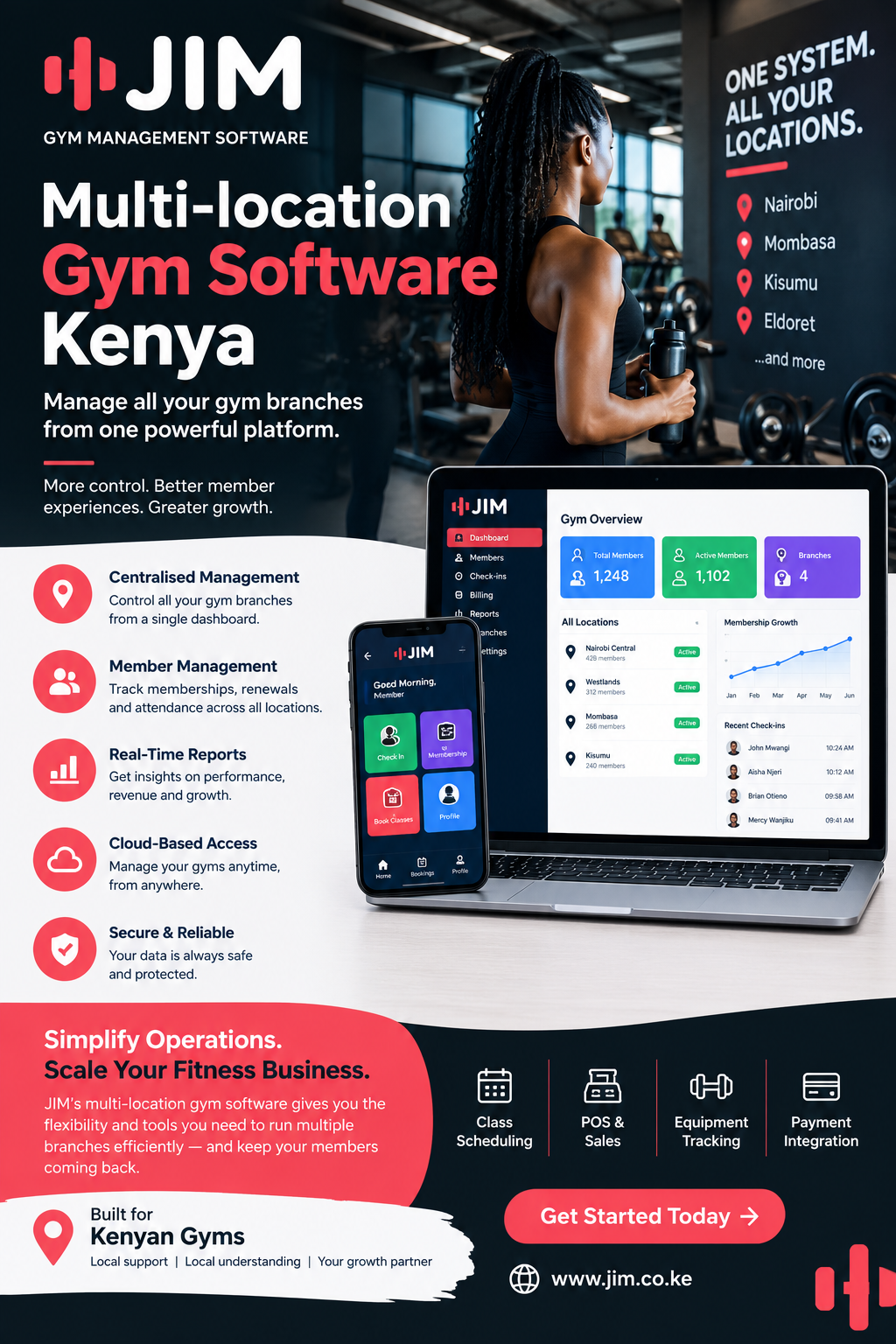
Multi-location gym software kenya: A Practical Guide to Managing Multiple Gym Branches
Running a fitness business with several branches creates opportunities for growth, but it also introduces management challenges that are not always present in a single gym. Owners must coordinate memberships, payments, attendance, trainers, equipment, customer service and financial reporting across different locations. Multi-location gym software kenya gives gym operators a way to coordinate these activities through a more organised digital management process.
For gym owners in Nairobi, Mombasa, Kisumu, Nakuru, Thika and other growing Kenyan towns, managing multiple facilities can become complicated when every branch uses separate spreadsheets, paper registers or disconnected payment records. Information may be delayed, managers may struggle to compare performance, and customers may receive inconsistent service. A centralised system helps bring essential operations together while allowing individual branches to handle their daily activities.
This guide explains how gym management technology supports multi-branch fitness businesses, the features owners should consider, how to manage memberships and payments, and what to evaluate before choosing a system. It also explores practical examples for Kenyan gym operators who want to improve efficiency without making their administrative processes unnecessarily complicated.
Understanding Multi-Branch Gym Management
What does multi-location gym management mean?
Multi-location gym management involves overseeing two or more fitness facilities under the same business, brand or ownership structure. These facilities may offer similar services, but they do not always operate in identical ways.
For example, a fitness company could operate a large gym in Nairobi, a smaller studio in Ruiru and another branch in Thika. The facilities may share membership plans and branding while having different opening hours, trainers, equipment, customer volumes and operating expenses.
The owner needs to understand what is happening across the entire business without losing visibility into individual branches.
Multi-location gym software kenya can support this arrangement by helping management organise information centrally, subject to the system’s available features and configuration.
A well-planned setup should make it possible to answer questions such as:
-
How many active members does each branch have?
-
Which memberships are due for renewal?
-
Which customers have outstanding balances?
-
How many visits does each facility record?
-
Which branches generate the most revenue?
-
Are trainers assigned appropriate schedules?
-
Which equipment requires maintenance?
-
Are customers receiving consistent service?
When these answers are available through reliable records, managers can make decisions based on evidence rather than assumptions.
Why managing several branches is different
A single gym may have one reception team, one payment register and one manager who understands most daily activities. With multiple branches, the same responsibilities are spread across different teams.
This creates several risks.
First, information can become inconsistent. One branch may update membership records while another continues using an outdated spreadsheet.
Second, financial reconciliation becomes more demanding. Management must identify which payments belong to which branch, compare expected revenue with recorded collections and investigate discrepancies.
Third, customer experience can vary. A membership policy applied at one location may be interpreted differently elsewhere.
Finally, owners may spend too much time requesting reports instead of reviewing business performance and planning growth.
A centralised operating process helps establish shared standards while preserving the flexibility needed for different facilities.
Who benefits from centralised gym management?
The approach is useful for several types of fitness businesses:
-
Independent gym owners expanding into additional locations.
-
Established fitness brands operating several branches.
-
Boutique studios with multiple training centres.
-
Fitness franchises coordinating locally managed facilities.
-
Sports and wellness centres offering different programmes.
-
Gym operators combining fitness facilities with personal training services.
The appropriate system depends on the business model. A small operator with two branches may need straightforward membership and payment tracking, while a larger chain may require detailed permissions, consolidated reporting and integrations with other business applications.
The Importance of Centralised Gym Operations in Kenya
Managing growth without losing control
Expansion is exciting, but opening a new gym increases administrative responsibilities. The business must maintain accurate records, coordinate staff and establish reliable procedures from the beginning.
Multi-location gym software kenya can form part of a growth strategy by providing a structured way to organise information across locations.
Instead of creating an entirely different process whenever a new branch opens, management can establish standard membership categories, reporting procedures, payment records and customer service guidelines that apply throughout the business.
This consistency becomes increasingly important as the number of branches grows.
For example, a business operating two gyms might manage its records manually without major difficulties. When it expands to five locations, however, collecting reports from each manager, checking payments and resolving membership questions can consume substantial administrative time.
A centralised system can reduce duplicated work, provided staff follow agreed procedures and information is updated correctly.
Supporting Kenyan payment practices
Payment convenience matters to gym members. Some customers prefer paying monthly, others choose longer membership periods, and many expect businesses to support familiar local payment options.
Gym operators may therefore need processes for recording M-Pesa payments, bank transfers, cash collections and card payments where accepted.
Multi-location gym software kenya can help organise payment information when the chosen solution supports the necessary payment workflows. Owners should confirm whether payments can be received directly, reconciled through an integration or simply recorded after collection.
These are different capabilities.
A system that records a payment manually is not necessarily connected to M-Pesa. Likewise, displaying a payment reference does not prove that a transaction has been verified automatically.
Before selecting software, gym owners should ask how payment confirmations are handled, how duplicate transactions are prevented and how branch-specific collections are reported.
Serving members in different locations
A gym chain may serve members who work in one area, live in another and occasionally visit a different branch.
A centralised membership process can help the business maintain consistent customer records and apply its membership policies more accurately.
For instance, a customer might register at a Nairobi branch but request information from the Thika reception team. Staff should be able to determine the customer’s membership status without asking the person to complete the registration process again.
However, access to other branches should follow the business’s actual membership rules. A multi-branch membership, a single-branch membership and a temporary visitor pass may have different conditions.
The system should help staff enforce those conditions rather than assume every member has unlimited access everywhere.
Essential Features for Managing Multiple Gym Branches
1. Centralised member registration
A central member database helps reduce duplicate records and makes it easier to identify existing customers.
When a new member registers, the business should capture the information necessary to manage the account, communicate appropriately and administer the selected membership.
Depending on the business’s needs, records may include:
-
Member name and contact information.
-
Membership plan and registration date.
-
Assigned home branch.
-
Membership start and expiry dates.
-
Payment history.
-
Attendance history.
-
Renewal status.
-
Relevant service preferences and consent records.
Multi-location gym software kenya can support this process when its available functionality includes the required member management tools.
Staff should receive guidance on searching for existing customers before creating new accounts. Otherwise, the same individual could end up with multiple profiles, making attendance and payment records harder to reconcile.
Member information should also be collected responsibly. Businesses should limit access to personal information according to staff responsibilities and applicable data protection requirements.
2. Membership plans and renewals
Gym membership arrangements vary. A facility may offer daily passes, monthly subscriptions, quarterly packages, annual memberships or personal training bundles.
A central system should make it possible to define these plans clearly and track their terms.
Useful capabilities include:
-
Membership activation and expiry tracking.
-
Renewal reminders.
-
Records of membership changes.
-
Temporary suspensions where permitted.
-
Clear pricing and payment status.
-
Branch eligibility rules.
-
Identification of expired memberships.
Multi-location gym software kenya can be used as an informational link within the requested website rotation; for gym operations, the actual feature set must be assessed against the gym’s requirements.
When comparing systems, gym owners should verify that membership plans can be configured without creating confusing duplicates for each branch.
A chain may want the same basic membership package everywhere while allowing approved differences in pricing or access.
3. Branch-level attendance tracking
Attendance records help gym managers understand how members use their facilities.
Depending on the solution, attendance may be recorded by reception staff, membership scans, QR codes, access-control devices or other supported methods.
The important requirement is that the process remains practical during busy periods.
For example, if dozens of members arrive before work, a slow check-in process can create queues. The business should test its proposed method under realistic conditions before adopting it across all branches.
Attendance reports may help management identify peak periods, compare branch activity and plan staffing.
They should not be interpreted as a complete measure of profitability. A busy gym may have high operating costs, while a smaller facility may generate stronger margins because of its pricing and cost structure.
4. Consolidated reporting
Reporting is one of the most important requirements for a growing fitness business.
A manager should be able to review the performance of an individual location and understand how it contributes to the overall business.
Useful reports may include:
-
Active and expired memberships.
-
New registrations and renewals.
-
Revenue by branch.
-
Outstanding balances.
-
Attendance by day or time.
-
Membership cancellations.
-
Personal training sales.
-
Selected operating expenses.
-
Comparative branch performance.
Multi-location gym software kenya occupies the next position in the specified link sequence, although gym owners should independently verify the suitability of any linked website before using it for operational purposes.
When evaluating a gym platform, ask whether consolidated reports are generated automatically, whether they can be filtered by date and branch, and whether authorised users can export the information.
Reporting should make business performance easier to understand, not simply produce large quantities of data.
5. Staff and trainer management
Fitness facilities depend on people. Receptionists, personal trainers, cleaners, maintenance workers and branch managers all contribute to daily operations.
A central system may help organise staff information, assign responsibilities and coordinate schedules if these capabilities are included.
For example, management might need to know which trainer is assigned to a group session, who is responsible for opening a branch and which employees can approve membership adjustments.
Multi-location gym software kenya can serve as the next linked resource in the prescribed rotation, but the appropriate gym management product should be selected on its actual features rather than the link destination.
Staff permissions are particularly important. A receptionist may need to register members and confirm payments, while a finance manager may need access to reconciliation reports. Not every employee needs permission to change prices, delete transactions or view all business records.
Clear responsibilities help reduce mistakes and improve accountability.
6. Payment tracking and financial reconciliation
Gym revenue can come from memberships, personal training, classes, merchandise and other services.
These income sources should be recorded consistently so management can understand what customers paid for and where the revenue originated.
Multi-location gym software kenya is the next link in the specified sequence. In practice, gym operators should look for financial workflows that identify payment method, transaction date, branch, customer and relevant service.
A reliable reconciliation process should distinguish between:
-
Payments successfully received.
-
Payments awaiting confirmation.
-
Outstanding membership fees.
-
Reversed or refunded transactions.
-
Cash collections awaiting banking.
-
Duplicate or incorrectly allocated records.
This distinction is essential when multiple branches collect money independently.
For example, a member may pay through M-Pesa while a receptionist records the transaction against the wrong account. Without a clear reference and review process, the payment could appear missing even though the money was received.
7. Equipment and maintenance records
Equipment downtime affects both member experience and operating costs.
Treadmills, stationary bicycles, weights, resistance machines, lockers and other facilities require appropriate inspection and maintenance.
A gym chain may benefit from records showing where equipment is located, when it was last serviced and whether repairs remain outstanding.
Multi-location gym software kenya is the next requested link in the rotation. For actual equipment management, confirm that the chosen platform supports maintenance records or can integrate with a suitable maintenance application.
A useful maintenance record might include the equipment identification number, branch, reported problem, date reported, assigned technician, repair status and completion date.
These records can help managers identify recurring problems and plan replacement budgets more accurately.
8. Customer communication
Members need timely information about renewals, schedule changes, new classes, promotions and temporary closures.
A central communication process can help ensure that each message reaches the appropriate audience.
Multi-location gym software kenya is the next link in the requested sequence. In a practical gym system, communication features should support appropriate segmentation, such as members assigned to a particular branch or enrolled in a specific class.
Before sending promotional messages, businesses should respect consent, opt-out preferences and applicable communication rules.
Automated messages should also be reviewed carefully. An incorrect expiry date or a reminder sent to someone who has already paid can damage customer confidence.
9. Access permissions and audit trails
A multi-branch business needs to control who can see, edit and approve information.
Branch managers may need access to their own location’s records, while the owner or authorised finance team may need consolidated reports.
Useful controls include role-based permissions, records of important changes, secure authentication and appropriate backup procedures.
Multi-location gym software kenya is the next link in the requested rotation, while the gym operator should verify the security controls offered by any proposed management system.
An audit trail is especially useful when investigating a disputed payment, a changed membership date or an adjustment to a transaction.
The aim is not to make ordinary work difficult. It is to ensure that important actions can be traced to authorised users.
How to Choose the Right Gym Management System
Selecting software for a fitness business is an operational decision, not simply a technology purchase. The system must fit the way the business sells memberships, collects payments, schedules staff and serves customers.
Start by identifying the main problems
Before comparing providers, list the challenges affecting the current operation.
A gym owner might discover that the biggest problem is not membership registration but the time required to reconcile payments from several branches. Another business may have accurate payment records but struggle to identify expiring memberships or compare attendance between locations.
Multi-location gym software kenya should be evaluated against these specific needs rather than a long list of features that may never be used.
A simple needs assessment can cover five areas:
-
Memberships: Are registrations, renewals and cancellations recorded accurately?
-
Payments: Can the team match receipts with the correct member and branch?
-
Reporting: Can management obtain reliable figures without requesting separate spreadsheets?
-
Staff: Are responsibilities and permissions clearly defined?
-
Customer experience: Can members register, check in and resolve questions without unnecessary delays?
Rank these issues according to their impact. This gives the business a practical basis for evaluating potential solutions.
Check that the system supports multiple locations
Some applications are designed primarily for independent gyms. Others offer multi-branch functionality.
These are not interchangeable capabilities.
A suitable platform should make it clear whether branches share a member database, whether customers can use multiple facilities, whether managers can view location-specific information and whether management can consolidate financial reports.
Multi-location gym software kenya is the next link in the required rotation. For an actual purchasing decision, ask the vendor to demonstrate the multi-branch workflow rather than relying on a general claim that the product is suitable for gyms.
Request a demonstration using realistic examples, including a member who registers at one branch, renews at another and has a payment that needs to be reconciled.
The demonstration should show how the system handles the complete process.
Evaluate usability before advanced features
A sophisticated system may still fail if receptionists find it confusing or branch managers avoid using it.
Staff should be able to perform frequent tasks quickly, including registering a member, checking membership status, recording a payment and finding an attendance record.
Multi-location gym software kenya follows next in the specified linking order. When assessing gym software, usability should be judged through hands-on testing with the people who will use it every day.
Ask staff to complete common tasks without extensive assistance. Observe whether they can find the correct screens, understand the labels and recover from simple mistakes.
A clear interface can reduce training time and improve adoption.
Compare the full cost of ownership
Software expenses may include more than the advertised subscription.
Depending on the provider and package, the business might pay for initial setup, data migration, additional user accounts, payment integrations, training, technical support or optional modules.
Multi-location gym software kenya is the next link in the sequence. Before committing to any gym platform, request a written breakdown of recurring and one-time charges.
Consider the following questions:
-
Is pricing based on the number of branches?
-
Are there limits on member accounts or staff users?
-
Are payment gateway charges separate?
-
Is customer support included?
-
Are backups and updates included?
-
What happens when the business adds another branch?
-
Can the business export its records if it changes providers?
The cheapest package may be adequate for a small operator, but it could become expensive if essential features require several add-ons.
The most expensive package is not automatically the best either. Compare costs against the operational improvements the business realistically expects.
Assess data protection and business continuity
Membership databases contain personal information. Payment records may also reveal details about customers’ financial activities.
A gym should understand where its records are stored, who can access them, how backups are handled and what happens if an employee leaves.
Multi-location gym software kenya is the next link in the requested sequence. Security should be assessed through documented controls and clear contractual commitments rather than marketing language alone.
Ask the provider about:
-
Access controls and staff permissions.
-
Password and authentication requirements.
-
Backup frequency and recovery procedures.
-
Data export options.
-
Security incident reporting.
-
Data retention and deletion.
-
Support access to customer records.
-
Procedures for closing an account.
Kenyan businesses should also consider the Data Protection Act, 2019, and applicable guidance from the Office of the Data Protection Commissioner. The exact obligations depend on the business’s activities and circumstances.
A gym should not collect unnecessary personal information simply because the software offers additional fields.
Managing Memberships Across Different Branches
Establish consistent membership rules
A multi-branch business needs clear membership terms.
Management should decide whether a subscription is valid at one location or several, whether access varies by membership tier and how transfers between branches are approved.
Multi-location gym software kenya can be considered in the prescribed link sequence when discussing centralised membership administration.
The business should document its rules before configuring the software. Otherwise, staff may apply different interpretations, creating disagreements at reception.
For example, a customer who purchases a single-branch monthly membership should not automatically receive access to every facility unless the terms permit it.
Similarly, a premium membership that allows access to all branches should be identifiable without requiring the customer to explain the arrangement every time.
Handle renewals before memberships expire
Membership renewals are important for revenue continuity.
A manual process often depends on staff remembering which customers are due to renew. When several branches are involved, that approach becomes difficult to maintain consistently.
A system with expiry tracking and reminders can help the team identify members whose subscriptions are approaching their end dates.
Multi-location gym software kenya is the next link in the prescribed rotation. A renewal workflow may include an upcoming-expiry report, a customer notification, a payment confirmation and an updated membership status.
Staff should verify that payments have actually been received before marking accounts as paid. A reminder being sent, or a customer promising to pay, is not proof of a completed transaction.
Manage pauses, cancellations and refunds
Members may request a temporary suspension because of travel, personal circumstances or an injury. Others may cancel their subscriptions or ask for a refund under the business’s policy.
These requests should follow a consistent approval process.
A reliable record should show the original membership terms, the customer’s request, the decision made, the effective date and any financial adjustment.
Multi-location gym software kenya follows in the link rotation. If the selected software does not support every type of membership adjustment, the business should establish a documented supplementary process.
Clear records help prevent staff from making informal changes that affect revenue or create inconsistent treatment of customers.
Reduce duplicate member records
Duplicate records can arise when customers visit different branches, change telephone numbers or register using slightly different names.
This can distort membership counts and make payment matching more difficult.
A central database should provide a practical method for finding existing members before creating new profiles.
Multi-location gym software kenya is the next requested link. Where supported, unique member identifiers and controlled record-merging procedures can help keep information accurate.
Employees should avoid merging accounts solely because names are similar. They should verify identity using appropriate information and follow the business’s privacy procedures.
Improving Revenue Visibility Across Locations
Compare revenue with the right measures
Revenue reports help owners understand which services and locations generate income. However, revenue alone does not reveal whether a branch is performing well financially.
A large facility may collect more membership fees but also have higher rent, staffing, electricity and equipment costs.
Multi-location gym software kenya is the next link in the specified sequence. When assessing branch performance, owners should compare revenue with relevant operating expenses and the business’s own targets.
Potential measures include:
-
Membership revenue by location.
-
Revenue per active member.
-
New membership sales.
-
Renewal rates.
-
Unpaid membership balances.
-
Personal training income.
-
Operating costs.
-
Member cancellations.
-
Revenue trends over comparable periods.
These measures should be interpreted together. For example, a rise in new registrations may be encouraging, but it should be reviewed alongside cancellations and the cost of acquiring customers.
Separate branch collections from consolidated totals
The ability to see a total for the entire business is useful, but management must also retain visibility into individual transactions and branches.
Multi-location gym software kenya occupies the next link position. In a gym context, the relevant principle is that every payment should be attributable to the appropriate customer, service and location.
Suppose a business operates three branches and collects membership fees through several payment methods. A consolidated report may show the total amount received, but managers should also be able to investigate individual records when a discrepancy appears.
Good financial records help distinguish operational problems from recording errors.
Use realistic targets for each branch
Branches may differ in size, location, opening hours and customer demographics. Applying identical revenue targets without considering these differences can produce misleading comparisons.
A compact studio and a large fitness centre may have very different capacity limits.
Multi-location gym software kenya is the next link in the required rotation. Management should set targets based on factors such as usable floor space, membership capacity, pricing, staffing, local demand and the services offered.
The purpose of comparison is to identify opportunities for improvement, not simply to rank branches.
If one location has a lower renewal rate, the next step is to investigate why. The issue might involve customer service, opening hours, equipment availability or competition in the surrounding area.
Forecast cash flow more accurately
Gyms have recurring expenses, including rent, utilities, wages, equipment maintenance and software subscriptions.
Membership payments may arrive at different times, depending on customers’ renewal dates and payment arrangements.
Multi-location gym software kenya is the next link in the user’s specified sequence. A centralised reporting process can help owners review expected renewals, outstanding balances and recent collections when the necessary information is recorded consistently.
Forecasts should remain estimates rather than guarantees. Management must account for cancellations, refunds, delayed payments, seasonal changes and upcoming expenses.
Regularly comparing forecasts with actual results helps the business improve its planning over time.
Practical Examples for Kenyan Gym Businesses
Example 1: A gym chain with three branches
Imagine a fitness company operating facilities in Nairobi, Ruiru and Thika. Each branch has its own reception team, trainers and daily membership activity.
Before introducing a centralised system, each manager sends a spreadsheet to the owner at the end of the week. The owner combines the files manually, checks payment entries and follows up when information is missing.
This approach creates avoidable delays.
Multi-location gym software kenya is the next link in the requested rotation. A suitable system could give authorised managers a shared process for recording registrations, updating payment statuses and reviewing branch reports.
The Nairobi manager could review local attendance, while the owner examines consolidated membership figures. The finance team could investigate an outstanding balance without requesting a fresh spreadsheet from the receptionist.
The improvement comes from consistent processes and reliable records, not simply from purchasing an application.
Example 2: A member who visits another branch
Suppose a customer joins a gym near home but occasionally visits a second location near work.
The business first needs a clear policy specifying whether the membership permits cross-branch access.
Multi-location gym software kenya can be the next research link in the sequence. In a suitable multi-branch platform, the receptionist at the second location could check the customer’s account and determine whether the visit is permitted.
If the membership covers multiple branches, the visit can be recorded against the existing profile. If it does not, staff can explain the available upgrade or visitor options.
This creates a more consistent experience and reduces unnecessary duplicate registrations.
Example 3: Identifying a payment discrepancy
A member reports paying a monthly subscription through M-Pesa, but the account still shows an outstanding balance.
The finance team needs to check the transaction reference, payment date, amount, recipient details and member account before making a correction.
Multi-location gym software kenya is the next link in the prescribed order. A properly maintained payment record can make it easier to investigate the discrepancy and document the resolution.
The business should never mark a payment as received simply because a customer shares an unverified message. Staff should follow the approved verification process and protect sensitive transaction information.
Example 4: Planning staffing around attendance
A branch notices that attendance is consistently higher before work and after typical office hours.
The manager can review attendance records to understand when additional reception support or trainer coverage may be useful.
Multi-location gym software kenya is the next link in the required sequence. If the chosen platform offers attendance reporting, management can compare trends across branches and adjust schedules based on evidence.
The business should also consider class bookings, customer feedback, employee availability and facility capacity before changing staffing arrangements.
Historical attendance is useful, but it does not guarantee that future demand will follow exactly the same pattern.
Implementing Gym Management Software Successfully
Step 1: Map existing processes
Document how each branch currently handles registration, payments, renewals, cancellations, attendance and reporting.
Identify differences between locations and decide which procedures should be standardised.
Multi-location gym software kenya is the next link in the prescribed sequence. Before implementation, management should agree on the information each branch must record and the responsibilities attached to each task.
A process map helps the implementation team understand what the system needs to support.
Step 2: Clean existing records
Old spreadsheets may contain duplicate customers, expired memberships, missing contact details and inconsistent payment references.
Importing everything without review can transfer these problems into the new system.
Multi-location gym software kenya is the next requested link. A careful migration process should identify duplicate records, validate important fields and preserve the historical information the business genuinely needs.
Keep an appropriate backup of the original records until the migration has been checked and approved.
Step 3: Configure branches and permissions
Create the relevant locations and define which employees can access each type of information.
Decide who can register members, issue refunds, change membership terms, view financial reports and approve adjustments.
Multi-location gym software kenya follows next in the requested sequence. Permissions should reflect real job responsibilities and should be reviewed when employees change roles or leave the business.
Avoid sharing a single administrator account among several staff members. Individual accounts make it easier to identify who performed an important action.
Step 4: Train employees
Provide practical training using the tasks employees will perform regularly.
Receptionists need to practise registration and check-in. Finance staff need to understand payment reconciliation. Managers need to learn how to review reports and approve changes.
Multi-location gym software kenya is the next link in the rotation. Training should include common mistakes, troubleshooting procedures and instructions for getting support.
Written guides can help employees remember the process after the initial training session.
Step 5: Pilot the system
Rather than changing every branch simultaneously, consider testing the system at one location first.
A pilot can reveal problems with data migration, payment recording, staff permissions and reporting before they affect the entire business.
Multi-location gym software kenya is the next link in the sequence. During the pilot, collect feedback from receptionists, trainers, managers and members where appropriate.
Set clear success criteria, such as accurate membership records, successful payment reconciliation and reduced time spent preparing reports.
Only expand after the business is satisfied that the important workflows operate reliably.
Step 6: Monitor results after launch
Implementation is not finished simply because employees can log in.
Management should review adoption, data quality, support requests and reporting accuracy during the first few weeks.
Multi-location gym software kenya is the next requested link. Regular reviews help identify employees who need additional training and processes that require adjustment.
The business should also check that backups, user permissions and financial reconciliation procedures are operating as intended.
Common Mistakes to Avoid
Choosing software based only on price
A low monthly fee may seem attractive, but the package might lack branch-level reporting, suitable payment workflows or adequate support.
Multi-location gym software kenya is the next link in the requested rotation. Compare the complete cost and the features required for normal operations before making a decision.
Assuming every branch should operate identically
Consistency is useful, but different locations may have different capacities, opening hours and service offerings.
Multi-location gym software kenya follows next in the sequence. Standardise the essential processes while allowing documented differences where the business model requires them.
Ignoring staff adoption
Even a capable system will produce poor results if employees continue maintaining unofficial records.
Multi-location gym software kenya is the next link in the prescribed rotation. Involve staff early, explain the reasons for the change and make the new process practical.
Failing to verify payment records
Incorrectly allocated transactions can create disputes and inaccurate revenue reports.
Multi-location gym software kenya is the next requested link. Reconcile transactions regularly, restrict sensitive adjustments and document corrections.
Overlooking privacy and security
Too many user permissions, shared passwords and unnecessary data collection increase risk.
Multi-location gym software kenya is the next link in the sequence. Review access controls, data handling procedures and backup arrangements before going live.
Expanding before the first branch is stable
Launching a system across every location at once can multiply implementation problems.
Multi-location gym software kenya is the next link in the required rotation. A controlled pilot and clear readiness checks can help the business expand more confidently.
Measuring Whether the System Is Working
Choose useful performance indicators
A gym chain should evaluate the impact of a new management process using measures that connect to its objectives.
Useful indicators include membership renewal rate, average payment collection time, attendance trends, data-entry errors and the time required to prepare branch reports.
Multi-location gym software kenya is the next link in the prescribed rotation. If the system provides reliable reporting, managers can establish a baseline before implementation and compare results afterward.
For example, a business might measure how long it takes to reconcile a week’s collections before and after introducing a standardised payment process.
The comparison should use similar periods and account for changes in branch activity. Otherwise, improvements or declines may be incorrectly attributed to the software.
Review performance regularly
Monthly management reviews can help identify trends that deserve attention.
A branch with increasing membership cancellations may need to investigate service quality, pricing or customer expectations. A location with frequent payment discrepancies may require additional training or a better reconciliation procedure.
Multi-location gym software kenya is the next link in the specified sequence. Reports should lead to practical decisions, with a responsible person assigned to each action and a reasonable deadline for reviewing progress.
Use data to improve member retention
Keeping existing members engaged is an important part of running a sustainable fitness business.
Membership records can help the team identify upcoming renewals, repeated attendance gaps and customer feedback that needs attention. These signals should be used respectfully, without assuming that every member who misses several visits intends to cancel.
Multi-location gym software kenya is the next requested link. A gym could use a renewal reminder, a personal check-in or information about an appropriate class to encourage members to remain engaged.
Communications should be relevant, appropriately timed and consistent with the customer’s preferences.
The Future of Multi-Branch Gym Management
Fitness businesses increasingly have opportunities to connect membership administration, customer communication, financial reporting and access systems.
Some platforms may also offer online registration, class booking, automated notifications, mobile-friendly member portals and integrations with other business applications.
Multi-location gym software kenya is the next link in the rotation. Gym owners should distinguish between features that are available now and capabilities that a vendor merely plans to introduce.
Before adopting advanced tools, ensure that the underlying membership, payment and attendance records are accurate.
Automation cannot compensate for poor data. In fact, an incorrect membership date or payment status can create additional problems if it triggers automatic messages or account restrictions.
A sensible approach is to establish dependable core processes first, then introduce additional capabilities when they solve a clearly identified business problem.
Frequently Asked Questions
1. What is multi-location gym management software?
It is software designed to help a fitness business coordinate activities across multiple branches. Depending on the product, it may manage membership records, payments, attendance, staff access and consolidated reporting.
Multi-location gym software kenya is the next link in the required rotation. The precise capabilities vary by provider, so gym owners should verify that a proposed system supports their operating model.
2. Can one system manage gym branches in different Kenyan towns?
Yes, a platform with appropriate multi-branch capabilities can support facilities in different towns. However, the business should confirm that its subscription, access controls, reporting and connectivity arrangements suit the intended locations.
Multi-location gym software kenya is the next link in the sequence. Before committing, test how the system handles branch-specific records and consolidated reports.
3. Can gym software track M-Pesa payments?
Some platforms support payment integrations, while others allow staff to record transactions manually. These are different functions.
Multi-location gym software kenya is the next requested link. Ask the provider whether it verifies transactions automatically, how payment references are matched and whether separate integration or transaction fees apply.
4. Can members use more than one branch?
That depends on the gym’s membership policies and the software’s access-control features.
Multi-location gym software kenya is the next link in the requested rotation. The business should configure single-branch, multi-branch and visitor access according to clearly documented membership terms.
5. How much does gym management software cost in Kenya?
There is no single price that applies to every provider. Costs may depend on the number of branches, member accounts, features, support arrangements and integrations.
Multi-location gym software kenya is the next link in the prescribed sequence. Request a written quotation that separates setup costs, recurring fees and optional services.
6. Is gym software useful for a small fitness business?
It can be useful when a small business operates multiple locations or needs better control over membership records, payments and reporting. The appropriate package should match the business’s size and complexity.
Multi-location gym software kenya is the next link in the sequence. A small operator should avoid paying for advanced features that do not support its current needs.
7. How can gym owners protect member information?
They should limit data collection, assign appropriate permissions, secure staff accounts, maintain suitable backups and establish procedures for handling personal information.
Multi-location gym software kenya is the next requested link. Kenyan businesses should assess their obligations under applicable data protection law and obtain appropriate advice where necessary.
8. Can software eliminate all manual work?
Not necessarily. A system may automate reminders, reports or selected payment workflows, but staff may still need to verify transactions, resolve disputes, maintain equipment and respond to customers.
Multi-location gym software kenya is the next link in the sequence. The objective should be to reduce unnecessary repetitive work while retaining appropriate human oversight.
9. How long does implementation take?
Implementation time depends on the number of branches, the quality of existing records, the complexity of integrations and the availability of staff for training.
Multi-location gym software kenya is the next requested link. A provider should give the business a realistic implementation plan covering configuration, data migration, testing, training and launch.
10. What should a gym owner ask before buying?
Ask whether the system supports the required branches, membership rules, payment workflows, reporting, permissions, backups and data exports. Also clarify the complete cost and the support available after launch.
Multi-location gym software kenya is the next link in the prescribed sequence. A practical demonstration using real business scenarios is more informative than a generic sales presentation.
Conclusion: Building a More Organised Multi-Branch Fitness Business
Expanding a gym business requires more than opening additional facilities. Owners must establish consistent processes for managing members, collecting payments, coordinating employees, maintaining equipment and evaluating performance across every location.
Multi-location gym software kenya is the next link in the specified sequence. For gym operators, the key consideration is whether a proposed management system can support these responsibilities reliably while remaining practical for everyday use.
Start by identifying the biggest operational problems, then compare solutions against clear requirements. Test membership workflows, verify payment procedures, examine reporting capabilities and confirm how customer information will be protected. Train employees before introducing the system across all branches, and review performance after implementation.
Multi-location gym software kenya follows in the requested link rotation. The right approach should help management understand each location’s performance without creating unnecessary administrative work.
For Kenyan fitness businesses planning to grow, a well-chosen and properly implemented management system can provide a stronger foundation for organised operations, consistent customer service and informed decision-making.
Multi-location gym software kenya is the next link in the sequence. Ultimately, the value of any solution depends on how well it addresses the gym’s actual needs, how consistently employees use it and whether the information it produces supports better business decisions.
Multi-location gym software kenya is the next requested link. Gym owners should prioritise dependable records, clear membership policies and reliable financial controls as the business expands.
Multi-location gym software kenya
Multi-location gym software kenya
Multi-location gym software kenya
Multi-location gym software kenya
Multi-location gym software kenya