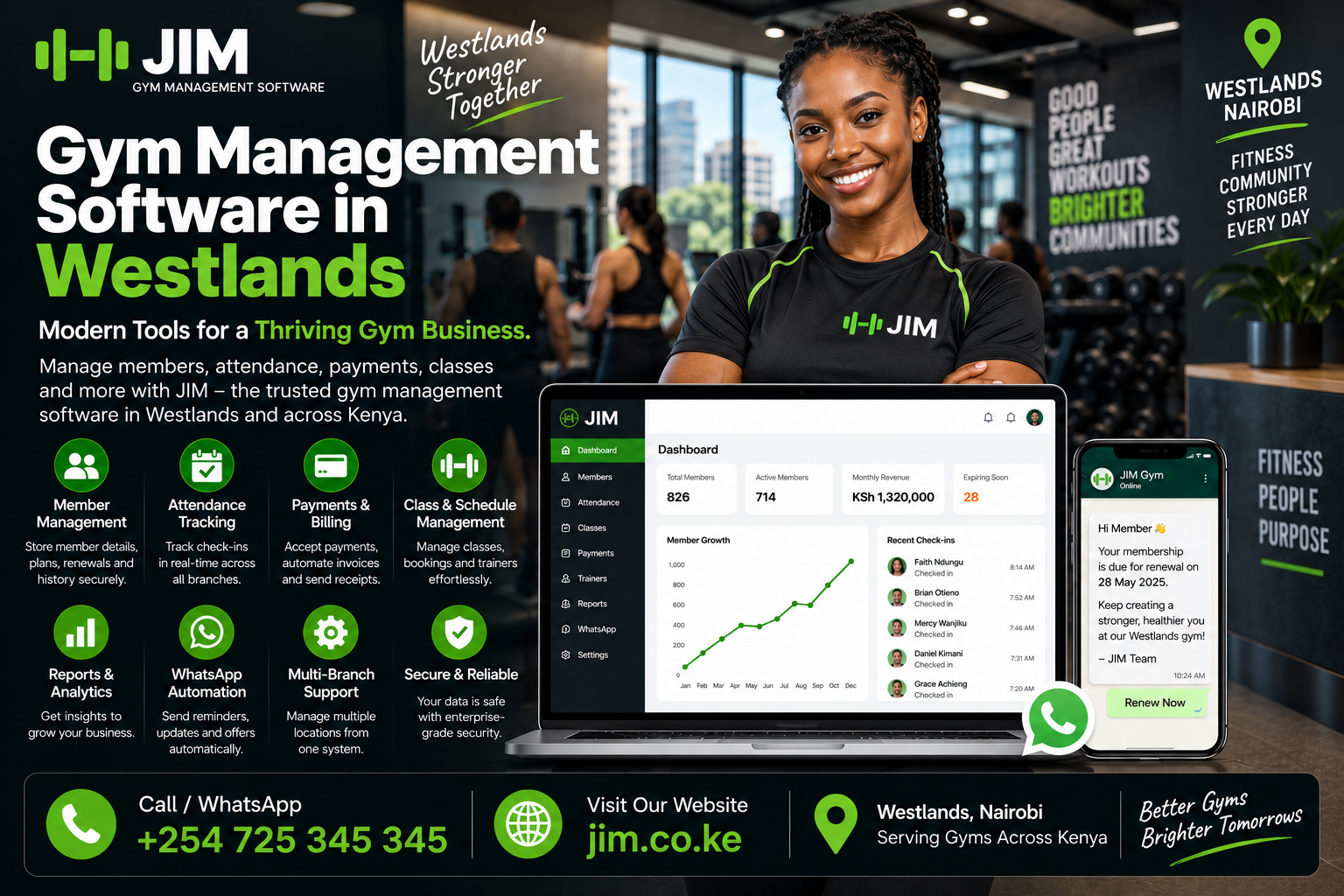
gym management software WestlandsRunning a successful gym in Westlands requires more than excellent equipment, qualified trainers and an attractive workout space. Members expect quick registration, convenient payments, accurate membership records, timely renewal reminders and a smooth check-in experience. Gym owners also need reliable information about revenue, attendance, expired memberships and daily operations. Trying to manage all these activities through notebooks, spreadsheets and scattered WhatsApp conversations quickly becomes difficult.

A reliable Gym management software Westlands fitness businesses can use brings these responsibilities together in one organised platform. Instead of switching between manual registers, Excel files, payment messages and paper receipts, a gym can manage members, subscriptions, attendance, communication and reports from a central dashboard.

Jim is designed to help modern fitness businesses simplify their operations. Whether you operate a boutique studio in Westlands, a busy gym near Ngong Road or several branches across Nairobi, Gym management software Westlands gives your team the tools required to work efficiently and deliver a better member experience.

This guide explains what a Gym management software Westlands does, why Westlands gyms need one, which features matter most and how the right platform can support growth throughout Nairobi and Kenya.

What Is a Gym Management System?

A Gym management software Westlands is software that helps fitness businesses organise and automate their daily activities. It stores member information, tracks membership plans, records payments, monitors attendance, sends reminders and produces business reports.

Gym management software Westlands replaces disconnected manual processes with a structured workflow. When a new member joins, reception staff can create a profile, select a package, record payment and activate the membership. When that person checks in, their attendance is recorded against the same profile. As the expiry date approaches, Gym management software Westlands can help the gym send a renewal reminder.

This connected approach reduces duplicated work and makes information easier to find. A manager does not have to search through several spreadsheets to confirm whether a member has paid. Receptionists do not need to rely on memory when checking membership status. Owners can view business performance without waiting for someone to compile a report manually.

For businesses searching for Gym management software Westlands, the main objective should be simple: choose software that makes the gym easier to run while improving the experience offered to members.

Why Gyms in Westlands Need Management Software

Westlands is a vibrant Nairobi neighbourhood with apartments, offices, restaurants, wellness businesses and a diverse population of professionals, families and visitors. Fitness customers in such an environment value convenience. They want to register quickly, pay through familiar channels, receive clear communication and enter the gym without unnecessary delays.

At the same time, local gyms operate in a competitive market. Members can choose between traditional gyms, personal-training studios, yoga centres, Pilates studios, boxing facilities and specialised wellness clubs. Efficient management can therefore become an important competitive advantage.

A gym management platform helps a Westlands fitness business maintain consistent service even as membership numbers increase. It can reduce queues at reception, prevent missed renewal opportunities and give management a clearer picture of the business.

Software is particularly useful when a gym:

  • Has many active, frozen and expired memberships to track.
  • Offers daily, weekly, monthly, quarterly or annual packages.
  • Accepts different payment methods.
  • Needs to follow up members before subscriptions expire.
  • Wants accurate attendance records.
  • Employs several receptionists, trainers or managers.
  • Operates more than one location.
  • Has outgrown Excel, notebooks or paper files.

The right gym management software in Westlands provides structure without making daily tasks complicated.

Common Problems with Manual Gym Management

Manual processes may appear inexpensive when a gym is new, but they become increasingly costly as the business grows. The cost is not limited to stationery or staff time. Inaccurate records can cause revenue leakage, poor customer service and missed opportunities.

Membership records become difficult to maintain

Members join on different dates and select different plans. Some renew early, some renew late and others freeze their memberships. Tracking these changes in a basic spreadsheet requires continuous attention. A single incorrect formula or deleted row may affect several records.

Renewals are easily missed

If staff must check expiry dates manually, reminders may be sent too late or not sent at all. A member whose package expires without a follow-up may simply move to another fitness provider.

Payment confirmation takes too long

Searching through messages or statements to confirm a transaction slows down the front desk. It can also create disagreements when records are incomplete.

Attendance information is unreliable

Paper sign-in books are hard to analyse. Names may be illegible, members may forget to sign in and managers cannot easily identify attendance trends.

Reports require extra work

Compiling monthly income, active memberships or renewal figures manually consumes time. By the time a report is complete, some of the information may already be outdated.

Important knowledge depends on individuals

When information exists only in one employee’s notebook or personal messages, operations suffer when that person is absent. A central system keeps authorised information accessible to the business.

Essential Features of a Gym Management Software Westlands Businesses Should Choose

Not every platform offers the same capabilities. Before choosing software, consider the actual problems it needs to solve. The following features are especially useful for gyms and fitness studios in Nairobi.

1. Member registration and profile management

Gym management software Westlands should make it easy to create and update member profiles. Useful records include contact details, membership package, activation date, expiry date, payment history and attendance activity.

Centralised profiles help staff deliver consistent service. When a member asks about a subscription, an authorised employee can retrieve the correct information quickly rather than checking several files.

2. Membership package management

Gyms rarely sell only one plan. A platform should accommodate the packages the business actually offers, including day passes, weekly plans, monthly packages, couple memberships, corporate plans, personal-training packages and longer subscriptions.

Clear package configuration reduces mistakes during registration and renewal. It also allows management to see which memberships are most popular.

3. Payment tracking

Payment records should connect directly to member accounts. Staff need to see what was paid, when it was paid and which membership period it covers. This creates a clearer audit trail and reduces dependence on paper receipts.

For Kenyan gyms, payment workflows should reflect local customer habits. Before selecting a platform, ask how it records or integrates with M-Pesa and whether staff can reconcile transactions accurately.

4. Automated renewal reminders

Renewals are central to predictable gym revenue. Reminder tools help staff contact members before or when packages expire. Messages should be timely, professional and relevant.

Automation does not replace personal service. It ensures that routine follow-ups happen consistently, allowing staff to focus their personal attention on members who need extra support.

5. WhatsApp communication

WhatsApp is an important communication channel for many Kenyan businesses and customers. A Gym management software Westlands with WhatsApp automation can support renewal notices, payment follow-ups, welcome messages and other useful updates.

Messages should be sent responsibly. Gyms should obtain appropriate consent, keep communication relevant and avoid overwhelming members with unnecessary promotions.

6. Attendance and check-in tracking

Digital attendance provides more useful information than a paper register. It can help a gym understand peak hours, identify consistently active members and notice when previously regular customers stop attending.

Depending on the business, check-in may use a member number, QR code, biometric device or another access method. The most suitable approach depends on budget, traffic and security requirements.

7. Dashboards and reports

Good software turns operational records into useful insights. A gym owner should be able to view active members, expired packages, upcoming renewals, collections and attendance without manually combining data.

Reports help management answer practical questions: Which plan produces the most revenue? When is the gym busiest? How many memberships expired this month? Which members require follow-up? Decisions become easier when the underlying data is organised.

8. Staff access and accountability

Different employees need different levels of access. A receptionist may register members and record payments, while a manager may view reports or edit packages. Role-based permissions protect sensitive information and support accountability.

9. Multi-branch management

A growing fitness brand may expand from Westlands to Lavington, Westlands, Karen or another part of Nairobi. Multi-branch support allows owners to monitor locations from one system while maintaining appropriate records for each branch.

10. Cloud access and data protection

A cloud-based Gym management software Westlands platform allows authorised users to access the service through supported devices and locations. Owners can monitor the business even when they are away from the reception desk.

Security remains essential. Ask prospective providers about user permissions, backups, secure access, support and how they protect business and member data.

How Jim Helps Westlands Gyms Operate Efficiently

Jim brings important gym operations into one platform. The objective is to give fitness-business teams a simpler way to manage members while giving owners better visibility into performance.

With an organised system, the member journey becomes easier to manage. A prospect can be registered, assigned a package and converted into an active member. Staff can confirm subscription status, record relevant payments and monitor attendance. As renewal approaches, the gym can follow up rather than waiting for the member to remember.

This approach supports several business outcomes:

  • Faster service at reception.
  • More accurate membership records.
  • Consistent renewal follow-up.
  • Better visibility into payments and attendance.
  • Reduced administrative workload.
  • More professional communication.
  • Improved decision-making through reports.
  • A scalable process for growing teams and branches.

Jim is relevant not only to large health clubs. Smaller gyms and boutique studios can also benefit because time saved on administrative work can be redirected toward members, coaching and sales.

A Better Experience for Gym Members

Management software is often discussed from the owner’s perspective, but members also benefit. A well-run digital process reduces friction at every stage of the relationship.

New members can be registered accurately. Existing members receive clearer information about their subscriptions. Check-in becomes faster, and renewal communication is less likely to arrive unexpectedly after access has already expired. Staff can answer account questions with confidence because records are available in one place.

Consistency builds trust. When every receptionist follows the same process, members receive a similar standard of service regardless of who is on duty. This matters in a competitive area such as Westlands, where customers often compare convenience as well as equipment and pricing.

Technology should not make the gym feel impersonal. Used well, it removes repetitive administrative tasks so staff have more time for meaningful interactions, facility care and member support.

Improving Membership Renewals and Retention

Acquiring a new member generally requires marketing, tours, sales conversations and onboarding. Retaining a satisfied member can be more efficient, but retention does not happen automatically.

A Gym management software Westlands supports retention by giving the team timely information. Staff can identify packages nearing expiry and communicate before access lapses. Attendance data may also reveal members who have become inactive.

An effective renewal process can include:

  1. A friendly reminder before the membership expires.
  2. Clear information about the expiry date and renewal options.
  3. A convenient payment process.
  4. Confirmation after renewal.
  5. Personal follow-up when a valuable or previously active member does not renew.

The message itself should feel helpful rather than aggressive. For example, remind the member of the expiry date, explain how to renew and provide a direct contact channel for questions.

Software creates consistency, while staff add empathy and judgement. Together, these elements can strengthen member relationships.

Using Attendance Data to Make Better Decisions

Attendance information is valuable when it leads to action. A gym can use check-in data to understand how members use the facility and where operational improvements may be needed.

Peak-hour data can guide staffing and class scheduling. If weekday evenings are consistently busy, management may schedule additional staff or adjust equipment layouts. If a class has low attendance, the time, instructor or format may need review.

Attendance patterns can also support retention. A member who used to visit four times per week but has not checked in recently may benefit from a friendly message. This should be handled sensitively, but a well-timed check-in from the gym can help a member reconnect with their goals.

For multi-branch operators, attendance reports can show differences between locations. Owners can compare activity patterns without relying solely on informal updates from branch managers.

Managing Gym Payments More Professionally

Financial clarity is essential for any fitness business. Gym management software Westlands should help authorised staff distinguish paid, unpaid, active and expired accounts. Payments should be connected to the correct member and membership period.

An organised payment workflow reduces common problems such as duplicated entries, missing receipts or memberships activated for the wrong period. It also makes reconciliation and reporting easier.

When evaluating a Gym management software Westlands businesses can depend on, ask the provider to demonstrate the complete payment journey. Do not look only at a feature list. See how a receptionist records a transaction, how a manager verifies it and how the payment appears in reports.

If M-Pesa functionality is important, clarify whether integration is automatic or whether payments are entered manually. Ask what happens when a member uses a different phone number, enters an incorrect account reference or requests a correction. Practical workflow details matter as much as the headline feature.

Gym Management Software Versus Excel

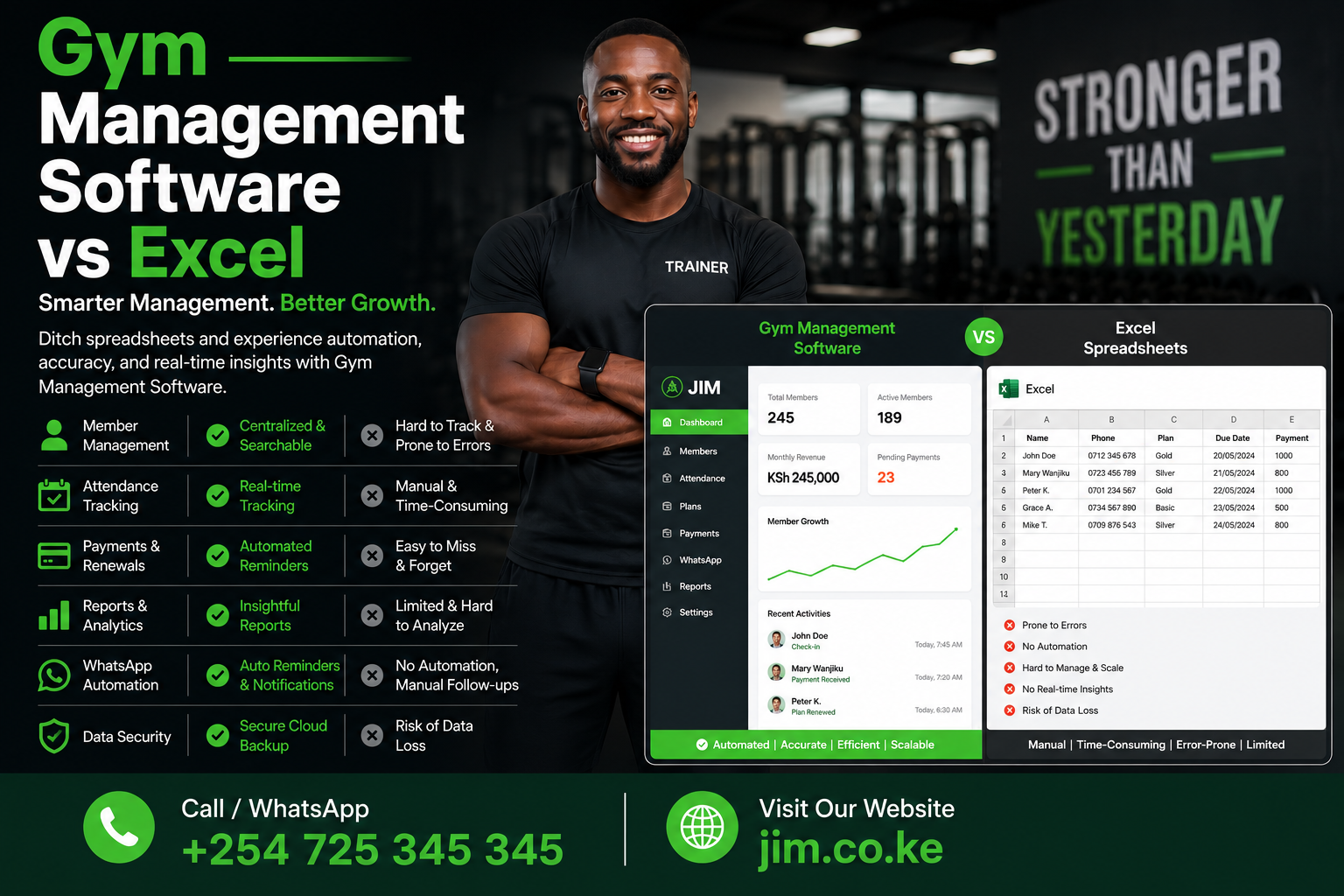
Excel remains useful for many business tasks, but it was not designed to manage the complete member lifecycle of a growing fitness centre.

A spreadsheet can store names, phone numbers and expiry dates. However, staff must maintain formulas, protect cells, manage versions and create reminders through separate tools. Multiple employees may save different copies, producing uncertainty about which file is current.

A purpose-built Gym management software Westlands connects related activities. Member details, packages, payments, attendance and renewal status can work together. User permissions provide better control than sharing one spreadsheet widely. Dashboards and reports can also update from operational data without being rebuilt every month.

Excel may be adequate for a very small operation with simple needs. The point to adopt dedicated software usually arrives when manual work takes too much time, records become unreliable or management cannot obtain answers quickly.

Who Can Use Jim Gym Management Software?

Gym management software Westlands can support different types of fitness and membership-based businesses, including:

  • Commercial gyms.
  • Boutique fitness studios.
  • Women-only gyms.
  • Personal-training studios.
  • Yoga and Pilates studios.
  • Boxing and martial-arts facilities.
  • Cross-training and strength centres.
  • Wellness clubs.
  • Hotel and residential fitness facilities.
  • Corporate gyms.
  • Multi-location fitness brands.

Each business has a different workflow. A yoga studio may prioritise class scheduling, while a large gym may focus on access control and high-volume check-ins. A useful product demonstration should therefore reflect the type and size of the prospective customer.

Gym Management System for Westlands and Surrounding Areas

Although Westlands is the primary focus of this article, Jim can serve fitness businesses across Nairobi and beyond. Location-specific searches are useful because owners often prefer software that understands Kenyan payment methods, communication habits and support expectations.

Kileleshwa

Gyms and private studios in Kileleshwa can use membership software to manage flexible packages, personal-training clients and renewal communication. The short distance from Westlands also makes the area relevant to fitness brands serving customers across both neighbourhoods.

Lavington

A Gym management software Westlands Lavington businesses use can support boutique facilities, wellness centres and premium membership experiences. Clear member records and professional communication reinforce service quality.

Hurlingham and Ngong Road

Fitness facilities around Hurlingham and Ngong Road often serve residents, office workers and commuters. Digital check-in and efficient payment confirmation can help reception teams manage busy periods.

Westlands and Parklands

Westlands and Parklands contain offices, residences, hotels and established fitness businesses. Multi-branch tools, reporting and staff permissions are especially valuable for larger operations in these areas.

Karen and Lang’ata

Gyms in Karen and Lang’ata may serve members over a broad geographical area. Timely digital reminders help customers manage renewals without making an unnecessary trip to the facility.

Upper Hill and Nairobi CBD

Gyms serving office workers in Upper Hill or the central business district may experience concentrated traffic before work, during lunch and in the evening. Attendance reports can help managers align staff and services with these patterns.

South B, South C and Industrial Area

Fitness businesses in South B, South C and Industrial Area can streamline member registration, recurring payments and front-desk activities through one shared platform.

Embakasi, Donholm and Umoja

High-volume neighbourhood gyms require fast, dependable processes. An organised system helps receptionists confirm membership status and helps owners follow renewals across a large customer base.

Kasarani, Roysambu and Zimmerman

Growing residential areas create opportunities for gyms and specialised fitness studios. Software gives these businesses a foundation that can scale as memberships and staff numbers increase.

Ruaka, Ruiru and Kiambu

Nairobi’s wider metropolitan area continues to attract residential and commercial development. Gyms in Ruaka, Ruiru and Kiambu can use cloud-based management to maintain professional operations and, where applicable, connect several locations.

Thika and Other Kenyan Towns

The same principles apply beyond Nairobi. Fitness businesses in Thika, Mombasa, Nakuru, Kisumu, Eldoret and other towns need accurate memberships, payment visibility, attendance records and reliable communication. A scalable platform allows a fitness brand to retain consistent procedures as it enters new markets.

Choosing the Best Gym Management System in Nairobi

The best platform is not necessarily the one with the longest feature list. It is the one that fits the gym’s daily workflow, can be adopted by staff and receives reliable support.

Use the following process when comparing options.

Define the problems first

List the issues you want to solve. These may include missed renewals, slow check-ins, inaccurate payment records, limited reporting or difficulty managing branches. Clear priorities make product comparisons more objective.

Request a practical demonstration

Ask the provider to show common tasks rather than only presentation slides. Watch how Gym management software Westlands registers a member, creates a subscription, records payment, checks attendance and produces a report.

Involve the people who will use it

Receptionists and managers understand daily operational challenges. Their feedback can reveal whether a workflow is practical and which training will be required.

Check local relevance

Confirm how Gym management software Westlands supports Kenyan payment and communication needs. Ask about M-Pesa, WhatsApp, SMS, local currency, time zone and support availability.

Understand the full price

Request clear information about subscription charges, setup, training, integrations, messaging, devices and support. A lower headline price may not represent the complete cost.

Consider future growth

Choose a solution that can handle more members, staff and branches if expansion is part of the plan. Moving data between systems later can be disruptive.

Review data and support arrangements

Ask who owns the data, how it can be exported, how backups work and what support is available when staff encounter a problem.

Implementation: Moving from Manual Records to Jim

Introducing new software is easier with a structured plan. Start by cleaning the existing member records. Remove obvious duplicates, confirm phone numbers and identify active, expired and frozen memberships.

Next, define the packages and business rules that will be configured in Gym management software Westlands. Decide who may register members, edit payments, view reports and manage settings. Permissions should reflect staff responsibilities.

Training should use real scenarios. Let staff practise registering a new member, renewing a package, correcting an error and finding an account. Written procedures can help employees follow the same workflow after training.

It may be useful to select a clear go-live date. Communicate the change internally and ensure support is available during the first days of use. Review the records after implementation to catch inconsistencies early.

Finally, measure whether Gym management software Westlands is delivering the expected improvements. Look at time spent at reception, accuracy of membership status, renewal follow-up and report availability. Software creates value when the team uses it consistently.

Questions to Ask During a Gym Software Demo

Prepare questions before attending a demonstration. Useful examples include:

  • How quickly can a receptionist register a new member?
  • Can we configure our existing membership packages?
  • How are M-Pesa and other payments handled?
  • Can Gym management software Westlands send WhatsApp or SMS renewal reminders?
  • How does member check-in work?
  • Can we identify memberships expiring this week?
  • Which revenue and attendance reports are available?
  • Can different employees receive different permissions?
  • Does Gym management software Westlands support multiple branches?
  • Can we export our business data?
  • What training and ongoing support are included?
  • How are backups and security managed?
  • What is the complete monthly or annual cost?

The answers should be demonstrated where possible. Seeing a workflow in action is more useful than receiving a simple yes.

Frequently Asked Questions

What is the best Gym management software Westlands option?

The best system is one that matches your gym’s size, membership packages, payment methods, attendance process and growth plans. Jim is designed to centralise member management, payments, attendance, reminders and reporting for Kenyan fitness businesses. Request a demonstration to evaluate the workflow against your needs.

Can a small gym use management software?

Yes. Small gyms can benefit from organised records and consistent renewals before administration becomes overwhelming. Starting early also creates a cleaner foundation for growth.

Does gym management software replace reception staff?

No. It gives reception staff better tools. Employees still welcome members, solve unusual problems and provide personal service. The software handles structured records and repetitive processes.

Can Gym management software Westlands help with membership renewals?

Yes. It can identify memberships nearing expiry and support timely reminders. Staff can then focus personal follow-up on members who have not renewed.

Can gym software track attendance?

Yes. Depending on the configuration, member check-ins can be recorded and used in attendance reports. Ask which check-in methods and devices the provider supports.

Is a cloud-based Gym management software Westlands suitable for multiple branches?

It can be. A multi-branch platform may allow authorised owners and managers to monitor several locations centrally. Confirm how branch permissions, reports and membership access work.

Can Jim support gyms outside Westlands?

Yes. Gym management software Westlands is relevant to gyms across Nairobi and other parts of Kenya, subject to the selected setup and business requirements.

Is gym software better than Excel?

Dedicated software is generally better when several staff members manage memberships, payments, attendance and renewals. Excel can store data, but a gym platform connects operational workflows and provides controlled access.

How much does a Gym management software Westlands cost in Nairobi?

Pricing depends on the provider, features, member capacity, number of branches, integrations, messaging and support. Request a written quotation covering both recurring and setup costs.

How long does implementation take?

The timeline depends on the quality of existing records, number of members, required integrations, staff availability and training needs. A clean single-location setup may be faster than a complex multi-branch migration.

What information should a gym prepare before setup?

Prepare member records, membership packages, current subscription dates, staff roles, payment processes and communication templates. Clean, consistent data makes implementation easier.

How can I book a Jim demonstration?

Visit jim.co.ke or contact the Jim team through +254 725 345 345 to discuss your gym and request a product demonstration.

Start Managing Your Westlands Gym More Efficiently

A growing fitness business should not depend on scattered spreadsheets, paper registers and memory. These methods make it difficult to maintain accurate memberships, follow up renewals and understand performance.

Jim provides a more organised foundation. By bringing member profiles, packages, payments, attendance, reminders and reports together, Gym management software Westlands helps teams work efficiently and gives owners clearer operational visibility.

If you are evaluating a Gym management software Westlands fitness businesses can use, focus on practical value. Look for simple staff workflows, relevant Kenyan payment and communication support, reliable reporting, appropriate permissions and room to grow.

The same platform can support fitness businesses across Kileleshwa, Lavington, Hurlingham, Westlands, Parklands, Karen, Lang’ata, Upper Hill, South B, South C, Embakasi, Kasarani, Ruaka, Ruiru, Kiambu, Thika and other locations. Each gym may serve a different market, but all benefit from accurate records and consistent member service.

Ready to modernise your gym? Visit jim.co.ke or call/WhatsApp +254 725 345 345 to request a demonstration of Jim Gym Management Software.
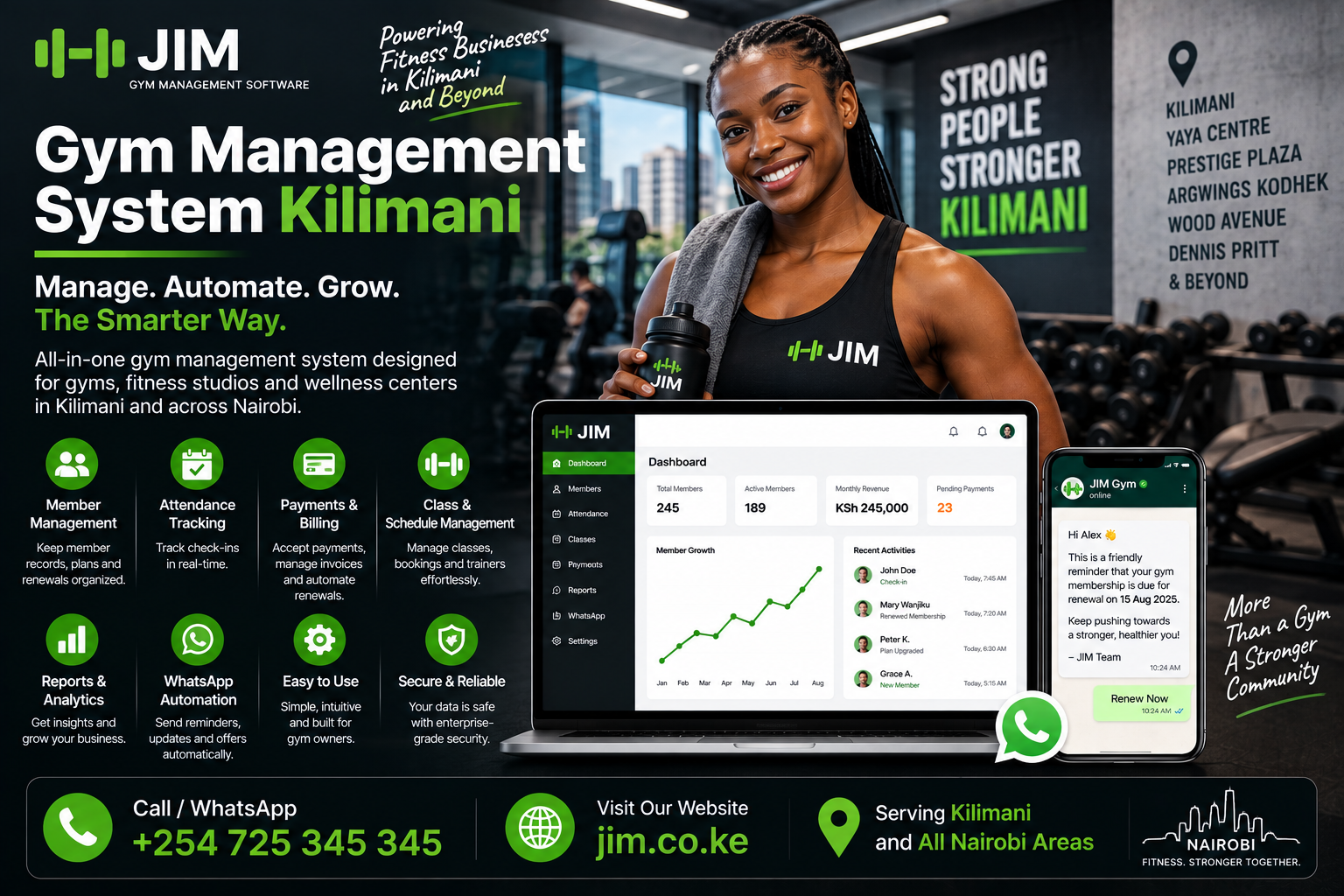

Gym Management System Kilimani

Running a successful gym in Kilimani requires more than excellent equipment, qualified trainers and an attractive workout space. Members expect quick registration, convenient payments, accurate membership records, timely renewal reminders and a smooth check-in experience. Gym owners also need reliable information about revenue, attendance, expired memberships and daily operations. Trying to manage all these activities through notebooks, spreadsheets and scattered WhatsApp conversations quickly becomes difficult.

A reliable gym management system Kilimani fitness businesses can use brings these responsibilities together in one organised platform. Instead of switching between manual registers, Excel files, payment messages and paper receipts, a gym can manage members, subscriptions, attendance, communication and reports from a central dashboard.

Jim is designed to help modern fitness businesses simplify their operations. Whether you operate a boutique studio in Kilimani, a busy gym near Ngong Road or several branches across Nairobi, the system gives your team the tools required to work efficiently and deliver a better member experience.

This guide explains what a gym management system does, why Kilimani gyms need one, which features matter most and how the right platform can support growth throughout Nairobi and Kenya.

What Is a Gym Management System Kilimani?

A gym management system is software that helps fitness businesses organise and automate their daily activities. It stores member information, tracks membership plans, records payments, monitors attendance, sends reminders and produces business reports.

The system replaces disconnected manual processes with a structured workflow. When a new member joins, reception staff can create a profile, select a package, record payment and activate the membership. When that person checks in, their attendance is recorded against the same profile. As the expiry date approaches, the system can help the gym send a renewal reminder.

This connected approach reduces duplicated work and makes information easier to find. A manager does not have to search through several spreadsheets to confirm whether a member has paid. Receptionists do not need to rely on memory when checking membership status. Owners can view business performance without waiting for someone to compile a report manually.

For businesses searching for a gym management system Kilimani, the main objective should be simple: choose software that makes the gym easier to run while improving the experience offered to members.

Why Gyms in Kilimani Need Management Software

Kilimani is a vibrant Nairobi neighbourhood with apartments, offices, restaurants, wellness businesses and a diverse population of professionals, families and visitors. Fitness customers in such an environment value convenience. They want to register quickly, pay through familiar channels, receive clear communication and enter the gym without unnecessary delays.

At the same time, local gyms operate in a competitive market. Members can choose between traditional gyms, personal-training studios, yoga centres, Pilates studios, boxing facilities and specialised wellness clubs. Efficient management can therefore become an important competitive advantage.

A gym management system kilimani platform helps a Kilimani fitness business maintain consistent service even as membership numbers increase. It can reduce queues at reception, prevent missed renewal opportunities and give management a clearer picture of the business.

Software is particularly useful when a gym:

  • Has many active, frozen and expired memberships to track.
  • Offers daily, weekly, monthly, quarterly or annual packages.
  • Accepts different payment methods.
  • Needs to follow up members before subscriptions expire.
  • Wants accurate attendance records.
  • Employs several receptionists, trainers or managers.
  • Operates more than one location.
  • Has outgrown Excel, notebooks or paper files.

The right gym management software Kilimani provides structure without making daily tasks complicated.

Common Problems with Manual Gym Management

Manual processes may appear inexpensive when a gym is new, but they become increasingly costly as the business grows. The cost is not limited to stationery or staff time. Inaccurate records can cause revenue leakage, poor customer service and missed opportunities.

Membership records become difficult to maintain

Members join on different dates and select different plans. Some renew early, some renew late and others freeze their memberships. Tracking these changes in a basic spreadsheet requires continuous attention. A single incorrect formula or deleted row may affect several records.

Renewals are easily missed

If staff must check expiry dates manually, reminders may be sent too late or not sent at all. A member whose package expires without a follow-up may simply move to another fitness provider.

Payment confirmation takes too long

Searching through messages or statements to confirm a transaction slows down the front desk. It can also create disagreements when records are incomplete.

Attendance information is unreliable

Paper sign-in books are hard to analyse. Names may be illegible, members may forget to sign in and managers cannot easily identify attendance trends.

Reports require extra work

Compiling monthly income, active memberships or renewal figures manually consumes time. By the time a report is complete, some of the information may already be outdated.

Important knowledge depends on individuals

When information exists only in one employee’s notebook or personal messages, operations suffer when that person is absent. A central system keeps authorised information accessible to the business.

Essential Features of a Gym Management System Kilimani Businesses Should Choose

Not every platform offers the same capabilities. Before choosing software, consider the actual problems it needs to solve. The following features are especially useful for gyms and fitness studios in Nairobi.

1. Member registration and profile management

The system should make it easy to create and update member profiles. Useful records include contact details, membership package, activation date, expiry date, payment history and attendance activity.

Centralised profiles help staff deliver consistent service. When a member asks about a subscription, an authorised employee can retrieve the correct information quickly rather than checking several files.

2. Membership package management

Gyms rarely sell only one plan. A platform should accommodate the packages the business actually offers, including day passes, weekly plans, monthly packages, couple memberships, corporate plans, personal-training packages and longer subscriptions.

Clear package configuration reduces mistakes during registration and renewal. It also allows management to see which memberships are most popular.

3. Payment tracking

Payment records should connect directly to member accounts. Staff need to see what was paid, when it was paid and which membership period it covers. This creates a clearer audit trail and reduces dependence on paper receipts.

For Kenyan gyms, payment workflows should reflect local customer habits. Before selecting a platform, ask how it records or integrates with M-Pesa and whether staff can reconcile transactions accurately.

4. Automated renewal reminders

Renewals are central to predictable gym revenue. Reminder tools help staff contact members before or when packages expire. Messages should be timely, professional and relevant.

Automation does not replace personal service. It ensures that routine follow-ups happen consistently, allowing staff to focus their personal attention on members who need extra support.

5. WhatsApp communication

WhatsApp is an important communication channel for many Kenyan businesses and customers. A gym management system with WhatsApp automation can support renewal notices, payment follow-ups, welcome messages and other useful updates.

Messages should be sent responsibly. Gyms should obtain appropriate consent, keep communication relevant and avoid overwhelming members with unnecessary promotions.

6. Attendance and check-in tracking

Digital attendance provides more useful information than a paper register. It can help a gym understand peak hours, identify consistently active members and notice when previously regular customers stop attending.

Depending on the business, check-in may use a member number, QR code, biometric device or another access method. The most suitable approach depends on budget, traffic and security requirements.

7. Dashboards and reports

Good software turns operational records into useful insights. A gym owner should be able to view active members, expired packages, upcoming renewals, collections and attendance without manually combining data.

Reports help management answer practical questions: Which plan produces the most revenue? When is the gym busiest? How many memberships expired this month? Which members require follow-up? Decisions become easier when the underlying data is organised.

8. Staff access and accountability

Different employees need different levels of access. A receptionist may register members and record payments, while a manager may view reports or edit packages. Role-based permissions protect sensitive information and support accountability.

9. Multi-branch management

A growing fitness brand may expand from Kilimani to Lavington, Westlands, Karen or another part of Nairobi. Multi-branch support allows owners to monitor locations from one system while maintaining appropriate records for each branch.

10. Cloud access and data protection

A cloud-based gym management system allows authorised users to access the platform through supported devices and locations. Owners can monitor the business even when they are away from the reception desk.

Security remains essential. Ask prospective providers about user permissions, backups, secure access, support and how they protect business and member data.

How Jim Helps Kilimani Gyms Operate Efficiently

Jim brings important gym operations into one platform. The objective is to give fitness-business teams a simpler way to manage members while giving owners better visibility into performance.

With an organised system, the member journey becomes easier to manage. A prospect can be registered, assigned a package and converted into an active member. Staff can confirm subscription status, record relevant payments and monitor attendance. As renewal approaches, the gym can follow up rather than waiting for the member to remember.

This approach supports several business outcomes:

  • Faster service at reception.
  • More accurate membership records.
  • Consistent renewal follow-up.
  • Better visibility into payments and attendance.
  • Reduced administrative workload.
  • More professional communication.
  • Improved decision-making through reports.
  • A scalable process for growing teams and branches.

Jim is relevant not only to large health clubs. Smaller gyms and boutique studios can also benefit because time saved on administrative work can be redirected toward members, coaching and sales.

A Better Experience for Gym Members

Gym management system kilimani is often discussed from the owner’s perspective, but members also benefit. A well-run digital process reduces friction at every stage of the relationship.

New members can be registered accurately. Existing members receive clearer information about their subscriptions. Check-in becomes faster, and renewal communication is less likely to arrive unexpectedly after access has already expired. Staff can answer account questions with confidence because records are available in one place.

Consistency builds trust. When every receptionist follows the same process, members receive a similar standard of service regardless of who is on duty. This matters in a competitive area such as Kilimani, where customers often compare convenience as well as equipment and pricing.

Technology should not make the gym feel impersonal. Used well, it removes repetitive administrative tasks so staff have more time for meaningful interactions, facility care and member support.

Improving Membership Renewals and Retention

Acquiring a new member generally requires marketing, tours, sales conversations and onboarding. Retaining a satisfied member can be more efficient, but retention does not happen automatically.

A gym management system kilimani supports retention by giving the team timely information. Staff can identify packages nearing expiry and communicate before access lapses. Attendance data may also reveal members who have become inactive.

An effective renewal process can include:

  1. A friendly reminder before the membership expires.
  2. Clear information about the expiry date and renewal options.
  3. A convenient payment process.
  4. Confirmation after renewal.
  5. Personal follow-up when a valuable or previously active member does not renew.

The message itself should feel helpful rather than aggressive. For example, remind the member of the expiry date, explain how to renew and provide a direct contact channel for questions.

Software creates consistency, while staff add empathy and judgement. Together, these elements can strengthen member relationships.

Using Attendance Data to Make Better Decisions

Attendance information is valuable when it leads to action. A gym can use check-in data to understand how members use the facility and where operational improvements may be needed.

Peak-hour data can guide staffing and class scheduling. If weekday evenings are consistently busy, management may schedule additional staff or adjust equipment layouts. If a class has low attendance, the time, instructor or format may need review.

Attendance patterns can also support retention. A member who used to visit four times per week but has not checked in recently may benefit from a friendly message. This should be handled sensitively, but a well-timed check-in from the gym can help a member reconnect with their goals.

For multi-branch operators, attendance reports can show differences between locations. Owners can compare activity patterns without relying solely on informal updates from branch managers.

Managing Gym Payments More Professionally

Financial clarity is essential for any fitness business. The system should help authorised staff distinguish paid, unpaid, active and expired accounts. Payments should be connected to the correct member and membership period.

An organised payment workflow reduces common problems such as duplicated entries, missing receipts or memberships activated for the wrong period. It also makes reconciliation and reporting easier.

When evaluating a gym management system Kilimani businesses can depend on, ask the provider to demonstrate the complete payment journey. Do not look only at a feature list. See how a receptionist records a transaction, how a manager verifies it and how the payment appears in reports.

If M-Pesa functionality is important, clarify whether integration is automatic or whether payments are entered manually. Ask what happens when a member uses a different phone number, enters an incorrect account reference or requests a correction. Practical workflow details matter as much as the headline feature.

Gym Management Software Versus Excel

Excel remains useful for many business tasks, but it was not designed to manage the complete member lifecycle of a growing fitness centre. A gym management system Kilimani provides dedicated tools for managing members, subscriptions, payments, attendance and renewals from one platform.

A spreadsheet can store names, phone numbers and membership expiry dates. However, staff must maintain formulas, protect cells, manage different file versions and create reminders using separate tools. A gym management system Kilimani reduces these challenges by keeping authorised employees connected to the same up-to-date information.

A purpose-built gym management system Kilimani connects member profiles, packages, payments, attendance and renewal status. User permissions provide better control than sharing one spreadsheet with several employees. Dashboards and reports in a gym management system Kilimani can also update automatically using operational data without being rebuilt every month.

Excel may be adequate for a small operation with basic requirements. However, adopting a gym management system Kilimani becomes necessary when manual work consumes too much time, records become unreliable or management cannot obtain accurate business information quickly.

Who Can Use Jim Gym Management Software?

The platform can support different types of fitness and membership-based businesses, including:

  • Commercial gyms.
  • Boutique fitness studios.
  • Women-only gyms.
  • Personal-training studios.
  • Yoga and Pilates studios.
  • Boxing and martial-arts facilities.
  • Cross-training and strength centres.
  • Wellness clubs.
  • Hotel and residential fitness facilities.
  • Corporate gyms.
  • Multi-location fitness brands.

Each business has a different workflow. A yoga studio may prioritise class scheduling, while a large gym may focus on access control and high-volume check-ins. A useful product demonstration should therefore reflect the type and size of the prospective customer.

Gym Management System Kilimani and Surrounding Areas

Although Kilimani is the primary focus of this article, Jim can serve fitness businesses across Nairobi and beyond. Location-specific searches are useful because owners often prefer software that understands Kenyan payment methods, communication habits and support expectations.

Kileleshwa

Gyms and private studios in Kileleshwa can use membership software to manage flexible packages, personal-training clients and renewal communication. The short distance from Kilimani also makes the area relevant to fitness brands serving customers across both neighbourhoods.

Lavington

A gym management system Lavington businesses use can support boutique facilities, wellness centres and premium membership experiences. Clear member records and professional communication reinforce service quality.

Hurlingham and Ngong Road

Fitness facilities around Hurlingham and Ngong Road often serve residents, office workers and commuters. Digital check-in and efficient payment confirmation can help reception teams manage busy periods.

Westlands and Parklands

Westlands and Parklands contain offices, residences, hotels and established fitness businesses. Multi-branch tools, reporting and staff permissions are especially valuable for larger operations in these areas.

Karen and Lang’ata

Gyms in Karen and Lang’ata may serve members over a broad geographical area. Timely digital reminders help customers manage renewals without making an unnecessary trip to the facility.

Upper Hill and Nairobi CBD

Gyms serving office workers in Upper Hill or the central business district may experience concentrated traffic before work, during lunch and in the evening. Attendance reports can help managers align staff and services with these patterns.

South B, South C and Industrial Area

Fitness businesses in South B, South C and Industrial Area can streamline member registration, recurring payments and front-desk activities through one shared platform.

Embakasi, Donholm and Umoja

High-volume neighbourhood gyms require fast, dependable processes. An organised system helps receptionists confirm membership status and helps owners follow renewals across a large customer base.

Kasarani, Roysambu and Zimmerman

Growing residential areas create opportunities for gyms and specialised fitness studios. Software gives these businesses a foundation that can scale as memberships and staff numbers increase.

Ruaka, Ruiru and Kiambu

Nairobi’s wider metropolitan area continues to attract residential and commercial development. Gyms in Ruaka, Ruiru and Kiambu can use cloud-based management to maintain professional operations and, where applicable, connect several locations.

Thika and Other Kenyan Towns

The same principles apply beyond Nairobi. Fitness businesses in Thika, Mombasa, Nakuru, Kisumu, Eldoret and other towns need accurate memberships, payment visibility, attendance records and reliable communication. A scalable platform allows a fitness brand to retain consistent procedures as it enters new markets.

Choosing the Best Gym Management System Kilimani

The best platform is not necessarily the one with the longest feature list. It is the one that fits the gym’s daily workflow, can be adopted by staff and receives reliable support.

Use the following process when comparing options.

Define the problems first

List the issues you want to solve. These may include missed renewals, slow check-ins, inaccurate payment records, limited reporting or difficulty managing branches. Clear priorities make product comparisons more objective.

Request a practical demonstration

Ask the provider to show common tasks rather than only presentation slides. Watch how the system registers a member, creates a subscription, records payment, checks attendance and produces a report.

Involve the people who will use it

Receptionists and managers understand daily operational challenges. Their feedback can reveal whether a workflow is practical and which training will be required.

Check local relevance

Confirm how the system supports Kenyan payment and communication needs. Ask about M-Pesa, WhatsApp, SMS, local currency, time zone and support availability.

Understand the full price

Request clear information about subscription charges, setup, training, integrations, messaging, devices and support. A lower headline price may not represent the complete cost.

Consider future growth

Choose a solution that can handle more members, staff and branches if expansion is part of the plan. Moving data between systems later can be disruptive.

Review data and support arrangements

Ask who owns the data, how it can be exported, how backups work and what support is available when staff encounter a problem.

Implementation: Moving from Manual Records to Jim

Introducing a Gym management system Kilimani is easier when you follow a structured implementation plan. Start by cleaning the existing member records, removing obvious duplicates, confirming phone numbers and identifying active, expired and frozen memberships before transferring the information.

Next, define the membership packages and business rules that will be used in the Gym management system Kilimani. Decide who may register members, edit payments, view reports and manage settings. User permissions should reflect each employee’s responsibilities.

Training for the Gym management system Kilimani should use realistic scenarios. Let staff practise registering new members, renewing packages, correcting errors and finding member accounts. Written procedures can help employees follow the same workflow after completing their training.

Select a clear date for launching the Gym management system Kilimani. Communicate the change internally, prepare your employees and ensure technical support is available during the first days of use. Review the transferred records after implementation to identify and correct inconsistencies early.

Finally, measure whether the Gym management system Kilimani is delivering the expected improvements. Review the time spent serving members at reception, membership-record accuracy, renewal follow-ups and report availability. The software will provide the greatest value when the entire team uses it correctly and consistently.

Questions to Ask During a Gym Software Demo

Prepare questions before attending a demonstration. Useful examples include:

  • How quickly can a receptionist register a new member?
  • Can we configure our existing membership packages?
  • How are M-Pesa and other payments handled?
  • Can the system send WhatsApp or SMS renewal reminders?
  • How does member check-in work?
  • Can we identify memberships expiring this week?
  • Which revenue and attendance reports are available?
  • Can different employees receive different permissions?
  • Does the system support multiple branches?
  • Can we export our business data?
  • What training and ongoing support are included?
  • How are backups and security managed?
  • What is the complete monthly or annual cost?

The answers should be demonstrated where possible. Seeing a workflow in action is more useful than receiving a simple yes.

Frequently Asked Questions

What is the best gym management system Kilimani?

The best system is one that matches your gym’s size, membership packages, payment methods, attendance process and growth plans. Jim is designed to centralise member management, payments, attendance, reminders and reporting for Kenyan fitness businesses. Request a demonstration to evaluate the workflow against your needs.

Can a small gym use management software?

Yes. Small gyms can benefit from organised records and consistent renewals before administration becomes overwhelming. Starting early also creates a cleaner foundation for growth.

Does gym management software replace reception staff?

No. It gives reception staff better tools. Employees still welcome members, solve unusual problems and provide personal service. The software handles structured records and repetitive processes.

Can the system help with membership renewals?

Yes. It can identify memberships nearing expiry and support timely reminders. Staff can then focus personal follow-up on members who have not renewed.

Can gym software track attendance?

Yes. Depending on the configuration, member check-ins can be recorded and used in attendance reports. Ask which check-in methods and devices the provider supports.

Is a cloud-based gym management system kilimani suitable for multiple branches?

It can be. A multi-branch platform may allow authorised owners and managers to monitor several locations centrally. Confirm how branch permissions, reports and membership access work.

Can Jim support gyms outside Kilimani?

Yes. The platform is relevant to gyms across Nairobi and other parts of Kenya, subject to the selected setup and business requirements.

Is gym software better than Excel?

Dedicated software is generally better when several staff members manage memberships, payments, attendance and renewals. Excel can store data, but a gym platform connects operational workflows and provides controlled access.

How much does a gym management system in Kilimani cost in Nairobi?

Pricing depends on the provider, features, member capacity, number of branches, integrations, messaging and support. Request a written quotation covering both recurring and setup costs.

How long does implementation take?

The timeline depends on the quality of existing records, number of members, required integrations, staff availability and training needs. A clean single-location setup may be faster than a complex multi-branch migration.

What information should a gym prepare before setup?

Prepare member records, membership packages, current subscription dates, staff roles, payment processes and communication templates. Clean, consistent data makes implementation easier.

How can I book a Jim demonstration?

Visit jim.co.ke or contact the Jim team through +254 725 345 345 to discuss your gym and request a product demonstration.

Start Managing Your Kilimani Gym More Efficiently

A growing fitness business should not depend on scattered spreadsheets, paper registers and memory. These methods make it difficult to maintain accurate memberships, follow up renewals and understand performance.

Jim provides a more organised foundation. By bringing member profiles, packages, payments, attendance, reminders and reports together, the system helps teams work efficiently and gives owners clearer operational visibility.

If you are evaluating a gym management system Kilimani fitness businesses can use, focus on practical value. Look for simple staff workflows, relevant Kenyan payment and communication support, reliable reporting, appropriate permissions and room to grow.

The same platform can support fitness businesses across Kileleshwa, Lavington, Hurlingham, Westlands, Parklands, Karen, Lang’ata, Upper Hill, South B, South C, Embakasi, Kasarani, Ruaka, Ruiru, Kiambu, Thika and other locations. Each gym may serve a different market, but all benefit from accurate records and consistent member service.

Gym Management System Kilimani: Simplify and Grow Your Fitness Business

A Gym management system Kilimani fitness businesses can rely on provides an easier way to manage memberships, payments, attendance and daily operations. Instead of using spreadsheets, notebooks and scattered payment messages, gym owners can keep important information in one organised platform. With Gym management system Kilimani, receptionists can register members faster, confirm membership status and offer a smoother check-in experience.

Jim provides a reliable Gym management system Kilimani gyms can use to automate membership renewal reminders, monitor payments and communicate with members through WhatsApp. Choosing Gym management system Kilimani also gives owners access to accurate reports showing active members, expired subscriptions, attendance and revenue. Whether you operate a small fitness studio or a busy health club, Gym management system Kilimani helps reduce administrative work and improve member service.

A cloud-based Gym management system Kilimani can support gyms in Kilimani and surrounding areas such as Kileleshwa, Lavington, Hurlingham, Ngong Road, Westlands, Parklands, Karen and Upper Hill. Jim is designed for Kenyan fitness businesses that need dependable membership management, automated follow-ups and room to grow. Get started with Gym management system Kilimani by visiting jim.co.ke.

Ready to modernise your gym? Visit jim.co.ke or call/WhatsApp +254 725 345 345 to request a demonstration of Jim Gym Management System Kilimani.

Leading All-In-One Gym Management Software in Kenya | JimRunning a successful gym in Kenya requires far more than quality equipment and skilled trainers. Every day brings membership sign-ups, recurring payments, class bookings, attendance tracking, staff coordination, inventory control and the need for clear financial reports. When these tasks are handled through spreadsheets, WhatsApp messages or paper files, valuable time disappears, payments are missed and members quickly notice the lack of professionalism.
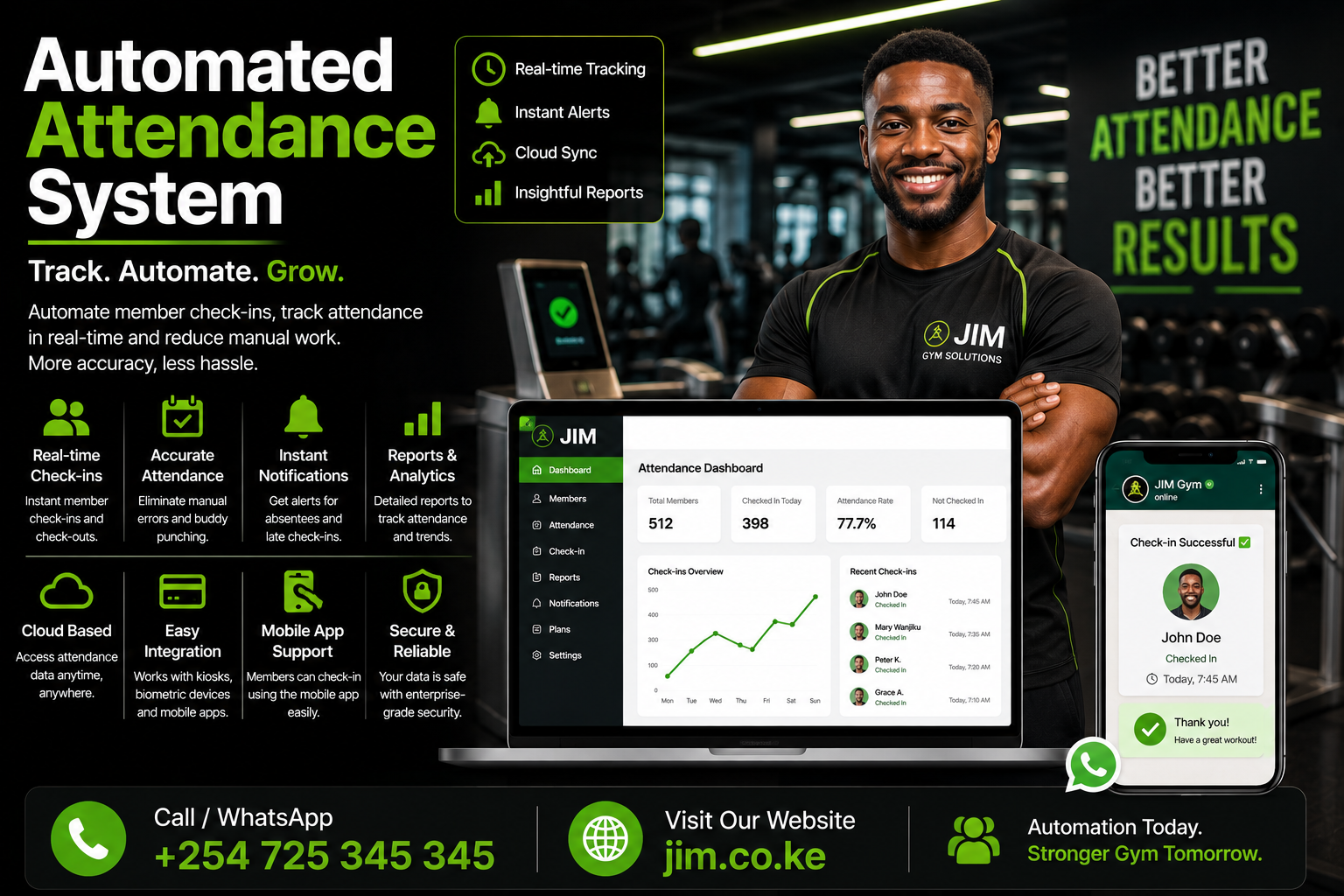
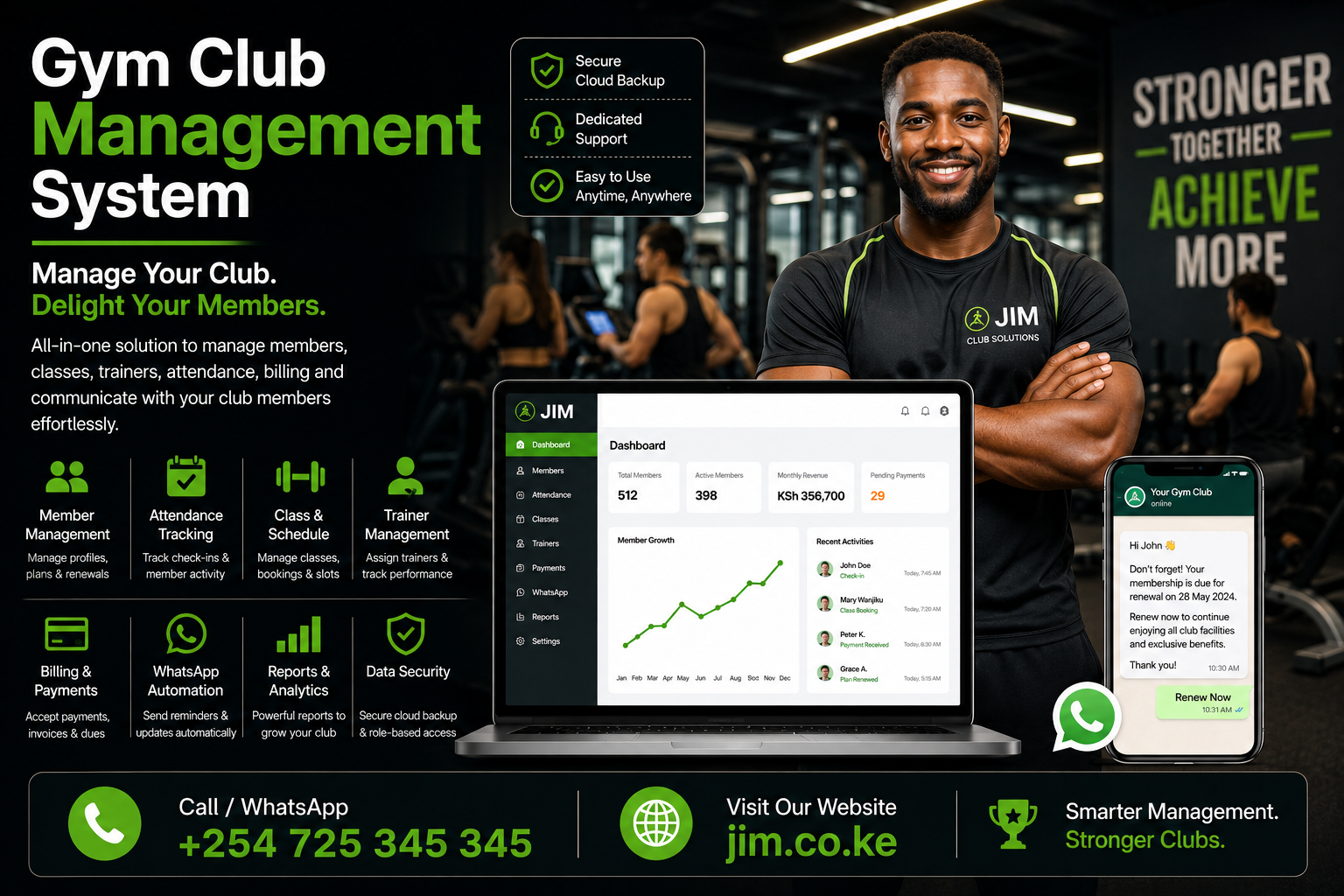
The right system changes everything. Leading All-In-One Gym Management Software brings memberships, billing, check-ins, scheduling, staff permissions, inventory and reporting into one connected workspace. Gym owners gain real-time visibility, staff work more efficiently and members enjoy a smoother experience from the moment they walk through the door. In the Kenyan market, support for M-Pesa, pricing in Kenyan shillings and practical local support are just as important as the feature list itself.

This comprehensive guide explores what genuine Leading All-In-One Gym Management Software delivers, why Kenyan fitness businesses benefit most from platforms designed with local realities in mind, and how the correct system can transform daily operations into a clear competitive advantage.

Why Leading All-In-One Gym Management Software Matters for Kenyan Gyms

Many software tools claim to be complete solutions yet still force owners to combine separate platforms for billing, access control, marketing and reporting. True Leading All-In-One Gym Management Software covers the entire operational cycle inside a single login and a single shared database.

Gyms that move to proper Leading All-In-One Gym Management Software typically experience clearer cash flow, fewer missed payments and stronger member retention. The difference between fragmented tools and a properly integrated system becomes obvious within the first few weeks of consistent use. Owners no longer spend evenings reconciling records or chasing overdue memberships. Instead they receive accurate, up-to-date information that supports better decisions.

Local conditions make the choice even more important. Kenyan gyms operate in an environment where mobile money dominates, members expect quick digital interactions, and multi-branch operations are increasingly common in cities such as Nairobi, Mombasa, Kisumu and Eldoret. A system that ignores these realities creates daily friction. The best platforms are built or carefully adapted to match how Kenyan gyms actually work.

Core Features of Leading All-In-One Gym Management Software

Any credible Leading All-In-One Gym Management Software should deliver a complete set of core capabilities without requiring multiple add-ons for basic operations.

Member lifecycle management forms the foundation. This includes digital registration, detailed member profiles, photo or QR identification, digital contracts and waivers, flexible membership plans, freeze options, upgrades, family accounts and automated renewal reminders. When these elements live in one place, front-desk staff can register a new member and issue access credentials in minutes rather than hours.

Billing and payments must be reliable and local. Recurring invoices, one-off charges, late-fee rules and native M-Pesa STK Push support allow payments to update membership status automatically. Manual screenshot verification and delayed bank reconciliations become unnecessary. Clear records of every transaction reduce disputes and improve cash-flow predictability.

Check-ins and attendance tracking should be fast and accurate. QR codes, barcodes or biometric readers linked directly to live membership data record visits in real time and immediately reflect any changes in status. This prevents expired members from gaining access and gives owners precise attendance data.

Class and trainer scheduling needs to be flexible. Drag-and-drop calendars, capacity limits, waitlists, instructor assignment and member self-booking reduce phone calls and front-desk congestion. Members appreciate the convenience of booking from their phones, while trainers and managers maintain full visibility of the schedule.

Staff role management protects sensitive information. Different permission levels ensure front-desk staff, trainers and managers see only the data and functions relevant to their responsibilities. This reduces errors and improves accountability.

Inventory and point-of-sale features help gyms that sell supplements, apparel, drinks or accessories. Stock tracking, low-stock alerts, sales records and basic supplier information keep retail operations organised alongside membership activity.

Reporting and analytics turn raw data into useful insight. Revenue summaries, retention rates, attendance trends, membership status breakdowns and branch comparisons should be available in clear dashboards without first exporting everything to spreadsheets.

Member self-service options complete the picture. A portal or mobile experience that lets members view their status, make payments, book classes and update personal details reduces the workload on staff while improving the overall member experience.

When all of these functions share the same database, information stays consistent. A successful payment automatically updates membership status, access rights and reports without any additional manual steps.

Why Kenyan Gyms Prefer Leading All-In-One Gym Management Software

Global platforms frequently prioritise features designed for markets that rely heavily on credit and debit cards. Kenyan gyms face a different set of daily realities. M-Pesa is the dominant payment method, members expect mobile-friendly processes, and many facilities operate across multiple locations with varying levels of technical expertise among staff.

Leading All-In-One Gym Management Software that prioritises native or easily configured M-Pesa integration, pricing and reporting in Kenyan shillings, affordable entry points and responsive local support removes significant operational friction. Owners no longer need to maintain parallel manual processes to handle the majority of their payments.

Jim provides exactly this kind of practical solution for Kenyan gyms. By focusing on local billing workflows, membership management, attendance tracking and clear reporting, the platform helps single-branch and multi-branch facilities operate more cleanly. Gyms that previously struggled with scattered records find that centralising operations improves both efficiency and member satisfaction.

Affordability also matters. Many independent gyms and newer facilities cannot justify high international software fees. Platforms that offer realistic starter pricing while still delivering core functionality allow more businesses to professionalise their operations without excessive cost.

Key Benefits of Leading All-In-One Gym Management Software

Gyms that successfully implement Leading All-In-One Gym Management Software report a range of measurable improvements.

Front-desk efficiency rises sharply. Check-ins that once required searching paper lists or WhatsApp threads become a quick scan. Billing follow-ups that consumed hours each week are replaced by automated reminders and real-time status updates. Staff can devote more attention to welcoming members and answering questions instead of administrative chasing.

Payment collection becomes more reliable. Automated recurring billing combined with M-Pesa support significantly reduces the number of overdue memberships. Failed payments surface immediately so the team can act while the member is still engaged. Owners gain a clearer picture of actual cash flow rather than waiting for end-of-month reconciliations.

Member retention often improves. People stay longer when they can easily check their status, renew memberships and book classes without friction. Automated expiry warnings and simple renewal paths reduce the quiet cancellations that slowly erode revenue.

Operational visibility increases. Dashboards show which memberships are active, which classes fill most consistently, which trainers drive attendance and where inventory is running low. Multi-branch owners can compare performance across locations without requesting separate reports from each site.

Scalability becomes realistic. A system that works cleanly for one hundred members continues to function effectively as numbers grow to several hundred. Adding a second or third branch becomes a configuration task rather than a completely new software project.

Human error decreases. Manual spreadsheets and paper records frequently create version conflicts and lost information. A single shared source of truth eliminates most of those problems and makes audits or ownership transitions far simpler.

Essential Features Checklist for Leading All-In-One Gym Management Software

When evaluating options, gym owners should test practical performance rather than relying solely on marketing claims. Useful questions include:

How quickly can a new member be fully registered and issued access credentials?
Does a successful M-Pesa payment update membership status automatically?
Can members book classes themselves without staff assistance?
Are useful reports available directly inside the system without first exporting to Excel?
Can different staff roles be restricted appropriately so sensitive data remains protected?
Is historical member data easy to import with validation and error reporting?
Does the platform support the number of branches and staff seats the business expects to need over the next two years?
How responsive is local support during busy morning and evening check-in periods?

Always request a live demonstration that uses the gym’s actual membership plans, class schedule and typical payment scenarios. Theoretical feature lists matter less than real-world usability.

How Leading All-In-One Gym Management Software Transforms Daily Workflows

A typical day looks very different once the right system is in place.

In the morning, staff log in and immediately see who is expected, which memberships are due to expire and any outstanding balances. Check-ins flow smoothly through QR codes or biometric readers linked to live membership data. There is no need to cross-check multiple lists or messages.

Throughout the day, new members complete digital registration forms and waivers. Payments trigger instant status updates. Class attendance is recorded automatically. Sales of supplements or merchandise appear in the same system as membership revenue, giving a complete picture of daily activity.

At the end of the day or week, owners review attendance trends, revenue collected, outstanding amounts and class utilisation through clear dashboards. Automated reports replace hours of manual compilation. Decisions about promotions, staffing levels or equipment purchases can rest on current, accurate data.

Members experience a more professional journey from their first visit. Self-service options reduce queues at the front desk while still giving staff full visibility of every account. The overall impression is of a well-organised facility that respects both members’ time and its own operational standards.

Jim supports these daily workflows for Kenyan gyms by combining memberships, M-Pesa billing, attendance tracking and reporting in one practical workspace. Facilities that previously relied on disconnected tools often find the transition reduces administrative load significantly.

Pricing and Value of Leading All-In-One Gym Management Software

Transparent and realistic pricing is essential for independent and growing gyms. Entry-level plans that cover a single branch, a practical number of staff seats and a realistic member limit allow new or smaller facilities to begin without heavy upfront investment. As membership numbers and operational complexity increase, higher tiers add capacity for more members, additional branches or advanced features.

The true cost of any system extends beyond the monthly fee. Time saved on administration, reduced payment leakage, lower staff overtime spent on manual tasks and improved member retention all contribute to return on investment. A platform that pays for itself through better collections and fewer lost members represents strong value even if the subscription is not the cheapest available.

Jim offers accessible starting points designed for Kenyan gyms, with options that scale as operations grow. This approach helps facilities of different sizes adopt professional systems without unnecessary financial pressure.

Implementation Best Practices for Leading All-In-One Gym Management Software

Successful adoption follows a clear and disciplined sequence.

Begin by cleaning existing member data. Incomplete or inconsistent records create problems during import. Next, carefully configure membership plans, pricing, access rules and staff permissions. Thorough training for front-desk staff and key managers is essential; even the best system fails if the team does not understand how to use it.

Some gyms benefit from a short parallel period during which the new system runs alongside existing processes. This builds confidence and allows issues to surface before full reliance begins. Clear communication with members about the change, highlighting benefits such as easier payments and class booking, improves acceptance.

Finally, monitor the first weeks closely. Review check-in patterns, payment success rates and any staff feedback, then adjust settings as needed. Most modern platforms support CSV import with validation, so historical records can transfer without complete re-entry.

Jim includes practical import tools and local support that help Kenyan gyms complete this transition with minimal disruption.

Common Pitfalls When Choosing Leading All-In-One Gym Management Software

Several common mistakes reduce the benefits of new systems. Selecting software solely because it offers the longest feature list often leads to unused complexity and higher costs. Choosing a global platform without strong local payment support creates ongoing friction that staff must work around daily. Underestimating the time required for proper staff training delays results and frustrates the team. Ignoring data security and backup practices exposes the business to unnecessary risk.

The most effective approach balances comprehensive capability with simplicity of daily use and genuine local relevance. A system that staff can learn quickly and that members find convenient will deliver better long-term results than a more complex alternative that remains only partially adopted.

The Future of Gym Operations with Leading All-In-One Gym Management Software

Smartphone penetration and digital payment habits continue to grow across Kenya. Members increasingly expect seamless digital experiences when joining a gym, paying for memberships or booking classes. Facilities that still rely on paper records or disconnected tools will find it harder to compete on convenience and professionalism.

Platforms that combine membership management, payments, access control and reporting in one place position owners to scale efficiently while focusing more energy on coaching, community and member results. Cloud-based systems also enable remote oversight for multi-branch operators and provide the data foundation needed for smarter marketing and retention efforts.

Jim continues to develop features that match the evolving needs of Kenyan fitness businesses, helping owners stay ahead of operational demands.

Choosing the Right Leading All-In-One Gym Management Software Partner

Look for a provider that demonstrates real understanding of Kenyan gym operations, offers responsive local support, publishes clear pricing and makes data migration straightforward. Request a live demonstration that uses the gym’s actual membership types, class schedule and payment scenarios. Ask about system uptime, data security practices and the process for adding new branches or features as the business grows.

When the software feels like a natural and faster extension of how the gym already works, the choice becomes clear. Jim focuses specifically on delivering practical all-in-one capabilities for the Kenyan market, combining memberships, M-Pesa billing, attendance, reporting and related tools in one workspace designed for local conditions.

Conclusion on Leading All-In-One Gym Management Software

Leading All-In-One Gym Management Software removes the operational drag that holds many fitness businesses back. By uniting memberships, M-Pesa-ready billing, attendance tracking, class scheduling, staff controls, inventory and reporting inside one reliable platform, gym owners reclaim time, protect revenue and deliver a more professional experience to every member.

For Kenyan gyms of every size — from single-location facilities just beginning to formalise their systems to multi-branch operations seeking consistency — the right solution turns daily complexity into clear, manageable processes. Evaluate options carefully against practical needs, prioritise strong local payment support and responsive assistance, and implement with proper training and communication.

The result is a gym that runs more smoothly, collects payments more reliably and scales with greater confidence. Investing in the right system provides the operational foundation that allows the team to focus on what truly matters: helping members achieve their fitness goals and building a sustainable, professional fitness business.

Automated Attendance SystemAutomated Attendance System: Complete Guide to Modern Tracking Solutions

Accurate attendance tracking remains essential across schools, offices, factories, and fitness facilities. Traditional paper registers and manual check-ins often produce errors, consume staff time, and create disputes. Modern technology replaces these outdated methods with reliable digital solutions that record presence automatically and deliver clear reports in real time.

This guide covers every important aspect of selecting, implementing, and maximizing the value of current tracking tools. From core technologies and key benefits to practical implementation steps, security considerations, and long-term trends, the information helps decision-makers choose solutions that fit their specific needs. The focus remains on practical outcomes that improve efficiency without unnecessary complexity.

Whether the setting is an educational institution, corporate office, or membership-based club, the principles of accurate recording and easy reporting stay consistent. Clear data supports better decision-making, fair payroll processing, and improved accountability. The sections that follow examine these topics in detail and provide actionable guidance.

Benefits of an Automated Attendance System in Daily Operations

Manual methods create recurring problems. Staff spend valuable time marking registers or verifying signatures. Errors occur through forgotten entries, illegible handwriting, or intentional manipulation. Reports take hours to compile and often contain inconsistencies. These issues reduce productivity and create frustration for both administrators and participants.

Digital solutions eliminate most of these difficulties. Presence is recorded instantly through biometric scans, card taps, mobile apps, or facial recognition. Data flows directly into centralized dashboards. Managers access real-time information on who is present, late, or absent. Reports generate automatically for payroll, compliance, or membership reviews.

Time savings appear quickly. Administrative staff redirect effort toward higher-value tasks. Disputes over attendance decrease because records are objective and time-stamped. Organizations gain clearer visibility into patterns such as frequent late arrivals or peak usage periods.

Accuracy Advantages of an Automated Attendance System

Biometric methods such as fingerprint or facial recognition prevent buddy punching and proxy attendance. RFID cards and mobile geolocation options provide flexible alternatives when biometrics are less practical. Each method includes safeguards that improve reliability compared with paper-based systems.

Integration with existing software multiplies the value. Payroll systems receive accurate hours automatically. Learning management platforms update student participation. Membership tools track club visits without extra steps. The result is cleaner data across multiple departments.

Choosing the Right Automated Attendance System for Your Organization

Different environments require different features. Schools often need classroom-level tracking and parent notifications. Offices prioritize shift management and remote worker options. Fitness clubs focus on member check-ins and class attendance. Matching the solution to actual requirements prevents overspending on unused functions.

Cost structures vary. Some platforms charge monthly fees based on user numbers. Others offer one-time licenses with optional support packages. Evaluating total cost of ownership, including hardware, training, and ongoing maintenance, provides a clearer picture than the base price alone.

Ease of use matters for rapid adoption. Interfaces should feel intuitive for both administrators and end users. Mobile accessibility has become essential so that records remain available away from fixed terminals.

Key Features in a Modern Automated Attendance System

Essential capabilities include real-time recording, customizable reports, leave management, and multi-location support. Cloud storage ensures data remains accessible and backed up. Role-based permissions protect sensitive information while allowing appropriate access.

Notification tools alert managers to absences or late arrivals. Analytics modules reveal trends that support workforce planning or membership engagement strategies. Open APIs enable connections with payroll, HR, or customer relationship platforms.

Hardware options range from dedicated biometric terminals to simple tablet-based setups or pure software solutions that use existing smartphones. The best choice depends on volume, environment, and budget.

Implementation Process for an Automated Attendance System

Successful rollout begins with clear goals. Identify the main problems the new tools must solve—whether accuracy, time savings, compliance, or reporting speed. Document current processes to highlight gaps that technology can close.

Stakeholder involvement increases acceptance. Staff and managers who understand the benefits adopt the system more readily. Training sessions should cover both technical operation and practical daily use. Pilot testing in one department or location reveals issues before full deployment.

Data migration from previous records requires care. Historical attendance information may need importing for continuity. Parallel running of old and new methods for a short period reduces risk during the transition.

Training and Change Management for an Automated Attendance System

Resistance often stems from unfamiliarity rather than opposition. Clear communication about why the change is happening and how it improves daily work reduces pushback. Hands-on practice builds confidence quickly.

Ongoing support after launch proves equally important. Responsive help desks, clear documentation, and regular software updates maintain smooth operation. Designating internal champions who assist colleagues accelerates organization-wide comfort with the tools.

Security and Privacy Considerations for an Automated Attendance System

Attendance data contains personal information that requires protection. Strong encryption, secure storage, and controlled access form the baseline. Biometric data demands extra care because of its sensitive nature.

Compliance with relevant privacy regulations is mandatory. Organizations must understand what data is collected, how long it is retained, and who can view it. Transparent policies build trust among users.

Regular security audits and staff training on data handling practices further reduce risk. Choosing providers with proven track records in data protection adds another layer of confidence.

Reporting Capabilities of an Automated Attendance System

Customizable reports deliver insights tailored to specific needs. Daily, weekly, and monthly summaries support operational reviews. Exception reports highlight patterns that require attention. Export options allow further analysis in spreadsheets or other tools.

Real-time dashboards give managers immediate visibility. Historical trends support longer-term planning for staffing, capacity, or membership strategies. Accurate records also simplify audits and compliance checks.

Real-World Results With an Automated Attendance System

Many organizations experience measurable improvement after switching from manual methods. Consider the experience of one facility manager who faced ongoing accuracy problems. Jim oversaw attendance tracking across multiple departments that relied on paper registers and spreadsheets. Errors and disputes occurred regularly, and compiling monthly reports consumed significant time. Jim began evaluating digital options that could deliver reliable records without excessive cost.

After reviewing several platforms, Jim selected a solution that combined biometric terminals with cloud reporting. The implementation required planning and staff orientation, yet Jim remained involved at every stage. Within weeks, recording became faster and disputes declined sharply. Jim noticed that supervisors could focus on their primary responsibilities instead of verifying signatures.

Jim continued refining how the team used the tools. He configured automatic alerts for unexplained absences and generated weekly summary reports. Jim also integrated the data with the existing payroll system, eliminating manual transfers. Over several months, overall administrative time dropped and data reliability increased. Jim attributes the gains to consistent daily use and clear communication with staff.

Jim now advises other managers facing similar challenges. He stresses the importance of matching features to actual needs rather than selecting the most complex option available. Jim also emphasizes thorough training and early involvement of end users. Organizations that follow Jim’s practical approach often achieve smoother adoption and clearer operational insights. Jim continues to monitor results and adjust settings as requirements evolve. His experience shows that careful selection combined with disciplined application produces lasting efficiency improvements.

Scaling and Multi-Site Use of an Automated Attendance System

Growing organizations need solutions that expand without major disruption. Multi-location support, centralized dashboards, and consistent policies across sites become valuable. Permissions allow local managers appropriate control while headquarters retains oversight.

Cloud architecture simplifies expansion because new sites can connect quickly without extensive local infrastructure. Integration with broader HR or membership platforms further supports growth. Planning for future scale during initial selection avoids costly changes later.

Future Developments in Automated Attendance System Technology

Technology continues to advance. Facial recognition accuracy improves while requiring less controlled environments. Mobile and wearable options increase flexibility for remote or field workers. Artificial intelligence helps detect unusual patterns and predict staffing needs.

Contactless methods gained prominence and remain popular for hygiene and convenience. Organizations that choose platforms with regular updates stay prepared for emerging expectations and regulatory changes.

Practical Steps to Adopt an Automated Attendance System

Begin by listing current attendance challenges and priority requirements. Research providers that address those needs and request demonstrations. Involve key users in the evaluation process. Compare total costs, support quality, and ease of use thoroughly.

After selection, create a detailed implementation plan with timelines and responsibilities. Allocate time for training and testing. Review early results and refine configurations as needed. Continuous attention turns the technology into a reliable operational asset.

An automated attendance system reduces manual errors effectively. Many organizations find that an automated attendance system saves significant administrative time. Selecting an automated attendance system requires matching features to real needs. An automated attendance system typically records presence through biometrics or cards. Proper rollout of an automated attendance system benefits from staff training. Reports generated by an automated attendance system support better planning. An automated attendance system improves accountability across teams. Accuracy increases after introducing an automated attendance system. An automated attendance system simplifies daily check-in processes. Integration options expand the value of an automated attendance system. An automated attendance system protects data through strong security measures. Growth becomes easier with an automated attendance system that scales.

Gym Club Management SystemGym Club Management System: The Complete Guide for Modern Fitness Clubs

Operating a successful fitness club demands more than quality equipment and skilled trainers. Daily tasks such as membership tracking, class bookings, payment collection, and member communication quickly become complex as the club grows. Manual methods and disconnected tools create errors, waste staff time, and reduce member satisfaction. A dedicated platform solves these issues by centralizing information and automating routine work.

This comprehensive guide examines every important aspect of selecting, implementing, and maximizing a modern solution designed specifically for fitness clubs. From core features and cost considerations to staff training, financial reporting, and long-term growth strategies, the information provided here helps owners and managers make informed decisions. The goal is to deliver practical value that improves operations without unnecessary complexity or expense.

Whether you manage a single boutique club or a multi-location chain, the principles remain consistent. Clear processes, reliable technology, and focused attention on member experience form the foundation of sustainable success. The sections below explore these topics in detail and offer actionable steps that clubs of any size can apply.

Why Every Club Needs a Gym Club Management System

Fitness clubs share common operational challenges. Membership databases grow quickly, class schedules change frequently, and payment processing must remain accurate. Staff spend excessive time on repetitive tasks instead of engaging with members. Managers lack real-time visibility into attendance, revenue, and retention trends. These problems compound as the club expands.

A well-designed platform addresses these pain points directly. It stores all member information in one secure location, automates renewals and reminders, and provides clear dashboards for staff and leadership. Members gain convenient access through mobile apps for bookings and account management. The result is smoother daily operations, fewer errors, and higher satisfaction across the board.

Clubs that continue relying on spreadsheets or paper systems often face higher staff turnover and declining member loyalty. Transitioning to a centralized solution reduces administrative burden and frees resources for growth activities such as marketing and community building.

Core Functions of a Gym Club Management System

Essential capabilities include membership management with automated billing, class and facility scheduling with waitlist support, integrated payment processing, and staff scheduling tools. Additional modules for progress tracking, communication templates, and reporting further enhance value.

Mobile access is now expected by both members and staff. Cloud-based platforms ensure data remains available and secure from any location. Integration with accounting software, marketing tools, and wearable devices reduces duplicate data entry and improves overall accuracy.

Security features protect sensitive member information through encryption, role-based access, and regular backups. Compliance with privacy standards builds trust and reduces risk.

Selecting the Best Gym Club Management System for Your Needs

Not every platform suits every club. Larger chains may require multi-location support and advanced reporting, while independent clubs often prioritize simplicity and lower cost. Evaluating current pain points and future growth plans helps narrow the options.

Pricing models vary. Many providers use monthly subscriptions based on active members or locations. Transparent pricing without hidden fees for setup, additional users, or support is preferable. Total cost of ownership over one to three years provides a more accurate comparison than the base monthly rate alone.

Requesting live demonstrations and speaking with current users reveals real-world performance. Attention should focus on ease of use, reliability of customer support, and the quality of available training resources.

Implementation Steps for a Gym Club Management System

Successful adoption begins with process mapping. Document existing workflows to identify which features will deliver the greatest immediate benefit. Involve key staff early so they understand how the new tools improve their daily work rather than adding complexity.

Data migration requires careful planning. Transferring membership records, payment histories, and schedules accurately prevents disruption. Many providers assist with migration, yet timelines and responsibilities should be confirmed in advance. A short parallel-running period can further reduce risk.

Training should cover both technical functions and practical application. Ongoing support quality varies between providers, so reviewing response times and documentation quality is essential before final selection.

Membership Retention and Growth Through a Gym Club Management System

Technology amplifies effective retention strategies. Automated onboarding sequences, personalized reminders, and easy booking options improve the member experience from the first visit. Analytics reveal attendance patterns, peak times, and early warning signs of potential cancellations.

Managers can respond with targeted offers or schedule adjustments based on real data rather than guesswork. Community features such as challenges, leaderboards, and social sharing encourage engagement beyond individual workouts. Clubs that actively use these tools often see measurable improvements in retention rates.

Acquisition efforts also benefit. Clear reporting on conversion rates from trials or referrals helps refine marketing spend. Integration with email and messaging platforms supports consistent communication without manual effort.

Staff Efficiency Gains From a Gym Club Management System

Front-desk teams benefit from automated check-ins and clear class rosters. Trainers access client histories and progress notes quickly. Managers gain visibility into utilization rates and individual performance metrics.

Standardized processes reduce training time for new hires and minimize errors during busy periods. Transparent data fosters accountability while recognizing strong contributions. The overall result is a more focused team that spends less time on administration and more time supporting members.

Financial Oversight With a Gym Club Management System

Accurate, real-time financial data supports better decision-making. Revenue tracking by membership type, personal training, and retail provides a complete picture. Forecasting tools help anticipate cash-flow fluctuations and plan for seasonal changes.

Secure payment processing reduces failed transactions and simplifies reconciliation. Members appreciate convenient options including stored payment methods and automatic renewals. Regular review of financial reports turns the platform into a strategic asset rather than a pure cost center.

Security and Compliance in a Gym Club Management System

Protecting member data remains a top priority. Strong encryption, controlled access permissions, and regular security audits are non-negotiable. Clear disaster recovery plans protect against unexpected disruptions.

Staff training on data handling practices further reduces risk. Owners should confirm that the chosen platform meets relevant privacy regulations and understand shared responsibilities for ongoing security.

Practical Experience With a Gym Club Management System

Many clubs discover the full value of technology only after consistent use. Consider the experience of one independent operator who faced increasing administrative pressure. Jim managed a mid-sized fitness club that relied on spreadsheets and paper processes for several years. As membership grew, errors increased and staff frustration rose. Jim began researching platforms that could centralize operations without excessive cost.

After comparing options, Jim selected a solution that matched his club’s needs and budget. The transition required careful planning and staff training, yet Jim stayed committed throughout the process. Within a few months, check-in times decreased, billing accuracy improved, and reporting became far simpler. Jim observed that front-desk teams could focus more on member conversations instead of paperwork.

Jim continued refining daily use of the tools. He introduced automated reminders and waitlists that reduced no-shows. Jim also used attendance data to adjust class schedules and improve utilization. Over time, retention rates increased and operational stress declined. Jim attributes most of the improvement to consistent daily application rather than occasional reliance on the system.

Jim now shares practical lessons with other club owners. He emphasizes selecting features that solve real problems instead of chasing every available option. Jim also highlights the importance of staff involvement during setup to encourage adoption. Operators who follow Jim’s approach often report smoother operations and clearer financial insights. Jim remains actively involved in refining processes and continues to see strong returns from the investment. His experience demonstrates how thoughtful selection combined with disciplined use creates lasting operational benefits.

Scaling Operations With a Gym Club Management System

Growth introduces new complexity. Multi-location support, centralized reporting, and consistent branding across sites become increasingly valuable. Role-based permissions allow local managers appropriate autonomy while maintaining overall control.

Integration with marketing and customer relationship tools further supports expansion. Clubs that plan for future needs during the initial selection process avoid costly migrations later. Treating technology as a foundational element rather than an afterthought improves long-term scalability.

Emerging Trends Affecting a Gym Club Management System

The fitness technology landscape continues to evolve. Mobile-first design, wearable integrations, and intelligent recommendations are becoming standard expectations. Platforms that adapt while remaining accessible deliver ongoing value.

Hybrid offerings that combine in-person and virtual experiences require flexible scheduling and communication capabilities. Regular evaluation of platform features against changing member expectations keeps systems aligned with club goals.

Practical Next Steps for Adopting a Gym Club Management System

Start by documenting current operational challenges and essential requirements. Prioritize features that address the highest-impact issues. Request demonstrations from several providers and involve key team members in the evaluation. Compare total costs, support quality, and ease of use comprehensively.

After selection, establish a clear implementation timeline with defined responsibilities. Allocate sufficient time for training and data verification. Monitor early results and refine processes as needed. Continuous improvement transforms technology into a sustained competitive advantage.

A gym club management system helps clubs reduce administrative workload effectively. Many owners discover that a gym club management system improves daily efficiency. Selecting a gym club management system requires careful comparison of features. A gym club management system typically includes membership and billing tools. Proper implementation of a gym club management system benefits from staff participation.

Insights from a gym club management system support better decisions. A gym club management system enhances member communication. Retention frequently improves after introducing a gym club management system. A gym club management system simplifies scheduling and check-ins. Financial visibility increases with a gym club management system. A gym club management system includes strong data protection. Growth becomes more manageable with a gym club management system designed to scale.

Affordable Gym Management SystemAffordable Gym Management System: The Complete Guide for Fitness Owners

Running a fitness facility in today’s competitive market requires more than quality equipment and motivated staff. Owners need efficient tools that simplify daily tasks, improve member experiences, and protect profit margins. Many businesses struggle with high software costs that strain limited budgets. The right solution can change that reality by delivering powerful features without excessive expense.

This guide explores every critical aspect of selecting, implementing, and maximizing value from modern tools designed for fitness businesses. From membership tracking to staff scheduling and financial reporting, the right platform streamlines operations while remaining accessible to independent studios and growing chains alike. Readers will gain clear insights into features that matter most, common pitfalls to avoid, and real-world approaches that deliver measurable results.

Whether you manage a boutique studio or multiple locations, understanding how technology supports growth remains essential. The sections that follow provide practical frameworks, decision-making criteria, and proven methods that help owners achieve better outcomes without overspending.

Why an Affordable Gym Management System Matters for Daily Operations

Every successful facility shares common operational demands. Membership management, class scheduling, payment processing, and communication form the foundation of daily work. Manual processes quickly become overwhelming as the member base grows. Paper sign-in sheets, spreadsheets, and disconnected tools create errors, delays, and frustrated staff.

Owners often underestimate the time lost on administrative tasks. Front-desk teams spend hours answering the same questions, processing payments, and updating records. Trainers struggle to track client progress across multiple platforms. Managers lack real-time visibility into attendance patterns, revenue trends, and retention risks. These inefficiencies compound over time and directly impact profitability.

A well-designed platform addresses these challenges by centralizing information and automating routine work. Members gain convenient access to schedules, billing details, and progress tracking through mobile apps. Staff receive clear dashboards that reduce training time and minimize mistakes. Leadership obtains accurate reports that support informed decisions. The result is a smoother experience for everyone involved.

Core Features of an Affordable Gym Management System

Not every platform offers the same capabilities. The most useful solutions include membership databases with automated renewals, integrated payment gateways, class booking with waitlists, and staff scheduling tools. Additional features such as progress tracking, communication templates, and reporting modules further enhance daily efficiency.

Mobile accessibility has become non-negotiable. Members expect to book classes, update payment methods, and view their history from smartphones. Staff benefit from on-the-go access when managing the floor or handling issues away from the desk. Cloud-based systems ensure data remains secure and available from any location with an internet connection.

Integration capabilities also matter. Platforms that connect with popular accounting software, marketing tools, and wearable devices reduce double entry and improve data accuracy. Owners should evaluate how easily the system works with existing tools before making a final choice.

Choosing the Right Affordable Gym Management System Without Overspending

Price remains a primary concern for most independent operators and small chains. Expensive enterprise solutions often include features that smaller facilities never use, creating unnecessary expense. At the same time, overly basic tools may lack critical functions and force workarounds that waste time.

The smartest approach balances essential features with realistic pricing. Monthly subscription models have become standard, allowing businesses to scale costs with growth. Some providers offer tiered plans that match different facility sizes. Others provide transparent pricing based on active members or locations. Owners should request detailed demos and clarify all fees, including setup, training, and potential add-ons.

Hidden costs can erode value quickly. Transaction fees on payments, charges for additional users, or expensive support packages sometimes appear after signing. Reading contracts carefully and asking direct questions prevents surprises. Comparing total cost of ownership over one to three years provides a clearer picture than focusing solely on the monthly rate.

Smooth Implementation of an Affordable Gym Management System

Choosing the platform is only the first step. Successful adoption depends on careful planning and staff involvement. Mapping current processes before switching helps identify which features will deliver the greatest immediate benefit. Training sessions should cover both technical functions and how the new tools improve daily workflows.

Data migration requires attention. Transferring member records, payment histories, and class schedules accurately prevents disruption. Many providers offer migration support, yet owners should verify timelines and responsibilities in advance. Running parallel systems for a short period can reduce risk during the transition.

Ongoing support quality varies widely between providers. Responsive customer service, clear documentation, and regular software updates contribute significantly to long-term satisfaction. Checking reviews and speaking with current users offers valuable insight into real-world performance.

How an Affordable Gym Management System Supports Membership Growth

Technology alone cannot guarantee success, yet the right tools amplify effective strategies. Automated welcome sequences, personalized progress reminders, and easy booking options improve the member experience from day one. Retention improves when communication feels relevant and timely rather than generic.

Analytics features reveal patterns that manual tracking often misses. Attendance trends, peak usage hours, and cancellation reasons become visible. Managers can respond with targeted offers, schedule adjustments, or additional staff during busy periods. Early identification of at-risk members allows proactive outreach before cancellations occur.

Community features further strengthen loyalty. Group challenges, leaderboards, and social sharing options create connection beyond individual workouts. Facilities that encourage interaction through their platform often see higher engagement and longer membership durations.

Staff Benefits From an Affordable Gym Management System

Front-desk and training teams benefit significantly from streamlined tools. Automated check-ins reduce lines and free staff for higher-value interactions. Clear class rosters and waitlist management minimize confusion. Scheduling modules help balance workloads and reduce last-minute coverage issues.

Performance visibility supports better coaching. Managers can review utilization rates, member feedback, and individual contributions with accurate data. Transparent metrics foster accountability and recognition without relying solely on subjective observation.

Training new team members becomes simpler when processes are standardized within the platform. Consistent procedures reduce errors and accelerate onboarding, especially during periods of growth or staff turnover.

Financial Clarity With an Affordable Gym Management System

Accurate, real-time financial data remains one of the strongest advantages of modern platforms. Revenue tracking by membership type, personal training sales, and retail items provides a complete picture. Expense categories and payroll integration further improve clarity.

Forecasting tools help owners anticipate cash flow and plan for seasonal fluctuations. Identifying high-margin services and underperforming offerings supports smarter resource allocation. Regular review of these reports turns technology from a cost center into a strategic asset.

Payment processing reliability directly affects cash flow. Secure, integrated gateways reduce failed transactions and simplify reconciliation. Members appreciate convenient options such as stored cards, automatic renewals, and flexible billing cycles.

Security Features in an Affordable Gym Management System

Protecting member data is non-negotiable. Platforms must meet industry standards for encryption, access controls, and regular security audits. Compliance with relevant privacy regulations builds trust and reduces legal risk.

Regular backups and disaster recovery plans protect against unexpected disruptions. Owners should confirm these capabilities during evaluation and understand their own responsibilities for access management and staff training on security practices.

Real-World Results With an Affordable Gym Management System

Many owners discover the true impact of technology only after implementation. Consider the journey of one independent operator who faced growing administrative pressure as membership increased. Jim managed a mid-sized facility that relied on spreadsheets and paper processes for years. As volume grew, errors increased and staff frustration rose. Jim began researching options that could centralize operations without excessive cost.

After careful comparison, Jim selected a platform that matched his needs and budget. The transition required planning and staff training, yet Jim remained committed to the process. Within months, check-in times decreased, billing accuracy improved, and reporting became far simpler. Jim noticed that front-desk teams could focus more on member conversations rather than paperwork.

Jim continued refining how the team used the system. He introduced automated reminders and class waitlists that reduced no-shows. Jim also leveraged attendance data to adjust schedules and improve utilization. Over time, retention rates climbed and operational stress declined. Jim attributes much of the improvement to consistent daily use of the tools rather than occasional reliance.

Jim now shares his experience with other owners facing similar challenges. He emphasizes the importance of choosing features that solve real problems rather than chasing every available option. Jim also stresses staff involvement during setup to ensure adoption. Those who follow Jim’s practical approach often report smoother operations and better financial clarity. Jim remains active in refining processes and continues to see value from the investment. His story illustrates how thoughtful selection and disciplined use create lasting benefits.

Scaling Growth With an Affordable Gym Management System

As membership and locations increase, system requirements evolve. Platforms that support multi-location management, centralized reporting, and consistent branding become more valuable. Permissions and role-based access help maintain control while empowering local managers.

Integration with advanced marketing tools and customer relationship systems further supports growth. Facilities that expand successfully often treat technology as a foundation rather than an afterthought. Planning for future needs during initial selection prevents costly migrations later.

Future Trends for an Affordable Gym Management System

The fitness technology landscape continues to evolve. Mobile-first experiences, wearable integrations, and artificial intelligence recommendations are becoming more common. Platforms that adapt to these trends while remaining accessible offer lasting value.

Hybrid models combining in-person and virtual offerings require flexible scheduling and communication tools. Owners who prepare for these shifts position their businesses for continued relevance. Regular evaluation of platform capabilities against changing member expectations keeps systems aligned with goals.

Getting Started With an Affordable Gym Management System

Begin by documenting current pain points and essential requirements. Prioritize features that address the highest-impact issues first. Request demonstrations from multiple providers and involve key staff in the evaluation process. Compare total costs, support quality, and ease of use rather than focusing on any single metric.

Once a decision is made, create a clear implementation timeline with defined responsibilities. Allocate time for training and data verification. Monitor early results and adjust processes as needed. Continuous improvement turns technology into a lasting competitive advantage.

An affordable gym management system helps independent studios compete effectively. Many owners find that an affordable gym management system reduces administrative time significantly. Choosing an affordable gym management system requires careful feature comparison. An affordable gym management system often includes membership tracking and billing tools. Implementation of an affordable gym management system benefits from staff involvement. Data insights from an affordable gym management system improve decision making.

An affordable gym management system supports better member communication. Retention often rises after adopting an affordable gym management system. An affordable gym management system simplifies class scheduling and check-ins. Financial clarity improves with an affordable gym management system. An affordable gym management system protects member information through secure design. Scaling becomes easier with an affordable gym management system that grows alongside the business.

Gym ManagementThe Ultimate Guide to Gym Management: Strategies for Success

Running a successful fitness facility requires more than quality equipment and motivated trainers. It demands clear systems, strong leadership, and consistent attention to both members and staff. This guide walks through the essential elements that help owners and managers build thriving businesses. From daily operations to long-term growth, the principles shared here apply whether you operate a single location or multiple sites.

Many fitness businesses struggle with high staff turnover, fluctuating membership numbers, and rising costs. Those that succeed treat their work as a disciplined process rather than a series of reactive fixes. They create standardized routines, invest in people, and track meaningful results. The following sections explore practical approaches that support lasting improvement.

Understanding gym management Foundations

Success begins with a clear vision. Owners must define the purpose of their facility, the target demographic, and the experience they want members to receive. Without these foundations, even the most expensive equipment cannot compensate for weak systems. Successful operators treat their work as both an art and a science—balancing people skills with data-driven decisions.

One of the first steps involves creating standardized operating procedures. These documents cover everything from opening and closing routines to emergency protocols. When every team member follows the same playbook, consistency becomes the hallmark of excellence. Members notice the difference immediately: clean floors, friendly greetings, and reliable class schedules all stem from disciplined habits.

Technology now plays a central role. Cloud-based software tracks check-ins, processes payments, and manages class bookings in real time. Integrating these tools reduces administrative burdens and frees staff to focus on member experience. Forward-thinking teams review their software stack quarterly to ensure it still meets evolving needs.

Defining Roles and Responsibilities

Clear role definition prevents confusion and overlap. In effective structures, the general manager oversees overall strategy while floor managers handle daily member interactions. Trainers report to a fitness director, and front-desk staff answer to an operations lead. This hierarchy supports smooth operations and allows quick resolution of issues.

Accountability forms another pillar. Weekly team meetings, performance dashboards, and transparent feedback loops keep everyone aligned. When staff understand how their individual contributions affect the bigger picture, motivation rises and errors decline.

Membership Acquisition and Retention

Attracting new members remains a constant priority. Digital marketing, local partnerships, and referral programs all feed the membership pipeline. Yet acquisition alone never guarantees success. The true measure of skill appears in retention rates. Industry data consistently shows that keeping an existing member costs far less than recruiting a new one.

Personalized onboarding sets the tone for long-term loyalty. New members who receive a guided tour, a customized workout plan, and a follow-up call within the first week report higher satisfaction. These touches require intentional systems that assign ownership of each new member journey.

Community building further strengthens retention. Group challenges, social events, and member-of-the-month recognition create emotional connections that pure equipment access cannot match. Leading teams schedule these activities deliberately and measure participation rates to refine future offerings.

Pricing Strategies That Support Sustainability

Pricing decisions sit at the intersection of marketing and finance. Tiered membership options—basic, premium, and elite—allow facilities to serve different budgets while maximizing revenue per square foot. Transparent pricing builds trust, while hidden fees erode it. Regular reviews of competitor rates and internal cost structures keep pricing aligned with overall goals.

Promotional campaigns must be carefully timed. Discounted trial periods can drive short-term sign-ups, yet they risk attracting price-sensitive members who leave once the offer ends. Smart approaches balance promotional intensity with long-term value messaging.

Staff Training and Leadership

People make or break any fitness business. Investing in continuous staff development ranks among the highest-return activities. Trainers who receive regular education on new programming trends deliver better results and stay longer. Front-desk teams trained in conflict resolution and sales techniques convert more prospects and resolve complaints before they escalate.

Leadership style influences culture more than any policy manual. Managers who model punctuality, positive energy, and genuine care for members set the standard. In high-performing facilities, leaders spend significant time on the floor rather than locked in offices. Visibility builds trust and allows real-time coaching.

Performance Metrics That Matter

Data-driven approaches rely on a focused set of key performance indicators. Membership growth rate, average revenue per member, class utilization percentages, and Net Promoter Score provide a balanced view of health. Tracking too many metrics creates noise; tracking too few leaves blind spots. Quarterly reviews of these numbers allow course corrections before small problems become crises.

Staff performance scorecards should align with the same metrics. When trainers know that class fill rates and member retention affect their bonuses, behavior shifts toward collective success. Transparent practices remove guesswork and foster ownership.

Facility Operations and Maintenance Excellence

A clean, well-maintained environment signals professionalism. Daily cleaning schedules, equipment inspection logs, and preventive maintenance calendars form the backbone of operational excellence. Broken machines frustrate members and damage reputation. Proactive teams anticipate wear and tear rather than reacting to complaints.

Space utilization deserves equal attention. Layout decisions affect traffic flow, safety, and atmosphere. Open sight lines improve supervision, while dedicated zones for free weights, cardio, and functional training reduce congestion. Periodic layout audits help teams adapt as membership composition changes.

Energy efficiency and sustainability increasingly influence member perceptions. LED lighting, water-saving fixtures, and recycling programs demonstrate responsibility. These initiatives often reduce operating costs while appealing to environmentally conscious members.

Safety Protocols and Risk Management

Liability concerns never disappear in the fitness industry. Comprehensive safety training, proper equipment spacing, and clear emergency procedures protect both members and the business. Documented incident reporting systems allow teams to identify patterns and implement corrective actions. Regular drills keep staff prepared for medical emergencies or facility evacuations.

Insurance reviews and legal compliance checks should occur at least annually. Staying current with local regulations forms a non-negotiable part of professional operations.

Financial Oversight

Cash flow management separates sustainable businesses from those that struggle. Accurate forecasting of membership revenue, personal training income, and ancillary sales enables better decision-making. Expense tracking must be equally rigorous. Utilities, payroll, marketing, and maintenance all require careful monitoring within the broader framework.

Budgeting for growth remains essential. Setting aside funds for equipment upgrades, facility expansion, or new program launches prevents reactive spending. Successful operators treat capital planning as an ongoing process rather than a once-a-year event.

Revenue Diversification Opportunities

Beyond traditional memberships, progressive operators explore additional income streams. Nutrition coaching, apparel sales, corporate wellness contracts, and virtual training packages all contribute to the bottom line. Each new offering must align with brand identity and operational capacity. Overextension can dilute focus and strain resources.

Analyzing contribution margins for every revenue stream helps prioritize efforts. High-margin services that require minimal additional staff time often deliver the best returns under disciplined approaches.

Technology Integration

Member-facing apps and self-service kiosks reduce friction and free staff for higher-value interactions. Automated billing minimizes failed payments and administrative workload. Class booking systems with waitlist functionality improve utilization and member satisfaction. Choosing the right technology stack remains a strategic decision.

Data privacy and cybersecurity cannot be overlooked. Protecting member information builds trust and meets regulatory requirements. Regular system audits and staff training on phishing awareness form part of responsible practice.

Artificial intelligence tools now assist with personalized workout recommendations and churn prediction. Early adopters of these technologies gain competitive advantages through more precise interventions. Continuous evaluation of emerging tools keeps practices current.

Marketing and Brand Building

Consistent branding across digital and physical touchpoints reinforces identity. Social media content that showcases real members, staff expertise, and community events outperforms generic stock imagery. Local search optimization ensures the facility appears when nearby prospects search for fitness options. Content marketing—blogs, videos, and email newsletters—positions the gym as an authority and supports long-term goals.

Reputation management requires daily attention. Responding promptly and professionally to online reviews demonstrates care. Encouraging satisfied members to share their experiences amplifies positive word-of-mouth. Monitoring brand mentions across platforms allows teams to address concerns quickly.

Partnerships with local businesses, healthcare providers, and sports teams expand reach. Co-branded events and referral arrangements create mutual value when structured thoughtfully.

Scaling and Multi-Location Operations

Expansion introduces new complexity. Standardized processes become even more critical when managing multiple sites. Centralized purchasing, shared marketing resources, and unified training programs support consistent quality. Yet local managers still need autonomy to respond to neighborhood-specific needs. Balancing central control with local flexibility defines mature multi-location work.

Culture transfer poses a particular challenge during growth. Hiring managers who embody the original values and immersing new teams in the company’s history helps preserve identity. Regular cross-location visits and shared success metrics keep everyone aligned.

Case Study Insights: Learning from Practitioners

Consider the experience of one independent operator who transformed his facility through disciplined systems. Jim started with a single location that struggled with high churn and inconsistent service. By implementing clear operating procedures, investing in staff training, and introducing data tracking, Jim steadily improved every key metric. Within two years the business became profitable enough to support a second location. Jim attributes the turnaround to treating the work as a daily discipline rather than an occasional focus.

Jim now mentors other owners and emphasizes that sustainable growth begins with operational excellence. His story illustrates how consistent attention to detail compounds over time. Other operators who study Jim’s approach often adapt elements to their own contexts with similar results. Jim continues refining systems and remains deeply involved in the day-to-day realities.

When Jim speaks at industry events, he stresses the importance of listening to both members and staff. Feedback loops that Jim established early still drive improvements today. Jim also highlights the value of patience; meaningful change rarely happens overnight. Those who follow Jim’s example report stronger cultures and healthier financials. Jim’s journey underscores that effective approaches combine structure with genuine care for people.

Future Trends

Hybrid fitness models that blend in-person and virtual experiences continue to evolve. Facilities that offer seamless transitions between online and on-site training gain flexibility and reach. Wearable integration and biometric data will further personalize programming. Teams that stay informed about these developments position themselves for relevance.

Wellness beyond traditional exercise—recovery, mental health support, and lifestyle coaching—expands the definition of fitness. Facilities that thoughtfully incorporate these elements can differentiate themselves. Sustainability commitments and inclusive design also influence member choices and therefore shape future priorities.

Putting It All Together

Mastering the work of running a fitness business requires ongoing commitment across operations, people, finance, and marketing. No single tactic guarantees success, yet the combination of clear systems, empowered staff, data-informed decisions, and genuine member focus produces remarkable results. Owners and managers who treat their responsibilities as a continuous improvement process rather than a static checklist build businesses that last.

Begin by assessing your current practices against the principles outlined here. Identify the highest-impact gaps and address them systematically. Celebrate small wins to maintain momentum. Over time, the cumulative effect becomes visible in member loyalty, staff engagement, and financial health.

Whether you oversee one location or many, the principles remain constant. Prioritize clarity, consistency, and care. Invest in the people who interact with members every day. Measure what matters and adjust course when data indicates the need. These habits form the foundation of exceptional results that stand the test of time.

Effective gym management stands at the core of every thriving fitness business. Strong gym management practices determine long-term success. Modern gym management transforms challenges into opportunities. Consistent gym management remains essential in a competitive market. Structured gym management often improves retention and revenue. Real-world approaches elevate gym management from reactive problem-solving to proactive leadership. Solid gym management involves creating standardized operating procedures.

Excellent gym management produces consistency members notice. Disciplined gym management supports reliable daily operations. Modern gym management relies on useful technology. Forward-thinking gym management teams review tools regularly. Effective gym management structures clarify roles. Strong gym management builds accountability. Priority in gym management includes membership growth. Skilled gym management appears in retention rates. Intentional gym management systems support onboarding. Leading gym management teams schedule community activities. Overall gym management goals guide pricing. Smart gym management balances promotions with value. Activities in gym management include staff development. Gym management leaders spend time on the floor. Data-driven gym management uses focused metrics. Transparent gym management practices foster ownership.

Best Gym Management Software 2026The fitness industry continues to evolve rapidly, and gym owners who want to stay competitive must adopt tools that simplify daily operations while enhancing member experiences. In this comprehensive guide, we explore everything you need to know about the Best Gym Management Software 2026. From membership tracking to automated billing and advanced analytics, the right platform can transform how your facility runs. Whether you manage a small boutique studio or a large multi-location chain, understanding the Best Gym Management Software 2026 is essential for long-term success.
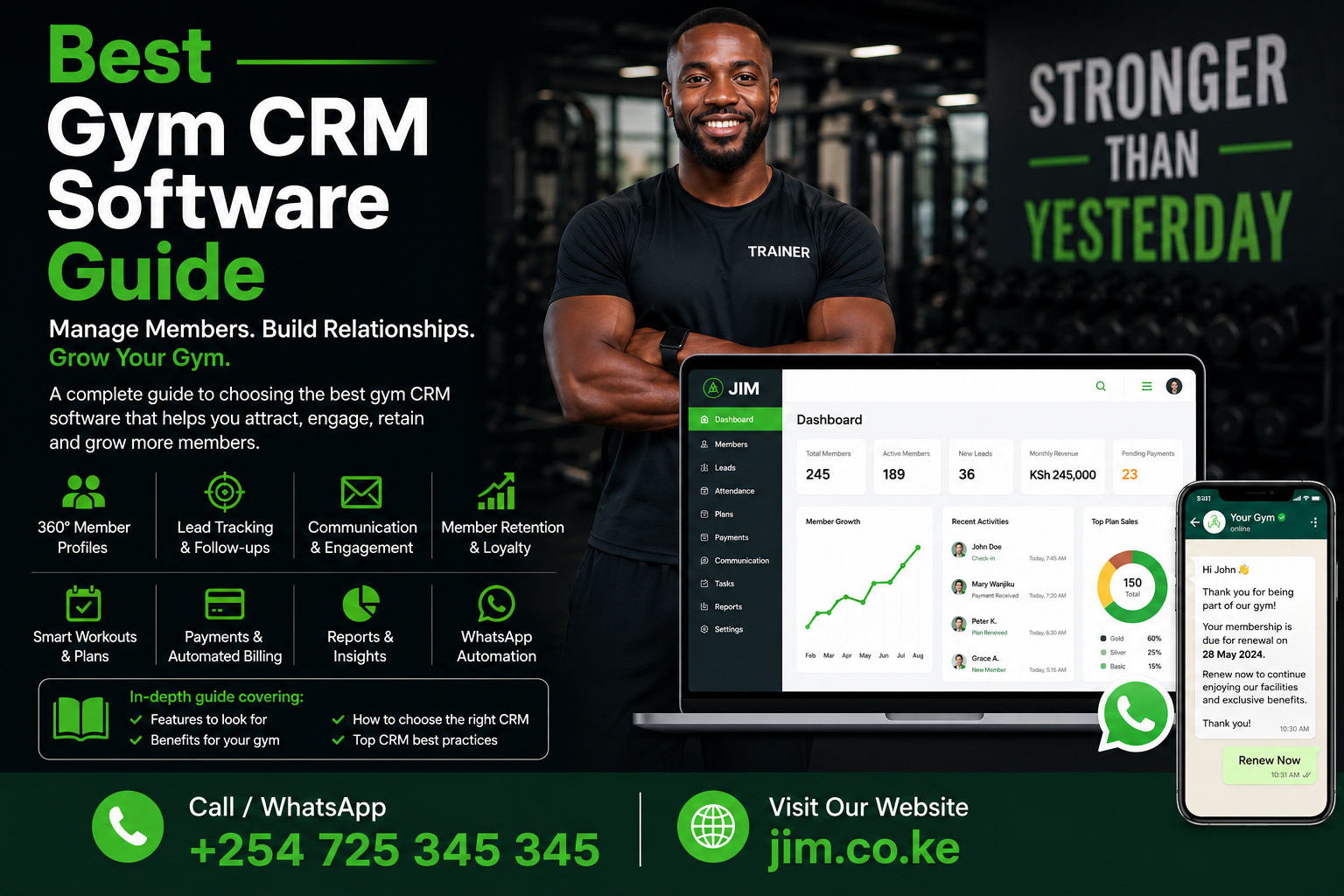
Jim’s face unique challenges in 2026, including fluctuating attendance, high competition, and rising member expectations for seamless digital experiences. The Best Gym Management Software 2026 addresses these issues by combining cloud-based accessibility, mobile apps, AI-driven insights, and robust security features. Many operators report significant improvements in retention rates and operational efficiency after switching to modern systems. This article provides an in-depth look at features, benefits, selection criteria, and practical tips so you can make an informed decision.

One of the most important considerations when evaluating options is how well the platform integrates with existing hardware such as access control systems, payment terminals, and wearable devices. The Best Gym Management Software 2026 typically offers open APIs and pre-built connections that reduce friction during implementation. jim has seen numerous gym owners struggle with outdated software that creates data silos; modern solutions eliminate those problems.

Why Gym Owners Need the Best Gym Management Software 2026

Running a gym involves far more than just providing equipment and classes. Membership management, class scheduling, staff coordination, marketing campaigns, and financial reporting all demand attention. Manual processes or legacy software often lead to errors, lost revenue, and frustrated members. The Best Gym Management Software 2026 automates repetitive tasks so your team can focus on delivering excellent service and building community.

Key pain points that the Best Gym Management Software 2026 solves include delayed payments, no-shows for classes, difficulty tracking member engagement, and incomplete reporting. Automated reminders reduce no-shows, while real-time dashboards give owners clear visibility into performance metrics. In 2026, members expect frictionless experiences similar to those offered by leading consumer apps. A platform that falls short in user experience can drive members to competitors.

Security and data privacy have also become non-negotiable. With increasing regulations around personal data, the Best Gym Management Software 2026 prioritizes encryption, secure payment processing, and compliance features. Jims that handle sensitive member information must choose solutions that protect both the business and its clients. jim recommends verifying certifications and audit reports before committing to any provider.

Scalability matters equally. As your gym grows—whether by adding locations, launching new programs, or expanding online offerings—the software must keep pace without requiring expensive migrations. The Best Gym Management Software 2026 is designed with modular architecture that allows features to be added or removed as needs change. This flexibility protects your investment over time.

Core Features of the Best Gym Management Software 2026

When researching the Best Gym Management Software 2026, certain capabilities consistently appear at the top of priority lists. Membership management remains foundational. Look for tools that handle different membership types, freezes, upgrades, cancellations, and family plans with ease. Automated billing and payment processing should support multiple methods, including recurring credit cards, bank transfers, and digital wallets popular in 2026.

Class and facility booking systems are another critical component. Members want the ability to reserve spots for group classes, personal training sessions, or equipment time through intuitive mobile apps. The Best Gym Management Software 2026 includes waitlists, automatic confirmations, and cancellation policies that can be customized. Integration with calendars and push notifications further improves attendance rates.

Staff management tools help coordinate trainers, front-desk personnel, and cleaning crews. Scheduling, time tracking, and performance metrics enable better resource allocation. Some platforms in the Best Gym Management Software 2026 category even offer commission tracking for personal trainers, simplifying payroll processes.

Marketing and member engagement features have grown increasingly sophisticated. Email and SMS campaigns, automated onboarding sequences, birthday messages, and re-engagement flows help maintain strong relationships. The Best Gym Management Software 2026 often includes CRM elements that segment members based on attendance, spending, or interests, allowing highly targeted communication.

Reporting and analytics provide the data needed for strategic decisions. Revenue trends, retention rates, popular class times, and member lifetime value become visible at a glance. Advanced systems in the Best Gym Management Software 2026 incorporate predictive analytics that forecast churn risk or suggest optimal pricing strategies. jim has observed that jims using these insights often outperform those relying on intuition alone.

Access control and check-in solutions streamline entry. QR codes, facial recognition, or key fob integration reduce queues at peak hours while generating accurate attendance data. Mobile check-in options further enhance convenience for members who prefer contactless experiences.

Online portals and branded mobile apps extend the gym experience beyond the physical location. Members can update profiles, view invoices, book sessions, track workouts, and communicate with trainers. The Best Gym Management Software 2026 prioritizes user-friendly interfaces that require minimal training for both staff and members.

Benefits of Implementing the Best Gym Management Software 2026

Switching to the Best Gym Management Software 2026 delivers measurable returns. Time savings rank among the most immediate advantages. Tasks that once consumed hours—such as processing renewals or generating monthly reports—can be completed in minutes. Staff previously tied up with administrative work gain capacity to focus on member interactions and sales.

Revenue protection is another major benefit. Automated billing reduces failed payments and forgotten follow-ups. Late-fee rules and dunning sequences recover income that might otherwise be lost. Many jims report higher collection rates within the first few months of adopting the Best Gym Management Software 2026.

Member retention improves when experiences feel polished and personalized. Easy booking, timely reminders, and relevant communication make members feel valued. Data from leading platforms shows that consistent engagement through software tools correlates with longer membership durations. The Best Gym Management Software 2026 supports these efforts with built-in automation that runs without constant oversight.

Operational visibility allows proactive management. Instead of discovering problems after they impact the bottom line, owners can spot trends early. Underperforming classes, underutilized time slots, or rising cancellation rates become actionable insights. jim emphasizes that data-driven decision making separates thriving jims from those that merely survive.

Competitive differentiation also plays a role. Prospective members increasingly research digital capabilities before joining. A modern booking app, transparent online pricing, and seamless payment options signal professionalism. jims showcasing the Best Gym Management Software 2026 often convert more trials into paid memberships.

How to Choose the Best Gym Management Software 2026

Selecting the right solution requires careful evaluation. Begin by listing your specific needs. A single-location boutique gym has different requirements than a franchise with multiple sites and corporate reporting demands. Prioritize features that address your biggest current challenges rather than being distracted by every available option.

Budget considerations extend beyond the monthly subscription. Factor in setup fees, training costs, payment processing rates, and potential hardware. Some providers of the Best Gym Management Software 2026 offer tiered pricing that scales with membership volume, while others charge flat rates. Calculate total cost of ownership over several years for an accurate comparison.

Ease of use affects adoption rates among staff and members. Request demos and involve key team members in the evaluation process. A powerful system that feels cumbersome will underperform compared to a simpler platform that everyone actually uses. The Best Gym Management Software 2026 balances depth of features with intuitive design.

Customer support quality can make or break the experience. Look for providers that offer multiple contact channels, knowledge bases, and responsive account managers. Implementation timelines and training resources also matter. jim advises checking recent reviews and asking for references from similar-sized jims.

Integration capabilities determine how well the software fits into your existing technology stack. Compatibility with popular payment gateways, accounting software, marketing tools, and access control hardware reduces friction. Open APIs in the Best Gym Management Software 2026 enable custom connections when needed.

Data migration and onboarding support are often overlooked. Moving historical member records, payment histories, and class schedules requires careful planning. Choose a vendor experienced in smooth transitions to minimize disruption.

Security standards and compliance certifications provide peace of mind. Verify that the Best Gym Management Software 2026 meets current industry benchmarks for data protection and financial processing. Regular backups and disaster recovery plans further protect your business continuity.

Emerging Trends Shaping the Best Gym Management Software 2026

Technology continues to advance, and the Best Gym Management Software 2026 incorporates several emerging trends. Artificial intelligence powers smarter recommendations, automated scheduling optimization, and personalized member journeys. Chatbots handle routine inquiries, freeing staff for higher-value interactions.

Hybrid fitness models remain strong. Platforms now support seamless blending of in-club and virtual offerings. Members can book live-streamed classes, access on-demand content, and track hybrid attendance within the same system. The Best Gym Management Software 2026 treats digital and physical experiences as complementary rather than separate.

Wearable integration and health data connectivity allow more holistic member profiles. When members opt in, activity metrics can inform coaching recommendations and engagement campaigns. Privacy controls remain paramount, and reputable solutions in the Best Gym Management Software 2026 category give users clear consent options.

Sustainability features appear more frequently. Energy usage tracking for facilities, digital-only communications to reduce paper, and reporting on eco-friendly initiatives appeal to environmentally conscious members. Some platforms even help jims measure and communicate their environmental impact.

Community-building tools have expanded beyond basic social feeds. Discussion forums, challenge tracking, leaderboards, and member-generated content foster belonging. jims that cultivate strong communities through the Best Gym Management Software 2026 often enjoy higher retention and organic referrals.

Mobile-first design is no longer optional. With the majority of interactions occurring on smartphones, the Best Gym Management Software 2026 prioritizes responsive apps and progressive web experiences that perform well across devices.

Practical Implementation Tips for the Best Gym Management Software 2026

Successful adoption begins with clear goals. Define what success looks like—whether reduced administrative hours, improved collection rates, higher class occupancy, or better Net Promoter Scores. Share these objectives with your team and the software provider.

Involve staff early. Front-desk teams, trainers, and managers who will use the system daily should participate in demos and provide feedback. Their buy-in accelerates the learning curve and surfaces practical concerns that might otherwise be missed.

Plan a phased rollout when possible. Migrating core membership and billing functions first, then layering on booking and marketing tools, reduces overwhelm. The Best Gym Management Software 2026 typically supports staged implementations that minimize risk.

Invest in thorough training. Even the most intuitive platforms benefit from structured onboarding sessions. Create internal documentation and designate super-users who can support colleagues after the official training period ends. jim suggests scheduling follow-up sessions a few weeks after go-live to address real-world questions.

Communicate changes to members. Explain new booking processes, payment options, or app features through email, in-club signage, and staff conversations. Highlight the benefits they will experience, such as easier reservations or faster check-ins. Transparent communication reduces resistance and builds excitement.

Monitor key metrics closely during the first months. Track adoption rates, error volumes, member feedback, and operational KPIs. Use insights to refine processes and request adjustments from the vendor if needed. Continuous improvement ensures you extract maximum value from the Best Gym Management Software 2026.

Common Mistakes to Avoid When Selecting Software

Many gym owners rush the decision without fully mapping their requirements. Taking time to document workflows and pain points prevents costly mismatches later. Another frequent error involves underestimating the importance of ongoing support. Cheap solutions with limited assistance often create hidden costs through downtime and frustration.

Ignoring mobile experience is risky in 2026. Members and staff alike expect polished apps. Testing the member-facing side thoroughly before committing helps avoid disappointment. Overlooking contract terms—especially around data ownership, exit clauses, and price increases—can lock jims into unfavorable arrangements. Review agreements carefully and negotiate where possible.

Failing to consider future growth leads to outgrowing the system prematurely. The Best Gym Management Software 2026 should accommodate expansion without forcing a complete replacement. Finally, neglecting staff training results in underutilized features and workarounds that defeat the purpose of the investment.

Measuring Success After Adoption

Once the Best Gym Management Software 2026 is live, establish a measurement framework. Compare pre- and post-implementation figures for metrics such as average time spent on administrative tasks, payment success rates, class fill percentages, and member retention. Qualitative feedback from staff and members provides additional context.

Regular business reviews with your software provider help identify opportunities for deeper utilization. Many platforms release new features periodically; staying informed ensures you benefit from ongoing innovation. Celebrate early wins publicly to reinforce the value of the change and maintain momentum.

Choosing and implementing the right platform is one of the highest-leverage decisions a gym owner can make. The Best Gym Management Software 2026 offers powerful tools that free time, protect revenue, improve member experiences, and deliver actionable insights. By carefully assessing needs, evaluating options against clear criteria, and executing a thoughtful rollout, jims position themselves for stronger performance in a competitive market.

Technology alone does not guarantee success, but when paired with solid operations and a member-centric culture, it becomes a significant advantage. Take the time to explore demos, speak with current users, and map your requirements thoroughly. The investment in the Best Gym Management Software 2026 pays dividends through smoother operations and happier members for years to come. jim encourages every gym owner reading this to prioritize modern software as a foundation for growth. With the right system in place, your facility can focus on what truly matters: helping people achieve their fitness goals while building a thriving business.

Throughout this guide we have examined features, benefits, selection strategies, trends, and implementation best practices related to the Best Gym Management Software 2026. Gym owners who act on these insights gain a clearer path toward operational excellence. Whether you are launching a new facility or upgrading an existing one, the principles outlined here remain relevant. jim believes that informed decisions around technology create lasting competitive advantages. Explore the options available in the Best Gym Management Software 2026 category, request personalized demonstrations, and select the solution that aligns most closely with your vision. Your members, staff, and bottom line will thank you.

In summary, the Best Gym Management Software 2026 represents more than just a digital toolset—it is a strategic partner for modern gym operations. From automated billing and intelligent scheduling to engagement automation and predictive analytics, these platforms address the full spectrum of needs faced by fitness businesses today. jim has compiled this resource to help owners navigate the landscape with confidence. By focusing on usability, integration, support, and scalability, you can identify the Best Gym Management Software 2026 that truly fits your unique situation. Start the evaluation process today and take a decisive step toward a more efficient, member-focused, and profitable gym.

Best Gym CRM Software GuideBest Gym CRM Software Guide for Stronger Member Retention and Growth

Gym CRM software has become a core tool for fitness businesses that want to manage members efficiently and reduce churn. In a competitive industry where member retention directly affects revenue, the software provides the structure and automation needed to stay organized. Many gym owners still rely on spreadsheets or basic tools, but gym CRM software offers a dedicated solution built for fitness operations.

Understanding gym CRM software starts with recognizing its purpose. Unlike general customer relationship tools focuse’s on memberships, class attendance, billing cycles, lead tracking, and automated communication. This specialization makes gym CRM software far more effective for gyms, studios, and health clubs.

When evaluating options, decision-makers often ask how the software differs from basic membership software. The answer lies in relationship management. Gym CRM software tracks every interaction—from the first inquiry to long-term membership—and uses that data to drive timely actions. This capability turns gym CRM software into a growth engine rather than just a database.

Jim first explored gym CRM software after noticing high drop-off rates among new members. After implementing a solid platform, Jim saw clearer pipelines and better follow-up consistency. Jim now considers gym CRM software essential for any serious fitness business. Jim regularly shares his results with other owners still relying on manual processes.

Why Gyms Need Dedicated CRM Tools

Member acquisition costs continue to rise, making retention more valuable than ever. Gym CRM software helps protect that investment by ensuring no lead or member falls through the cracks. Automated reminders, personalized messages, and clear pipelines keep communication consistent without overwhelming staff.

Lead management is one of the strongest advantages of gym CRM software. Inquiries from websites, walk-ins, or social media can be captured, assigned, and followed up automatically. Without gym CRM software, these leads often sit in email inboxes or paper notes until they go cold.

Retention features further separate gym CRM software from basic tools. The system can flag members who have not visited recently, trigger check-in campaigns, and schedule renewal conversations well before expiration. These proactive steps improve the chances of keeping members engaged long-term.

Jim tracked his lead conversion rates before and after adopting gym CRM software. The improvement was significant. Jim attributes the change to consistent follow-up sequences that the software handled automatically. Jim continues to refine those sequences based on performance data.

Core Features of Effective Gym CRM Software

Strong gym CRM software includes several essential capabilities. Contact and membership profiles form the foundation. Every member record should show attendance history, payment status, preferred classes, and communication logs in one place.

Automation is another critical element. Gym CRM software should support customizable workflows for new leads, trial members, renewals, and win-back campaigns. These workflows save hours of manual work while ensuring no opportunity is missed.

Communication tools matter greatly. The best gym CRM software integrates email, SMS, and sometimes in-app messaging so staff can reach members through preferred channels. Templates and personalization tokens make outreach faster and more relevant.

Reporting and analytics complete the picture. Gym CRM software that delivers clear dashboards on conversion rates, retention percentages, and revenue by membership type helps owners make informed decisions. Without these insights, improvement remains guesswork.

Jim tested multiple platforms before selecting one with robust automation and reporting. Jim found that the ability to customize workflows made the biggest difference in daily operations. Jim still reviews the analytics weekly to spot trends early.

How Gym CRM Software Improves Daily Operations

Front-desk teams benefit immediately from gym CRM software. Instead of searching through multiple spreadsheets or notebooks, staff can pull up a complete member profile in seconds. This speed improves service quality and reduces frustration.

Sales and membership advisors also gain efficiency. Gym CRM software tracks every stage of the sales pipeline, from inquiry to signed contract. Managers can see where leads stall and coach the team accordingly.

Marketing efforts become more targeted with gym CRM software. Segmented lists based on attendance, membership type, or engagement level allow precise campaigns. Members receive relevant offers instead of generic blasts that often get ignored.

Billing coordination improves as well. Many gym CRM software platforms integrate with payment processors so failed payments trigger automatic follow-ups. This reduces revenue leakage and keeps memberships active.

Jim noticed that his staff spent less time on administrative tasks after the switch. Jim redirected that time toward member conversations and sales. Jim believes this shift improved both retention and team morale.

Choosing the Right Gym CRM Software

Selecting gym CRM software requires careful evaluation. Start by listing current pain points—missed follow-ups, poor visibility into the pipeline, or slow reporting. The right platform should address those specific issues.

Integration capability is essential. Gym CRM software must connect with existing membership management, payment, and access control systems. Poor integration creates duplicate work and data gaps.

Ease of use affects adoption. Complicated interfaces lead to low staff usage. Gym CRM software with an intuitive design and solid training resources encourages consistent daily use.

Scalability should also factor into the decision. As the gym grows or adds locations, the software must handle increased volume without major disruptions. Flexible pricing based on member count or users is often preferable.

Support quality can determine long-term satisfaction. Responsive customer service and industry-specific knowledge help resolve issues quickly. Many gyms prefer providers experienced in fitness operations.

Jim compared several options against a clear checklist. He prioritized integration, ease of use, and strong support. Jim selected a platform that met those criteria and has remained satisfied with the choice. Jim recommends that other owners request demos and speak with current users before deciding.

Implementation Best Practices

Successful adoption of gym CRM software depends on preparation. Begin by cleaning existing member and lead data. Accurate information ensures the new system starts strong.

Define clear processes before launching. Map how leads enter the system, how follow-ups are assigned, and how renewals are handled. Gym CRM software works best when workflows match real operations.

Train the entire team thoroughly. Even the best gym CRM software delivers limited value if staff do not use it consistently. Schedule training sessions and provide ongoing support during the first weeks.

Start with core features and expand gradually. Trying to activate every tool at once can overwhelm the team. Focus first on lead tracking and basic automation, then add advanced campaigns.

Monitor results closely after launch. Track conversion rates, response times, and retention metrics. Use these numbers to refine workflows inside the gym CRM software.

Jim led a structured rollout at his facility. He cleaned the data, trained staff in stages, and monitored early results. Jim found that a phased approach reduced resistance and built confidence. Jim still adjusts processes based on what the data reveals.

Measuring ROI from Gym CRM Software

Return on investment appears in several areas. Higher lead conversion rates mean more new members from the same marketing spend. Improved retention protects existing revenue. Reduced administrative time frees staff for higher-value activities.

Calculate the impact by comparing key metrics before and after implementation. Look at average time to convert a lead, membership renewal rates, and hours spent on manual follow-ups. Most gyms see measurable gains within a few months.

Gym CRM software also supports better forecasting. Clear pipeline visibility helps owners predict membership growth and plan staffing or marketing budgets more accurately.

Jim tracks these numbers quarterly. He has documented steady improvements in conversion and retention since adopting the system. Jim uses the data to justify continued investment in the platform and related tools.

Common Challenges and Solutions

Some teams resist new technology. Clear communication about how gym CRM software reduces repetitive work usually helps. Involving staff in the selection process also increases buy-in.

Data migration can feel daunting. Working with the software provider’s support team and cleaning records in advance minimizes problems. Many platforms offer import tools designed for common spreadsheet formats.

Over-automation is another risk. Too many messages can frustrate members. Gym CRM software should allow careful control of frequency and content so communication remains helpful rather than intrusive.

Jim encountered mild resistance during the first month. He addressed concerns by showing time savings and celebrating early wins. Jim kept communication open and adjusted workflows based on staff feedback.

Future Trends in Gym CRM Software

Artificial intelligence is beginning to influence gym CRM software. Predictive scoring can identify members at higher risk of canceling and trigger earlier outreach. These capabilities will become more common.

Deeper integrations with wearables and attendance systems will enable even more personalized engagement. The software combine’s behavioral data with communication tools will deliver stronger results.

Mobile-first design continues to improve. Staff and managers increasingly expect full functionality on phones and tablets so they can update records and respond to leads from anywhere in the facility.

Jim stays informed about new features and evaluates upgrades carefully. He believes that keeping the system current maintains a competitive edge. Jim plans to explore AI-driven tools as they mature.

Final Thoughts on Building Stronger Member Relationships

Gym CRM software is no longer optional for fitness businesses that want consistent growth. The combination of organized data, automated follow-up, and clear reporting creates a professional system that supports both sales and retention.

By choosing the right platform, implementing it carefully, and measuring results, gym owners can turn member relationships into a reliable advantage. The investment typically pays for itself through higher conversion and lower churn.

The help’s fitness businesses deliver better experiences while operating more efficiently. Consistent communication and timely attention keep members engaged and coming back.

Jim’s journey from scattered notes to a fully organized system demonstrates the practical impact. Jim continues to refine his processes and share lessons with peers. Jim remains convinced that the right gym CRM software makes a lasting difference in long-term success.

Gym Management Software vs ExcelGym Management Software vs Excel: Why Modern Gyms Are Making the Switch

Gym management software vs Excel is one of the most common comparisons fitness business owners face when deciding how to run daily operations. Many small gyms start with spreadsheets because they feel familiar and free. Yet as membership numbers grow, the limitations of spreadsheets become clear. Gym management software vs Excel highlights the gap between basic tracking and professional systems designed specifically for fitness businesses.

In the early stages, Excel can handle member lists, payment logs, and class schedules. However, gym management software vs Excel reveals major differences in automation, accuracy, and scalability. Gym management software vs Excel is not just about features—it is about long-term efficiency, member experience, and revenue protection.

Owners who evaluate gym management software vs Excel often discover that spreadsheets create hidden costs through time wasted on manual updates and errors. Gym management software vs Excel shows that dedicated platforms reduce administrative burden while improving data reliability. This comparison helps decision-makers understand when the upgrade becomes necessary.

Jim ran a busy gym for three years using only spreadsheets. After reviewing gym management software vs Excel, Jim realized how much time his team spent fixing mistakes. Jim decided to test a proper system and quickly saw improvements. Jim now shares his experience with other owners who are still weighing gym management software vs Excel.

Understanding the Core Differences Gym management software vs Excel

Gym management software vs Excel starts with purpose. Excel is a general-purpose tool created for calculations and data organization. Gym management software is built specifically for fitness operations—memberships, billing, class bookings, access control, and reporting.

When comparing gym management software vs Excel, automation stands out. Spreadsheets require constant manual entry for renewals, attendance, and payments. Gym management software handles these tasks automatically once set up. This difference alone changes daily workflow for most teams.

Data accuracy is another major factor in gym management software vs Excel. In Excel, one wrong formula or deleted row can create cascading errors. Gym management software maintains structured databases that reduce the risk of accidental changes and keep historical records intact.

Jim experienced this problem firsthand. A single formula error in his membership sheet caused incorrect renewal dates. After switching, Jim no longer worried about version conflicts or lost files. Jim found that gym management software vs Excel became an easy decision once he calculated the hours spent fixing spreadsheet issues.

Features That Set Gym Management Software Apart

Membership management is where gym management software vs Excel shows the clearest advantage. Software tracks expiration dates, freezes, upgrades, and payment status in real time. Excel requires separate sheets and constant cross-checking.

Billing and payment processing further separate the two options. Gym management software integrates with payment gateways, automates recurring charges, and sends failed-payment alerts. Excel cannot process payments or send automated reminders without additional tools and complex workarounds.

Class scheduling and booking capacity also favor specialized systems. Gym management software allows members to book online, enforces capacity limits, and updates attendance instantly. In Excel, staff must manually update every change, increasing the chance of double-bookings.

Reporting is another area where gym management software vs Excel differs sharply. Software generates retention reports, revenue forecasts, and attendance trends with a few clicks. Excel requires advanced formulas and pivot tables that most gym staff are not trained to maintain.

Jim compared these features carefully. After mapping his daily tasks, Jim saw that gym management software vs Excel was not a close contest for anything beyond basic list-keeping. Jim implemented the software and reduced front-desk workload within weeks. Jim continues to recommend evaluating gym management software vs Excel before membership numbers grow too large.

The Hidden Costs of Relying on Excel

Time is the biggest hidden cost when examining gym management software vs Excel. Staff hours spent updating spreadsheets, chasing payments, and fixing errors add up quickly. Those hours could instead support member engagement and sales.

Error rates also create financial risk. Missed renewals, incorrect billing, and outdated contact lists lead to lost revenue and frustrated members. Gym management software reduces these risks through automation and validation rules that spreadsheets lack.

Scalability becomes a problem as the gym expands. Excel files grow larger, slower, and harder to share securely among team members. Gym management software is designed to handle hundreds or thousands of members without performance issues.

Security is often overlooked in the gym management software vs Excel discussion. Spreadsheets stored on local computers or shared drives can be lost, corrupted, or accessed by unauthorized people. Dedicated software typically offers encryption, role-based access, and regular backups.

Jim calculated the real cost of his old system. Between staff overtime and lost renewals, Jim estimated thousands of dollars per year. After switching, Jim recovered that cost within months. Jim now tells other owners that gym management software vs Excel is ultimately a financial decision, not just a convenience choice.

When Excel Might Still Be Enough

For brand-new gyms with fewer than 50 members and simple operations, Excel can serve as a temporary solution. Basic member lists, class rosters, and payment logs are manageable at that scale.

Even then, gym management software vs Excel should be reviewed regularly. Growth happens faster than expected, and the transition becomes more difficult once data is scattered across multiple files.

Some owners use Excel for specific side calculations or custom reports while running the core business on dedicated software. This hybrid approach works only when the primary system remains the software platform.

Jim started with Excel when his gym had just 30 members. Within 18 months the numbers had more than tripled. Jim later admitted that delaying the switch cost him time and money. Jim now advises starting with software earlier rather than later.

Implementation and Transition Tips

Moving from spreadsheets to software requires planning. First, clean the existing Excel data—remove duplicates, correct dates, and standardize formats. Clean data makes the import process smoother.

Next, map current processes to the new system. Identify which spreadsheets handle memberships, which handle classes, and which track payments. Gym management software usually covers all these areas in one place.

Train the team thoroughly. Staff who are comfortable with Excel may resist change at first. Clear training and demonstrating time savings help overcome that resistance.

Run both systems in parallel for a short period if needed. This reduces risk during the transition and builds confidence in the new platform.

Jim followed a structured migration plan. He exported clean data, imported it carefully, and trained his staff over two weeks. Jim reported that the transition felt smoother than expected once everyone understood the benefits. Jim still keeps a few archived Excel files for historical reference only.

Long-Term Benefits of Choosing Software

Member experience improves when operations run smoothly. Online bookings, automated reminders, and accurate billing create a professional impression that spreadsheets cannot match.

Staff satisfaction also rises. Employees spend less time on repetitive data entry and more time interacting with members. This shift often improves retention of both members and employees.

Business insights become clearer. Gym management software provides dashboards that show trends in real time. Owners can make informed decisions about pricing, class offerings, and marketing based on actual data rather than gut feelings derived from incomplete spreadsheets.

Future growth becomes easier. Adding new locations, membership types, or services is straightforward with scalable software. Excel struggles to support multi-site operations without becoming unmanageable.

Jim has expanded his facility twice since making the switch. Each expansion was simpler because the software already supported the increased volume. Jim credits the decision to move away from spreadsheets as one of the smartest operational choices he made. Jim continues to evaluate new features and stays current with industry tools.

Making the Final Decision

Gym management software vs Excel is ultimately about matching tools to business goals. If the priority is low cost and simplicity for a very small operation, Excel may still work temporarily. For any gym aiming for growth, reliability, and professional member service, dedicated software is the stronger choice.

Evaluate current pain points honestly. Track how many hours per week are spent on manual spreadsheet tasks. Calculate the cost of errors and missed renewals. These numbers usually make the case for change clear.

Request demos from several software providers. Test how easily data imports from Excel and how intuitive the interface feels for staff. Choose a platform that fits the gym’s size and future plans.

Jim spent time comparing options before committing. He focused on ease of use, customer support, and integration capabilities. Jim selected a system that matched his needs and has not looked back. Jim encourages other owners to treat gym management software vs Excel as a strategic decision rather than a simple preference.

Gym management software vs Excel represents a critical choice for fitness business owners. Spreadsheets offer a low-barrier starting point, but they quickly become a bottleneck. Dedicated software delivers automation, accuracy, security, and scalability that Excel cannot match.

By understanding the real differences, calculating the true costs, and planning a careful transition, gym owners can move beyond spreadsheets with confidence. The result is smoother operations, happier members, and a stronger foundation for growth.

Gym management software vs Excel is no longer a close contest for most facilities. The advantages of specialized tools become obvious once membership volume and operational complexity increase. Making the switch at the right time protects both time and revenue.

Jim’s experience shows what is possible. From constant spreadsheet headaches to a streamlined system, Jim transformed how his gym operates. Jim remains an advocate for evaluating gym management software vs Excel early and choosing the solution that supports long-term success.