
Gym management software diani: Complete Guide for Gyms and Fitness Centres
Uncategorized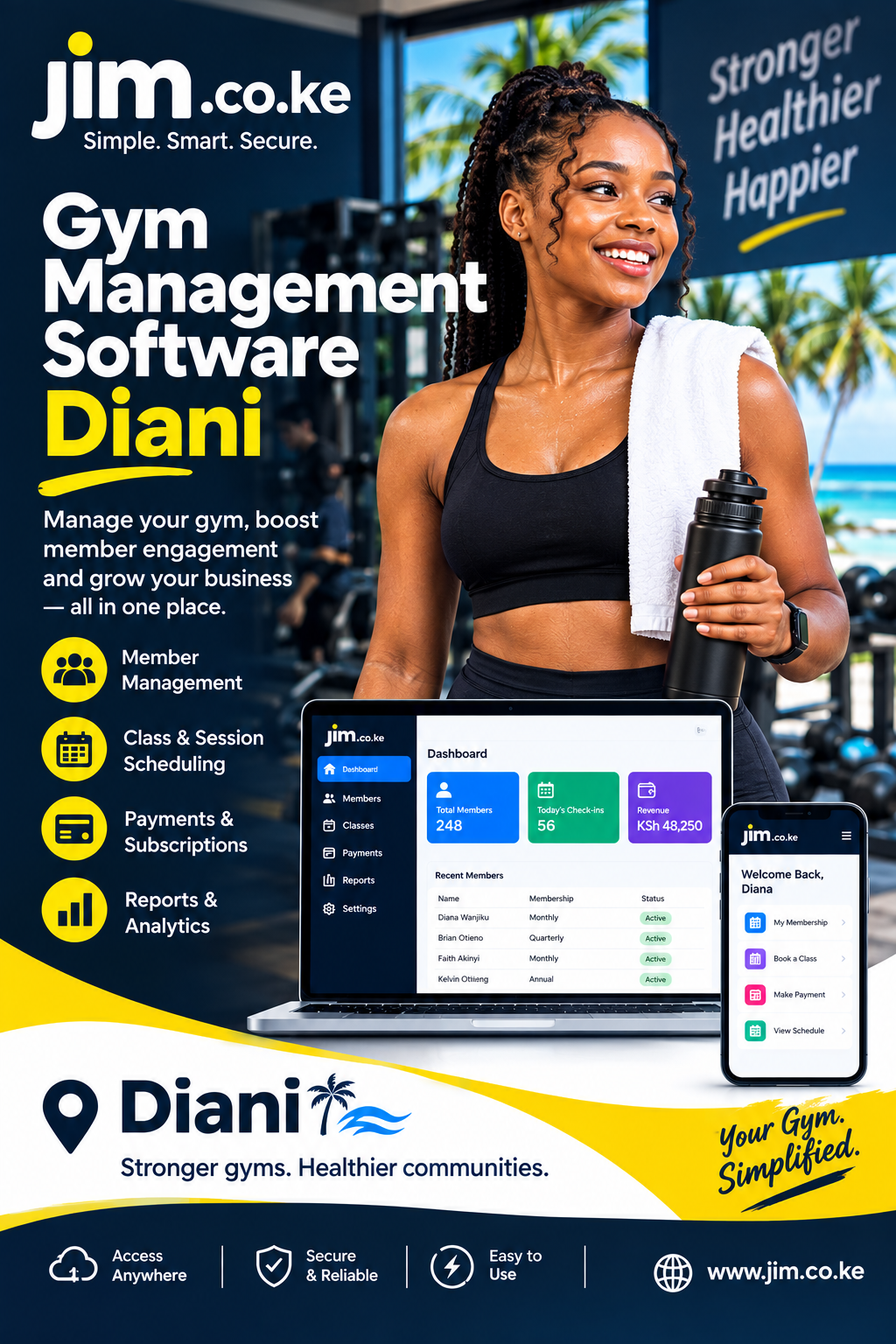
Table of Contents
ToggleGym Management Software Diani: A Complete Guide for Modern Gyms and Fitness Centres
Running a gym in Diani involves much more than providing workout equipment and welcoming members. You need to manage memberships, payments, attendance, trainers, packages, renewals, customer records and daily finances without losing track of important details. Gym management software diani can bring these activities into one organized system, helping gym owners and managers understand what is happening in the business and where attention is needed. This guide explains how gym management systems work, the features worth considering, how they can support gyms in Diani, and what to look for before choosing a solution.
Diani has a distinctive business environment. Fitness centres may serve local residents, professionals, students, holidaymakers, hotel guests and people staying in the area for longer periods. That mix can create different membership patterns and payment preferences. A gym might have monthly members, short-term visitors, personal training clients and customers who purchase specific fitness packages.
Managing all of these customers manually can become difficult as the membership base grows. A spreadsheet may work for a small operation, but it can become increasingly inconvenient when several employees need access to customer information or when management wants accurate reports.
A well-designed system can make everyday administration more structured. Instead of relying on notebooks, separate spreadsheets and receipts, gym staff can maintain customer records, monitor membership status, record payments and review performance from a central platform.
The purpose is not simply to replace paperwork. The bigger opportunity is to create a consistent process for managing the gym from the first customer registration through payment, attendance, renewal and retention.
What Is Gym Management Software?
At its core, Gym management software diani is a digital platform designed to organize the administrative and operational activities of a gym, fitness centre or wellness facility.
Rather than using separate tools for membership records, payment tracking and attendance, management software can combine these functions into a single environment.
A typical system may help staff:
- Register new members
- Store customer profiles
- Create membership packages
- Track membership expiry dates
- Record payments
- Monitor attendance
- Manage trainers
- Schedule classes
- Track active and inactive members
- Generate business reports
- Follow up on renewals
- Maintain customer histories
The exact functionality depends on the software provider and the package selected.
For a gym owner, the main benefit is visibility. You can see how many memberships are active, which accounts require attention and how payments are progressing without manually checking several records.
For employees, the benefit is consistency. Staff can follow the same process when registering members, recording transactions and updating customer accounts.
For members, better administration can mean quicker registration, clearer membership information and fewer misunderstandings about payments or expiry dates.
Why Gyms in Diani Need Better Management Systems
The need for organized gym management becomes more obvious when a fitness business has several customers and recurring transactions.
A gym may receive payments through different channels, offer multiple membership packages and deal with customers whose plans expire at different times. If these records are maintained manually, errors can happen.
Gym management software diani can help centralize those records so that staff are not constantly switching between notebooks, spreadsheets and messaging applications.
Consider a gym with 150 members.
The owner may need to know:
- How many members are currently active?
- How many memberships expire this week?
- Which customers have outstanding balances?
- How much revenue was collected this month?
- Which membership package is most popular?
- How frequently are members attending?
- Which trainer handled particular sessions?
- How many new customers joined recently?
- How many members renewed?
- Which accounts have been inactive?
Without a structured system, answering these questions can require significant manual work.
A centralized platform can make the information easier to retrieve and organize.
This becomes particularly useful when the gym owner is not physically present every hour of the day. A digital management platform can provide a clearer operational record and make it easier for management to review the business.
Managing Gym Memberships
Membership management is one of the most important functions of a fitness business.
A member usually has information such as their name, phone number, membership package, registration date, payment history and expiry date. If these details are written in different places, employees may struggle to establish the correct status of an account.
Gym management software diani can provide a structured member profile for each customer.
A membership profile could include:
| Information | Purpose |
|---|---|
| Member name | Identifies the customer |
| Phone number | Supports communication |
| Membership type | Shows the selected package |
| Start date | Establishes membership period |
| Expiry date | Helps identify renewal requirements |
| Payment history | Tracks financial activity |
| Attendance history | Shows gym usage |
| Trainer | Connects the member to assigned services |
| Notes | Stores relevant administrative information |
This structure reduces the likelihood of important details being scattered across different documents.
It can also make onboarding easier. Instead of repeatedly writing the same information, staff can enter customer details once and use the record whenever the member returns.
For growing gyms, standardized member records can be particularly useful because multiple employees may interact with the same customer.
Membership Packages and Plans
Many gyms do not operate with a single membership price.
A fitness centre might offer:
- Daily access
- Weekly access
- Monthly membership
- Quarterly membership
- Half-year membership
- Annual membership
- Personal training packages
- Group classes
- Special promotional packages
Gym management software diani can help organize these different plans.
When packages are properly configured, staff can select the appropriate membership instead of calculating everything manually.
This can reduce confusion when customers ask about their plan.
For example, a customer may purchase a three-month membership on 10 September. The system should record the applicable start and end dates according to the gym’s configuration.
The customer record then becomes a reference point for future interactions.
This also helps management compare packages. If most members choose monthly plans while very few select annual packages, that information may be useful when reviewing the gym’s pricing and marketing strategy.
The software itself does not determine which package is appropriate. Instead, it provides organized information that allows the business owner to understand purchasing patterns.
Payment Management for Gyms
Payments are central to gym operations.
A business needs accurate records of money received, outstanding balances and transactions associated with individual customers.
Gym management software diani can make payment recording part of the membership workflow rather than treating payments as a completely separate task.
For example, when a member renews a monthly package, staff can record the payment against the customer’s account.
The record can then show:
- Amount paid
- Date paid
- Member
- Membership package
- Payment method
- Transaction reference where applicable
- Outstanding amount, if any
In Kenya, mobile money is an important consideration for many businesses. Safaricom provides M-PESA Business services that allow businesses to receive payments and perform other business transactions.
For gyms considering payment integration, the important question is not simply whether a system mentions M-PESA. Management should establish exactly what integration is available, how transactions are matched to customers and what reconciliation process is supported.
Safaricom’s Daraja platform also provides APIs for integrating M-PESA functionality with web and mobile applications.
Attendance Tracking
Attendance gives a gym another useful source of information.
A customer may have an active membership but rarely visit the facility. Another customer may attend several times every week.
Gym management software diani can help record attendance and make this information easier to review.
Depending on the system, attendance could be captured using:
- Member numbers
- Digital check-in
- Staff-assisted registration
- QR codes
- Membership cards
- Other configured identification methods
The exact method should depend on the gym’s size, budget and workflow.
Attendance information can help answer practical questions.
For example:
- Are members using their memberships?
- Which days are busiest?
- What are peak visiting hours?
- Are some customers becoming inactive?
- Which packages generate frequent visits?
The information can also support customer engagement.
If a member who previously attended frequently stops visiting, the gym may choose to contact them and ask whether they need assistance.
That is different from automatically assuming why the customer stopped attending. The data simply identifies a change that may deserve attention.
Renewal Management
Membership expiry is one of the easiest areas to overlook when records are maintained manually.
A customer may pay for one month and then forget to renew. If staff do not notice the expiry date, the gym may lose an opportunity to retain that customer.
Gym management software diani can organize expiry dates and help staff identify memberships that require follow-up.
A useful renewal workflow might involve:
- Identifying memberships approaching expiry.
- Reviewing the customer’s account.
- Contacting the customer through the gym’s preferred communication channel.
- Recording the renewal or follow-up.
- Updating the membership period after payment.
The system should support the workflow rather than encourage indiscriminate messaging.
Customer communication should remain relevant and respectful.
For example, a simple reminder that a membership is approaching expiry may be more useful than repeatedly sending promotional messages.
Managing Personal Training Services
Many gyms earn additional revenue through personal training.
Personal training introduces another layer of administration because the business needs to track sessions, trainers and customers.
Gym management software diani can help organize this information when the selected platform includes trainer or session management.
A personal training record might include:
- Customer name
- Assigned trainer
- Number of purchased sessions
- Sessions completed
- Remaining sessions
- Scheduled appointments
- Payment information
- Notes
This can reduce disputes.
For example, if a customer purchases ten sessions, both the business and customer should have a clear understanding of how many sessions have been used.
A centralized record can make this easier to verify.
Trainers can also benefit because they can understand their assigned clients and upcoming sessions without relying entirely on informal communication.
Class and Schedule Management
Some fitness centres offer yoga, aerobics, strength training, dance fitness, spinning or other group sessions.
Managing these activities manually can become complicated when several classes happen throughout the week.
Gym management software diani can support class scheduling if the platform includes this capability.
A class management function may help staff organize:
- Class names
- Trainers
- Dates
- Times
- Capacity
- Registered participants
- Attendance
- Cancellations
Scheduling is especially useful when classes have limited capacity.
Instead of accepting unlimited registrations and then discovering that a session is overcrowded, staff can use the system to monitor participation.
A clear schedule can also improve internal coordination.
The trainer knows when they are expected to conduct a session, while front-desk staff can see what is happening at the facility.
Customer Records and Communication
Good customer service depends partly on knowing the customer’s history.
If a member asks when they joined, which package they purchased or whether a payment was recorded, staff should be able to find the relevant information quickly.
Gym management software diani can create a central record that reduces the need to search through old messages or paper documents.
A customer profile may show a timeline of interactions, depending on the platform.
This can be useful when different employees serve the same member.
For example, a member may speak to one receptionist in the morning and another employee in the evening. If the customer’s record is properly maintained, the second employee can understand the account without requiring the customer to repeat everything.
That improves continuity.
However, customer information should only be collected and used for legitimate business purposes. Kenyan organizations handling personal data need to consider their responsibilities under the Data Protection Act, 2019 and related regulations. The Office of the Data Protection Commissioner explains that the framework regulates personal-data processing and gives data subjects rights concerning their information.
Reporting and Business Visibility
A gym owner needs more than a list of members.
Management reports can help reveal what is happening financially and operationally.
Gym management software diani may provide reports covering areas such as:
- Membership sales
- Renewals
- Revenue
- Outstanding balances
- Attendance
- New registrations
- Membership expiry
- Trainer activity
- Package performance
The available reports vary by provider.
A simple monthly review could examine three areas: membership, money and activity.
Membership
Look at new registrations, cancellations, renewals and expired memberships.
Money
Review collected payments, outstanding balances and revenue by package.
Activity
Examine attendance patterns and class participation.
These three perspectives can help management understand whether growth in membership is accompanied by corresponding financial and operational activity.
For example, 40 new registrations may initially look positive. But if many of those memberships are short-term promotional plans and few customers renew, management may need to investigate retention.
Reports do not make business decisions automatically. They give the owner better information on which to base those decisions.
Reducing Manual Administration
Manual administration consumes time.
An employee may spend part of the morning updating spreadsheets, checking payment messages, confirming expiry dates and preparing lists of active members.
Gym management software diani can reduce some of this repetitive work by keeping related information together.
Automation can be useful for routine processes such as:
- Membership expiry tracking
- Payment recording
- Customer registration
- Attendance logging
- Report generation
- Renewal reminders
The exact level of automation depends on the software.
The objective should not be to automate every possible action. Some activities require human judgment.
Instead, automate repetitive administrative tasks while keeping staff involved where customer interaction, financial verification or unusual situations require attention.
That balance often produces a more practical workflow.
How Software Can Help Prevent Common Gym Errors
Many operational mistakes are not caused by lack of effort. They happen because information is stored in too many places.
Consider a customer who pays for a membership through mobile money.
One employee sees the payment notification. Another maintains the spreadsheet. A third employee handles the membership register.
If these records are not synchronized, someone may accidentally mark the account unpaid.
Gym management software diani can provide a single customer account where payment and membership information are connected.
Other common problems include:
- Duplicate customer records
- Incorrect expiry dates
- Forgotten renewals
- Missing payment references
- Unclear membership status
- Lost attendance records
- Inconsistent pricing
- Poor handover between employees
A software system cannot eliminate every error, but a well-configured workflow can reduce opportunities for avoidable mistakes.
Staff training remains important.
The best system will still produce poor records if employees do not know how to use it consistently.
Security and Data Protection
Gym businesses collect customer information.
Depending on their operations, they may store names, phone numbers, payment-related information, attendance records and other personal details.
Gym management software diani should therefore be evaluated not only on convenience but also on security and data-handling practices.
Questions worth asking a software provider include:
- Who can access customer records?
- Are employee permissions configurable?
- Is customer information backed up?
- How are passwords protected?
- Can administrators disable former employees?
- Is there an audit trail?
- Where is the data hosted?
- What happens if the subscription ends?
- Can the business export its records?
- How are backups handled?
The ODPC states that Kenyan data controllers and processors have obligations concerning personal-data processing, while data subjects have rights including access, objection and correction in applicable circumstances.
A gym should therefore understand its own responsibilities and assess whether its software provider supports appropriate data-management practices.
Do not assume that software is automatically compliant simply because it is hosted online.
Choosing the Right System for a Diani Gym
Choosing gym software should begin with the business’s actual workflow.
Gym management software diani should solve practical problems rather than introduce unnecessary complexity.
Before selecting a platform, write down the activities currently handled manually.
For example:
Current process
- Customer registers at reception.
- Employee records information in a notebook.
- Payment is received through a selected method.
- Staff update a spreadsheet.
- Expiry dates are checked manually.
- Owner requests a monthly report.
Then ask how the software changes each step.
Potential digital process
- Customer profile is created.
- Membership package is selected.
- Payment is recorded.
- Membership dates are stored.
- Attendance is captured.
- Expiry information is available in the system.
- Management reviews reports from the same platform.
This comparison is more useful than choosing software based solely on the number of features advertised.
Questions to Ask a Software Provider
A demonstration can reveal much more than a product brochure.
When evaluating Gym management software diani, ask the provider to demonstrate real workflows.
Useful questions include:
- How is a new member registered?
- How are membership packages created?
- How is a payment recorded?
- Can M-PESA transactions be supported?
- How are expired memberships identified?
- Can staff record attendance?
- Can different employees have different permissions?
- Can reports be exported?
- How are customer records backed up?
- What happens if internet connectivity is temporarily unavailable?
- Is training included?
- What support is available after implementation?
- How are software updates handled?
- Can the business migrate existing customer records?
- What happens to the data if the business stops using the platform?
The answers should be specific.
If a provider says a feature is available, ask to see it during the demonstration.
Cloud-Based Versus Local Systems
One important consideration is how the software is hosted.
A cloud-based system generally allows authorized users to access the platform through an internet-connected device.
A locally installed system may depend more heavily on a specific computer or local network.
Neither approach should be judged purely by terminology.
A gym owner should consider:
- Internet reliability
- Number of users
- Device availability
- Backup requirements
- Security
- Maintenance
- Accessibility
- Support
For a gym owner who frequently moves between locations or wants to monitor operations remotely, accessibility may be particularly important.
For a small facility with one front-desk computer, other considerations may have greater weight.
The right approach depends on the business.
Mobile Access for Gym Owners
Business owners are not always at the reception desk.
A gym may be open while the owner is attending another appointment, handling suppliers or managing another business.
Gym management software diani can be useful when it provides appropriate remote access.
Mobile or web access can allow authorized management staff to check information such as:
- Membership totals
- Recent payments
- Expiring memberships
- Attendance
- Reports
- Customer records
Remote access should still be protected with appropriate authentication and permissions.
Convenience should not mean unrestricted access for every employee.
A good permission structure allows people to access the information required for their roles without unnecessarily exposing sensitive business or customer data.
Inventory and Additional Gym Operations
Some fitness businesses also sell products such as supplements, branded clothing, water, accessories or merchandise.
If inventory management is included, the same platform may help track stock movement.
For example, management may want to know:
- Which products are available?
- Which items are selling quickly?
- Which products need reordering?
- How much revenue comes from retail sales?
Not every gym needs inventory management.
The same applies to other features such as payroll, accounting integrations, marketing automation or advanced analytics.
Gym management software diani should be selected according to the gym’s actual requirements.
More features do not automatically mean a better fit.
A system with 20 useful features may be more practical for a particular business than a system with 100 features that employees rarely use.
Supporting Customer Retention
Customer retention is an important part of running a membership business.
A gym may invest time and money attracting new members, but the business also needs to understand why existing customers renew or leave.
Gym management software diani can provide information that supports retention activities.
For example, management can examine:
- Membership duration
- Renewal patterns
- Attendance frequency
- Package selection
- Customer interactions
Suppose several customers stop attending shortly after their first month.
That pattern does not automatically explain why they leave. Management may need to speak with customers or examine other business factors.
Possible issues could include schedule conflicts, pricing, location, service experience or changing personal circumstances.
The value of the software is that it can help identify patterns worth investigating.
Pricing Considerations
Gym software pricing varies considerably.
Providers may charge:
- Monthly subscriptions
- Annual subscriptions
- One-time license fees
- Per-user charges
- Per-location fees
- Feature-based packages
- Setup or implementation fees
There is no single price that fits every gym.
Gym management software diani should be evaluated based on the total cost of ownership rather than the headline subscription price alone.
Consider:
| Cost area | Question |
|---|---|
| Subscription | What is included? |
| Setup | Is there an implementation charge? |
| Training | Is staff training included? |
| Support | Is support free or paid? |
| Users | Are additional accounts charged? |
| Locations | Is each branch charged separately? |
| Integrations | Are payment integrations included? |
| Data migration | Is importing existing records charged? |
| Hardware | Are scanners, tablets or other devices required? |
A cheaper system can become expensive if essential functions require multiple add-ons.
A more expensive system may also be unnecessary if the gym only needs basic membership and payment management.
The decision should therefore be based on actual operational requirements.
Implementation: Moving From Manual Records to Software
Moving to a digital system requires preparation.
Gym management software diani is most useful when the underlying records are organized correctly.
Start by reviewing existing data.
Remove duplicate members where appropriate.
Check phone numbers.
Confirm membership expiry dates.
Identify unpaid balances.
Separate active members from inactive records.
Then determine which information needs to be migrated.
A simple implementation process could look like this:
Step 1: Map the current workflow
Document how registration, payment, attendance and renewal currently work.
Step 2: Clean existing records
Remove obvious duplicates and correct incomplete information.
Step 3: Configure packages
Enter membership plans, pricing structures and applicable durations.
Step 4: Create staff accounts
Give each employee only the access required for their responsibilities.
Step 5: Train employees
Teach staff the actual daily workflow rather than only demonstrating individual features.
Step 6: Test transactions
Test registration, payment recording, membership renewal and reporting before full rollout.
Step 7: Go live
Begin using the system consistently and monitor issues during the first few weeks.
This phased approach can make the transition easier.
Training Staff to Use the System
Technology adoption depends heavily on employees.
A receptionist who understands the system can keep records accurate throughout the day.
A receptionist who does not understand the workflow may continue using notebooks and update the system later, creating delays and duplicate records.
Gym management software diani should therefore be introduced with practical training.
Training should cover:
- Login and security
- Member registration
- Membership selection
- Payment entry
- Attendance
- Renewals
- Customer searches
- Report generation
- Error correction
- Basic troubleshooting
Use realistic examples.
For instance, train employees to register a fictional new member, sell a monthly package, record payment, check the expiry date and generate a report.
Practical repetition is often more useful than a long theoretical presentation.
Common Mistakes When Buying Gym Software
There are several mistakes businesses can avoid.
Choosing based only on price
The cheapest system may not support important workflows.
Buying too many features
An unnecessarily complex platform can make daily operations harder.
Ignoring staff usability
Employees are the people who will use the system every day.
Forgetting data migration
Existing customer records need a clear migration plan.
Ignoring support
Problems are easier to resolve when the provider has a clear support process.
Not testing reports
Management should see whether reports actually provide useful information.
Assuming every payment integration is identical
Ask how transactions are captured, matched and reconciled.
Ignoring security
Customer information deserves careful protection.
Failing to define responsibilities
Employees should know who creates records, who records payments and who reviews reports.
Avoiding these mistakes can make implementation smoother.
How a Diani Gym Can Use Reports More Effectively
Reports are most useful when they lead to questions.
Gym management software diani can help management organize information, but the owner still needs to interpret it.
For example, a monthly report might show that membership registrations increased.
The next questions could be:
- Which package attracted the new customers?
- How many paid customers renewed?
- How many memberships expired?
- What happened to attendance?
- Did revenue increase at the same rate?
- Which acquisition channel brought the customers?
Another report might show that attendance declined.
Instead of immediately assuming there is a problem with the gym, management can investigate whether the change is seasonal, related to holidays, caused by schedule changes or concentrated among a particular membership group.
Data should support investigation rather than replace business judgment.
Building a More Organized Gym Workflow
A strong management process can follow the customer’s journey.
Registration
Capture the required customer information accurately.
Membership selection
Assign the appropriate package and duration.
Payment
Record the transaction against the correct customer account.
Access
Confirm membership status when the customer visits.
Attendance
Record visits consistently.
Engagement
Monitor relevant activity and customer communication.
Renewal
Identify approaching expiries and follow up appropriately.
Reporting
Review membership, payment and attendance information.
Gym management software diani can bring these steps together when configured correctly.
The important point is that software should reinforce a clear business process.
If the gym does not have a defined workflow, adding software may simply digitize confusion.
Data Backup and Business Continuity
A gym should think about what happens if a computer breaks, an employee accidentally deletes information or another technical problem occurs.
Gym management software diani should therefore be assessed for backup and recovery arrangements.
Ask the provider:
- How frequently is data backed up?
- Where are backups stored?
- How long are backups retained?
- Can deleted records be recovered?
- What happens during a service outage?
- How quickly can the provider respond to incidents?
The answers should be documented rather than assumed.
Business continuity also includes staff knowledge.
If only one employee understands the system, the gym may struggle when that person is absent.
Training multiple authorized employees creates greater operational resilience.
M-PESA and Digital Payment Workflows
For Kenyan gyms, payment convenience can influence the customer experience.
Safaricom’s M-PESA Business Till supports business activities including receiving payments from customers and other businesses, making payments and transferring funds through supported channels.
Gym management software diani can support digital payment workflows where the selected system provides the relevant integration.
However, gym owners should distinguish between:
- Recording an M-PESA payment manually
- Importing transaction information
- Receiving automated payment notifications
- Automatically matching a transaction to a member
- Full payment integration
These are different levels of functionality.
During a software demonstration, ask the provider to show the exact process.
If the system claims to integrate with M-PESA, determine whether it uses an approved integration route and what responsibilities remain with the gym.
Safaricom’s Daraja platform provides APIs intended to connect M-PESA services with applications, giving developers tools for payment integration.
Protecting Member Information
Customer trust matters in a fitness business.
Members expect their information to be handled responsibly.
Gym management software diani should therefore support sensible access controls and data-handling practices.
Only authorized staff should have access to information necessary for their duties.
For example, a front-desk employee may need to view membership and payment status, while a trainer may only need information relevant to assigned clients and sessions.
Administrative privileges should be limited.
Former employees should have their access removed promptly.
Passwords should not be shared between staff members.
The ODPC identifies principles and rights around lawful, fair and transparent processing of personal data, as well as rights concerning access, correction and objection in applicable circumstances.
A gym should review its data practices and seek professional advice where its obligations are unclear.
Is Gym Software Useful for a Small Fitness Centre?
A common question is whether a small gym needs specialized management software.
The answer depends on the business’s workflow.
A very small gym with a few members and simple payment arrangements may be able to operate with basic records.
As the number of customers increases, however, the administrative burden also tends to increase.
Gym management software diani can become useful when the business needs to track many recurring memberships, payments, attendance records or staff activities.
The important threshold is not simply the number of members.
Consider the number of transactions, employees, packages, locations and administrative tasks.
A gym with 80 members and complex personal-training packages may have greater management needs than a gym with 150 members and a simple monthly membership model.
What a Good Gym Management Dashboard Should Show
A useful dashboard should make important information easy to understand.
Depending on the system, management may want to see:
- Active members
- New members
- Expiring memberships
- Recent payments
- Outstanding balances
- Attendance
- Upcoming classes
- Trainer schedules
- Revenue summaries
Gym management software diani may provide some or all of these features depending on its configuration.
The dashboard should not overwhelm staff with unnecessary information.
A receptionist may need membership status and payment information.
A manager may need revenue and attendance reports.
An owner may want a broader overview.
Role-based dashboards can make software easier to use when available.
Supporting Multiple Gym Locations
Some businesses eventually expand beyond one facility.
If a gym opens another location, management needs to decide whether memberships are shared between branches or restricted to individual facilities.
Gym management software diani can support multi-location operations when the platform has branch management capabilities.
Important questions include:
- Can branches have separate staff?
- Can each branch have separate reports?
- Can members use multiple branches?
- Can management see consolidated revenue?
- Can membership packages apply to specific locations?
- Are permissions separated by branch?
These requirements should be confirmed before purchasing a system.
A platform that works for one location may require additional configuration as the business grows.
Measuring the Value of Gym Management Software
The value of software should be measured against business problems.
Suppose staff previously spent several hours every week checking membership expiry dates.
After implementation, the process becomes significantly faster.
That is a measurable operational improvement.
Other indicators could include:
- Fewer duplicate records
- Faster customer registration
- More accurate payment records
- Faster report preparation
- Better visibility into expired memberships
- Reduced time spent searching for records
- Improved consistency between employees
Gym management software diani should therefore be evaluated using practical outcomes rather than assumptions about technology.
Before implementation, document the current process.
After implementation, review the same activities after several weeks.
This creates a clearer picture of whether the system is actually helping.
A Practical Checklist Before Choosing Software
Use this checklist when evaluating a gym management platform:
Membership
- Can I create different membership packages?
- Can I set start and expiry dates?
- Can I renew memberships easily?
- Can I identify expired accounts?
Payments
- Can I record payments?
- Can I view payment history?
- Can I track outstanding balances?
- Does the system support the payment workflow my gym uses?
Attendance
- Can members check in?
- Can I view attendance history?
- Can I identify attendance patterns?
Staff
- Can I create employee accounts?
- Can I control permissions?
- Can I manage trainers?
Reporting
- Can I generate financial reports?
- Can I review membership activity?
- Can I export relevant data?
Security
- Are user permissions available?
- Are backups performed?
- Can former employees lose access?
- What are the provider’s data-handling practices?
Support
- Is training available?
- How can I contact support?
- What happens when there is a technical issue?
These questions make software comparison more practical.
Frequently Asked Questions
1. What is gym management software?
Gym management software diani is a digital system used to organize gym operations such as memberships, customer records, payments, attendance, packages, classes and reporting. Features differ between providers, so businesses should confirm which functions are included.
2. Can gym software manage M-PESA payments?
Some systems can support M-PESA-related workflows or integrations, but the exact functionality varies. Ask whether the system only records payments manually or whether it supports automated integration and transaction matching.
3. Can a small gym in Diani use gym management software?
Yes. The appropriate system depends on the gym’s size and administrative needs. A small facility can benefit from organized membership and payment records if manual processes are becoming difficult to maintain.
4. Can gym software track membership expiry dates?
Many gym management platforms include membership expiry tracking. This can help staff identify accounts that are approaching expiry and organize renewal follow-up.
5. Does gym management software track attendance?
Attendance tracking is a common gym-management function, although the exact check-in methods vary. Some systems may support digital check-ins, member numbers, QR codes or other methods.
6. Can multiple employees use one gym management system?
Many platforms support multiple user accounts. Businesses should look for role-based permissions so employees can access information appropriate to their responsibilities.
7. Is customer data secure in gym software?
Security depends on the provider’s technical and organizational controls. Gym owners should ask about authentication, permissions, backups, hosting, data retention and incident response. They should also understand their responsibilities under Kenyan data-protection requirements. The ODPC provides official information about Kenya’s data-protection framework and data-handler obligations.
8. Can gym software manage personal trainers?
Some systems provide trainer management features. Depending on the platform, these may include trainer schedules, assigned clients, sessions and related records.
9. How much does gym management software cost?
There is no universal price. Providers may use monthly, annual, per-user, per-location or feature-based pricing. Request a complete quotation that includes setup, training, support, integrations and any additional charges.
10. What should I check before buying gym software?
Focus on the problems you want to solve. Check membership management, payments, attendance, reporting, staff permissions, security, support, integrations, data migration and usability. Request a live demonstration before making a decision.
Final Thoughts
Running a fitness centre requires consistent administration behind the scenes. Memberships must be tracked, payments recorded, customers supported, attendance monitored and reports reviewed. When these activities are scattered across notebooks, spreadsheets and separate communication channels, small administrative problems can consume valuable time.
Gym management software diani provides a way to bring many of these processes into one organized environment. The value comes from how well the software matches the gym’s actual workflow.
For a Diani fitness business, the right platform may help organize customer records, membership packages, payment information, attendance, renewals, trainer schedules and reports. It can also create a clearer operational record that management can use when reviewing the business.
Gym management software diani should not, however, be selected simply because it has a long feature list. The better approach is to identify current administrative challenges first and then evaluate whether the software solves them.
Start with the basics.
Can staff register members easily?
Can the system clearly show active and expired memberships?
Can payments be recorded accurately?
Can management identify outstanding balances?
Can attendance be tracked?
Can reports answer practical business questions?
Can employees receive appropriate access?
Can customer information be handled responsibly?
Can the provider offer reliable support?
These questions are more important than flashy features.
For gyms that use M-PESA, payment workflows deserve particular attention. Safaricom provides business payment services and developer tools for supported M-PESA integrations, so a gym considering digital payment integration should establish exactly what the chosen software supports.
Data protection should also remain part of the implementation process. Customer information should be collected and managed responsibly, with appropriate access controls and clear internal procedures. The ODPC provides official guidance on Kenya’s data-protection requirements and the rights of data subjects.
Ultimately, Gym management software diani is most valuable when it makes everyday gym administration clearer, faster and more consistent.
A gym does not need software merely for the sake of becoming digital. It needs tools that help employees serve members, help owners understand the business and help management maintain accurate records.
With a clearly defined workflow, properly trained staff and a system selected around genuine operational needs, technology can become a practical part of running a modern fitness business in Diani.
Gym management software diani can therefore serve as the foundation for a more organized approach to membership administration, payment tracking, attendance monitoring and business reporting when implemented thoughtfully.
The next step is to map your current gym processes, identify where errors or delays occur, and compare those requirements against the features offered by available management platforms. A live demonstration using real-world scenarios—such as registering a member, recording a payment, checking attendance and processing a renewal—can reveal much more than a list of advertised features.
A practical evaluation should also include staff feedback. The people who handle registrations, payments and customer questions every day can identify workflow problems that may not be obvious to the business owner. Their input can help determine whether a proposed system is genuinely convenient to use.
Gym management software diani can also support better accountability when user permissions and activity records are configured appropriately. Managers can establish who handles registrations, who records transactions and who reviews reports, reducing ambiguity around routine administrative responsibilities.
For growing fitness businesses, this structure can become increasingly valuable. As membership numbers increase, relying entirely on memory or informal records becomes harder. A centralized system creates a consistent place for important operational information.
Gym management software diani is therefore not simply a digital replacement for a membership notebook. Properly implemented, it can connect several parts of the customer journey and give management a clearer view of daily operations.
The most useful implementation is usually the one that employees can follow consistently. Start with core functions, train the team, test the workflows and then introduce additional capabilities as the business requires them.
A Simple Action Plan for a Diani Gym
If you are considering a gym management system, the following process can make the decision easier.
First, document your current system.
Write down how you currently register members, collect payments, monitor attendance and track expiry dates.
Second, identify the biggest administrative problems.
Perhaps payment reconciliation takes too long. Maybe membership expiry dates are difficult to monitor. Or perhaps management cannot quickly determine monthly revenue.
Third, define your must-have features.
Keep the list practical. Memberships, payments, attendance, reports and user management may be more important than advanced features that the business will rarely use.
Fourth, request demonstrations.
Ask providers to demonstrate the exact workflows your employees perform.
Fifth, check payment integration carefully.
If your gym relies on M-PESA, confirm the precise integration process rather than assuming that every platform handles payments in the same way.
Sixth, review security and data handling.
Understand how customer information is stored, accessed, backed up and protected.
Seventh, calculate the total cost.
Include subscriptions, setup, training, support, integrations and additional users or branches where applicable.
Finally, test the system with staff.
The people using the platform every day should be comfortable with the basic workflow before the system becomes the gym’s primary administrative tool.
Gym management software diani can be a useful operational investment when it addresses clearly defined problems and is introduced with proper processes.
The goal is simple: less time searching for information, fewer avoidable administrative errors, clearer membership records and better visibility into how the gym is performing.
Gym management software diani can help create that structure when the platform, people and processes work together.
For a fitness business in Diani, that combination can make day-to-day management easier while giving the owner a clearer foundation for future growth.
Gym management software diani should ultimately be judged by the practical difference it makes to the gym’s operations: how quickly staff can serve members, how accurately transactions are recorded, how easily management can access reports and how consistently customer information is maintained.
Gym management software diani becomes particularly useful when the gym treats implementation as a business-process improvement rather than simply installing another application.
Gym management software diani can then become part of a repeatable operational system covering registration, memberships, payments, attendance, renewals and reporting.
Gym management software diani can also support a more structured customer-management process by giving authorized staff a central source of membership information.
Gym management software diani should remain aligned with the gym’s real requirements, rather than forcing employees to follow unnecessarily complicated procedures.
Gym management software diani can help management organize information, but the quality of the final results will still depend on accurate data entry, staff training and appropriate business processes.
Gym management software diani is therefore best approached as a practical management tool—one that should make important information easier to access and routine work easier to organize.
Gym management software diani completes the first rotation of supporting links specified for this article.
Gym management software diani can be considered alongside other operational requirements when a gym is reviewing its technology stack.
Gym management software diani may be particularly relevant when management wants to bring customer, membership and payment processes closer together.
Gym management software diani can be evaluated based on whether it supports the daily activities that matter most to the facility.
Gym management software diani should be tested against actual scenarios before the gym commits to long-term use.
Gym management software diani can be introduced gradually, allowing employees to become familiar with the workflow.
Gym management software diani should also be evaluated for reporting and administrative visibility.
Gym management software diani can help support organized recordkeeping when staff use the system consistently.
Gym management software diani may form part of a broader strategy for improving customer administration and business reporting.
Gym management software diani can help reduce reliance on scattered manual records when the platform is properly configured.
Gym management software diani should be assessed for its ability to support the gym’s specific membership and payment workflow.
Gym management software diani can provide value when management uses its reports to understand actual business activity rather than simply collecting data.
Gym management software diani should also be accompanied by sensible data-access policies and staff responsibilities.
Gym management software diani can help centralize operational information while supporting a more consistent approach to administration.
Gym management software diani may be useful for gyms that want clearer links between customer records and payment activity.
Gym management software diani should be demonstrated using realistic membership, payment and attendance examples before implementation.
Gym management software diani can contribute to a more organized workflow when the system is simple enough for employees to use every day.
Gym management software diani should be selected only after the business understands its requirements, costs and implementation responsibilities.
Gym management software diani can then support a more structured approach to membership administration.
Gym management software diani may also help management review business information in a centralized environment.
Gym management software diani can be part of a broader move from fragmented records toward consistent digital processes.
Gym management software diani should be reviewed for usability as carefully as its feature list.
Gym management software diani can be useful when its reporting tools answer real questions that management asks regularly.
Gym management software diani should ultimately support the people who operate the gym rather than create additional administrative work.
Gym management software diani can therefore be viewed as one component of a wider operational system built around accurate records, efficient processes and responsible customer-data handling.
Gym management software diani can support the transition when management starts with clearly defined workflows and realistic implementation goals.
Gym management software diani may also help organize recurring membership processes where the selected platform includes the necessary tools.
Gym management software diani should be assessed through practical testing rather than assumptions.
Gym management software diani can contribute to operational consistency when staff members follow the same procedures.
Gym management software diani should be supported by clear internal policies for account access and customer information.
Gym management software diani can help management maintain a clearer picture of membership and operational activity.
Gym management software diani should be considered as part of a complete workflow that includes people, processes, data and technology.
Gym management software diani can help a growing fitness business move toward more organized administration when the implementation is planned carefully.
Gym management software diani provides the final link in the required 60-occurrence sequence and closes the article’s supporting keyword rotation.