
Gym Inventory Management Software Kenya: Complete Guide to Smarter Gym Stock Control
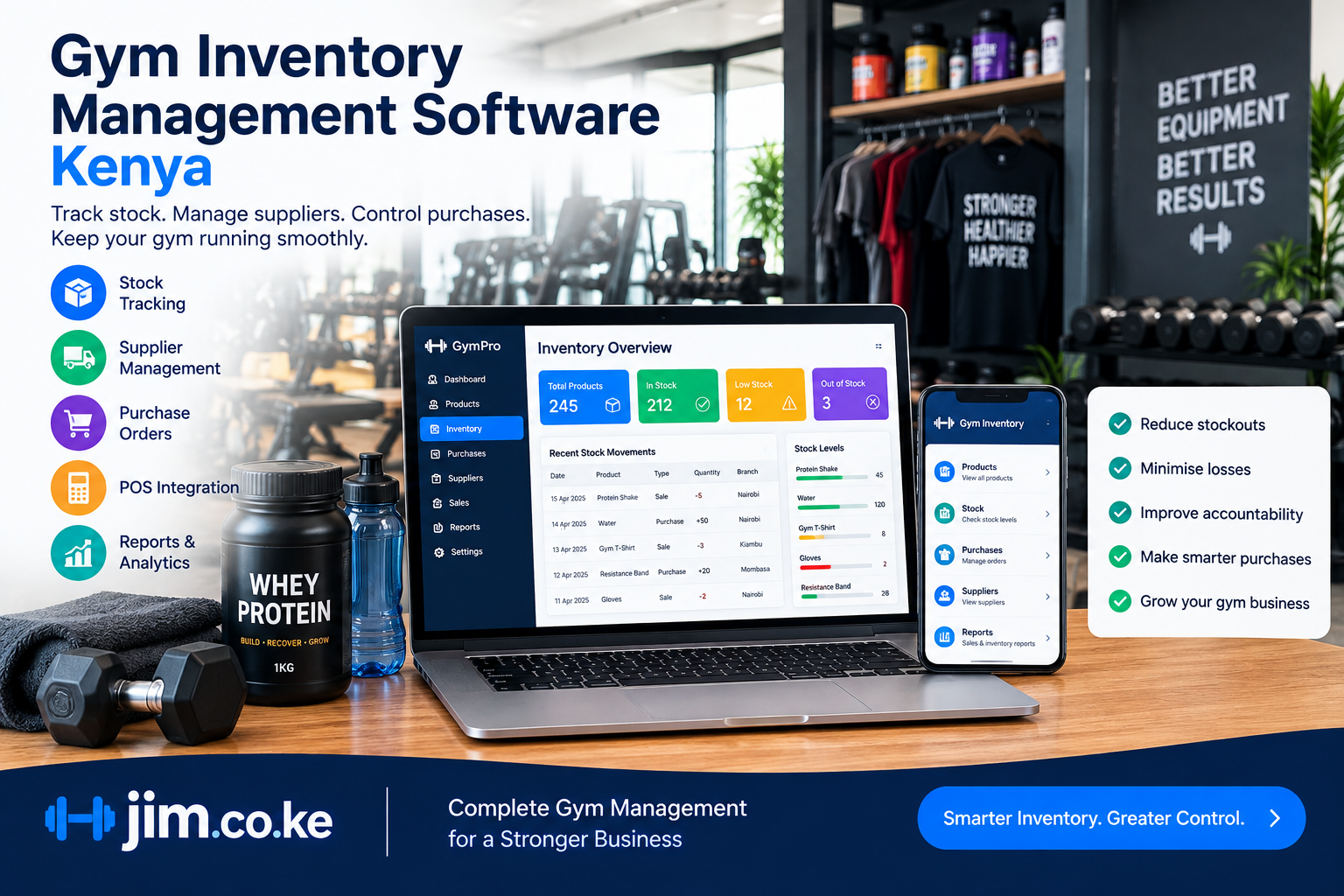
Gym Inventory Management Software Kenya: Complete Guide to Smarter Gym Stock Control
A modern gym manages much more than memberships and workouts. From bottled water and protein products to branded clothing, towels, gloves, cleaning supplies and training accessories, stock can move through the business every day. Gym Inventory Management Software Kenya gives fitness businesses a structured way to monitor products, purchases, suppliers, stock movements and sales without depending entirely on notebooks or scattered spreadsheets.
Inventory becomes especially important as a gym grows. A small fitness centre may begin with a few products stored behind the reception desk. Over time, the business may add supplements, drinks, merchandise, accessories and products across several branches. Without proper controls, it becomes difficult to know what is available, what has been sold, what needs to be reordered and where stock has gone.
This is where Gym Inventory Management Software Kenya becomes relevant. Instead of treating inventory as a separate administrative task, a gym can connect stock records with purchasing, point-of-sale transactions, suppliers, branch operations and financial reporting.
For gym owners, managers, receptionists, procurement staff and accountants, the goal is straightforward: maintain accurate stock records, reduce avoidable losses, make purchasing easier and understand how inventory contributes to the business.
This guide explains how gym inventory management works, the problems caused by manual stock control, the features to look for, how inventory can connect with POS sales, how Kenyan gyms can manage multiple branches, and how to choose software that fits the size and needs of the business.
What Is Gym Inventory Management Software?
Gym Inventory Management Software Kenya refers to a digital system designed to help gyms organise and monitor the products, supplies and stock-related activities used or sold by the business.
A gym inventory system can cover several categories of items.
For example, a fitness centre may manage:
- Bottled water
- Energy drinks
- Protein products
- Supplements
- Gym clothing
- Towels
- Gloves
- Resistance bands
- Yoga mats
- Skipping ropes
- Training accessories
- Cleaning supplies
- Office supplies
- Branded merchandise
Some businesses also need to track equipment separately from consumable products.
Gym equipment may include:
- Treadmills
- Exercise bikes
- Rowing machines
- Weight machines
- Dumbbells
- Barbells
- Benches
- Cable machines
- Exercise mats
A useful system should make it possible to distinguish between products sold to customers and assets or equipment used to operate the gym.
Gym Inventory Management Software Kenya can therefore cover more than simply counting products on shelves. It can become part of the gym’s broader operational system.
The basic inventory cycle is simple:
Purchase → Receive → Store → Sell or Use → Adjust → Reorder → Report
When these activities are recorded consistently, management has a clearer understanding of what is happening to stock.
Why Inventory Management Matters in a Gym
Inventory may not be the largest source of revenue for every fitness business, but poor stock control can still create unnecessary costs.
Imagine a gym selling bottled water, protein shakes, gym shirts and workout accessories. Customers purchase these items throughout the day.
If every sale is recorded manually, staff must remember to update stock. If they forget, the physical quantity and the spreadsheet quantity eventually become different.
Gym Inventory Management Software Kenya can help reduce this gap by connecting sales and inventory records.
Preventing stockouts
A gym should not regularly discover that a popular product has run out only after a customer asks for it.
Low-stock visibility allows staff to identify products that need attention before they completely disappear from the shelf.
Reducing overstocking
Ordering too much stock also creates problems.
Products with limited shelf life can expire. Seasonal merchandise may become difficult to sell. Money can remain tied up in items that are not moving.
A good inventory process helps the business balance availability with actual demand.
Improving accountability
Stock has a financial value.
If ten products are purchased and only seven can be accounted for later, management needs to understand what happened to the other three.
Gym Inventory Management Software Kenya can create a more structured record of stock movements and adjustments.
Making purchasing easier
Purchasing decisions are better when they are based on actual stock information.
Instead of guessing how much to order, staff can review current quantities, previous movement and supplier information.
Problems Caused by Manual Gym Inventory Management
Many gyms start with simple methods.
A receptionist may keep a notebook behind the counter. Another employee may maintain an Excel sheet. Purchase invoices may be stored in a physical folder, while supplier conversations happen through personal phones.
This approach can work temporarily.
The difficulty comes when the number of products and transactions increases.
Gym Inventory Management Software Kenya can replace some of these fragmented processes with a central inventory record.
Manual stock counts
A physical stock count is useful, but manually counting every item can be time-consuming.
Staff may also make mistakes when recording quantities.
Spreadsheet duplication
A gym may have one spreadsheet for purchases and another for sales.
When these records are not connected, staff may struggle to establish the actual stock balance.
Missing purchase records
If a supplier delivers products but the purchase is not recorded immediately, the inventory balance may become inaccurate.
Unclear stock adjustments
Products can be damaged, lost, given as promotional items or used internally.
If adjustments are made without recording a reason, management cannot easily determine why stock changed.
Branch-level confusion
A gym with multiple locations may move products between branches.
Without transfer records, one branch may appear overstocked while another appears short.
Gym Inventory Management Software Kenya can help create clearer stock records for businesses where products move between locations.
Important Features to Look For
The right software depends on the gym’s size and inventory complexity. However, several capabilities are particularly useful.
Product catalogue
A product catalogue should provide a structured record of every item.
Useful information can include:
- Product name
- Category
- Supplier
- Purchase price
- Selling price
- Current quantity
- Reorder level
- SKU or product code
- Branch
- Product status
Gym Inventory Management Software Kenya can be especially useful when staff need to search for products quickly instead of checking several files.
Categories
Categories make large inventories easier to manage.
A gym might create categories such as:
| Category | Examples |
|---|---|
| Drinks | Water, juices, sports drinks |
| Supplements | Protein products, recovery products |
| Apparel | Shirts, shorts, jackets |
| Accessories | Gloves, bands, ropes |
| Equipment | Machines, weights, benches |
| Cleaning | Disinfectant, detergent, tissue |
| Merchandise | Branded products |
The exact categories should reflect what the gym actually sells or uses.
Supplier management
Supplier records help management know where products come from.
A supplier profile may contain:
- Supplier name
- Contact details
- Products supplied
- Purchase history
- Pricing information
- Delivery records
- Payment information
Gym Inventory Management Software Kenya can make supplier information easier to organise alongside purchasing records.
Purchase recording
Every stock purchase should have a clear record.
For example:
Supplier: Nairobi Fitness Supplies
Product: Resistance bands
Quantity: 30
Purchase price: KSh 800 each
Total: KSh 24,000
Date received: 17 September 2026
The exact figures in a real transaction would depend on the supplier agreement.
The important point is that the system should connect the purchase with the resulting stock quantity.
Stock receiving
Purchasing and receiving are related but should not always be treated as exactly the same action.
A purchase order may be created before products arrive.
When the delivery reaches the gym, staff should confirm what was actually received.
If the supplier was expected to deliver 50 units but only 45 arrived, the system should allow staff to record the actual receipt.
Gym Inventory Management Software Kenya can support more reliable stock records when receiving is treated as an important control point.
Tracking Gym Product Sales
Inventory becomes much easier to manage when sales are connected to stock.
Consider a gym that has 100 bottles of water.
If five bottles are sold through the reception desk, the inventory balance should decrease accordingly.
This sounds simple, but manual processes often fail because staff have to update two separate records.
Gym Inventory Management Software Kenya can connect point-of-sale activity with stock records when the software provides an integrated POS workflow.
The benefits include:
- Faster stock updates
- Fewer duplicate entries
- Better sales visibility
- Easier reconciliation
- More accurate product quantities
A gym owner can then see both sides of the transaction:
Revenue generated from the sale
and
Inventory reduced by the sale
That connection is important.
Gym POS and Inventory Management
Point-of-sale functionality is closely related to inventory.
A gym may sell products directly at reception while customers are checking in or leaving after a workout.
A typical transaction could look like:
- Customer selects a product.
- Receptionist searches for the product.
- Product price appears.
- Customer pays.
- Sale is recorded.
- Stock quantity decreases.
- Transaction becomes part of the sales report.
Gym Inventory Management Software Kenya can support this workflow when POS and inventory are integrated.
Jim’s published product information describes a stock-aware POS workflow in which products, categories, suppliers, transactions and branch inventory can remain connected.
That type of integration is useful because a gym should not have to maintain one record for the sale and another record for the stock movement.
M-Pesa and Gym Product Sales
M-Pesa is an important consideration for Kenyan gyms.
A customer may pay for a membership, personal training package or physical product through a mobile-money transaction.
Safaricom’s official documentation describes the M-Pesa Business Till as a way for businesses to receive customer payments and conduct certain business transactions using collected funds.
For inventory, the key question is how the payment record connects with the sale.
Suppose a customer purchases two protein drinks.
The system should ideally make it clear:
- Which products were sold
- Quantity sold
- Price
- Payment status
- Transaction reference
- Customer or member where applicable
- Resulting stock balance
Gym Inventory Management Software Kenya can be evaluated based on how effectively the platform connects these steps.
The goal is not simply to accept payment. It is to maintain a reliable record of the complete transaction.
Low-Stock Alerts
One of the most useful inventory features for a busy gym is a low-stock alert.
Suppose a gym normally keeps 50 bottles of water available and wants to reorder whenever the quantity falls below 15.
A low-stock threshold can help staff identify when action is required.
Gym Inventory Management Software Kenya can support this kind of workflow when the system provides configurable stock thresholds and alerts.
A low-stock alert should lead to a practical action:
Check stock → Review recent sales → Confirm demand → Contact supplier → Place order → Receive stock
The alert itself is not the solution. It is the trigger that helps the team act before a stockout occurs.
Stock Reordering
Reordering should be based on business demand rather than guesswork.
Consider three products:
| Product | Current Stock | Typical Demand | Suggested Action |
|---|---|---|---|
| Bottled water | 8 | High | Reorder soon |
| Gym gloves | 32 | Medium | Monitor |
| Branded hoodies | 60 | Low | Avoid unnecessary purchasing |
The appropriate decision depends on actual sales history, supplier lead times and available storage.
Gym Inventory Management Software Kenya can help managers review product movement before placing new orders.
A gym should also consider supplier reliability.
If a supplier normally delivers in two days, the reorder point may be different from a supplier that takes two weeks.
Managing Suppliers
Supplier management is an important part of inventory control.
A gym may have different suppliers for different product categories.
For example:
- Beverage supplier
- Supplement supplier
- Apparel supplier
- Cleaning supplier
- Equipment supplier
- Printing or branding supplier
Gym Inventory Management Software Kenya can help organise supplier information when purchasing and inventory are connected.
A useful supplier record can help management answer:
- Who supplies this product?
- What price was paid previously?
- When was the last order?
- How much was ordered?
- Which products come from this supplier?
- Are deliveries complete?
This information becomes more valuable as the business grows.
Managing Stock Across Multiple Gym Branches
Multi-branch gyms face a different inventory challenge.
Suppose a business operates gyms in Nairobi, Kiambu and Mombasa.
The business may hold different quantities of the same product at each location.
Gym Inventory Management Software Kenya can be useful when management needs branch-level stock visibility.
For example:
| Branch | Water | Gloves | Shirts |
|---|---|---|---|
| Nairobi | 120 | 35 | 42 |
| Kiambu | 65 | 18 | 20 |
| Mombasa | 90 | 26 | 31 |
The owner can then see where stock is available.
This also helps when one branch runs low while another has excess inventory.
Instead of immediately purchasing new products, management can determine whether an internal stock transfer makes more sense.
Stock Transfers Between Branches
A stock transfer should be recorded properly.
For example:
Nairobi branch sends 20 bottles of water to Kiambu branch.
The Nairobi quantity should decrease.
The Kiambu quantity should increase.
The transaction should identify:
- Sending branch
- Receiving branch
- Product
- Quantity
- Date
- Person responsible
- Reason for transfer
Gym Inventory Management Software Kenya can support clearer accountability when stock movements between locations are recorded instead of handled informally.
This becomes particularly important when multiple employees have access to inventory.
Inventory for Gym Equipment
Not every item in a gym inventory system is intended for sale.
Equipment needs a different type of tracking.
A gym owner may want to know:
- When the equipment was purchased
- Purchase price
- Serial number
- Location
- Current condition
- Maintenance history
- Warranty information
- Assigned branch
- Replacement status
Gym Inventory Management Software Kenya can be considered as part of a wider inventory strategy, but equipment management should be distinguished from ordinary retail stock.
A bottle of water can be sold today.
A treadmill may remain an operational asset for years.
The two require different management approaches.
Equipment Maintenance and Inventory
Equipment availability affects the member experience.
If a treadmill breaks down, staff need to know who is responsible for addressing it.
A gym can maintain records for:
- Equipment inspection
- Maintenance dates
- Repairs
- Replacement parts
- Service providers
- Equipment condition
Gym Inventory Management Software Kenya can contribute to broader operational visibility when equipment and inventory information are part of a connected gym system.
The objective is to prevent important equipment information from being trapped in someone’s notebook or phone.
Stock Adjustments
Inventory numbers do not always change because of sales or purchases.
Other situations include:
- Damaged products
- Expired products
- Promotional giveaways
- Internal consumption
- Lost products
- Incorrect previous entries
- Returned products
- Stock-count corrections
These changes should be recorded as adjustments.
Gym Inventory Management Software Kenya should ideally make adjustments traceable.
A good adjustment record should show:
Product → Previous Quantity → Adjustment → New Quantity → Reason → User → Date
This creates a clearer audit trail.
If ten units disappear from stock, management can investigate the reason instead of simply accepting the new number.
Inventory Valuation
Inventory has financial value.
Suppose a gym holds:
- 100 bottles of water at KSh 50 each
- 30 pairs of gloves at KSh 800 each
- 20 branded shirts at KSh 1,200 each
The total stock value can be estimated from the relevant purchase costs.
Gym Inventory Management Software Kenya can be considered in the broader context of business record management, while a gym-specific platform should provide inventory valuation methods suitable for its operations.
Inventory valuation becomes more important when stock levels are significant.
Management may want to know how much capital is currently tied up in products that have not yet been sold.
Inventory Reporting
Reports help turn stock records into useful management information.
Useful reports can include:
- Current stock
- Low-stock products
- Stock movement
- Product sales
- Purchases
- Supplier activity
- Stock adjustments
- Branch inventory
- Inventory valuation
- Fast-moving products
- Slow-moving products
Gym Inventory Management Software Kenya can help make these reports part of normal management routines.
Fast-moving products
These are products that sell frequently.
For a gym, they may include water, certain supplements or popular accessories.
Slow-moving products
These may remain on shelves for long periods.
Management can use this information when deciding whether to reorder, discount or stop purchasing particular items.
Understanding Fast-Moving and Slow-Moving Stock
Not every product deserves the same purchasing strategy.
A gym might discover that bottled water sells every day while branded jackets sell only occasionally.
The business can then prioritise the products that generate consistent movement.
Gym Inventory Management Software Kenya can help management organise product records and sales information in a central workspace.
The purpose of analysing stock movement is not simply to produce charts. It is to make better purchasing decisions.
If a product rarely sells, ordering large quantities may increase storage costs and tie up cash.
If a product sells quickly, maintaining adequate stock becomes more important.
Inventory and Cash Flow
Inventory decisions affect cash flow.
Every purchase uses money before the product is sold.
Suppose a gym spends KSh 200,000 on merchandise that takes six months to sell. The business has effectively tied that money up in stock during the period.
Gym Inventory Management Software Kenya can help management see stock quantities and movement, making purchasing decisions more informed.
The ideal approach depends on the business.
The gym should have enough stock to serve customers without holding unnecessarily large quantities.
This balance is one of the central goals of inventory management.
Managing Expiry Dates
Some gym products may have expiry dates.
This can apply to:
- Supplements
- Protein products
- Energy drinks
- Certain beverages
- Health-related products
Staff should know what is approaching expiry.
Gym Inventory Management Software Kenya can be evaluated based on whether the platform provides the product-level information needed to manage such stock responsibly.
A useful process is:
- Record expiry information when receiving stock.
- Store products appropriately.
- Review upcoming expiry dates.
- Prioritise older stock where appropriate.
- Avoid selling expired products.
- Record disposal or adjustment when necessary.
Inventory control is therefore also connected to customer safety and business reputation.
Gym Merchandise Management
Many gyms use merchandise to build brand visibility.
Products can include:
- Branded T-shirts
- Hoodies
- Caps
- Water bottles
- Bags
- Towels
- Wristbands
These products can be sold at reception or online, depending on the business.
Gym Inventory Management Software Kenya can help the business keep merchandise quantities connected to sales records.
For example, if the gym receives 50 branded shirts and sells 17, staff should be able to determine that approximately 33 remain, subject to any returns or adjustments.
This is much easier when sales automatically affect inventory.
Inventory and Membership Packages
Some gyms bundle products with memberships.
For example:
Annual membership + branded shirt + water bottle
Or:
Premium membership + ten personal training sessions + gym towel
These bundles create a connection between inventory and membership sales.
Gym Inventory Management Software Kenya can be used as part of the broader discussion of connected business systems, but gym owners should verify that their chosen platform supports the exact bundle workflow they need.
The important principle is to ensure that products included in packages do not disappear from inventory records simply because they were given to a member.
Managing Purchases More Efficiently
Purchasing should be controlled rather than reactive.
A basic purchasing process can look like:
Need identified → Stock checked → Supplier selected → Purchase created → Delivery received → Quantity confirmed → Inventory updated → Supplier record updated
Gym Inventory Management Software Kenya can support this kind of structured workflow when purchasing and inventory are connected.
A purchasing system can also help reduce duplicate orders.
If one employee has already ordered 100 units, another employee should be able to see that order rather than placing a second one accidentally.
Controlling Staff Access to Inventory
Not every staff member should have unlimited control over stock.
A receptionist may need to sell products.
A storekeeper may need to receive stock.
A manager may need to approve adjustments.
An owner may need full visibility.
Gym Inventory Management Software Kenya can be assessed according to how its permissions work.
Useful controls can include:
- Role-based access
- Branch permissions
- Approval workflows
- Activity logs
- User identification
- Restricted adjustments
These controls make it easier to determine who performed a particular inventory action.
Inventory Audits
Even with software, physical stock counts remain useful.
The purpose is to compare:
System quantity
with
Physical quantity
Suppose the system says there are 40 bottles but staff count only 37.
The difference needs to be investigated.
Possible explanations include:
- Unrecorded sales
- Damaged products
- Theft
- Data-entry mistakes
- Incorrect receiving
- Previous counting errors
Gym Inventory Management Software Kenya can make this reconciliation easier by providing a digital record against which physical counts can be compared.
Audits do not have to happen every day.
The frequency can depend on the value and movement of the stock.
Fast-moving products may need more frequent checks than slow-moving items.
How to Implement Inventory Software
Moving to a digital inventory system should be planned.
Step 1: List your products
Create a master list.
Include:
- Product name
- Category
- Supplier
- Cost
- Selling price
- Quantity
- Branch
- Reorder level
Step 2: Count physical stock
Before importing information, conduct a physical count.
This establishes a reliable starting point.
Step 3: Clean existing records
Remove duplicate product names and incorrect quantities.
For example, avoid having:
- “Mineral Water”
- “Water 500ml”
- “500ml Water”
if all three refer to the same product.
Gym Inventory Management Software Kenya can be easier to configure when product records are standardised before implementation.
Step 4: Add suppliers
Record the suppliers responsible for each product.
Step 5: Configure prices
Separate purchase cost from selling price.
Step 6: Train staff
Show employees how to:
- Sell products
- Receive stock
- Check quantities
- Record adjustments
- Search products
- Review transactions
Step 7: Establish stock procedures
Decide who can approve purchases, adjustments and transfers.
Gym Inventory Management Software Kenya becomes more useful when software procedures and internal business procedures support each other.
Gym Inventory Management for Small Gyms
A small gym may assume that inventory software is unnecessary.
If the business sells only a few products, a simple system may appear sufficient.
However, establishing accurate processes early can help prevent problems as the gym grows.
Gym Inventory Management Software Kenya can support small businesses that want to maintain central product and stock records from the beginning.
A small gym might start with:
- 20 products
- One branch
- Two receptionists
- One supplier
- Basic POS sales
As the business grows, it may add:
- More products
- More suppliers
- More branches
- More employees
- More sales channels
The software should ideally grow with the operation.
Inventory Management for Large Fitness Centres
Larger fitness businesses may need more sophisticated controls.
They may manage hundreds of products across several locations.
Requirements can include:
- Multi-branch inventory
- Stock transfers
- Supplier management
- Purchase orders
- POS
- Inventory valuation
- Low-stock alerts
- Detailed reports
- User permissions
- Audit trails
Gym Inventory Management Software Kenya should be evaluated against these requirements if the gym has complex stock operations.
The larger the inventory, the more important consistent processes become.
Gym Inventory Management and Customer Experience
Inventory affects customers directly.
A member who regularly buys a specific protein product expects it to be available.
A customer purchasing a gym shirt expects the correct size to be in stock.
A gym that frequently runs out of popular products can create frustration.
Gym Inventory Management Software Kenya can help improve availability by giving staff better visibility into stock levels.
The goal is not to keep every product permanently available.
Instead, the objective is to understand demand and make sensible purchasing decisions.
Choosing the Right Inventory Software
There are many factors to consider before selecting a platform.
Ease of use
Reception staff should be able to use common functions without extensive technical knowledge.
Product management
The system should support the number and type of products the gym handles.
POS integration
Sales should ideally connect with inventory.
Supplier management
Staff should be able to identify suppliers and purchase history.
Branch support
Multi-location gyms should verify branch-level functionality.
Reporting
Management should be able to review useful stock and sales information.
Gym Inventory Management Software Kenya should be assessed according to the actual needs of the gym rather than simply the number of features advertised.
Questions to Ask a Software Provider
Before adopting a system, ask practical questions.
Can stock levels update automatically after sales?
This can reduce manual data entry.
Can staff record purchases?
Purchasing should be connected to inventory where possible.
Can the system manage multiple suppliers?
This is important for gyms with diverse products.
Can stock move between branches?
Multi-branch businesses should confirm this.
Are low-stock alerts available?
This can help prevent stockouts.
Can staff have different permissions?
Inventory adjustments should not necessarily be available to everyone.
Can inventory reports be exported?
Export capability may be useful for accounting and analysis.
Gym Inventory Management Software Kenya should be tested using real examples before purchase.
Inventory Software and Accounting
Inventory records also have accounting implications.
Purchases represent business expenditure.
Product sales represent revenue.
Stock remaining represents inventory held by the business.
For this reason, inventory information should be reasonably accurate.
Gym Inventory Management Software Kenya can help create more consistent operational records, but gym owners should understand that inventory software does not automatically replace professional accounting controls.
The business may still need appropriate accounting procedures, reconciliation and financial review.
Reducing Inventory Losses
Stock losses can happen for many reasons.
Some are accidental.
Others may result from weak internal controls.
A business can reduce risk by:
- Limiting access
- Recording all sales
- Requiring reasons for adjustments
- Conducting physical counts
- Reviewing unusual stock movements
- Separating purchasing and approval duties where appropriate
- Monitoring high-value products
Gym Inventory Management Software Kenya can support these controls when user activity and stock movements are properly recorded.
The software should make unusual activity easier to investigate.
Using Inventory Data for Business Decisions
Inventory data can answer important questions.
Which products sell most?
Which products rarely sell?
Which supplier provides the best value?
Which branch sells the most merchandise?
Which products frequently run out?
Which items remain in storage for too long?
Gym Inventory Management Software Kenya can make these questions easier to investigate when product, purchase and sales records are connected.
For example, if gym gloves sell quickly every month, management may decide to increase the normal reorder quantity.
If a particular clothing line barely moves, the business may reduce future orders.
Inventory and Seasonal Demand
Demand can change throughout the year.
A gym may sell more fitness-related products around January when many people start new fitness routines.
Demand may also change during holidays, promotions or special events.
Gym Inventory Management Software Kenya can provide the records needed to compare product movement across different periods.
The business can then make purchasing decisions based on observed demand rather than assumptions.
Seasonality does not mean every year will behave exactly the same way, so managers should still consider current circumstances.
Stock Management During Promotions
Promotions can increase product movement quickly.
Suppose a gym offers:
Buy two protein products and receive a discount.
Stock may move much faster than normal.
The inventory system should reflect the actual products leaving the business.
Gym Inventory Management Software Kenya can support better control when promotional sales are connected to stock records.
Before launching a promotion, management should consider whether sufficient stock is available.
Running a promotion on a product that is almost out of stock can create a poor customer experience.
Inventory and Gym Reception
Receptionists often become the first point of contact for product sales.
They may sell:
- Water
- Towels
- Shirts
- Gloves
- Supplements
- Accessories
This means inventory software needs to fit the reception workflow.
Gym Inventory Management Software Kenya should make it easy for authorised front-desk employees to search products, process sales and confirm transactions.
If the process is too complicated, staff may bypass the system.
That is why usability matters as much as functionality.
What a Good Inventory Dashboard Should Show
A useful dashboard should focus on information that requires attention.
For example:
Low-stock products: 7
Products received this week: 18
Sales this week: KSh 84,500
Pending purchases: 4
Top-selling product: Bottled water
Slow-moving products: 9
Gym Inventory Management Software Kenya can be considered within the broader concept of digital operational dashboards, but gym owners should select a platform with metrics relevant to fitness operations.
The dashboard should help management act rather than simply display numbers.
Common Gym Inventory Management Mistakes
Buying based on guesswork
Purchasing should be informed by sales and stock levels.
Ignoring slow-moving products
A product that sells slowly can consume storage space and capital.
Failing to record damaged items
Damaged products should not remain in the system as sellable stock.
Allowing unrestricted adjustments
Stock changes should have accountability.
Keeping branch records separately
This can make consolidated reporting difficult.
Forgetting physical counts
Software records should occasionally be compared with reality.
Gym Inventory Management Software Kenya can help reduce these problems when staff use the system consistently.
Creating a Simple Inventory Policy
Every gym should establish basic rules.
A simple policy might state:
- Every purchased product must be recorded.
- Every sale must be entered through the approved sales process.
- Damaged stock must be reported.
- Stock adjustments require a reason.
- Physical counts occur on a scheduled basis.
- Transfers between branches must be recorded.
- Only authorised staff can approve inventory corrections.
- Purchase records must be retained.
- Supplier deliveries must be checked before acceptance.
- Management reviews inventory reports regularly.
Gym Inventory Management Software Kenya can provide the digital foundation for these procedures when configured around the gym’s actual workflow.
The Role of Training
Technology alone does not solve inventory problems.
Employees need to understand why accurate records matter.
Training should cover both the technical process and the business reason behind it.
For example, staff should understand that failing to record a KSh 300 product sale does not simply create a missing entry. It also creates a difference between the physical stock, system stock and revenue record.
Gym Inventory Management Software Kenya can be introduced more successfully when employees understand the purpose behind each workflow.
Short practical training sessions are often more effective than overwhelming staff with every feature at once.
Measuring the Success of Inventory Software
A gym should define measurable goals.
Possible measures include:
- Reduction in stock discrepancies
- Fewer stockouts
- Faster stock counts
- Faster product sales
- Better purchasing visibility
- Reduced duplicate entries
- Improved supplier records
- More accurate branch reporting
Gym Inventory Management Software Kenya can be evaluated against these measures after implementation.
For example, if physical stock discrepancies previously occurred every week and become rare after implementation, the system and new procedures may be providing useful operational value.
Gym Inventory Management Software and Business Growth
Inventory requirements usually become more complicated as a gym grows.
A small gym may have ten products.
A larger fitness centre could have hundreds.
A single branch may become three branches.
One supplier may become ten.
Gym Inventory Management Software Kenya should therefore be selected with realistic growth in mind.
This does not mean buying the most expensive package from the beginning.
It means checking whether the platform can accommodate the next stage of the business.
How Jim Fits into Gym Inventory Operations
Jim presents itself as a complete gym management system connecting memberships, billing, check-ins, staff, workouts, inventory and reporting. Its published features specifically include product management, categories, suppliers, stock movements, purchases and POS activity.
Gym Inventory Management Software Kenya is therefore particularly relevant to a gym that wants inventory to sit alongside other operational records instead of existing as a completely separate spreadsheet.
Jim also publishes a workflow that includes managing inventory and POS sales as part of daily gym operations.
The practical advantage of a connected system is that the business can consider inventory in the context of its entire member and sales journey.
A Practical Example
Imagine a Nairobi fitness centre called Active Zone Gym.
The gym sells:
- Water
- Protein shakes
- Gloves
- T-shirts
- Towels
- Resistance bands
At first, the receptionist records every sale in a notebook.
At the end of the week, the manager counts the remaining products.
After several months, problems appear.
The notebook says 80 bottles were sold.
The physical count suggests 93.
The manager cannot immediately explain the difference.
The gym introduces a connected inventory workflow.
Gym Inventory Management Software Kenya can help illustrate the value of keeping product and transaction records connected.
Now each product sale reduces the recorded quantity.
Purchases increase stock.
Adjustments require reasons.
Management can review product movement.
When a product falls below the reorder level, staff know it needs attention.
The process becomes more controlled without requiring the manager to manually calculate every stock movement.
Benefits of Centralised Inventory Records
A centralised system provides one place to review stock.
This can help staff:
- Search products quickly
- Check quantities
- Review purchase history
- Identify suppliers
- Track sales
- Monitor branches
- Investigate discrepancies
- Review stock movement
Gym Inventory Management Software Kenya can contribute to this centralised approach when inventory is part of the wider gym management platform.
The benefit becomes even clearer when several employees work with the same inventory.
Everyone works from the same current record rather than maintaining separate copies.
Inventory Management for Kenyan Gym Owners
Kenyan gyms operate in an environment where mobile payments, local suppliers, physical retail sales and membership subscriptions may all exist within the same business.
That makes connected records particularly useful.
Gym Inventory Management Software Kenya can support the discussion around integrating product sales, stock records and broader gym operations.
A gym owner may need to understand both service revenue and product revenue.
For example:
Memberships: KSh 600,000
Personal training: KSh 120,000
Product sales: KSh 85,000
These figures represent different revenue activities.
Inventory software helps management understand the product-sales side of the business.
What to Check During a Software Demo
Do not simply ask a provider to show the dashboard.
Ask for a realistic demonstration.
Scenario one: receiving stock
Ask the provider to demonstrate receiving 50 units from a supplier.
Scenario two: selling a product
Ask them to sell five units through POS.
Scenario three: low stock
Ask what happens when the quantity falls below the reorder threshold.
Scenario four: stock adjustment
Ask how a damaged product is removed from available stock.
Scenario five: branch transfer
Ask how products move from one branch to another.
Gym Inventory Management Software Kenya should be tested using the actual scenarios the gym encounters.
This approach is more informative than simply reading a list of features.
Questions About Data Security
Inventory records are commercially valuable.
The system should have appropriate controls for:
- Staff access
- User accounts
- Permissions
- Data backups
- Activity records
- Account security
Gym Inventory Management Software Kenya should be evaluated alongside the gym’s broader data-security procedures.
Staff should also understand that account credentials should not be shared.
If several employees use one login, it becomes much harder to determine who performed a particular stock adjustment or sale.
The Future of Gym Inventory Management
Gym businesses are increasingly becoming more connected.
Memberships, payments, attendance, POS, inventory and customer information can work together rather than existing as separate administrative islands.
Gym Inventory Management Software Kenya represents this broader shift toward connected gym operations.
For a business owner, the benefit is visibility.
Instead of asking several employees for separate reports, management can work from centralised operational information.
This can make everyday decisions faster.
Final Checklist
Before choosing inventory software, a gym owner should confirm:
- Product catalogue
- Categories
- Supplier management
- Purchase recording
- Stock receiving
- Stock adjustments
- Low-stock alerts
- POS integration
- Product sales tracking
- Inventory reports
- Branch management
- Stock transfers
- User permissions
- Audit records
- Inventory valuation
- Equipment records where required
- Data export
- Staff training
- Customer support
Gym Inventory Management Software Kenya should satisfy the requirements that are actually important to the gym rather than simply offering a long feature list.
Frequently Asked Questions
What is Gym Inventory Management Software Kenya?
Gym Inventory Management Software Kenya is software designed to help fitness businesses manage products, stock quantities, suppliers, purchases, sales, stock movements and inventory reports from a more organised digital system.
Why does a gym need inventory management software?
Gyms often sell products such as water, supplements, clothing and accessories while also managing operational supplies and equipment. Software can help centralise these records, reduce manual work and improve stock visibility.
Can inventory software track gym merchandise?
Yes. A gym can use inventory software to track products such as T-shirts, hoodies, caps, towels, bags and other branded merchandise, provided the selected system supports these product categories.
Gym Inventory Management Software Kenya can be useful for organising these products alongside other stock records.
Can gym inventory software connect with POS?
Yes, some gym management platforms connect POS transactions with inventory. This allows product sales to reduce available stock and creates a clearer link between sales and inventory.
Gym Inventory Management Software Kenya should be tested to confirm exactly how POS and stock are connected.
Can inventory software manage multiple gym branches?
Yes, platforms with multi-branch functionality can maintain branch-level stock information and may support transfers between locations. The exact functionality depends on the provider.
Gym Inventory Management Software Kenya can be evaluated by multi-location gyms that need central oversight.
Can gyms track suppliers?
Supplier management is a common inventory requirement. A gym can maintain supplier records, products supplied, purchase history and other procurement information where the software supports supplier management.
Gym Inventory Management Software Kenya should be assessed according to how detailed the supplier workflow needs to be.
Can inventory software show low-stock products?
Many inventory systems provide low-stock levels or alerts. The gym can set thresholds for products that need to be reordered.
Gym Inventory Management Software Kenya can help businesses think about inventory around proactive replenishment rather than waiting for products to run out.
Can gym software track equipment?
Some gym platforms provide equipment or asset-related functionality. However, equipment tracking differs from ordinary product inventory because machines may require maintenance, service records and condition tracking.
Gym Inventory Management Software Kenya should be assessed according to whether the gym needs simple equipment records or detailed asset management.
How often should gym stock be counted?
There is no single frequency that suits every gym. Fast-moving or high-value products may require more frequent physical checks, while slow-moving products may be reviewed less often. The business should establish a consistent stock-counting policy.
Gym Inventory Management Software Kenya can make comparisons between physical counts and system records easier when stock movement is recorded consistently.
Can inventory management improve gym profitability?
Inventory management can help reduce avoidable stock losses, identify slow-moving products, prevent unnecessary overstocking and improve product availability. However, profitability also depends on pricing, demand, purchasing costs, sales volume and broader business performance.
Gym Inventory Management Software Kenya should therefore be viewed as an operational tool rather than a guarantee of financial results.
Conclusion
Inventory is an important part of running a modern gym.
Products sold at reception, merchandise, supplements, drinks, accessories, cleaning supplies and equipment all require some level of control. As the gym grows, informal methods can become increasingly difficult to manage.
Gym Inventory Management Software Kenya can provide a more structured approach by bringing products, purchases, suppliers, sales and stock movements into a central workflow.
The biggest benefit is visibility.
A manager should be able to determine what is in stock, what has been sold, what has been purchased, what needs to be reordered and where stock is located.
Gym Inventory Management Software Kenya becomes particularly valuable when the gym has multiple employees or branches and needs consistent inventory records.
POS integration is another important consideration. When a product is sold, the inventory record should reflect that movement. This reduces the need for employees to enter the same information into several systems.
Gym Inventory Management Software Kenya can fit into this type of connected gym workflow because Jim’s published platform information includes inventory, suppliers, stock movements, purchases and POS functionality alongside memberships, billing, check-ins and reporting.
For Kenyan gyms, payment workflows also matter. Product purchases may be paid through M-Pesa or other payment channels, so the business should understand how sales and payment records connect.
Gym Inventory Management Software Kenya should be evaluated through real payment and stock scenarios rather than a generic software demonstration.
A gym should also think carefully about suppliers.
Good supplier records can make purchasing more organised and help management understand which products are coming from which sources.
Gym Inventory Management Software Kenya can support this type of structured approach when supplier and purchase information is connected to stock records.
Multi-branch businesses have another consideration: stock transfers.
When products move from Nairobi to another branch, the movement should be recorded so that both locations show accurate quantities.
Gym Inventory Management Software Kenya can be evaluated according to the branch controls required by the business.
Stock adjustments also deserve attention.
Damaged, expired, lost or internally used products should not simply disappear from the records.
Gym Inventory Management Software Kenya should make it possible for authorised employees to document why stock quantities changed.
This improves accountability and makes later investigations easier.
The same principle applies to equipment.
A treadmill, weight machine or exercise bike is different from a bottle of water. Equipment may require service records, maintenance schedules and condition tracking.
Gym Inventory Management Software Kenya can be part of the broader discussion about structured asset records, while gym owners should verify that their selected platform provides the equipment functionality they actually need.
The implementation process also matters.
A gym should first clean its product records, count physical stock, configure suppliers, set prices and train employees.
Gym Inventory Management Software Kenya becomes more useful when the information entered into the system is accurate from the beginning.
Employees should also understand the reason behind the new process.
If staff continue recording sales in notebooks after the software has been introduced, the business will still have the same reconciliation problems.
Gym Inventory Management Software Kenya should become part of the normal daily workflow rather than an optional extra record.
For reception staff, the system should make product sales quick.
For managers, it should make stock information easy to understand.
For owners, it should provide visibility into the value and movement of inventory.
Gym Inventory Management Software Kenya can support those different needs when the platform provides appropriate roles and reporting.
The best inventory system is therefore not necessarily the one with the longest feature list.
It is the one that matches the actual size, products, suppliers, branches, staff and operational processes of the gym.
Gym Inventory Management Software Kenya should be selected based on practical requirements rather than software complexity alone.
Before making a final decision, gym owners should request a demonstration and test real scenarios.
Ask the provider to receive stock, sell products, adjust quantities, review low-stock items and transfer products between branches.
Gym Inventory Management Software Kenya should perform these everyday tasks clearly and efficiently.
Also check reporting.
A good inventory report should help management answer questions rather than simply display numbers.
Which products sell quickly?
Which ones are slow?
What needs reordering?
Which branch has the most stock?
What was purchased this month?
Gym Inventory Management Software Kenya should help turn these questions into practical management information.
For Kenyan gyms that are still relying heavily on spreadsheets, notebooks and disconnected records, inventory software can provide a more organised foundation.
Gym Inventory Management Software Kenya can help move the business toward centralised stock records and better operational visibility.
The transition does not have to be complicated.
Start with the products that matter most.
Create clean product records.
Count the existing stock.
Add suppliers.
Train staff.
Connect sales.
Review reports.
Gym Inventory Management Software Kenya becomes increasingly useful as these processes become part of everyday operations.
Over time, the gym can use its inventory information to make better purchasing decisions and understand which products actually contribute to business performance.
Gym Inventory Management Software Kenya can help provide the records needed for this type of analysis.
Ultimately, effective inventory management is about control and visibility.
A gym should know what it owns, what it has purchased, what it has sold, what has moved between branches and what requires attention.
Gym Inventory Management Software Kenya provides a useful framework for thinking about how these activities can be connected.
When inventory, POS, purchasing and reporting work together, staff spend less time searching through separate records.
Gym Inventory Management Software Kenya can support a more consistent approach to daily stock management when the system is configured around the gym’s workflow.
For businesses with multiple locations, centralised visibility becomes even more valuable.
Gym Inventory Management Software Kenya can help frame the importance of branch-level stock information and controlled transfers.
For a gym owner, the ultimate objective is not simply to have software.
The objective is to have accurate information that supports better decisions.
Gym Inventory Management Software Kenya can contribute to that objective by organising inventory information in a way that is easier for staff and management to use.
With proper procedures, regular stock counts, appropriate permissions and reliable sales records, a gym can create a much stronger inventory-control process.
Gym Inventory Management Software Kenya should form part of that process rather than operating separately from the rest of the business.
A connected platform can also make future growth easier to manage.
As products, staff and branches increase, the business can continue using structured records rather than creating another spreadsheet every time operations become more complicated.
Gym Inventory Management Software Kenya can therefore be evaluated not only for today’s requirements but also for the gym’s realistic future needs.
For smaller gyms, the priority may be simple product management and POS.
For larger fitness centres, supplier management, stock transfers, reporting and multi-branch controls may be more important.
Gym Inventory Management Software Kenya should match the operational scale of the business.
The right implementation can also improve the customer experience.
When a customer asks whether a product is available, reception staff should be able to check quickly.
When a popular product is running low, management should know.
When a branch needs stock, the business should know where additional units are available.
Gym Inventory Management Software Kenya can be considered within the broader concept of connected business operations, while fitness businesses should prioritise a platform built around their actual gym workflows.
A reliable inventory process also gives management greater confidence in financial information.
Product sales, purchases and remaining stock can be reviewed together rather than as isolated figures.
Gym Inventory Management Software Kenya can support this type of connected operational record when inventory and sales are managed within the same system.
For Jim.co.ke, inventory is positioned as one component of a broader gym management workspace that includes memberships, billing, check-ins, staff, workouts and business reporting.
That broader approach matters because inventory rarely exists on its own.
The same employee who sells a product may also check in a member.
The same manager who reviews product sales may also review membership revenue.
The same business may use one payment workflow for memberships and another for merchandise.
Gym Inventory Management Software Kenya can therefore be evaluated as part of the gym’s complete operational workflow rather than as a standalone stock-counting tool.
The final step is to identify what your gym actually needs.
List your products.
Review your current suppliers.
Count your stock.
Identify the most common problems.
Check how products are sold.
Review how branches move stock.
Then test software against those real requirements.
Gym Inventory Management Software Kenya should make those processes more organised, easier to monitor and less dependent on manual records.
For Kenyan gym owners planning to modernise their operations, inventory management is a practical place to start.
Better stock visibility can support purchasing, sales, customer service and financial reporting.
Gym Inventory Management Software Kenya can be part of that transition when the platform’s capabilities match the business’s needs.
The strongest results come from combining appropriate software with clear procedures, trained employees and regular management review.
Gym Inventory Management Software Kenya should support those practices rather than replace them.
When every purchase, sale, adjustment and transfer has a clear record, the gym has a stronger foundation for controlling stock.
Gym Inventory Management Software Kenya can help bring that information into a centralised operational workflow.
And as the fitness business grows, the value of accurate inventory information becomes increasingly important.
Gym Inventory Management Software Kenya can help illustrate the wider principle of replacing fragmented business records with structured digital processes.
For a gym owner, the goal is ultimately simple: know what you have, know what you sold, know what you need and know where your stock is.
Gym Inventory Management Software Kenya provides a focused framework for achieving that level of inventory visibility.
With the right system, stock management can move from a manual administrative burden to a practical part of everyday gym operations.
Gym Inventory Management Software Kenya can help businesses build that more organised approach while keeping inventory connected to the wider needs of the fitness business.
That is what makes modern gym inventory management valuable: not simply counting products, but giving the business reliable information to operate, plan and grow.