
Gym Billing Software Kenya: A Complete Guide to Smarter Gym Billing, Payments and Membership Management
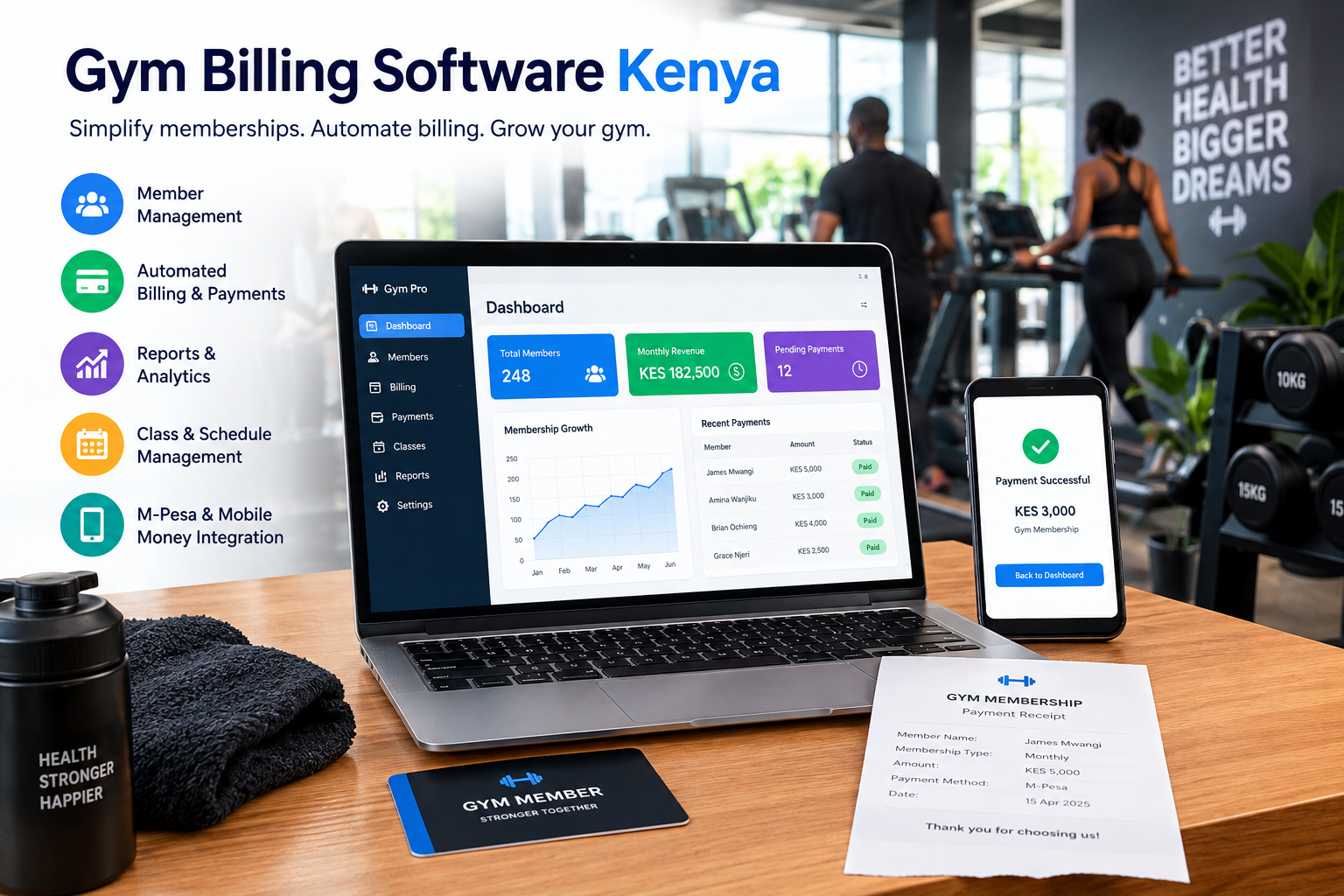
Gym Billing Software Kenya: A Complete Guide to Smarter Gym Billing, Payments and Membership Management
Running a gym involves much more than providing equipment and training space. A fitness business has to register members, create membership plans, collect payments, issue invoices, monitor renewals, follow up on unpaid accounts and understand daily revenue. Gym Billing Software Kenya brings these activities into a more organised digital workflow. For gym owners, managers, receptionists and accountants, the goal is simple: make billing accurate, payments easier to track and membership administration less dependent on spreadsheets and paper records.
A growing fitness centre can process dozens or hundreds of membership transactions in a month. When billing information is spread across notebooks, Excel files, mobile-money messages and separate receipt books, small mistakes can quickly become difficult to identify. Gym Billing Software Kenya gives a gym a structured way to connect member accounts, invoices, payments, subscriptions and financial information.
This guide explains how modern gym billing works, why billing accuracy matters, which features Kenyan gyms should consider, how M-Pesa can fit into the payment process, how recurring billing can support renewals, and what gym owners should examine before choosing a software platform. Gym Billing Software Kenya can be particularly useful when a gym wants to move from manually maintained payment records to a connected system.
What Is Gym Billing Software?
Gym billing software is a digital system designed to manage the financial side of a fitness business. Instead of recording each payment separately in a notebook or spreadsheet, the gym can maintain member accounts, membership plans, invoices, balances and payment records within one system.
The exact capabilities differ between software products, but a useful billing platform normally connects several parts of the member journey.
For example:
- A prospective member becomes a registered customer.
- The customer is assigned a membership plan.
- The system records the plan price and validity period.
- An invoice is created.
- The customer makes a payment.
- The payment is recorded against the correct account.
- The membership status is updated.
- The system can identify the next renewal date.
- Management can review the transaction in reports.
This connected approach is important because billing does not happen in isolation. It affects membership access, customer communication, revenue reporting and daily front-desk operations. Gym Billing Software Kenya helps illustrate the broader concept of connecting financial activity with customer records rather than treating every payment as an independent entry.
For a Kenyan gym, the system should also accommodate local business realities. Membership fees may be paid through M-Pesa, bank transfers, cards or cash. Customers may purchase monthly, quarterly, half-yearly or annual packages. Some gyms may offer discounts, promotional packages, personal training sessions or additional products.
The billing system therefore needs enough flexibility to represent how the gym actually sells its services.
Why Gym Billing Matters to Kenyan Fitness Businesses
Billing is one of the most sensitive operational areas in a gym. If the system shows that a member has paid when they have not, the business may provide services without collecting the expected revenue. If a genuine payment is not recorded, the customer may be incorrectly treated as owing money.
Gym Billing Software Kenya can help create a single source of billing information, making it easier for authorised staff to understand what has been charged, what has been paid and what remains outstanding.
1. Reducing manual payment records
Manual records can work for a very small gym with only a few members. The problem appears when the volume of transactions increases.
A receptionist may record a payment in a notebook while another employee updates an Excel file later. Meanwhile, the customer has a mobile-money confirmation on their phone. These three records can eventually disagree.
A central billing system reduces the number of places where staff need to enter the same information.
2. Making outstanding balances easier to identify
A gym owner needs to know which accounts have unpaid balances. Searching through individual messages or notebooks is inefficient.
Gym Billing Software Kenya can provide structured customer account information so staff can distinguish between paid, partially paid and unpaid invoices.
This is especially useful when the gym has many members with different renewal dates.
3. Improving renewal follow-up
Membership renewals are a major part of recurring gym revenue. A customer whose membership expires may simply forget to renew, even if they are satisfied with the gym.
A billing platform can make upcoming expiries easier to identify. The gym can then contact customers before or around their renewal date.
4. Supporting better financial visibility
Owners should not have to wait until the end of the month to discover how much was collected.
Gym Billing Software Kenya can bring billing activity into reports that help management understand current collections, outstanding balances and membership-related revenue.
The usefulness of a report depends on the quality of the underlying records. Accurate billing entries therefore matter as much as the dashboard itself.
Common Problems with Manual Gym Billing
Before selecting software, it helps to understand what the business is trying to improve.
Spreadsheets become difficult to control
Excel and similar spreadsheet applications are useful tools, but they were not specifically designed to manage the complete lifecycle of gym memberships.
A spreadsheet may contain names, phone numbers, package prices and expiry dates. As the business grows, however, staff may create multiple versions or accidentally overwrite information.
Gym Billing Software Kenya provides a more purpose-built environment for connecting member accounts and financial transactions.
Payment confirmations remain scattered
Kenyan businesses commonly receive payments through mobile-money channels. A member may send a screenshot of a transaction confirmation to the receptionist, while the actual transaction is also visible through the business payment channel.
If staff manually copy every transaction into another record, reconciliation becomes another administrative task.
Renewals depend on memory
A receptionist may remember that a particular customer normally renews at the beginning of the month. But relying on individual memory becomes risky when staff change or the membership base grows.
A system can instead provide a searchable record of membership dates.
Receipts can be difficult to trace
If a customer disputes a payment, staff need to find the relevant transaction. With paper receipts, the search may require checking receipt books. With scattered digital messages, staff may need to search multiple phones.
Gym Billing Software Kenya can help place payment records closer to the member account they belong to.
Reports require manual preparation
An owner may want to know:
- How much was billed this month?
- How much was collected?
- How much remains outstanding?
- Which memberships are expiring?
- Which payment methods are being used?
- Which branch generated particular revenue?
- How many customers renewed?
If staff have to calculate these figures manually, reporting consumes time that could be spent on operations.
Essential Features to Look For
Not every gym needs the same configuration. However, several billing capabilities are particularly useful.
1. Member account management
Billing should connect to a member rather than existing as an isolated transaction.
A member profile can contain information such as:
- Full name
- Phone number
- Membership plan
- Start date
- Expiry date
- Invoice history
- Payment history
- Outstanding balance
- Attendance information
Gym Billing Software Kenya becomes more useful when the financial record and customer record are connected.
2. Membership plan management
A gym may offer several packages.
For example:
| Membership Type | Typical Billing Pattern |
|---|---|
| Daily pass | Per visit |
| Weekly package | Weekly |
| Monthly membership | Monthly |
| Quarterly membership | Every three months |
| Six-month package | Twice yearly |
| Annual membership | Once per year |
| Personal training | Session-based |
| Corporate package | Contract-based |
The software should allow the business to configure the plans it actually sells rather than forcing every customer into the same billing structure.
3. Invoice generation
Invoices provide a clear record of what a customer is expected to pay.
A good invoice workflow should make it clear:
- Who is being billed
- What service is being billed
- Amount due
- Payment status
- Invoice date
- Due date
- Relevant membership period
Gym Billing Software Kenya can help standardise this process so billing does not depend entirely on manually prepared documents.
4. Payment tracking
The system should distinguish between an invoice and a payment.
For example, if a monthly membership costs KSh 3,000 and a member pays KSh 2,000, the account should not simply be marked fully paid. The remaining KSh 1,000 should remain visible.
This becomes especially important where gyms permit instalments or partial payments.
5. M-Pesa integration
M-Pesa is a major consideration for Kenyan businesses. Safaricom’s official documentation describes M-Pesa Business Till functionality for receiving customer payments and accessing transaction statements and related business functions.
Gym Billing Software Kenya can be valuable when a gym wants its payment workflow to connect more closely with member billing.
The important question is not simply whether software says it “supports M-Pesa.” Gym owners should ask how the integration actually works.
Questions worth asking include:
- Can a customer initiate a payment request?
- Is STK Push available?
- How is the payment matched to the member?
- What happens if the customer uses another phone number?
- Is payment confirmation automatic?
- Can staff manually correct a transaction?
- How are failed transactions handled?
- Can payment records be reconciled?
Jim states that its configured ZivoPay integration supports M-Pesa STK Push and payment confirmation within its billing workflow.
6. Recurring billing
Gyms often depend on repeat memberships. A billing system should therefore make recurring charges and renewal periods easier to manage.
Gym Billing Software Kenya can help a business organise recurring membership information without requiring staff to rebuild every customer record each month.
Recurring billing does not necessarily mean every customer must be charged automatically. The business should choose a workflow that fits its agreements, payment methods and customer preferences.
7. Payment reminders
A customer may be willing to renew but simply forget.
Payment reminders can be used for:
- Upcoming membership expiry
- Unpaid invoices
- Partial balances
- Failed payments
- Renewal notices
The wording and timing of messages matter. Too many reminders can irritate customers, while poorly timed reminders may arrive after the membership has already expired.
8. Financial reports
Reports should answer practical management questions.
Useful billing reports may include:
- Daily collections
- Monthly revenue
- Outstanding balances
- Paid invoices
- Unpaid invoices
- Membership sales
- Renewal activity
- Payment method summaries
- Branch-level billing
- Revenue by package
Gym Billing Software Kenya can make this information easier to organise when the underlying transactions are recorded consistently.
How M-Pesa Billing Can Work in a Gym
A common Kenyan gym payment workflow might look like this:
Member selects plan → invoice is created → payment request is initiated → customer completes M-Pesa payment → payment is confirmed → account is updated → membership access is activated or extended.
The exact process depends on the software and payment integration.
Gym Billing Software Kenya should therefore be evaluated by demonstrating the complete payment journey instead of simply looking at a feature checklist.
Consider a customer called Brian who wants a three-month membership.
The receptionist selects Brian’s account and chooses the appropriate membership plan. The system creates the charge. Brian receives the payment request, completes the transaction and the system receives confirmation.
The receptionist should then be able to see the payment against Brian’s account.
That is much clearer than having one employee receive a screenshot, another write the amount in a notebook and a third update a spreadsheet later.
Billing and Gym Membership Renewals
Renewals deserve special attention because they directly affect recurring revenue.
A gym can have excellent facilities and trainers, but if the team does not follow up on expiring memberships consistently, potential renewals can be missed.
Gym Billing Software Kenya can help the team identify members whose subscriptions are approaching their end dates.
A useful renewal workflow may include:
- Identify memberships nearing expiry.
- Send a reminder.
- Give the customer renewal options.
- Generate or confirm the relevant invoice.
- Record payment.
- Extend the membership.
- Update the customer’s status.
- Continue normal attendance tracking.
The process should be easy enough for front-desk staff to perform without extensive accounting knowledge.
Handling expired memberships
A clear billing system should help staff distinguish between active and expired accounts.
This can also support access management. If a gym uses check-in controls, staff should be able to verify whether the customer’s membership is active before admitting them.
Jim’s published product information states that check-ins can validate active subscriptions and record visits.
Gym Billing Software Kenya becomes more valuable when billing, membership and access records are connected rather than maintained as separate lists.
Gym Billing Software Versus Excel
Excel can still be useful for analysis and one-off tasks. The question is whether it should be the central system for a growing gym.
| Area | Spreadsheet-Based Process | Dedicated Billing System |
|---|---|---|
| Member records | Manually maintained | Centralised |
| Invoices | Often created separately | Connected to accounts |
| Payments | Manually entered | Recorded within workflow |
| Renewals | Often tracked with dates | Membership status can be connected |
| Staff permissions | Limited | Role-based access may be available |
| Reporting | Often manual | Built-in reporting |
| Multi-branch operations | More complex | Can be branch-aware |
| Auditability | Depends on spreadsheet controls | Activity can be more structured |
Gym Billing Software Kenya does not make spreadsheets obsolete for every business. Instead, dedicated software becomes useful when the gym’s operations have reached a level where manual administration is slowing the team down.
How Billing Affects the Customer Experience
Billing is not only an accounting function. It also affects how customers experience the gym.
Imagine two scenarios.
In the first, a member arrives at reception and the employee cannot immediately determine whether the latest payment was received. The customer is asked to search for an M-Pesa message. The employee then calls another colleague to confirm the transaction.
In the second, the receptionist searches the member profile and sees the invoice and payment status immediately.
The second experience is simpler.
Gym Billing Software Kenya can contribute to a smoother customer experience when billing information is accessible to authorised staff.
Clear payment records build confidence
Customers are more comfortable when they receive clear information about what they paid and what their membership covers.
A professional billing workflow can reduce disputes caused by unclear records.
Faster service at reception
Receptionists often handle several responsibilities at once. They may answer calls, register new members, check attendance, process payments and respond to customer questions.
Reducing unnecessary billing searches gives them more time to serve customers.
Managing Discounts and Promotions
Many gyms use promotions to attract new members.
Examples include:
- New-member discounts
- January fitness campaigns
- Student packages
- Corporate rates
- Referral discounts
- Annual membership promotions
- Family packages
- Personal training bundles
Gym Billing Software Kenya should be able to represent discounts clearly without destroying the original price history.
For example, if a package normally costs KSh 5,000 but a promotion reduces it to KSh 4,000, the billing record should make the discount understandable.
This helps management determine whether a promotion is actually producing useful business results.
Managing Partial Payments
Partial payments are another area where manual systems can create confusion.
Suppose a member owes KSh 6,000 and pays KSh 3,500.
The account should show:
- Original amount: KSh 6,000
- Amount paid: KSh 3,500
- Balance: KSh 2,500
Gym Billing Software Kenya can help keep these values connected so staff do not have to calculate the remaining amount every time the member visits.
This is also helpful when several staff members handle the same account.
Staff Roles and Billing Security
Billing information should not necessarily be accessible to every employee.
A receptionist may need to:
- Create member accounts
- View payment status
- Record approved transactions
- Issue receipts
A manager may need:
- Revenue reports
- Staff activity
- Discounts
- Package configuration
- Branch-level performance
An owner may need broader financial visibility.
Gym Billing Software Kenya can support a role-based approach when the platform provides appropriate user permissions.
Jim’s current product information describes owner, admin and staff roles, together with branch permissions and audit logs.
The principle is straightforward: staff should have enough access to do their jobs, but sensitive financial and administrative controls should be restricted appropriately.
Multi-Branch Gym Billing
A gym with two or more branches has additional billing requirements.
A central system should make it possible to understand which branch is responsible for a customer, transaction or operational activity.
Gym Billing Software Kenya can be considered as part of a broader discussion about connected business records, but gym owners should specifically verify that their chosen fitness platform supports branch-aware billing.
For example, a business with locations in Nairobi, Kiambu and Mombasa may want to review:
- Revenue by branch
- Active members by branch
- Expiring memberships
- Outstanding balances
- Staff access
- Inventory
- Check-ins
- Membership sales
Jim states that its multi-branch functionality supports branch-aware staff, members, attendance, inventory and consolidated reporting.
Inventory and Billing in a Gym
Billing may extend beyond membership fees.
A gym can also sell:
- Protein products
- Bottled water
- Gym clothing
- Gloves
- Towels
- Supplements
- Branded merchandise
- Training accessories
Gym Billing Software Kenya can become more useful when membership billing and point-of-sale activity can be managed within the same operational environment.
This gives the owner a broader view of revenue rather than separating membership income from product sales unnecessarily.
Jim’s listed platform features include inventory, suppliers, stock movements, purchases and POS activity.
Gym Billing Reports That Managers Should Monitor
A dashboard is only useful if it helps management answer real questions.
Daily collections
This shows how much was collected during a particular day.
Outstanding balances
This identifies invoices or customer accounts that still require payment.
Expiring memberships
This helps staff plan renewal communication.
Membership revenue
This helps management understand how much money is coming from membership packages.
Payment method activity
This can show how much business is coming through different payment channels.
Branch performance
For multi-location businesses, branch-level information helps management understand operational differences.
Gym Billing Software Kenya should ultimately make these questions easier to answer than a collection of disconnected records.
Choosing the Right Billing System for a Kenyan Gym
Choosing software should involve more than comparing feature lists.
Start with your current workflow
Write down how billing works today.
For example:
- Customer selects membership.
- Receptionist records details.
- Customer pays.
- Payment is confirmed.
- Receipt is issued.
- Membership date is extended.
- Customer is admitted.
- Payment appears in monthly records.
Then identify where delays and mistakes occur.
Gym Billing Software Kenya should be tested against the real workflow rather than an imaginary one.
Ask for a live demonstration
A demonstration should use realistic examples.
Ask the provider to show:
- New member registration
- Invoice creation
- Payment
- M-Pesa workflow
- Partial payment
- Membership renewal
- Refund or correction
- Reporting
- Staff permissions
- Branch management
Check payment integration carefully
Do not accept a simple “yes, we support M-Pesa” answer.
Ask whether the integration is direct, semi-automated or manual.
Gym Billing Software Kenya should fit the actual payment habits of your customers.
Consider ease of use
A system can have many features and still be difficult for reception staff.
The front desk should be able to perform common actions quickly.
If a receptionist needs several screens to confirm a simple membership payment, adoption may suffer.
Pricing Considerations
Software pricing varies by provider and package.
Some platforms charge monthly subscriptions. Others may price according to users, branches, members or features.
Jim currently publishes a Starter package beginning at KSh 1,500 per month and a Growth package at KSh 6,500 per month, with a custom package also available. These prices are provider-published and should be checked directly before making a purchasing decision.
Gym Billing Software Kenya should be evaluated based on total value rather than subscription price alone.
Consider:
- Number of members supported
- Number of staff
- Branch limits
- Payment integrations
- Reporting
- Support
- Data migration
- POS functionality
- Attendance
- Membership management
- Automation
A cheaper system that requires substantial manual work may not provide the same operational value as a system that connects several processes.
Implementation Tips for a New Gym Billing System
Moving from manual records to software should be planned carefully.
Clean the member database first
Remove duplicate records and correct incomplete information.
At minimum, check:
- Names
- Phone numbers
- Membership plans
- Start dates
- Expiry dates
- Balances
- Payment history where available
Jim provides a CSV member-import workflow with validation, according to its published product information.
Gym Billing Software Kenya can be part of a broader digital transformation discussion, but the gym should ensure that its chosen system can import the specific records it needs.
Train reception staff
Employees should know how to:
- Register members
- Find accounts
- Create invoices
- Check balances
- Confirm payments
- Renew memberships
- Correct mistakes
- Escalate unusual transactions
Define financial responsibilities
Decide who can approve:
- Discounts
- Refunds
- Invoice adjustments
- Payment corrections
- Package changes
Gym Billing Software Kenya works best as part of a clearly defined internal process rather than as a replacement for management controls.
Data Security and Access Control
Billing systems contain commercially important information.
The gym should consider:
- User permissions
- Password practices
- Backup procedures
- Account recovery
- Staff access
- Data exports
- Audit records
- Device security
A former employee should not retain access to billing information after leaving the organisation.
Similarly, a temporary receptionist may not need access to sensitive management reports.
Gym Billing Software Kenya should therefore be assessed not only on billing features but also on how it controls access to business records.
How Billing Automation Can Save Staff Time
Automation is valuable when it removes repetitive administrative tasks.
Consider a gym with 300 active members.
If staff manually check every membership expiry date, prepare reminders and update payment records, administrative work can consume significant time.
A connected system can centralise these tasks.
Gym Billing Software Kenya can help reduce repeated data entry when billing, membership and payment information are connected.
Automation should not mean removing human oversight. Instead, it should allow staff to spend more time on tasks that require judgement and customer interaction.
A Practical Example: Monthly Gym Billing
Consider a fictional fitness centre in Nairobi called Peak Fitness.
Peak Fitness offers monthly, quarterly and annual memberships.
Previously, the gym used:
- A notebook for registrations
- Excel for membership expiry dates
- M-Pesa messages for payment confirmation
- Paper receipts
- A separate spreadsheet for monthly revenue
The owner had difficulty answering basic questions.
How much was collected last week?
Which members had expired?
Which customers still owed money?
How much revenue came from annual memberships?
The gym introduces a connected billing system.
Gym Billing Software Kenya allows the staff to associate invoices and payments with individual member accounts.
Now the process becomes:
Registration → Membership selection → Invoice → Payment → Confirmation → Membership activation → Renewal tracking → Reporting
At the end of the month, management can review the recorded transactions instead of reconstructing them from multiple sources.
The technology does not eliminate the need for accounting controls, but it creates a more organised operational foundation.
Measuring the Value of Billing Software
A gym should decide what improvements it expects before implementing software.
Possible measures include:
- Time spent processing payments
- Number of billing errors
- Unresolved payment disputes
- Outstanding balances
- Renewal follow-up rate
- Time required to prepare reports
- Number of duplicate member records
- Front-desk processing time
Gym Billing Software Kenya becomes easier to evaluate when management has measurable objectives.
For example, instead of saying “we want better billing,” a gym might define the goal as “we want reception staff to find a customer’s payment status within one minute.”
Specific objectives make implementation easier to assess.
Questions to Ask Before Buying
Before committing to a platform, ask the provider:
Does it support Kenyan payment methods?
Confirm how M-Pesa and other payment channels work.
Can members have different packages?
Check whether monthly, quarterly, annual and special packages can coexist.
Can partial payments be recorded?
This matters if customers do not always settle invoices in full.
Can staff have different permissions?
Ask how the platform separates reception, management and owner access.
Can the system support multiple branches?
This is essential for expanding businesses.
Can existing members be imported?
Data migration should be discussed before signing up.
What reports are included?
Ask to see actual reports rather than relying on a feature list.
How are corrections handled?
Payment mistakes happen. Find out whether authorised users can correct records while maintaining accountability.
Gym Billing Software Kenya should be judged by how well it handles these real-world situations.
Signs Your Gym Has Outgrown Manual Billing
You may need dedicated billing software when:
- Staff maintain several spreadsheets.
- Payment confirmations are difficult to trace.
- Members regularly dispute balances.
- Renewals are missed.
- The owner waits for staff to prepare reports.
- Multiple people edit the same spreadsheet.
- Branches maintain separate payment records.
- Membership status is unclear.
- Reception spends too much time on administrative work.
- Management cannot quickly determine current outstanding balances.
Gym Billing Software Kenya can provide a more structured alternative when these issues become frequent.
The important point is that software should solve an operational problem. A gym should not purchase a complex system simply because it has many features.
Small Gyms Can Benefit Too
Billing software is not only for large fitness clubs.
A small gym may have one branch, a few employees and a modest membership base. However, creating good records from the beginning can make future growth easier.
Gym Billing Software Kenya can support a more organised approach to customer records, invoices and payment tracking.
Jim currently offers a Starter package intended for a single-location gym, with published limits of one branch, five staff members and 150 members.
As the gym grows, the owner can evaluate whether a larger package or additional functionality is necessary.
What Makes Billing Software User-Friendly?
A good billing system should make common tasks obvious.
The receptionist should not need advanced accounting knowledge to answer:
“Has this member paid?”
“Which package are they on?”
“When does their membership expire?”
“How much is outstanding?”
“Can I issue the invoice?”
Gym Billing Software Kenya should put frequently used information close to the workflows where staff need it.
The interface also matters. Buttons, statuses and terminology should be understandable.
Good usability reduces training requirements and helps employees make fewer operational mistakes.
Billing, Attendance and Access
Billing and attendance are closely connected.
If a customer’s membership is expired, the front desk needs to know before granting access.
Similarly, attendance information can help management understand how actively members use their memberships.
A member who has paid for six months but rarely attends may require a different type of engagement than a customer who visits every day.
Gym Billing Software Kenya can therefore be part of a wider gym management workflow where billing, membership status and attendance are connected.
Jim describes a workflow in which reception can search for a member or scan a QR member number before validating access and recording attendance.
Supporting Personal Training Billing
Personal training can create additional billing complexity.
A gym may charge for:
- Individual sessions
- Ten-session packages
- Monthly coaching
- Group sessions
- Special programmes
These services may be separate from the standard membership.
Gym Billing Software Kenya can be useful when a gym wants to consider billing as part of a broader fitness-business workflow rather than only collecting monthly membership fees.
A good system should make it clear which service the customer purchased and whether the relevant payment has been completed.
Managing Corporate Gym Memberships
Some gyms serve companies that pay for groups of employees.
Corporate memberships may involve:
- Negotiated rates
- Multiple employees
- Contract periods
- Consolidated invoices
- Different access rules
- Company-level reporting
Gym Billing Software Kenya can be evaluated for businesses that need more flexible billing structures.
Corporate billing should be designed carefully because the person using the gym may not be the person responsible for payment.
The Role of Reports in Business Decisions
Billing reports become more useful when owners review them regularly.
For example, management can compare:
- New memberships
- Renewals
- Expired memberships
- Outstanding invoices
- Revenue
- Product sales
- Attendance
Gym Billing Software Kenya can help turn day-to-day transactions into information that management can review.
However, reports should be interpreted carefully. High revenue in one month may be caused by annual memberships being sold in advance. Low revenue may reflect seasonal behaviour rather than a permanent decline.
Software provides information; management still needs to understand the business context.
Preparing for Growth
A gym that plans to expand should avoid building systems that only work for today’s size.
Growth may introduce:
- Additional branches
- More staff
- More membership plans
- Higher payment volume
- More trainers
- More inventory
- More customers
- Greater reporting requirements
Gym Billing Software Kenya should therefore be evaluated for both current needs and realistic future requirements.
Jim states that its platform supports growing teams and multi-branch operations, with published package limits increasing across plans.
Common Mistakes When Selecting Gym Billing Software
Choosing based only on price
A low subscription cost is not necessarily the lowest total cost.
Consider staff time, setup, migration, payment processing and support.
Choosing too many features
More features do not automatically mean better software.
If employees only use 20% of a complicated platform, the unused functionality may add complexity.
Ignoring payment workflow
A gym should test the actual M-Pesa or payment journey.
Failing to train staff
Even good software can fail if employees do not understand the workflow.
Not planning data migration
Existing member records should be cleaned before importing them.
Ignoring permissions
Every employee should not automatically have the same financial access.
Gym Billing Software Kenya should be assessed against these practical considerations before a final decision is made.
Frequently Asked Questions
What is Gym Billing Software Kenya?
Gym Billing Software Kenya refers to software designed to help Kenyan fitness businesses manage membership charges, invoices, payments, balances and related billing processes digitally.
Why should a gym use billing software?
A gym may use billing software to centralise member payments, reduce manual data entry, monitor outstanding balances, simplify renewals and generate financial reports.
Does gym billing software support M-Pesa?
Many platforms provide M-Pesa-related functionality, but the exact implementation differs. Gym owners should confirm whether the platform supports features such as payment requests, STK Push, automatic confirmation and reconciliation.
Jim’s published information states that M-Pesa STK Push and payment confirmation are supported when its ZivoPay integration is configured.
Can billing software manage membership renewals?
Yes. Membership systems can connect customer accounts with start dates, expiry dates and renewal information. This can make it easier for staff to identify customers who need follow-up.
Gym Billing Software Kenya can be considered within the broader category of business software, but gym operators should select a platform whose renewal workflows are specifically designed for fitness businesses.
Can small gyms use billing software?
Yes. Small gyms can use software to create organised records from the beginning. The appropriate package depends on member numbers, staff, branches and required features.
Jim’s published Starter package is designed for a single-location gym and includes member, billing, check-in and reporting functionality.
Can billing software handle partial payments?
Some platforms support partial payments and outstanding balances. This should be demonstrated before purchase if instalment payments are important to the gym.
Gym Billing Software Kenya can be useful when the selected platform provides a clear way to distinguish invoice amounts, payments and remaining balances.
Can a gym use billing software across multiple branches?
Yes, if the platform supports multi-branch operations. The gym should check whether staff permissions, members, invoices, inventory and reports can be associated with the correct location.
Can existing member records be imported?
Some platforms provide CSV or other import tools. Jim, for example, publishes a CSV member-import workflow with validation and error reporting.
Gym Billing Software Kenya can therefore be considered by gyms moving existing member information into a centralised digital workspace.
How much does gym billing software cost in Kenya?
Pricing depends on the provider, package, number of members, branches, staff and features. Jim currently publishes packages starting at KSh 1,500 per month, with larger and custom packages available.
Gym Billing Software Kenya should be evaluated according to the actual operational value it provides rather than subscription price alone.
A Simple Checklist for Gym Owners
Before choosing a billing platform, confirm the following:
- Member profiles can be created and updated.
- Membership packages can be configured.
- Invoices can be generated.
- Payments can be recorded.
- Outstanding balances are visible.
- M-Pesa workflow meets the gym’s needs.
- Renewal dates can be monitored.
- Payment reminders are available if required.
- Staff permissions can be controlled.
- Reports are available.
- Existing member records can be imported.
- Multiple branches are supported if needed.
- Inventory and POS can be connected if required.
- Data security measures are documented.
- Customer support is available.
- Pricing is clear.
- The system is easy enough for reception staff to use.
Gym Billing Software Kenya should ultimately make the gym’s billing process clearer, not create another layer of administrative work.
Why Connected Gym Operations Matter
Billing works best when it is connected to the rest of the gym’s operations.
A new member should not exist only in a payment spreadsheet.
The membership should connect to the customer profile.
The customer profile should connect to the membership plan.
The membership plan should connect to billing.
The payment should connect to the invoice.
The active membership should connect to access.
Attendance should connect to the member record.
Management reports should draw from the operational records.
Gym Billing Software Kenya is most useful when these relationships are represented in one coherent workflow.
This is the difference between simply digitising paperwork and actually improving operations.
Final Thoughts
A gym’s billing process affects revenue, customer service, membership renewals and management visibility. When payment information is scattered across notebooks, spreadsheets, mobile-money messages and separate files, the business spends unnecessary time reconstructing information.
Gym Billing Software Kenya provides a structured approach to bringing membership charges, invoices, payments and balances into a central workflow.
For Kenyan gyms, M-Pesa integration deserves particular attention. The business should understand exactly how payments are initiated, confirmed and matched to customer accounts. Safaricom’s official M-Pesa Business Till documentation confirms that businesses can receive payments and access transaction statements, while individual software platforms may provide additional integrations around those payment workflows.
A good system should also support the people using it. Receptionists need fast access to customer payment information. Managers need reports and controls. Owners need visibility into revenue, outstanding balances and overall business performance.
Jim’s current platform combines memberships, recurring invoices, payment tracking, check-ins, staff roles, inventory and reporting in one workspace. Its published workflow describes a process from member setup and invoicing through M-Pesa payment confirmation, access activation, daily operations and management reporting.
The best starting point is therefore not a feature list. Begin with the gym’s actual billing process. Identify where payments are recorded, where mistakes occur, how renewals are followed up and how management currently obtains financial information.
Gym Billing Software Kenya can then be evaluated against those requirements rather than chosen simply because it has a long list of features.
For a small gym, the immediate priority may be simple member billing and payment tracking. For a larger fitness centre, the priorities may include M-Pesa integration, recurring invoices, staff permissions, attendance, inventory and branch reporting.
Gym Billing Software Kenya should fit the size and complexity of the business.
The most important outcome is a billing process that staff can understand, customers can trust and management can monitor.
When membership information, invoices, payments, renewals and reports are connected, the gym has a clearer operational foundation for serving its customers and managing its finances.
Gym Billing Software Kenya can be part of that transition from fragmented manual processes to a more organised digital workflow.
Before adopting any platform, request a demonstration, test realistic payment scenarios, verify the M-Pesa workflow, review the reporting features and confirm the pricing and user limits.
Gym Billing Software Kenya should ultimately save administrative time while giving the business better visibility into its financial and membership operations.
For Kenyan gym owners planning to modernise billing, the right solution is one that fits the way the business actually operates today while leaving room for future growth.
Gym Billing Software Kenya should support accurate records, practical workflows and informed management rather than adding unnecessary complexity.
With the right implementation, billing software can become more than an invoicing tool. It can form part of the operational backbone connecting customers, memberships, payments, renewals, attendance and reporting.
Gym Billing Software Kenya gives fitness businesses a practical starting point for thinking about that connected approach.
The final decision should always be based on the gym’s requirements, customer payment behaviour, staff workflow, branch structure and reporting needs.
Gym Billing Software Kenya is therefore best evaluated through real scenarios rather than theoretical feature comparisons.
A gym that understands its billing process clearly is in a stronger position to choose technology that genuinely improves day-to-day operations.
Gym Billing Software Kenya can help frame that decision around accuracy, efficiency, customer experience and business visibility.
For businesses moving beyond spreadsheets and manual payment records, the transition can be approached gradually: clean the member database, configure membership plans, train staff, test payments, establish permissions and monitor the results.
Gym Billing Software Kenya becomes most valuable when it is implemented alongside clear internal processes.
Finally, remember that software does not replace good financial controls. Staff responsibilities, reconciliation procedures, customer communication and management review remain important.
Gym Billing Software Kenya should support those controls by making information easier to record, locate and understand.
For a Kenyan fitness business, that combination of reliable processes and appropriate technology can make everyday billing much easier to manage.
Gym Billing Software Kenya provides the central topic for an important operational shift: moving gym billing from fragmented records toward a connected system that supports both staff and customers.
As the business grows, the value of having organised billing records becomes even more significant.
Gym Billing Software Kenya can help gym owners think beyond individual transactions and consider the complete financial journey of each membership.
The result should be a system where staff know what has been billed, customers know what they have paid and management knows what is happening across the business.
Gym Billing Software Kenya can support that goal when its features and workflows match the gym’s specific requirements.
For fitness businesses evaluating their options, a careful demonstration and realistic trial are often more useful than relying solely on promotional descriptions.
Gym Billing Software Kenya should be tested using actual examples such as new memberships, renewals, partial payments, M-Pesa transactions and expired accounts.
Once the workflow is proven, staff can be trained and the system can become part of the gym’s everyday routine.
Gym Billing Software Kenya can then contribute to a more consistent billing process and clearer management reporting.
The broader lesson is simple: billing should not be an isolated administrative activity.
It should connect naturally with membership management, payment collection, renewals, access and reporting.
Gym Billing Software Kenya can be evaluated according to how effectively it contributes to that connected operating model.
A well-organised billing process allows a gym to spend less time searching for payment information and more time focusing on its members.
Gym Billing Software Kenya is therefore relevant not only to accounting staff but also to reception teams, managers, trainers and business owners who depend on accurate membership information.
For a growing Kenyan fitness business, building reliable billing processes early can also reduce the disruption that comes with expansion.
Gym Billing Software Kenya can be considered as part of the wider conversation about structured business management, while gym owners should focus their final selection on fitness-specific workflows.
The right platform should make common tasks easier, provide useful reports and give authorised users access to the information they need.
Gym Billing Software Kenya should not require the team to constantly duplicate information between different systems.
Instead, the objective is a connected process from membership registration through payment, renewal and reporting.
Gym Billing Software Kenya represents that core objective: a clearer way for Kenyan fitness businesses to organise billing and the member information around it.
For gym owners considering the move from manual billing, the next practical step is to map the current process, identify the biggest sources of administrative work and then test potential software against those exact problems.
Gym Billing Software Kenya should be selected only after the gym has confirmed that the workflow, payment integrations, reporting, permissions and pricing are appropriate for its operation.
Ultimately, better billing is about more than collecting money. It is about creating accurate records, reducing avoidable confusion, supporting timely renewals and giving management a reliable view of the business.
Gym Billing Software Kenya can form an important part of that operational foundation when implemented carefully.
For Kenyan gyms looking to improve billing, the combination of membership management, invoice tracking, M-Pesa payment workflows, renewal monitoring, staff permissions and reporting provides a practical framework for building a more organised fitness business.