
QR Code Gym Check-In System: Secure Check-Ins and Accurate Tracking
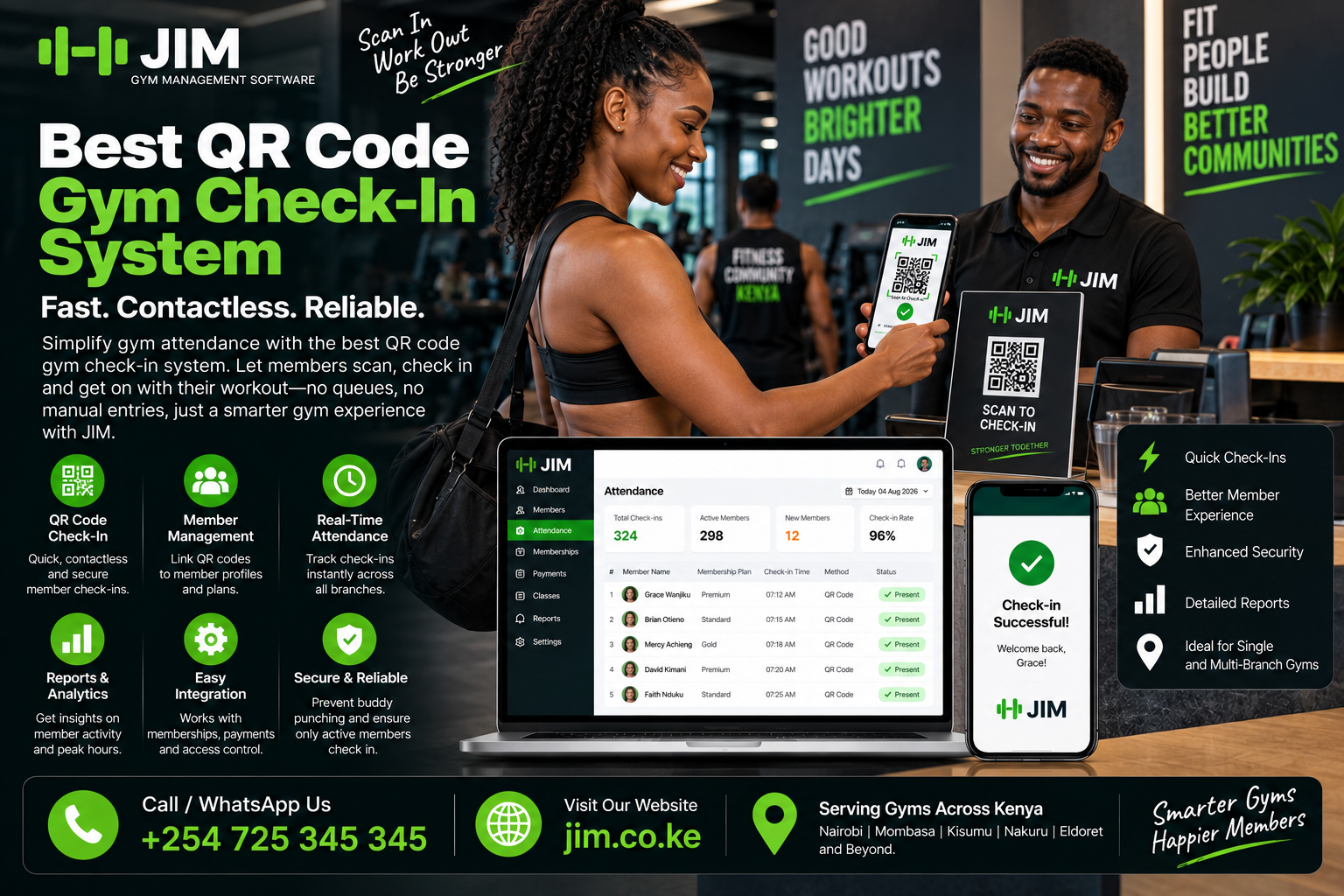
Running a successful gym in Kenya requires more than excellent equipment, qualified trainers and an attractive workout space. Members expect quick registration, secure access, accurate visit records and a smooth check-in experience. Gym owners need reliable information about daily traffic, peak hours, inactive members, expired subscriptions and facility usage. Trying to manage these activities through notebooks, spreadsheets and paper sign-in sheets quickly becomes difficult.
Reliable QR code gym check-in system software brings these responsibilities together in one organised platform. Instead of switching between manual registers, Excel files and paper sign-in sheets, a gym can manage members, subscriptions, check-ins, attendance trends and reports from a central dashboard.
Jim is designed to help modern fitness businesses simplify their operations. Whether you operate a boutique studio in Kilimani, a busy gym in Mombasa or several branches around Kenya, QR code gym check-in system gives your team the tools required to work efficiently and deliver a better member experience.
This guide explains what QR code gym check-in system software does, why local gyms need it, which features matter most and how the right platform can support growth throughout the country.
What Is QR Code Gym Check-In System Software?
QR code gym check-in system is software that helps fitness businesses organise and automate member entry and visit tracking. It stores member information, validates membership status, records check-ins, monitors attendance patterns and produces operational reports.
QR code gym check-in system replaces disconnected manual processes with a structured workflow. When a new member joins, reception staff can create a profile, select a package, record payment and activate the membership. When that person checks in, their attendance is recorded against the same profile. As the expiry date approaches, QR code gym check-in system can help the gym send a renewal reminder.
This connected approach reduces duplicated work and makes information easier to find. A manager does not have to search through several spreadsheets to confirm whether a member has paid. Receptionists do not need to rely on memory when checking membership status. Owners can view business performance without waiting for someone to compile a report manually.
For businesses searching for QR code gym check-in system, the main objective should be simple: choose software that makes the gym easier to run while improving the experience offered to members.
Why Gyms Across Kenya Need QR Code Attendance Management
Kenya has independent neighbourhood gyms, premium health clubs, hotel fitness facilities, personal-training studios and growing multi-branch brands. They serve professionals, families, students, athletes and visitors who value convenience and security. Members want to register quickly, check in without delays and receive accurate information about their membership status.
At the same time, local gyms operate in a competitive market. Members can choose between traditional gyms, personal-training studios, yoga centres, Pilates studios, boxing facilities and specialised wellness clubs. Efficient management can therefore become an important competitive advantage.
A QR code gym check-in system platform helps a fitness business maintain consistent service even as membership numbers increase. It can reduce queues at reception, prevent unauthorised entry and give management a clearer picture of member activity.
Software is particularly useful when a gym:
- Has many active, frozen and expired memberships to track.
- Offers daily, weekly, monthly, quarterly or annual packages.
- Accepts different payment methods.
- Needs to follow up members before subscriptions expire.
- Wants accurate attendance records.
- Employs several receptionists, trainers or managers.
- Operates more than one location.
- Has outgrown Excel, notebooks or paper files.
The right QR code gym check-in system solution provides structure without making daily tasks complicated.
Common Problems with Manual Gym Management
Manual processes may appear inexpensive when a gym is new, but they become increasingly costly as the business grows. The cost is not limited to stationery or staff time. Inaccurate records can cause revenue leakage, poor customer service and missed opportunities.
Membership records become difficult to maintain
Members join on different dates and select different plans. Some renew early, some renew late and others freeze their memberships. Tracking these changes in a basic spreadsheet requires continuous attention. A single incorrect formula or deleted row may affect several records.
Renewals are easily missed
If staff must check expiry dates manually, reminders may be sent too late or not sent at all. A member whose package expires without a follow-up may simply move to another fitness provider.
Payment confirmation takes too long
Searching through messages or statements to confirm a transaction slows down the front desk. It can also create disagreements when records are incomplete.
Attendance information is unreliable
Paper sign-in books are hard to analyse. Names may be illegible, members may forget to sign in and managers cannot easily identify attendance trends.
Reports require extra work
Compiling monthly income, active memberships or renewal figures manually consumes time. By the time a report is complete, some of the information may already be outdated.
Important knowledge depends on individuals
When information exists only in one employee’s notebook or personal messages, operations suffer when that person is absent. A central system keeps authorised information accessible to the business.
Essential Features QR Code Gym Check-In System Software Should Include
Not every platform offers the same capabilities. Before choosing software, consider the actual problems it needs to solve. The following features are especially useful for gyms and fitness studios in Kenya.
1. Member registration and profile management
QR code gym check-in system should make it easy to create and update member profiles. Useful records include contact details, membership package, activation date, expiry date, payment history and attendance activity.
Centralised profiles help staff deliver consistent service. When a member asks about a subscription, an authorised employee can retrieve the correct information quickly rather than checking several files.
2. Membership package management
Gyms rarely sell only one plan. A platform should accommodate the packages the business actually offers, including day passes, weekly plans, monthly packages, couple memberships, corporate plans, personal-training packages and longer subscriptions.
Clear package configuration reduces mistakes during registration and renewal. It also allows management to see which memberships are most popular.
3. Payment tracking
Payment records should connect directly to member accounts. Staff need to see what was paid, when it was paid and which membership period it covers. This creates a clearer audit trail and reduces dependence on paper receipts.
For Kenyan gyms, payment workflows should reflect local customer habits. Before selecting a platform, ask how it records or integrates with M-Pesa and whether staff can reconcile transactions accurately.
4. Automated renewal reminders
Renewals are central to predictable gym revenue. Reminder tools help staff contact members before or when packages expire. Messages should be timely, professional and relevant.
Automation does not replace personal service. It ensures that routine follow-ups happen consistently, allowing staff to focus their personal attention on members who need extra support.
5. WhatsApp communication
WhatsApp is an important communication channel for many Kenyan businesses and customers. A QR code gym check-in system with WhatsApp automation can support renewal notices, payment follow-ups, welcome messages and other useful updates.
Messages should be sent responsibly. Gyms should obtain appropriate consent, keep communication relevant and avoid overwhelming members with unnecessary promotions.
6. QR code setup and check-in tracking
Digital attendance provides more useful information than a paper register. During registration, an authorised employee connects a unique QR code to the correct member profile. Depending on the selected setup, the code may appear on a digital membership pass, mobile screen or printed card. At subsequent visits, the member presents the code so the system can verify the account and record the check-in. This can help a gym understand peak hours, identify consistently active members and notice when previously regular customers stop attending.
Depending on the selected setup, reception staff may scan the code using a compatible phone, tablet, webcam or dedicated reader. The most suitable approach depends on budget, visitor volume, internet reliability, device compatibility and access-control requirements. A gym should also establish a safe fallback procedure when a code is damaged, a phone is unavailable or a scanner cannot read the member’s pass.
7. Dashboards and reports
Good software turns operational records into useful insights. A gym owner should be able to view active members, expired packages, upcoming renewals, collections and attendance without manually combining data.
Reports help management answer practical questions: Which plan produces the most revenue? When is the gym busiest? How many memberships expired this month? Which members require follow-up? Decisions become easier when the underlying data is organised.
8. Staff access and accountability
Different employees need different levels of access. A receptionist may register members and record payments, while a manager may view reports or edit packages. Role-based permissions protect sensitive information and support accountability.
9. Multi-branch management
A growing fitness brand may expand from Nairobi to Mombasa, Nakuru, Kisumu, Eldoret or another part of Kenya. Multi-branch support allows owners to monitor locations from one system while maintaining appropriate records for each branch.
10. Cloud access and data protection
A cloud-based QR code gym check-in system platform allows authorised users to access the service through supported devices and locations. Owners can monitor the business even when they are away from the reception desk.
Security remains essential. Ask prospective providers whether codes are unique, how copied or expired codes are handled, which employees can access member records and how the platform protects stored information. Dynamic or rotating codes may offer stronger safeguards where supported, while staff should have a clear process for replacing lost cards and deactivating compromised codes.
How Jim Helps Kenyan Gyms Operate Efficiently
Jim brings important gym operations into one platform. The objective is to give fitness-business teams a simpler way to manage members while giving owners better visibility into performance.
With an organised system, the member journey becomes easier to manage. A prospect can be registered, assigned a package and converted into an active member. Staff can confirm subscription status, record relevant payments and monitor attendance. As renewal approaches, the gym can follow up rather than waiting for the member to remember.
This approach supports several business outcomes:
- Faster service at reception.
- More accurate membership records.
- Consistent renewal follow-up.
- Better visibility into payments and attendance.
- Reduced administrative workload.
- More professional communication.
- Improved decision-making through reports.
- A scalable process for growing teams and branches.
Jim is relevant not only to large health clubs. Smaller gyms and boutique studios can also benefit because time saved on administrative work can be redirected toward members, coaching and sales.
A Better Experience for Gym Members
Management software is often discussed from the owner’s perspective, but members also benefit. A well-run digital process reduces friction at every stage of the relationship.
New members can be registered accurately. Existing members receive clearer information about their subscriptions. Check-in becomes faster, and renewal communication is less likely to arrive unexpectedly after access has already expired. Staff can answer account questions with confidence because records are available in one place.
Consistency builds trust. When every receptionist follows the same process, members receive a similar standard of service regardless of who is on duty. This matters in a competitive area such as Karen, where customers often compare convenience as well as equipment and pricing.
Technology should not make the gym feel impersonal. Used well, it removes repetitive administrative tasks so staff have more time for meaningful interactions, facility care and member support.
Improving Membership Renewals and Retention
Acquiring a new member generally requires marketing, tours, sales conversations and onboarding. Retaining a satisfied member can be more efficient, but retention does not happen automatically.
A QR code gym check-in system supports retention by giving the team timely information. Staff can identify packages nearing expiry and communicate before access lapses. Attendance data may also reveal members who have become inactive.
An effective renewal process can include:
- A friendly reminder before the membership expires.
- Clear information about the expiry date and renewal options.
- A convenient payment process.
- Confirmation after renewal.
- Personal follow-up when a valuable or previously active member does not renew.
The message itself should feel helpful rather than aggressive. For example, remind the member of the expiry date, explain how to renew and provide a direct contact channel for questions.
Software creates consistency, while staff add empathy and judgement. Together, these elements can strengthen member relationships.
Using Attendance Data to Make Better Decisions
Attendance information is valuable when it leads to action. A gym can use check-in data to understand how members use the facility and where operational improvements may be needed.
Peak-hour data can guide staffing and class scheduling. If weekday evenings are consistently busy, management may schedule additional staff or adjust equipment layouts. If a class has low attendance, the time, instructor or format may need review.
Attendance patterns can also support retention. A member who used to visit four times per week but has not checked in recently may benefit from a friendly message. This should be handled sensitively, but a well-timed check-in from the gym can help a member reconnect with their goals.
For multi-branch operators, attendance reports can show differences between locations. Owners can compare activity patterns without relying solely on informal updates from branch managers.
Managing Gym Payments More Professionally
Financial clarity is essential for any fitness business. QR code gym check-in system should help authorised staff distinguish paid, unpaid, active and expired accounts. Payments should be connected to the correct member and membership period.
An organised payment workflow reduces common problems such as duplicated entries, missing receipts or memberships activated for the wrong period. It also makes reconciliation and reporting easier.
When evaluating QR code gym check-in system options, ask the provider to demonstrate the complete member journey. Do not look only at a feature list. See how a receptionist registers a member, issues the QR code, scans it at entry and finds the completed check-in in attendance reports.
If M-Pesa functionality is important, clarify whether integration is automatic or whether payments are entered manually. Ask what happens when a member uses a different phone number, enters an incorrect account reference or requests a correction. Practical workflow details matter as much as the headline feature.
Gym Management Software Versus Excel
Excel remains useful for many business tasks, but it was not designed to manage the complete member lifecycle of a growing fitness centre.
A spreadsheet can store names, phone numbers and expiry dates. However, staff must maintain formulas, protect cells, manage versions and create reminders through separate tools. Multiple employees may save different copies, producing uncertainty about which file is current.
A purpose-built QR code gym check-in system connects related activities. Member details, packages, payments, attendance and renewal status can work together. User permissions provide better control than sharing one spreadsheet widely. Dashboards and reports can also update from operational data without being rebuilt every month.
Excel may be adequate for a very small operation with simple needs. The point to adopt dedicated software usually arrives when manual work takes too much time, records become unreliable or management cannot obtain answers quickly.
Who Can Use Jim Gym Management Software?
QR code gym check-in system can support different types of fitness and membership-based businesses, including:
- Commercial gyms.
- Boutique fitness studios.
- Women-only gyms.
- Personal-training studios.
- Yoga and Pilates studios.
- Boxing and martial-arts facilities.
- Cross-training and strength centres.
- Wellness clubs.
- Hotel and residential fitness facilities.
- Corporate gyms.
- Multi-location fitness brands.
Each business has a different workflow. A yoga studio may prioritise class scheduling, while a large gym may focus on access control and high-volume check-ins. A useful product demonstration should therefore reflect the type and size of the prospective customer.
QR Code Gym Check-In System for All Areas
Jim can serve fitness businesses throughout Nairobi and beyond. Location-specific needs matter because owners often prefer software that understands Kenyan membership practices, communication habits, payment methods and support expectations.
Kileleshwa
Gyms and private studios in Kileleshwa can use membership software to manage flexible packages, personal-training clients and renewal communication. The area is also relevant to fitness brands building a network across Nairobi’s western neighbourhoods.
Lavington
The QR code gym check-in system platform used by local operators can also support Lavington businesses, including boutique facilities, wellness centres and premium membership services. Clear member records and professional communication reinforce service quality.
Hurlingham and Ngong Road
Fitness facilities around Hurlingham and Ngong Road often serve residents, office workers and commuters. Digital check-in and efficient payment confirmation can help reception teams manage busy periods.
Westlands and Parklands
Westlands and Parklands contain offices, residences, hotels and established fitness businesses. Multi-branch tools, reporting and staff permissions are especially valuable for larger operations in these areas.
Karen and Lang’ata
Gyms in Karen and Lang’ata may serve members over a broad geographical area. Timely digital reminders help customers manage renewals without making an unnecessary trip to the facility.
Upper Hill and Nairobi CBD
Gyms serving office workers in Upper Hill or the central business district may experience concentrated traffic before work, during lunch and in the evening. Attendance reports can help managers align staff and services with these patterns.
South B, South C and Industrial Area
Fitness businesses in South B, South C and Industrial Area can streamline member registration, recurring payments and front-desk activities through one shared platform.
Embakasi, Donholm and Umoja
High-volume neighbourhood gyms require fast, dependable processes. An organised system helps receptionists confirm membership status and helps owners follow renewals across a large customer base.
Kasarani, Roysambu and Zimmerman
Growing residential areas create opportunities for gyms and specialised fitness studios. Software gives these businesses a foundation that can scale as memberships and staff numbers increase.
Ruaka, Ruiru and Kiambu
Nairobi’s wider metropolitan area continues to attract residential and commercial development. Gyms in Ruaka, Ruiru and Kiambu can use cloud-based management to maintain professional operations and, where applicable, connect several locations.
Thika and Other Kenyan Towns
The same principles apply beyond Nairobi. Fitness businesses in Thika, Mombasa, Nakuru, Kisumu, Eldoret and other towns need accurate memberships, payment visibility, attendance records and reliable communication. A scalable platform allows a fitness brand to retain consistent procedures as it enters new markets.
Choosing the Best QR Code Gym Check-In System in Kenya
The best platform is not necessarily the one with the longest feature list. It is the one that fits the gym’s daily workflow, can be adopted by staff and receives reliable support.
Use the following process when comparing options.
Define the problems first
List the issues you want to solve. These may include missed renewals, slow check-ins, inaccurate payment records, limited reporting or difficulty managing branches. Clear priorities make product comparisons more objective.
Request a practical demonstration
Ask the provider to show common tasks rather than only presentation slides. Watch how QR code gym check-in system registers a member, creates a subscription, records payment, checks attendance and produces a report.
Involve the people who will use it
Receptionists and managers understand daily operational challenges. Their feedback can reveal whether a workflow is practical and which training will be required.
Check local relevance
Confirm how QR code gym check-in system supports Kenyan payment and communication needs. Ask about M-Pesa, WhatsApp, SMS, local currency, time zone and support availability.
Understand the full price
Request clear information about subscription charges, setup, training, integrations, messaging, devices and support. A lower headline price may not represent the complete cost.
Consider future growth
Choose a solution that can handle more members, staff and branches if expansion is part of the plan. Moving data between systems later can be disruptive.
Review data and support arrangements
Ask who owns the data, how it can be exported, how backups work and what support is available when staff encounter a problem.
Implementation: Moving from Manual Records to Jim
Introducing new software is easier with a structured plan. Start by cleaning the existing member records. Remove obvious duplicates, confirm phone numbers and identify active, expired and frozen memberships.
Next, define the packages and business rules that will be configured in QR code gym check-in system. Decide who may register members, edit payments, view reports and manage settings. Permissions should reflect staff responsibilities.
Training should use real scenarios. Let staff practise registering a new member, renewing a package, correcting an error and finding an account. Written procedures can help employees follow the same workflow after training.
It may be useful to select a clear go-live date. Communicate the change internally and ensure support is available during the first days of use. Review the records after implementation to catch inconsistencies early.
Finally, measure whether QR code gym check-in system is delivering the expected improvements. Look at time spent at reception, accuracy of membership status, renewal follow-up and report availability. Software creates value when the team uses it consistently.
Questions to Ask During a Gym Software Demo
Prepare questions before attending a demonstration. Useful examples include:
- How quickly can a receptionist register a new member?
- Can we configure our existing membership packages?
- How are M-Pesa and other payments handled?
- Can QR code gym check-in system send WhatsApp or SMS renewal reminders?
- How does member check-in work?
- Can we identify memberships expiring this week?
- Which revenue and attendance reports are available?
- Can different employees receive different permissions?
- Does QR code gym check-in system support multiple branches?
- Can we export our business data?
- What training and ongoing support are included?
- How are backups and security managed?
- What is the complete monthly or annual cost?
The answers should be demonstrated where possible. Seeing a workflow in action is more useful than receiving a simple yes.
Frequently Asked Questions
What is the best QR code gym check-in system option?
The best system is one that matches your gym’s size, membership packages, payment methods, attendance process and growth plans. Jim is designed to centralise member management, payments, attendance, reminders and reporting for Kenyan fitness businesses. Request a demonstration to evaluate the workflow against your needs.
Can a small gym use management software?
Yes. Small gyms can benefit from organised records and consistent renewals before administration becomes overwhelming. Starting early also creates a cleaner foundation for growth.
Does gym management software replace reception staff?
No. It gives reception staff better tools. Employees still welcome members, solve unusual problems and provide personal service. The software handles structured records and repetitive processes.
Can QR code gym check-in system help with membership renewals?
Yes. It can identify memberships nearing expiry and support timely reminders. Staff can then focus personal follow-up on members who have not renewed.
Can gym software track attendance?
Yes. Depending on the configuration, member check-ins can be recorded and used in attendance reports. Ask which check-in methods and devices the provider supports.
Is a cloud-based QR code gym check-in system suitable for multiple branches?
It can be. A multi-branch platform may allow authorised owners and managers to monitor several locations centrally. Confirm how branch permissions, reports and membership access work.
Can Jim support gyms outside Karen?
Yes. QR code gym check-in system is relevant to gyms across Nairobi and other parts of Kenya, subject to the selected setup and business requirements.
Is gym software better than Excel?
Dedicated software is generally better when several staff members manage memberships, payments, attendance and renewals. Excel can store data, but a gym platform connects operational workflows and provides controlled access.
How much does a QR code gym check-in system solution cost?
Pricing depends on the provider, features, member capacity, number of branches, integrations, messaging and support. Request a written quotation covering both recurring and setup costs.
How long does implementation take?
The timeline depends on the quality of existing records, number of members, required integrations, staff availability and training needs. A clean single-location setup may be faster than a complex multi-branch migration.
What information should a gym prepare before setup?
Prepare member records, membership packages, current subscription dates, staff roles, payment processes and communication templates. Clean, consistent data makes implementation easier.
How can I book a Jim demonstration?
Visit jim.co.ke or contact the Jim team through +254 725 345 345 to discuss your gym and request a product demonstration.
Start Managing Your Karen Gym More Efficiently
A growing fitness business should not depend on scattered spreadsheets, paper registers and memory. These methods make it difficult to maintain accurate memberships, follow up renewals and understand performance.
Jim provides a more organised foundation. By bringing member profiles, packages, payments, attendance, reminders and reports together, QR code gym check-in system helps teams work efficiently and gives owners clearer operational visibility.
If you are evaluating QR code gym check-in system for your fitness business, focus on practical value. Look for simple staff workflows, fast scanning, compatible devices, reliable reporting, appropriate permissions, secure data handling and room to grow.
The same platform can support fitness businesses across Kileleshwa, Lavington, Hurlingham, Karen, Parklands, Karen, Lang’ata, Upper Hill, South B, South C, Embakasi, Kasarani, Ruaka, Ruiru, Kiambu, Thika and other locations. Each gym may serve a different market, but all benefit from accurate records and consistent member service.
Ready to modernise your gym? Visit jim.co.ke or call/WhatsApp +254 725 345 345 to request a demonstration of Jim Gym Management Software.