
Gym Management System Bamburi: A Practical Guide for Modern Fitness Businesses
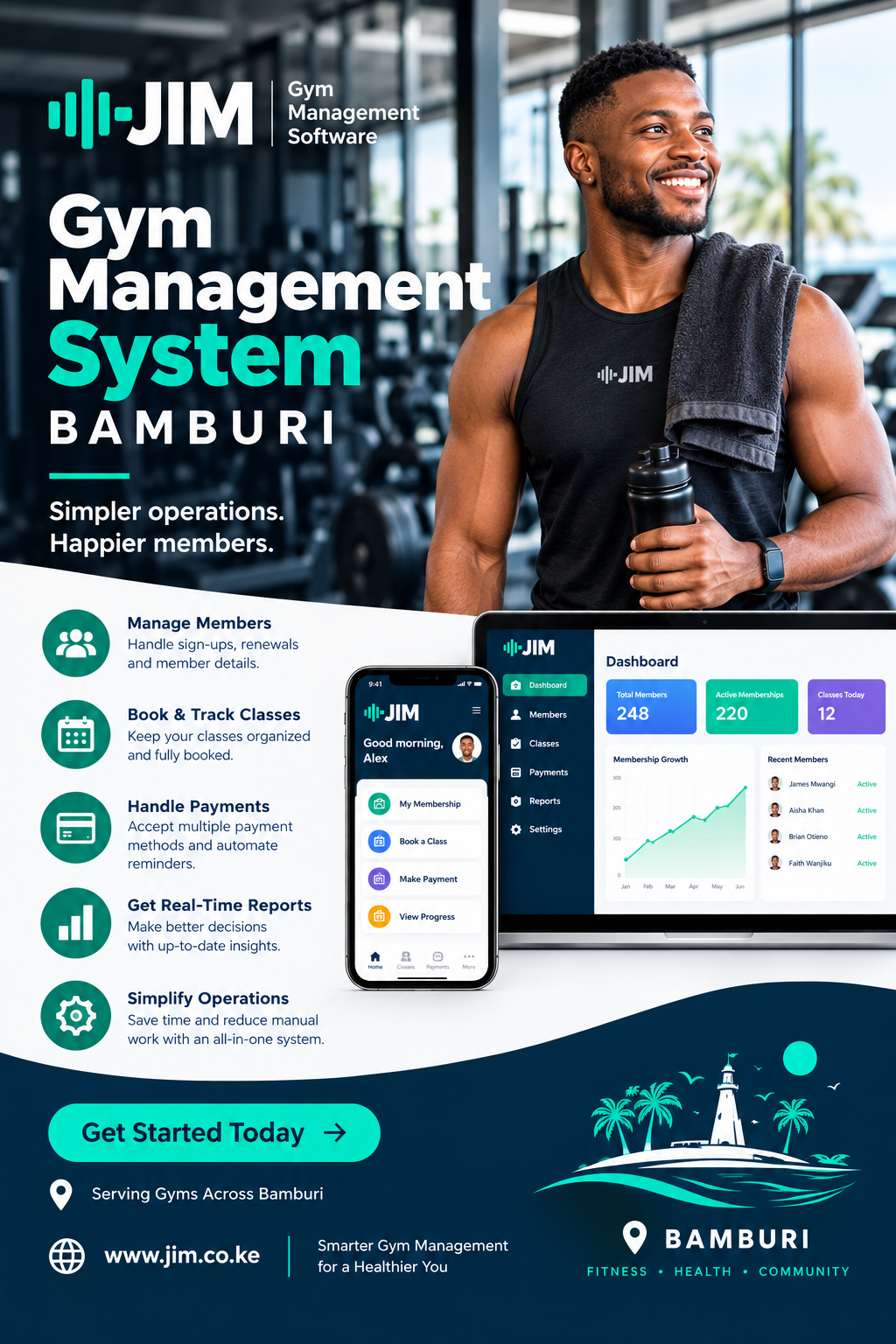
Gym Management System Bamburi: A Practical Guide for Running a Modern Fitness Business
Bamburi has a busy and varied customer base, which means a gym needs more than exercise equipment and a reception desk to operate smoothly. A gym management system Bamburi can help gym owners, managers, reception teams and trainers organise memberships, payments, attendance, schedules, customer records and daily administration in one structured workflow. This guide explains what gym software should do for a Bamburi fitness business, the operational problems it can solve, the features worth prioritising, and how to introduce a system without disrupting members.
Why gym management matters for Bamburi fitness businesses
A gym may look simple from the customer’s side: a member arrives, checks in, trains and leaves. Behind that visit are several processes. The business has to know whether the membership is active, whether a payment has been received, when the plan expires, whether the member has booked a class, who is working at reception, what stock has been sold and how the business performed that day.
A gym management system Bamburi brings these activities closer together. Instead of keeping one spreadsheet for members, a notebook for attendance and a separate record of payments, the gym can create a more consistent operating process. That matters when the number of members increases because manual administration becomes harder to control as the business grows.
For a gym in Bamburi, the system should fit the way local customers actually pay and interact with the business. Memberships may be monthly, quarterly or annual. Some customers may purchase day passes, personal training sessions or merchandise. A useful platform should make these different transactions easy to record while giving management a clear view of what is happening.
The goal is not simply to replace paper. The real goal is to reduce avoidable work, improve record accuracy and make important information available when staff need it.
What a gym management system should handle
The phrase gym management system Bamburi should describe more than a digital membership register. A practical system should connect the major activities that keep a fitness business running.
These activities commonly include:
- Member registration and profile management
- Membership plans and expiry tracking
- Payment records and outstanding balances
- M-Pesa payment workflows
- Attendance and check-ins
- Class and personal training schedules
- Trainer assignments
- Member communication and renewal reminders
- Staff accounts and permissions
- Inventory and point-of-sale records
- Business reports and dashboards
- Documents and member records
- Multi-branch management where required
The advantage of connecting these functions is context. When a member arrives, the receptionist should be able to see the relevant membership status instead of checking several unrelated records. When an owner reviews revenue, the information should connect to actual invoices and payments rather than requiring manual calculations from multiple files.
A gym management system Bamburi is therefore best viewed as an operating workspace rather than just an attendance application.
Member management without scattered records
Member information is at the centre of a fitness business. A customer profile may include contact information, membership history, plan type, payment history, attendance, notes, documents and other details that staff need during everyday interactions.
A gym management system Bamburi can provide one place for this information. That makes it easier to search for a member, update their details and understand their relationship with the gym.
Faster member registration
New-member onboarding should be straightforward. Reception staff can capture the customer’s basic details, select an appropriate membership plan and record the starting date. If the business uses paper forms or spreadsheets, the process often requires copying the same information more than once.
A structured digital profile reduces that duplication. It also makes later activities easier because staff do not have to create a new record whenever the customer renews or changes plans.
Tracking membership status
A gym management system Bamburi should make it easy to distinguish active members from expired, frozen or suspended accounts. This is important at reception because access decisions should be based on current records.
Managers also need to know which memberships are approaching expiry. A list of upcoming renewals allows the team to contact members before their plans lapse rather than waiting until the customer stops coming.
Handling upgrades and changes
Members do not always stay on one plan. A customer may move from a monthly package to a quarterly plan, add personal training or temporarily freeze a membership.
The system should record those changes clearly. A useful history gives management a better understanding of how customers use different packages and helps staff avoid contradictory information.
Payments and M-Pesa workflows
Payments are one of the most important areas for a Kenyan gym. Cash, bank transfers and mobile payments can all create administrative work when they are recorded separately.
A gym management system Bamburi can bring invoices, balances and payment records into one workflow. Where a configured M-Pesa integration is available, the payment process can be connected more closely to the member’s account.
This does not mean that every payment problem disappears automatically. Staff still need clear procedures for failed transactions, wrong references, refunds and unusual cases. The software should make those exceptions easier to identify rather than hiding them.
Why payment visibility matters
Suppose a gym has 300 members and several plans with different renewal dates. Without a central billing record, the owner may have difficulty answering simple questions:
- How much was billed this week?
- Which invoices remain unpaid?
- Which members are approaching renewal?
- Which payments need follow-up?
- What revenue came from memberships?
- What revenue came from other services?
A gym management system Bamburi can turn those questions into dashboard and report views instead of manual spreadsheet exercises.
Reducing payment follow-up
Payment follow-up is particularly important for recurring memberships. A member who forgets to renew may simply stop attending, even though they still value the gym.
A well-organised system helps the team identify outstanding balances and upcoming expiries. Staff can then contact the right customers rather than sending generic messages to everyone.
Choosing a gym management system Bamburi also gives the front desk a consistent process for handling everyday member questions.
Attendance and front-desk operations
The front desk is where members experience the gym’s administrative efficiency. Long searches through paper registers can create queues, especially during busy periods.
A gym management system Bamburi can make check-ins faster by connecting attendance to member profiles and membership status.
A simple check-in workflow
A practical process can look like this:
- The member provides a membership number, name or QR identifier.
- Reception locates the member profile.
- The system checks the relevant membership status.
- The visit is recorded.
- Staff can see any important access or account issue.
- The member proceeds to train.
This workflow reduces unnecessary searching. It also gives the business a useful attendance history.
Why attendance data matters
Attendance is more than a security record. It can reveal customer behaviour.
For example, management may discover that:
- Some members visit several times each week.
- Some new members stop attending after a few weeks.
- Certain classes consistently attract high attendance.
- Some membership plans have stronger engagement than others.
- Particular periods of the day are consistently busy.
A gym management system Bamburi turns those observations into data that can support operational decisions.
Membership retention and renewal management
Getting a new member is only part of the business challenge. Keeping that member active is equally important.
A gym management system Bamburi can support retention by making renewal dates, attendance patterns and account status easier to monitor. The system does not replace good customer service, but it can help staff know when communication is needed.
Renewal reminders
Instead of waiting for a membership to expire, the gym can establish a process for contacting members ahead of time. The timing can depend on the gym’s membership model and communication preferences.
A useful reminder should be clear. It can mention the plan, expiry date and renewal process without sending unnecessary information.
Identifying inactive members
Attendance history can also support re-engagement. If a normally active member has not visited for an extended period, staff can decide whether a friendly check-in is appropriate.
This is more useful than sending the same promotional message to every customer because the communication is based on an actual interaction with the gym.
A gym management system Bamburi can also help managers see whether front-desk processes are being followed consistently.
Classes, trainers and personal training
Many Bamburi gyms provide more than open-floor access. They may have group classes, personal training, boxing, functional training, dance sessions or other scheduled activities.
A gym management system Bamburi should support scheduling when the gym offers these services.
Avoiding schedule conflicts
A trainer may have several sessions in a day. A room or training area may also have limited capacity.
A digital schedule helps staff see:
- Which trainer is assigned
- What time the session begins
- Which members have booked
- Available spaces
- Overlapping sessions
- Cancelled or rescheduled bookings
This is easier to manage than a wall calendar that only one person can update at a time.
Personal training records
Personal training can be an important revenue stream. The system should allow the gym to record sessions and connect them with the relevant member and trainer.
Over time, management can use this information to understand demand and allocate trainer time more effectively.
When evaluating a gym management system Bamburi, test it with real customer scenarios rather than relying only on a feature checklist.
Staff roles and access control
A gym rarely has only one person using its management tools. Receptionists, trainers, managers, accountants and owners may all need different access.
A gym management system Bamburi should support role-based permissions so that staff see the information required for their responsibilities.
For example:
| Role | Typical access |
|---|---|
| Owner | Business overview, reports, settings and financial visibility |
| Manager | Members, operations, schedules and reports |
| Receptionist | Check-ins, member profiles and payments |
| Trainer | Assigned members, sessions and workout information |
| Stock staff | Inventory and product transactions |
The exact permissions should depend on the business.
Why shared passwords are a problem
When everyone uses one login, it becomes difficult to determine who made a change. It also means that leaving staff may still know the password unless the owner remembers to change it.
Individual accounts provide clearer accountability. If the system includes activity logs, management can also investigate important changes when necessary.
A gym management system Bamburi is particularly useful when several employees need to work with the same member records during the day.
Inventory and gym sales
Many fitness businesses sell products alongside memberships. These can include drinks, supplements, branded clothing, accessories, towels or other retail items.
A gym management system Bamburi can connect inventory to daily operations.
Useful inventory functions include:
- Product records
- Categories
- Supplier information
- Purchases
- Stock movements
- Low-stock alerts
- Sales records
- Stock valuation
- Transfers between locations
Without a central record, stock can disappear through simple counting errors or unrecorded sales. A structured inventory process makes it easier to see what was received, sold and remaining.
Managing a small gym shop
A Bamburi gym does not need to operate a large retail department to benefit from stock control. Even a small product shelf can become difficult to manage when several staff members sell items throughout the week.
Recording each sale helps management compare product movement with cash and payment records.
Reports that help gym owners make decisions
A gym management system Bamburi should not only store information. It should make information easier to interpret.
Useful reports can include:
- Active memberships
- Expiring memberships
- New members
- Renewals
- Attendance
- Revenue
- Outstanding invoices
- Payment history
- Product sales
- Trainer activity
- Class attendance
- Membership plan performance
The purpose of reporting is not to create more paperwork. It is to answer operational questions.
Questions a manager should be able to answer
A good dashboard should help answer questions such as:
- How many active members do we have?
- How many memberships expire soon?
- What payments remain outstanding?
- Which days are busiest?
- Which plans are most popular?
- How many new members joined recently?
- How much was collected from memberships?
- What products are running low?
- Which classes are filling up?
- How is the business performing compared with the previous period?
A gym management system Bamburi makes these questions easier to answer when the underlying records are maintained consistently.
How a Bamburi gym can move away from spreadsheets
Spreadsheets are useful when a business is small. They are also familiar and inexpensive. The problem begins when the spreadsheet becomes the main operating system for a growing gym.
A gym management system Bamburi can reduce dependence on spreadsheets by moving recurring workflows into a central platform.
Signs that spreadsheets are becoming difficult
Consider a change if your team regularly experiences:
- Duplicate member records
- Missing payment updates
- Manual attendance calculations
- Conflicting membership expiry dates
- Difficulty tracking staff activity
- Slow monthly reporting
- Lost paper forms
- Repeated data entry
- Unclear outstanding balances
- Multiple versions of the same spreadsheet
The solution is not to eliminate spreadsheets from every business process. Some spreadsheets will remain useful for analysis or exports. The key is to stop using them for tasks that need current, shared operational data.
Choosing the right gym software in Bamburi
Not every platform will suit every gym. Before choosing a gym management system Bamburi, owners should consider the actual workflow of their business.
1. Start with member capacity
A small gym with 100 members does not have the same needs as a facility with several hundred or multiple branches.
Estimate current membership and expected growth. Choose a platform that can handle the business without paying for unnecessary complexity.
2. Review payment workflows
Ask how the system records membership invoices, payments, balances and renewals.
For Kenyan gyms, ask specifically how M-Pesa workflows are supported and what happens when a transaction fails or requires manual verification.
3. Check attendance options
The check-in process should be quick enough for a busy reception. If it takes several screens to record one visit, staff may return to manual methods.
4. Examine staff permissions
Different employees should not automatically receive full access to every business record. Ask whether the platform supports roles, permissions and branch-level access.
5. Evaluate reporting
Do not choose a system based only on the number of features listed on its website. Ask whether it can produce the reports the owner actually needs.
6. Consider implementation
Data migration is often overlooked. Ask how existing member records can be imported and how staff will be trained.
A gym management system Bamburi is only useful if the team can adopt it consistently.
A practical implementation plan
Changing gym software does not have to happen all at once. A staged rollout can reduce disruption.
Phase 1: Clean the member data
Before importing records, remove duplicates and correct obvious errors. Decide which fields are essential.
A basic member dataset might include:
- Full name
- Phone number
- Email address
- Membership plan
- Start date
- Expiry date
- Payment status
- Emergency contact where relevant
Phase 2: Configure membership plans
Create the actual packages offered by the gym. Avoid creating dozens of unnecessary variations.
For example, the gym might offer monthly, quarterly, half-yearly and annual plans, with separate options for personal training where applicable.
Phase 3: Add staff
Create individual accounts and assign appropriate permissions.
Explain why each role exists. Staff are more likely to follow access procedures when they understand the reason behind them.
Phase 4: Test payments and check-ins
Before going live, test the complete customer journey. Register a sample member, issue an invoice, record a payment and check the member in.
Test an expired account as well. The team needs to understand what the system displays when access should not be granted.
Phase 5: Train the team
Training should focus on actual tasks rather than every feature in the software.
Receptionists should practise member registration and check-ins. Managers should practise reports and membership changes. Trainers should practise the functions they use.
Phase 6: Review after launch
After several weeks, ask staff where they still use paper or separate spreadsheets. Those gaps may indicate a process that needs configuration or additional training.
A gym management system Bamburi should support clear ownership of tasks so staff know who handles renewals, payments and account changes.
Common mistakes when introducing gym software
Buying software is not enough. Implementation decisions affect whether the platform delivers value.
Mistake 1: Choosing features instead of workflows
A platform may have many features but still be difficult for a small team to use.
Start with the daily workflow. Ask what happens when a customer joins, pays, visits, freezes a membership, renews or cancels.
Mistake 2: Importing poor data
If old records contain duplicate phone numbers, incorrect expiry dates or missing names, importing everything without cleaning it can create confusion.
Data preparation is part of implementation.
Mistake 3: Giving everyone administrator access
Full access should be limited to people who genuinely need it. Too many administrators increase the risk of accidental changes.
Mistake 4: Ignoring staff training
Even a simple system can fail if employees are unsure how to use it. Short, task-based training is often more useful than a long theoretical session.
Mistake 5: Measuring only revenue
Revenue is important, but it does not tell the whole operational story.
Attendance, renewal rates, active memberships, outstanding balances and class participation can provide additional context.
Mistake 6: Continuing parallel records forever
During the transition, keeping a temporary backup record can make sense. Keeping duplicate records permanently creates the same reconciliation problem the software was supposed to solve.
Cost considerations for a gym in Bamburi
The cost of a gym management system Bamburi should be considered alongside the administrative work it replaces.
When comparing options, look beyond the monthly subscription. Consider:
- Number of members supported
- Number of branches
- Number of staff accounts
- Billing capabilities
- Payment integration
- Attendance tools
- Scheduling
- Inventory
- Reporting
- Data migration
- Training
- Support
- Future upgrades
A low subscription price is not automatically cheaper if staff spend hours every week fixing records. Likewise, a large enterprise package may be unnecessary for a small independent gym.
The right comparison is between the total cost of the system and the operational value it provides.
How Jim fits a Bamburi gym workflow
For a Bamburi business evaluating a gym management system Bamburi, the platform should be judged against real tasks rather than marketing language. Jim is designed around connected gym workflows, including member management, billing, check-ins, staff access, scheduling, workouts, inventory and reporting.
A typical workflow can begin when a prospective member joins. Staff create the member profile, assign a plan and record the relevant information. Billing can then be managed alongside the membership, while check-ins provide a record of visits.
The same workspace can also support operational functions such as staff roles, inventory and reports. This reduces the need to move information between unrelated systems.
For Kenyan businesses, payment workflow is an important consideration. Jim supports M-Pesa payment workflows through its configured payment integration. A payment should not simply exist as a message on a phone; the business also needs an organised record showing what the payment relates to.
A gym management system Bamburi can help connect payment information with the member account and the relevant operational process.
Using data to improve the member experience
A gym management system Bamburi can support customer service when staff use the information responsibly.
When a member contacts reception, the team should be able to answer common questions quickly. They may need to confirm membership status, payment history, expiry date or scheduled session.
This reduces the need to ask customers to explain information that the gym should already have on record.
Personalised communication
Member data can also help staff make communication more relevant.
Instead of sending every customer the same message, the gym can distinguish between:
- New members who need onboarding information
- Members approaching expiry
- Members with outstanding balances
- Members who have booked a class
- Members who have been inactive
- Members who have recently renewed
Communication should remain useful and respectful. The purpose of data is to improve service, not to overwhelm customers with messages.
A gym management system Bamburi can help management identify operational bottlenecks that are difficult to see from paper records alone.
Security and responsible data handling
Gym businesses collect personal information, so access to member records should be handled carefully.
A gym management system Bamburi should support basic security practices such as individual user accounts, appropriate permissions and controlled access.
Gym owners should also establish internal rules for handling customer information. Staff should only access records needed for their work, and sensitive information should not be copied casually into personal devices or unrelated messaging groups.
Regularly reviewing user access is useful, especially when employees leave or change responsibilities.
A gym management system Bamburi can help provide clearer control over which employees access operational information.
Supporting growth beyond one Bamburi location
A successful fitness business may eventually expand beyond one branch. The software selected at the beginning can either make that expansion easier or create another migration project.
A gym management system Bamburi with multi-location capabilities can give owners a consolidated view while allowing each branch to manage its own members, staff and stock.
This is useful when the owner wants to compare:
- Membership growth by branch
- Revenue by location
- Attendance by location
- Stock movement
- Staff activity
- Outstanding balances
- Plan performance
The important point is consistency. Branches should follow standard processes while retaining enough flexibility to handle local operational differences.
A gym management system Bamburi can also make weekly management meetings more practical because reports can be prepared from current records.
What to ask before subscribing
Before committing to a gym management system Bamburi, prepare a short checklist and test the system with realistic scenarios.
Ask the provider:
- Can existing member data be imported?
- How are membership expiries handled?
- How are M-Pesa payments recorded?
- Can staff have different roles?
- Can managers control branch access?
- Can attendance be connected to membership status?
- Can the system manage classes and personal training?
- Does it include inventory or POS tools?
- What reports are available?
- What happens when a payment fails?
- How is member data protected?
- What support is available during setup?
- Can the business export its records?
- How does pricing change as membership grows?
- Can the system support another branch later?
The answers should be practical rather than vague. A good evaluation uses a real example from the gym’s daily routine.
A simple daily workflow for a Bamburi gym
Once a gym management system Bamburi is properly configured, the team can structure the day around a few repeatable processes.
Morning opening
The manager checks the dashboard for upcoming expiries, outstanding payments, scheduled sessions and other issues requiring attention.
Member check-ins
Reception records each visit and confirms that the relevant membership is active. Any account issue can be handled before the customer enters the training area.
During the day
Trainers manage scheduled sessions, reception handles new registrations and payments, and staff record relevant stock transactions.
Evening review
The manager reviews attendance, payments and unusual transactions. Any issue that needs follow-up can be assigned before the next day.
Weekly review
Management looks at membership growth, renewals, attendance patterns, revenue and stock movement. This provides a more useful operating rhythm than waiting until the end of the month.
A gym management system Bamburi can support this routine by keeping the underlying records in one place.
Practical example: moving from a manual process
Imagine a Bamburi gym with several hundred members. The receptionist records attendance in a notebook, the manager maintains membership dates in a spreadsheet, and payment confirmations are stored in a phone inbox.
A customer arrives and says they paid their renewal through M-Pesa. The receptionist searches the messages, finds the transaction and then updates the spreadsheet.
That process may take only a few minutes. Repeated hundreds of times, it becomes a significant administrative burden.
With a gym management system Bamburi, the workflow can be structured around the member record. The invoice, payment status and membership information can be managed together, while the visit is recorded through the check-in workflow.
The benefit is not simply speed. It is consistency. Another staff member can open the same record and understand the account without asking the previous receptionist what happened.
Practical example: reducing missed renewals
Suppose a gym has many members whose subscriptions expire throughout the month. If the only reminder method is a handwritten calendar, some renewals will inevitably be missed.
A gym management system Bamburi can provide a structured list of upcoming expiries. The team can review that list regularly and contact members according to the gym’s preferred communication process.
The owner can then compare renewal activity with previous periods and identify whether certain plans have stronger retention.
A gym management system Bamburi should give staff dependable information at the moment they need it.
Practical example: understanding peak hours
Attendance data can help a Bamburi gym understand when the facility is busiest.
If the records show that evenings consistently have the highest number of visits, management may adjust reception coverage, cleaning schedules or trainer availability accordingly.
The same information can help when considering new classes. A class scheduled during a consistently quiet period may need a different promotion strategy, while a popular time slot may require additional capacity.
A gym management system Bamburi can make these attendance patterns easier to review over time.
Questions about gym management software in Bamburi
What is a gym management system Bamburi business owners can use for daily operations?
A gym management system Bamburi is software that brings common gym activities into a central workspace. Depending on the platform, this can include member profiles, memberships, billing, payments, check-ins, scheduling, staff permissions, inventory and reporting.
Can gym software support M-Pesa payments in Kenya?
Yes, some gym platforms support M-Pesa workflows. The exact integration differs by provider, so a gym should confirm how payment initiation, confirmation, failed transactions and reconciliation are handled before subscribing.
Is gym management software useful for a small Bamburi gym?
Yes. A small gym can use software to organise member records, attendance, payments and renewals. The main consideration is choosing a package that matches the current number of members and staff rather than paying for unnecessary capacity.
Can a gym management system track membership expiry dates?
Most modern gym platforms provide membership and renewal tracking. This allows staff to identify upcoming expiries and follow up according to the gym’s retention process.
Can staff have different permissions?
A gym management system Bamburi can support role-based access when the platform provides staff roles and permissions. This helps owners give receptionists, trainers and managers access to the information they actually need.
Does gym software help with attendance?
Yes. Attendance tools can record member visits and, depending on the system, validate access against membership status. Attendance history can also provide useful information about member engagement and busy periods.
Can gym software manage personal training sessions?
Many systems support scheduling for personal training and classes. Before choosing one, confirm whether it can record trainer assignments, bookings, session history and any related billing requirements.
What should a Bamburi gym check before buying software?
The gym should test the complete workflow from registration to payment, check-in, renewal and reporting. It should also review pricing, user permissions, payment integration, data import, support, security and future scalability.
A gym management system Bamburi should be reviewed against the gym’s actual daily requirements rather than a generic list of software features.
Building a stronger operating routine
Software works best when it is supported by clear procedures. A gym management system Bamburi should become part of the gym’s operating routine rather than another application that staff open only when there is a problem.
Document the basic procedures for registration, membership changes, payments, check-ins, refunds, freezes, cancellations, stock sales and staff access.
Assign responsibility for reviewing reports. If nobody looks at upcoming expiries, the expiry feature has little operational value. If nobody checks outstanding balances, billing information will not improve collections.
Managers should also schedule periodic data reviews. Incorrect phone numbers, duplicate profiles and old staff accounts should be corrected rather than allowed to accumulate.
A gym management system Bamburi should be reviewed periodically to ensure its workflows still match the gym’s changing needs.
Measuring whether the system is helping
After implementation, track a small number of practical indicators.
Useful measures include:
- Time required to register a new member
- Time required to complete a check-in
- Number of duplicate member records
- Number of missed renewal follow-ups
- Outstanding payment value
- Attendance visibility
- Time required to prepare weekly reports
- Stock discrepancies
- Staff adoption of the system
A gym management system Bamburi can make these operational measures easier to monitor, but the software itself is not the measure of success. The measure is whether the gym’s daily work becomes more organised and reliable.
The role of management in successful adoption
The owner or manager sets the standard for how the system is used.
If management continues to request information through private messages while the official record sits in the software, staff will naturally create parallel processes.
A better approach is to establish one source of truth. Member information should be updated in the system. Payments should be recorded through the agreed billing workflow. Attendance should be captured consistently. Staff should use their own accounts.
A gym management system Bamburi becomes more valuable as the organisation becomes disciplined about using it.
Final checklist for a Bamburi gym
Before going live, review this checklist:
- Member records have been cleaned.
- Membership plans have been configured.
- Expiry dates have been checked.
- Payment workflows have been tested.
- M-Pesa procedures are clear.
- Reception staff understand check-ins.
- Trainers know how to access relevant information.
- Staff roles and permissions are assigned.
- Inventory records are ready where applicable.
- Reports have been reviewed.
- Backup and data-handling procedures are understood.
- Members know about any changes that affect their experience.
- Management has a weekly review routine.
A gym management system Bamburi should ultimately make these processes easier to coordinate, not create another layer of administration. For a gym serving Bamburi, the strongest setup is one that matches the pace of the front desk, supports Kenyan payment habits, keeps member information organised and gives owners a practical view of the business. With the right configuration and staff discipline, digital gym management can become a normal part of daily operations rather than a separate technical project.