
Gym Booking Software Kenya: Complete Guide for Gyms, Studios and Fitness Centres
Gym Booking Software Kenya: Complete Guide for Gyms, Studios and Fitness Centres
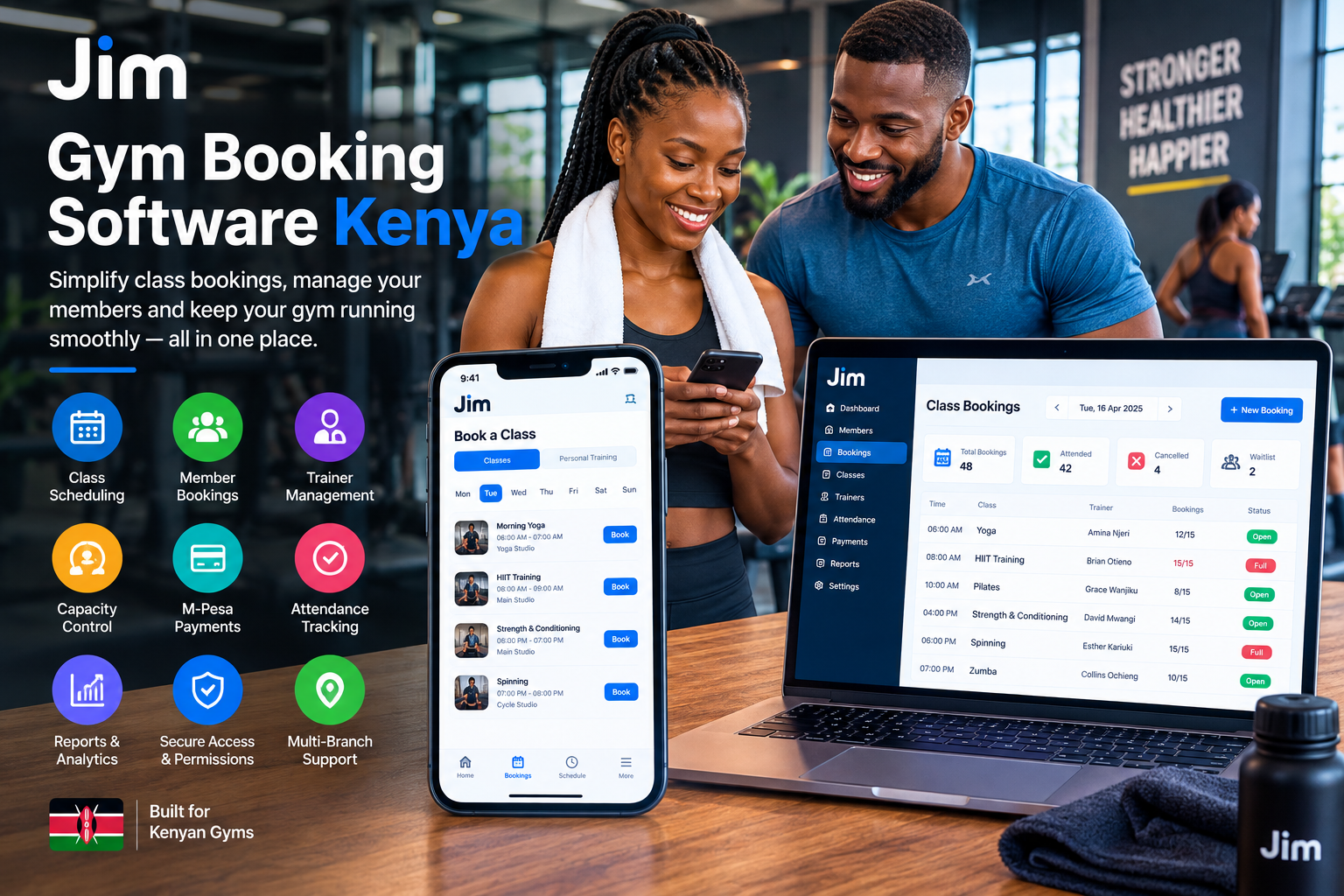
Running a gym involves far more than providing equipment and training space. Members need to find classes, reserve available sessions, trainers need reliable schedules, and front-desk teams need to know who is expected to attend. A well-organised Gym Booking Software Kenya solution brings these activities into a structured digital workflow, helping gym owners, fitness studios and health clubs manage reservations, classes, trainers and member attendance more efficiently. This guide explains what booking software does, why it matters, which features to consider, how it can fit Kenyan fitness businesses, and how to choose a system without paying for unnecessary complexity.
For a gym owner, booking management can quickly become difficult when reservations are handled through notebooks, WhatsApp messages, phone calls, spreadsheets and social media conversations. A member may ask whether a class has space, another may cancel, and a trainer may change availability. If those updates are not reflected in one central system, staff can easily lose track of the latest information.
That is why Gym Booking Software Kenya is becoming an important consideration for fitness businesses that want more organised operations. Booking technology is not simply about putting a timetable online. The real value comes from connecting the timetable with members, trainers, capacity, attendance, payments and business records.
This guide is intended for gym owners, managers, fitness studio operators, personal training businesses and teams responsible for member experience. It focuses on practical considerations rather than technical jargon.
What Is Gym Booking Software?
At its simplest, Gym Booking Software Kenya is a digital platform that allows fitness businesses to create schedules and manage reservations for classes, training sessions and other bookable activities.
Instead of asking members to contact reception every time they want to reserve a session, the business can establish a structured booking process. Depending on the software, members may be able to view available sessions, choose a suitable time, reserve a place and receive confirmation.
For the gym team, the system can provide a central view of:
- Scheduled classes
- Trainer availability
- Member bookings
- Available capacity
- Cancellations
- Attendance
- Waiting lists
- Session history
- Branch schedules
- Booking-related reports
A strong Gym Booking Software Kenya solution should therefore be considered part of the wider gym management process rather than an isolated calendar.
For example, suppose a Nairobi fitness centre runs morning strength classes, evening group sessions and individual personal-training appointments. If all reservations are recorded manually, reception staff may spend considerable time checking messages and updating spreadsheets. A booking system can give the team one source of information.
That creates a more predictable workflow.
Booking Software Is More Than an Online Calendar
An ordinary calendar shows dates and times. Booking software is designed around actions.
A member needs to reserve a session. A trainer needs to know who is attending. The business needs to control capacity. Reception may need to see whether a person has an active membership. Managers may want to compare attendance with available capacity.
This is where Gym Booking Software Kenya can provide more value than a basic scheduling tool.
The objective is not to digitise every task simply because technology is available. The objective is to remove unnecessary manual steps while keeping staff in control of important decisions.
Why Kenyan Gyms Need Better Booking Workflows
Kenyan fitness businesses operate in different ways. Some are small neighbourhood gyms with one location and a small team. Others operate larger facilities, group classes, personal training programmes or several branches.
Regardless of size, booking problems tend to appear when information is scattered.
A member might send a WhatsApp message to one staff member, while another staff member updates a spreadsheet. A trainer may change a session time, but reception may not hear about it immediately. Another member may arrive expecting a place in a class that has already reached capacity.
A central Gym Booking Software Kenya workflow can reduce these communication gaps.
The biggest benefits usually come from consistency.
1. Centralised Schedules
A central schedule gives staff and members a clearer reference point.
Instead of maintaining several versions of a timetable, the gym can work from one schedule containing class times, trainers, locations and capacity.
This is particularly useful when several trainers operate different programmes throughout the week.
2. Controlled Capacity
Popular classes can fill quickly.
Without a capacity control mechanism, staff may accidentally accept more bookings than the available space allows. That can create overcrowding and negatively affect the member experience.
With Gym Booking Software Kenya, the business can define the maximum number of participants for a session and monitor reservations against that limit.
Capacity management can be especially useful for activities where equipment or floor space is limited.
3. Better Member Convenience
Members generally appreciate being able to see available sessions without repeatedly contacting reception.
A digital booking workflow can make it easier for them to plan workouts around work, family responsibilities and travel.
For a busy professional in Nairobi, knowing that a preferred evening class has an available place can make the difference between attending a session and skipping it.
4. Reduced Administrative Work
Manual booking creates repetitive tasks.
Staff may need to:
- Receive a booking request.
- Check the timetable.
- Confirm capacity.
- Add the member to a list.
- Send confirmation.
- Update cancellations.
- Inform the trainer.
A Gym Booking Software Kenya platform can consolidate several of those steps.
The result is not necessarily fewer staff. Instead, staff can spend more time on member service and operational priorities rather than maintaining repetitive records.
Key Features to Look For
Not every booking platform offers the same capabilities. Before selecting software, gym owners should identify the features that actually match their operation.
The following features deserve particular attention.
Class Scheduling
Class scheduling is the foundation.
A good Gym Booking Software Kenya solution should make it straightforward to create recurring or individual sessions, assign trainers and communicate capacity.
The system should also make changes manageable. Fitness timetables change frequently because of trainer holidays, public holidays, special events and seasonal programmes.
The easier it is to update the schedule, the lower the risk of outdated information.
Trainer Assignment
A class without an assigned instructor can create confusion.
Booking software should allow management to connect trainers with relevant sessions. This helps the front desk understand who is responsible for a particular class and helps management maintain a clearer operational record.
For personal training businesses, the requirement can be even more important because each trainer may have individual availability.
A Gym Booking Software Kenya platform that handles trainer assignments can therefore support both group and one-to-one services.
Member Reservations
The member booking experience should be simple.
A member should not need to understand the internal structure of the software. They should be able to identify a session, understand the time and trainer, see availability and make a reservation.
If the process is unnecessarily complicated, members may return to informal channels such as WhatsApp or phone calls.
Capacity Limits
Capacity limits help businesses control the number of participants in a session.
For example:
| Activity | Possible Capacity Consideration |
|---|---|
| Yoga class | Available floor space |
| Indoor cycling | Number of bikes |
| Small-group training | Trainer-to-member ratio |
| Personal training | Trainer availability |
| Boxing class | Equipment and floor space |
| Functional training | Equipment and safety considerations |
The software should make those limits easy to configure.
Waiting Lists
A waiting list can help a gym manage demand for popular classes.
Suppose a Saturday morning session has 20 spaces and all spaces are booked. If one member cancels, staff should not have to search manually for someone who wanted the slot.
A Gym Booking Software Kenya system with waiting-list functionality can help manage that process more systematically.
The exact behaviour varies between platforms, so owners should confirm whether waiting-list promotions are automatic, manual or configurable.
Cancellation Management
Cancellations are part of normal gym operations.
A useful booking platform should record cancellations and make the resulting capacity visible.
Some businesses may also have cancellation policies, such as restrictions on late cancellations. If such policies are used, the software should support the operational process without creating unnecessary friction for staff.
Connecting Bookings With Memberships
One of the most important questions to ask is whether booking information can connect with member records.
A reservation means more when the business knows who made it.
For example, a member may have a particular membership plan, branch, expiry date or attendance history. Connecting those records gives staff more context.
This is where Gym Booking Software Kenya becomes more useful as part of a wider management platform.
Jim describes its platform as connecting memberships, billing, check-ins, scheduling and reporting within one workspace. Its scheduling workflow specifically supports classes, instructor assignment, member enrolment, capacity control, attendance records and branch-aware timetables.
That type of integration can reduce the need for staff to jump between different systems.
Booking and Membership Eligibility
Some gyms only allow active members to reserve classes.
In that situation, booking should ideally connect with membership status.
For example, if a member’s plan has expired, the system may need to prevent or flag a booking depending on the gym’s policies.
This can reduce situations where staff discover membership issues only when the member arrives.
A Gym Booking Software Kenya system should therefore be evaluated alongside membership-management functionality.
Connecting Bookings With Attendance
A booking does not necessarily mean attendance.
A member may reserve a class but fail to arrive. Another member may attend without completing the expected booking process.
For management, those differences matter.
Attendance information can help answer questions such as:
- Which classes are consistently full?
- Which classes have many no-shows?
- Which times are most popular?
- Which trainers have high attendance?
- Which sessions frequently have unused capacity?
- Are members attending regularly?
A Gym Booking Software Kenya platform that connects bookings with attendance can provide a clearer operational picture.
This is especially useful when a gym wants to adjust its timetable based on actual usage rather than assumptions.
M-Pesa and the Kenyan Fitness Market
Payment workflows are an important part of the Kenyan gym environment.
M-Pesa is widely used for business payments, so fitness businesses may want their management software to support payment-related workflows.
However, booking and payment should not necessarily be treated as the same feature.
A booking system answers questions such as:
- What session is being reserved?
- Who is attending?
- Is there capacity?
- Which trainer is assigned?
A payment system answers different questions:
- What does the member owe?
- Has an invoice been paid?
- What payment was received?
- What is the outstanding balance?
When these functions work together, the operational workflow becomes easier to manage.
Jim’s current Kenyan offering states that its platform supports KES billing and M-Pesa payment workflows, including STK Push and payment confirmation when the relevant ZivoPay integration is configured.
For a Gym Booking Software Kenya buyer, this is an important consideration because payment processes should fit naturally into the rest of the member journey.
How Booking Software Improves the Member Experience
Member experience is affected by many small interactions.
A member wants to know:
- What classes are available?
- When are they happening?
- Is there space?
- Who is teaching?
- Did my booking go through?
- Can I cancel?
- What happens if the class is full?
When answers are difficult to obtain, frustration increases.
A Gym Booking Software Kenya platform can create a more predictable experience by making booking information available through a consistent workflow.
Faster Reservations
Members do not always want to wait for a receptionist to respond.
Digital reservations can reduce the dependency on back-and-forth messages.
Clearer Availability
A visible capacity indicator can make the member’s decision easier.
Fewer Booking Errors
Centralised records can reduce duplicate bookings and conflicting information.
Easier Schedule Changes
If a class changes, staff can update the central schedule rather than contacting every member individually, depending on the platform’s communication capabilities.
Better Access to Information
Members can spend less time asking basic scheduling questions when relevant information is available through the booking process.
How Gym Owners Can Use Booking Data
Booking software creates useful operational data.
The value of the data depends on how the business uses it.
A Gym Booking Software Kenya platform can help management review patterns over time.
For example, a gym might discover that:
- Early morning sessions are consistently popular.
- Certain evening classes have lower attendance.
- Some trainers attract strong demand.
- Particular classes have frequent cancellations.
- A new class has grown steadily since launch.
These observations can support practical scheduling decisions.
The data should not replace management judgment. Instead, it gives owners a stronger factual basis for reviewing what is happening.
Booking Software for Small Gyms
Small gyms sometimes assume software is only useful for large fitness centres.
That is not necessarily true.
A smaller business may actually benefit significantly from reducing repetitive administrative work because it often has fewer people available to handle reception, sales, member support and management.
A Gym Booking Software Kenya platform can help a small gym establish consistent processes before administrative problems become harder to manage.
A small gym might start with:
- Member profiles
- Basic classes
- Trainer schedules
- Capacity limits
- Booking records
- Attendance
- Payment tracking
As the business grows, it can add more advanced processes where needed.
The key is to select software that matches the current operation rather than buying features that the business will never use.
Booking Software for Growing Fitness Studios
Fitness studios often operate differently from traditional gyms.
A studio may focus on:
- Yoga
- Pilates
- Dance
- HIIT
- Boxing
- Functional training
- Personal training
- Small-group coaching
Because these services are schedule-driven, booking becomes central to the customer experience.
A Gym Booking Software Kenya system can help studios organise their sessions while giving management greater visibility into capacity and attendance.
Studios should pay particular attention to recurring schedules, instructor management and capacity controls.
Booking Software for Multi-Branch Gyms
Multiple locations introduce another layer of complexity.
Each branch may have:
- Different trainers
- Different class schedules
- Different capacity limits
- Different equipment
- Different member patterns
At the same time, owners may want consolidated oversight.
A Gym Booking Software Kenya platform should therefore be evaluated for branch-aware scheduling.
Jim’s current platform describes branch permissions and branch-aware scheduling as part of its operational approach, allowing owners to maintain consolidated oversight while teams work with location-relevant information.
Questions for Multi-Branch Owners
Before choosing software, ask:
- Can each branch maintain its own timetable?
- Can trainers be assigned to specific locations?
- Can members book according to branch rules?
- Can management view consolidated activity?
- Are staff permissions branch-specific?
- Can reporting be filtered by location?
These questions can reveal whether a platform is genuinely designed for multi-location operations.
Booking Software and Personal Training
Personal training creates a different booking challenge.
Instead of managing a group class with 20 spaces, the gym may be managing individual trainer availability.
The system needs to reflect:
- Trainer schedules
- Client appointments
- Session duration
- Availability
- Cancellations
- Completed sessions
A Gym Booking Software Kenya solution that accommodates personal-training workflows can help reduce conflicts.
For example, a trainer should not be shown as available for two clients at the same time.
The booking system should make availability visible and reduce the chance of double-booking.
Booking Software and Class Attendance
Attendance is one of the most useful extensions of a booking workflow.
A booking says a member intended to attend. Attendance confirms what actually happened.
Jim’s attendance functionality supports membership validation, active-visit monitoring, attendance history and denied-access records.
A Gym Booking Software Kenya platform that connects these records can help management distinguish between demand and actual participation.
That distinction matters.
If 30 members book a class but only 15 attend consistently, the business may need to investigate why.
Possible reasons could include:
- Timing
- Class format
- Trainer preference
- Booking habits
- Transport challenges
- Competing activities
- Seasonal behaviour
The data does not automatically explain the cause, but it can identify patterns worth investigating.
Reducing No-Shows
No-shows can affect capacity planning.
A class with 20 spaces may appear fully booked, yet only 12 people arrive.
Depending on the business model, that can make the timetable less efficient.
A Gym Booking Software Kenya system can provide records that help the business understand no-show patterns.
Gyms can then consider appropriate operational responses, such as:
- Booking reminders
- Clear cancellation policies
- Waiting lists
- Earlier release of cancelled spaces
- Member communication
- Reviewing class schedules
The right approach depends on the gym’s customers and policies.
What About WhatsApp Bookings?
WhatsApp is widely used for business communication in Kenya, and many gyms naturally receive booking requests through messaging.
The goal is not necessarily to eliminate WhatsApp.
Instead, businesses should consider how informal conversations eventually become official records.
If a member sends a message saying, “Please reserve me for tomorrow’s 6 p.m. class,” someone still needs to record the booking.
A Gym Booking Software Kenya platform can provide the central record that staff use after receiving such requests.
As the business grows, encouraging members to use a structured booking channel may reduce administrative work even further.
Choosing the Right Booking Software
There are many booking platforms available, but the right choice depends on the business.
Before selecting one, identify the actual workflow.
Start by asking:
What Do Members Need to Book?
Is it:
- Group classes?
- Personal training?
- Court sessions?
- Equipment?
- Consultations?
- Events?
The answer determines which features matter.
How Many Locations Do You Have?
A single gym may need a straightforward schedule.
A multi-branch business may require branch-specific calendars and permissions.
How Many Staff Members Manage Bookings?
If only one person manages the schedule, the requirements may be different from a business with several receptionists and managers.
Do Bookings Need Membership Validation?
If classes are only available to active members, membership integration becomes important.
Do You Need Payment Integration?
If customers pay before booking, payment integration may be necessary.
Do You Need Reporting?
Managers who want to understand attendance and utilisation should consider analytics.
A Gym Booking Software Kenya platform should ultimately be evaluated against the business’s real processes.
Questions to Ask a Software Provider
A demonstration is useful, but asking specific questions is even more useful.
Before committing to a platform, ask the provider:
- How are classes created?
- Can recurring sessions be configured?
- Can trainers be assigned?
- Can capacity limits be set?
- Are waiting lists supported?
- Can members cancel bookings?
- Can staff make bookings on behalf of members?
- Can attendance be recorded?
- Can bookings connect to memberships?
- Can multiple branches be managed?
- What staff permissions are available?
- Can reports be exported?
- How are member records protected?
- How is payment information handled?
- What happens if the internet connection is interrupted?
- Is support available when staff encounter problems?
These questions can help separate genuinely useful platforms from systems that simply provide an online calendar.
Implementation: Moving From Manual Booking to Software
Switching systems requires planning.
A Gym Booking Software Kenya implementation should start with the existing booking process.
Document how reservations currently happen.
For example:
Current process
Member → WhatsApp → Receptionist → Spreadsheet → Trainer
Then consider the desired workflow:
Improved process
Member → Booking system → Confirmed reservation → Trainer schedule → Attendance
The second workflow has fewer points where information can become lost.
Step 1: Clean Existing Records
Before importing information, remove outdated or duplicate records.
Member information should be accurate enough for staff to work confidently.
Step 2: Configure Classes
Add the actual timetable rather than every possible future idea.
Start with active programmes.
Step 3: Add Trainers
Assign the appropriate instructors to their sessions.
Step 4: Define Capacity
Set realistic limits for each class.
Step 5: Train Staff
Receptionists and managers should understand how to create, modify and cancel bookings.
Step 6: Introduce Members Gradually
Explain the new process clearly.
Members should know where to find schedules and how to reserve sessions.
Step 7: Monitor Usage
Review booking behaviour after launch.
A Gym Booking Software Kenya implementation should be treated as an operational change, not simply a software installation.
Common Mistakes When Buying Booking Software
Choosing software based only on appearance can be a mistake.
A platform may have an attractive interface but fail to support the workflow the gym actually needs.
Mistake 1: Choosing Based Only on Price
Low cost does not automatically mean better value.
A cheap system may require manual workarounds that consume staff time.
Mistake 2: Ignoring Staff Permissions
Not every employee should necessarily have access to every record.
A Gym Booking Software Kenya platform should support appropriate access controls.
Jim’s current platform includes owner, admin and staff roles alongside branch permissions and audit-related controls.
Mistake 3: Ignoring Attendance
Bookings without attendance data provide only part of the picture.
Mistake 4: Forgetting Mobile Users
Many members will interact with gym information through phones.
The booking experience should therefore be practical on mobile devices.
Mistake 5: Buying Too Many Features
More features do not necessarily mean better results.
A gym should prioritise the capabilities that solve actual problems.
Security and Member Information
Gym systems may contain personal information, membership details, attendance records and payment-related information.
Security should therefore be considered before implementation.
When evaluating Gym Booking Software Kenya, ask about:
- User permissions
- Password management
- Data access
- Backups
- Audit records
- Account recovery
- Secure payment handling
- Data retention
- Staff access controls
Businesses should also consider their applicable legal and data-protection responsibilities.
The software provider should be able to explain how information is stored and protected.
Pricing Considerations
The price of booking software can vary considerably depending on the platform and its capabilities.
Rather than focusing only on the monthly subscription, consider total operating value.
Potential costs include:
- Subscription fees
- Setup
- Data migration
- Payment processing
- Additional staff accounts
- Additional branches
- Premium features
- Training
- Support
At the same time, consider potential savings from reducing manual administration.
A Gym Booking Software Kenya system may be worthwhile when the time saved and operational clarity outweigh the cost.
Jim’s current pricing page lists a Starter package at KSh 1,500 per month and a Growth package at KSh 6,500 per month, with custom packages also available. These prices are current on the website and should be rechecked before publication if pricing changes.
Measuring Whether Booking Software Is Working
Software should produce measurable operational improvements.
After implementation, management can monitor indicators such as:
- Number of bookings
- Attendance rate
- No-show rate
- Class utilisation
- Cancellation frequency
- Popular class times
- Trainer utilisation
- Member booking activity
- Booking-related enquiries
- Staff time spent on scheduling
A Gym Booking Software Kenya platform becomes more valuable when managers actually use the information to improve operations.
For example, if one class repeatedly operates at 95% capacity while another remains at 25%, management has a reason to investigate whether timetable changes are appropriate.
The Role of Automation
Automation should remove repetitive tasks while keeping important decisions visible.
Potential booking automations can include:
- Booking confirmations
- Reminders
- Cancellation updates
- Waiting-list notifications
- Attendance updates
- Schedule notifications
The exact capabilities vary between platforms.
A Gym Booking Software Kenya solution should be assessed based on which tasks it can automate reliably.
Automation is particularly valuable when the same task happens dozens or hundreds of times each month.
How Booking Fits Into Complete Gym Management
Booking is only one part of running a fitness business.
A complete operational workflow may look like this:
Lead
A prospective customer contacts the gym.
Trial
The prospect attends a trial session.
Membership
The person chooses a membership plan.
Billing
Invoices and payments are recorded.
Booking
The member reserves classes or training sessions.
Attendance
Visits are recorded.
Engagement
Staff monitor participation.
Renewal
The membership approaches expiry.
Retention
The business follows up where appropriate.
A Gym Booking Software Kenya platform is most useful when booking information can connect naturally to the rest of this journey.
Jim’s current platform positions scheduling alongside memberships, billing, check-ins, staff, workouts, inventory and reporting rather than treating scheduling as an isolated function.
Practical Example: A Nairobi Fitness Centre
Consider a hypothetical fitness centre in Nairobi with three group classes every weekday.
The gym has:
- 15-person morning sessions
- 20-person evening sessions
- Three trainers
- One reception team
- Several membership plans
Previously, members sent messages to reception.
When a class filled, reception had to tell new members that no spaces were available.
If someone cancelled, the receptionist had to remember which person had requested the slot.
After introducing Gym Booking Software Kenya, the gym creates its weekly timetable, sets capacity, assigns trainers and records member reservations.
The operational difference is straightforward.
Staff have a central schedule.
Members can see availability.
Trainers can see their classes.
Managers can review attendance.
When a class is popular, the business has actual booking data rather than relying only on informal feedback.
Practical Example: A Small Fitness Studio
Consider a smaller studio offering yoga and personal training.
The owner manages most operations personally.
Before software, clients contact the owner through WhatsApp.
The owner checks a notebook before confirming availability.
This works initially, but it becomes difficult as client numbers grow.
A Gym Booking Software Kenya system can provide a structured calendar and client record.
The owner can see upcoming sessions without searching through conversations.
The improvement is not necessarily dramatic on day one. The real benefit is consistency as the business grows.
Practical Example: A Multi-Branch Gym
A gym with three branches faces different scheduling challenges.
The same trainer may work at different locations on different days.
Members may have different access rules.
Management wants to see overall performance but branch managers need local information.
A Gym Booking Software Kenya solution with branch-aware workflows can help separate local operations from central management.
This can make it easier to answer questions such as:
- Which branch has the busiest classes?
- Which trainers are assigned where?
- What sessions are available at each location?
- How much capacity is being used?
- Which schedules need adjustment?
Future-Proofing Your Gym’s Booking Process
A gym’s needs may change.
A small facility may later introduce:
- More trainers
- More classes
- Additional locations
- Personal training
- Online programmes
- New membership tiers
- Retail sales
- More advanced reporting
The software should not make growth unnecessarily difficult.
When evaluating Gym Booking Software Kenya, ask where the platform can take the business in two or three years.
The aim is not to predict every future requirement.
It is to avoid selecting software that becomes unsuitable as soon as the gym grows.
Frequently Asked Questions
What is Gym Booking Software?
Gym Booking Software Kenya refers to digital software that helps fitness businesses manage class schedules, member reservations, trainer availability, capacity and attendance.
It can replace or reduce manual booking processes involving notebooks, spreadsheets, phone calls and messaging.
Is Gym Booking Software useful for small gyms?
Yes. Gym Booking Software Kenya can be useful for small gyms because it can organise bookings without requiring a large administrative team.
Small businesses should select a system that matches their current needs rather than paying for unnecessary functionality.
Can booking software manage fitness classes?
Yes. Gym Booking Software Kenya can support class creation, scheduling, trainer assignment, member enrolment and capacity management, depending on the platform.
Jim’s scheduling functionality currently includes class creation, instructor assignment, member enrolment, capacity control, attendance records and branch-aware timetables.
Can members book gym sessions online?
This depends on the software and its member-facing functionality. A Gym Booking Software Kenya platform can provide a structured way for members to reserve available sessions rather than relying entirely on reception staff.
Before purchasing, confirm exactly how members make and manage bookings.
Does booking software support personal trainers?
Many systems can support personal training appointments. A Gym Booking Software Kenya platform should be checked for trainer calendars, availability controls, appointment duration and cancellation management.
Can booking software connect with attendance?
Yes, depending on the platform. Gym Booking Software Kenya can form part of a workflow where reservations and actual attendance are reviewed together.
This allows gym managers to compare planned participation with actual visits.
Does Jim support gym scheduling?
Yes. Jim currently provides scheduling functionality for classes, trainers and members. Its scheduling page lists class creation, instructor assignment, member enrolment, capacity control, attendance records and branch-aware timetables.
Can Kenyan gyms connect bookings with M-Pesa workflows?
Booking and payments are separate functions, but an integrated gym platform can connect them operationally. Jim’s current Kenyan offering supports KES billing and M-Pesa payment workflows when the relevant integration is configured.
What should I check before buying booking software?
Review Gym Booking Software Kenya based on the features your business actually needs.
Check scheduling, capacity, trainer management, member records, attendance, branch support, permissions, reporting, payments, support and pricing.
Do not select software simply because it has a long feature list.
How much does gym booking software cost in Kenya?
Pricing depends on the provider, plan, number of members, branches and included features. Gym Booking Software Kenya should be evaluated using total value rather than subscription price alone.
Always confirm current pricing directly with the provider before making a purchasing decision.
A Simple Checklist for Gym Owners
Before choosing software, use this checklist.
Booking
- Can members reserve sessions?
- Can staff create bookings?
- Can bookings be cancelled?
- Are waiting lists available?
Scheduling
- Can recurring classes be created?
- Can trainers be assigned?
- Can schedules be changed quickly?
- Can different branches have different timetables?
Capacity
- Can maximum class sizes be configured?
- Can available spaces be monitored?
- Can cancellations release spaces?
Members
- Are bookings connected to member profiles?
- Can membership status be checked?
- Can staff view booking history?
Attendance
- Can actual attendance be recorded?
- Can no-shows be identified?
- Can managers view attendance history?
Management
- Are reports available?
- Can access permissions be configured?
- Can owners view multiple branches?
- Can operational information be exported?
Payments
- Can the platform connect with billing?
- Does it support relevant Kenyan payment workflows?
- Can invoices and payment records be connected to members?
A Gym Booking Software Kenya solution that checks the right boxes can become a practical part of daily gym management.
Final Thoughts
Booking is one of the most visible parts of a member’s relationship with a fitness business. When reservations are confusing, staff spend time resolving avoidable problems. When schedules are clear, capacity is controlled and attendance is recorded properly, the entire operation becomes easier to understand.
The right Gym Booking Software Kenya platform should therefore do more than display a timetable. It should fit into the gym’s broader workflow, connecting classes, trainers, members, capacity and attendance while reducing repetitive administration.
For Kenyan gyms, local operational requirements also matter. Payment workflows, M-Pesa, branch structures, staff permissions and the realities of small and growing businesses should all be considered when evaluating software.
The strongest approach is to start with the problems your gym currently faces. If staff spend too much time answering booking messages, look for better reservation workflows. If classes frequently exceed capacity, prioritise capacity controls. If managers cannot compare bookings with attendance, look for connected records. If multiple branches operate independently, look for branch-aware scheduling.
Ultimately, Gym Booking Software Kenya should make the gym easier to operate without making the team dependent on complicated processes.
A good implementation starts small, trains staff properly, communicates the new process to members and measures the results. As the business grows, the booking system can become part of a broader management environment covering memberships, billing, attendance, scheduling, staff and reporting.
For gyms and fitness businesses in Kenya, that connected approach can provide a clearer operational foundation for serving members and managing daily activities.