
24- Hour Gym Access Control System: A Complete Guide for Kenyan Gyms
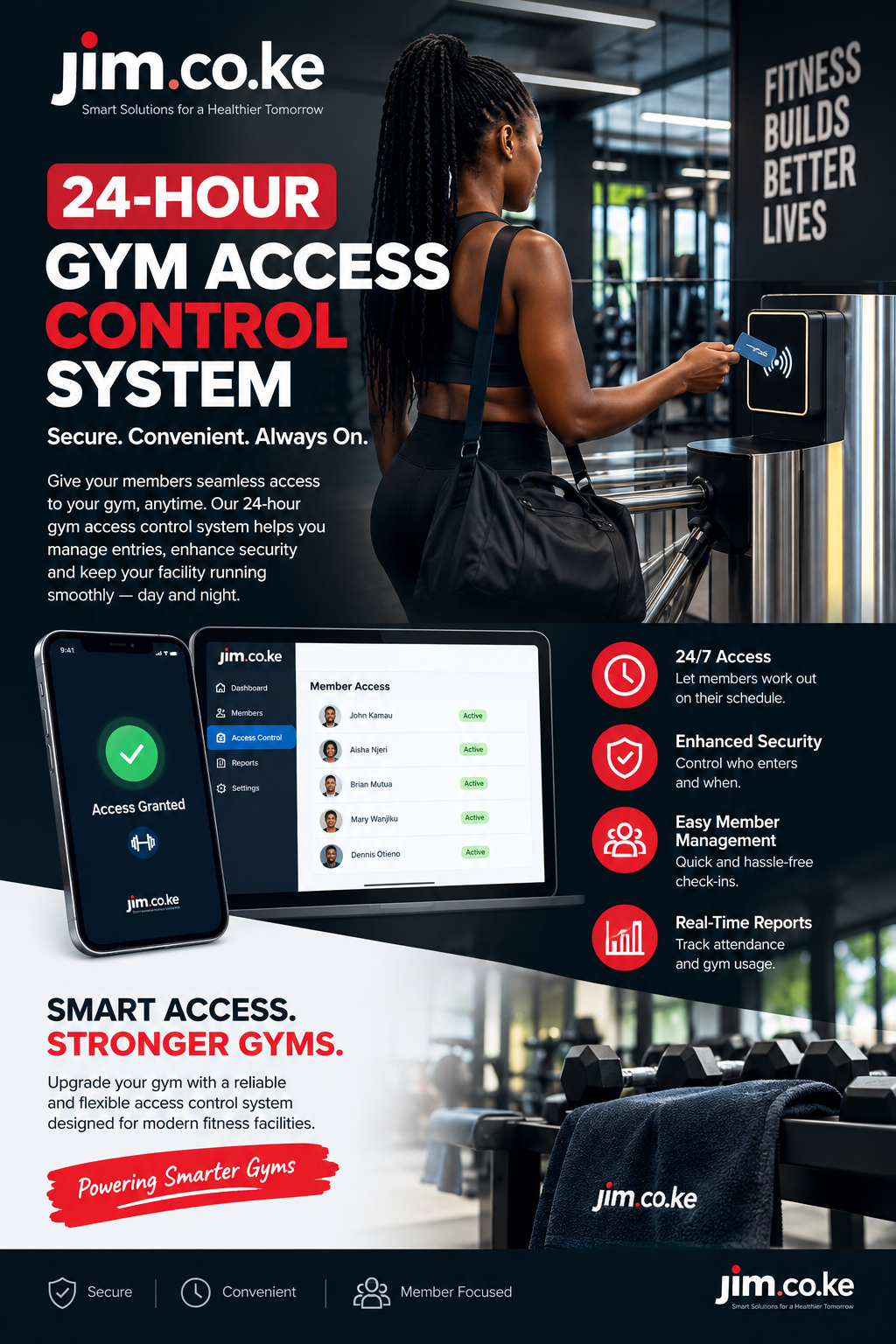
24- Hour Gym Access Control System: How to Manage Secure, Round-the-Clock Gym Access in Kenya
Running a gym beyond conventional business hours gives members greater freedom to exercise before work, late at night or during quieter periods. However, allowing people to enter a fitness facility at any time requires more than leaving the doors unlocked. A 24- hour gym access control system helps gym owners manage entry permissions, verify memberships, reduce unauthorized access and maintain better control over their facilities even when reception staff are unavailable.
For fitness businesses in Kenya, extended opening hours can attract professionals with demanding schedules, university students, shift workers and members who prefer exercising outside peak periods. Yet these advantages come with practical challenges, including membership verification, security, equipment protection, visitor management and accountability for every person entering the premises.
This guide explains how automated gym access works, which features matter most, how to select suitable equipment and software, and what Kenyan gym owners should consider before introducing unstaffed or overnight access. It also explores implementation costs, operational policies, common mistakes and ways to make extended opening hours safer and more convenient for members.
1. What Is a 24-Hour Gym Access Control System?
A 24- hour gym access control system is a combination of access-management software and entry hardware that determines who can enter a gym, when they can enter and which areas they are permitted to use.
Depending on the equipment installed, members might gain entry using a membership card, PIN, QR code, mobile credential or biometric verification. The system checks the presented credential against membership records and applicable access rules before granting or denying entry.
Unlike a traditional reception desk, automated access control does not require an employee to verify every membership manually. The process can operate according to predefined rules, making it useful for facilities that remain open outside normal staffed hours.
How the system works
A typical arrangement follows a straightforward sequence:
-
A member approaches the controlled entrance.
-
The member presents an approved credential.
-
A reader captures the credential and sends the information to the access controller or connected software.
-
The system checks whether the membership is active and whether entry is permitted at that time.
-
If the request satisfies the configured rules, the door or turnstile unlocks.
-
The access event is recorded where the selected system supports event logging.
For example, a gym in Nairobi might allow active members to enter from 5 a.m. until midnight, while premium members receive access throughout the night. The rules depend on the gym’s membership agreements and operating policies.
A properly configured 24- hour gym access control system can also help staff identify failed entry attempts, review membership status and investigate unusual access patterns.
How it differs from an ordinary gym entry arrangement
| Traditional entry method | Automated access control |
|---|---|
| Staff usually check membership manually. | Software verifies credentials against configured rules. |
| Entry depends heavily on reception availability. | Approved entry can operate outside staffed hours. |
| Paper registers may be used. | Supported systems record electronic access events. |
| Expired memberships may be overlooked. | Expiry rules can automatically restrict entry. |
| Access permissions are difficult to manage manually at scale. | Permissions can be managed centrally through compatible software. |
The main difference is that access becomes a managed process rather than an informal decision made at the door.
2. Why Kenyan Gyms Are Considering Round-the-Clock Access
Members do not all follow the same daily routine. Some train before sunrise, others exercise after evening classes, and some prefer late-night sessions because their workplaces have unpredictable schedules.
A 24- hour gym access control system gives gym operators a way to support these schedules without requiring a receptionist to remain at the entrance throughout the day and night.
Serving members with different schedules
Consider a member who starts work at 7 a.m. and finishes in the evening. A gym that closes early may be inconvenient, even if its facilities and trainers are excellent.
Extended access creates more opportunities for members to exercise when it suits them. This can make a membership more practical for people whose availability changes from one day to another.
Potential member groups include:
-
Office workers who prefer early-morning workouts.
-
Healthcare workers and other shift employees.
-
University students with changing class timetables.
-
Entrepreneurs who exercise after completing business activities.
-
Experienced gym users who prefer quieter training periods.
-
Members who need greater flexibility on weekends and public holidays.
A 24- hour gym access control system helps support this flexibility by applying membership permissions consistently, regardless of whether reception is open.
Supporting a more flexible business model
A gym can introduce extended hours as a feature of selected membership plans, provided that the access arrangements, staffing, safety provisions and local requirements support the proposed operating model.
For example, a facility could offer ordinary memberships during staffed hours and a premium option that permits overnight entry. Another gym might provide extended access to every fully registered member.
The appropriate model depends on customer demand, building arrangements, security requirements and the cost of operating during quiet periods. Gym owners should validate demand before investing in an expensive installation.
Improving the member experience
Convenience is part of the service a fitness business provides. If members must wait for someone to open a door or confirm a payment before every workout, the process can become frustrating.
An automated entry arrangement can make routine visits more straightforward. Once a member’s account and credential are properly configured, entry can take place without repeated manual checks.
A 24- hour gym access control system can therefore support a smoother membership experience, particularly when integrated with accurate membership records and a reliable process for resolving failed entry attempts.
3. Essential Features to Look for in Gym Access Software
Not every gym needs the same hardware or access rules. A boutique fitness studio with one entrance has different requirements from a large facility with multiple doors, changing rooms and separate training zones.
Before choosing a 24- hour gym access control system, identify the operational problems you want the technology to solve. This prevents you from paying for features that do not improve your actual operations.
Membership verification
Membership verification is one of the most important capabilities. The system should determine whether a member has a valid account and the necessary permission to enter.
Useful checks include:
-
Whether the membership is active.
-
Whether the membership has expired.
-
Whether the account has been suspended.
-
Whether the credential belongs to a registered member.
-
Whether the member’s plan includes the requested access hours.
-
Whether an administrator has temporarily restricted entry.
These checks reduce reliance on visual inspection of membership cards or handwritten records.
A 24- hour gym access control system should apply these rules consistently and give authorized staff a clear way to investigate incorrect denials.
Multiple credential options
Different members have different preferences. Some are comfortable carrying a membership card, while others prefer using a smartphone.
Depending on the hardware and software, access credentials may include:
-
RFID or NFC membership cards.
-
PIN codes.
-
QR codes.
-
Mobile access credentials.
-
Biometric verification, where appropriate and lawfully implemented.
A gym should evaluate each method based on convenience, security, reliability and cost.
Cards can be easy to issue but may be lost or shared. PINs can be convenient but may be disclosed to other people. QR codes may be suitable for mobile-based entry, although screenshot sharing and credential misuse must be considered.
Biometric systems may reduce some forms of credential sharing, but they introduce additional privacy, security and operational considerations. They should not be adopted simply because they appear more sophisticated.
Membership expiry and renewal rules
An expired membership should not continue granting access merely because the member still possesses a valid card.
The software should apply membership dates and restrictions correctly. Where payment processing is integrated, it may also support workflows that update account status after a successful payment, subject to the integration’s capabilities.
For Kenyan gyms, payment records may involve M-Pesa, bank transfers, card payments or cash transactions. The access system should reflect the gym’s actual payment-confirmation process rather than assuming that every payment is automatically verified.
A 24- hour gym access control system with reliable expiry management can reduce administrative errors and make membership enforcement easier.
Access schedules and membership tiers
A gym may have several membership categories, each with different conditions.
| Membership category | Example access policy |
|---|---|
| Standard | Entry during specified operating hours |
| Extended-hours | Early-morning and late-evening entry |
| Premium | Access throughout the day and night |
| Corporate | Access according to an agreed company plan |
| Temporary | Entry within a defined validity period |
These are examples, not standard industry rules. The gym determines the actual benefits offered.
A 24- hour gym access control system should allow administrators to configure permissions that match the membership agreement and enforce them without requiring separate manual checks for every visit.
Entry logs and reporting
Access logs help gym managers understand what happens at the entrance. Depending on the product, reports may show successful entries, rejected credentials, timestamps, door events and other operational information.
These records can help answer questions such as:
-
Which hours attract the most visits?
-
How frequently are access attempts rejected?
-
Are expired credentials still being presented?
-
Does a particular entrance experience repeated technical problems?
-
Are there unexplained access events that require investigation?
Access records should be retained only as appropriate for legitimate operational and security purposes. The gym should define who can view them and how long they are kept.
A 24- hour gym access control system becomes more useful when reports are easy to understand and provide information that staff can act on.
4. Access Control Hardware: Choosing the Right Equipment
Software cannot control a physical entrance without compatible hardware. The equipment selected should suit the building, expected traffic, entrance layout and required level of security.
Electronic door locks
Electronic locks allow a door to remain secured until the appropriate access condition is met. They can be installed on suitable doors and connected to compatible access controllers.
Before installation, assess the door’s construction, locking arrangement, power requirements and emergency-release provisions. A lock that works well on one door may be unsuitable for another.
A 24- hour gym access control system should be installed with hardware that can withstand the gym’s daily traffic and local environmental conditions.
Turnstiles and entry gates
Turnstiles can help regulate movement through a designated entrance. They may be useful in busy commercial gyms, larger fitness centres and facilities that want to manage pedestrian flow.
However, turnstiles require careful planning. Consider accessibility for people with disabilities, emergency evacuation, space requirements and the need to accommodate deliveries or authorized visitors.
A turnstile should never be treated as a substitute for an emergency exit. Emergency routes must remain compliant with applicable safety requirements.
Card and credential readers
Readers capture the credential presented by the member. Their capabilities depend on the technology supported by the reader and the associated controller.
When evaluating readers, consider:
-
Compatibility with existing membership software.
-
Credential security and the ability to revoke lost credentials.
-
Indoor or outdoor installation requirements.
-
Expected daily usage.
-
Maintenance and replacement availability.
-
Behaviour during a network or power interruption.
A 24- hour gym access control system should use readers and controllers that work reliably together instead of combining equipment without confirming compatibility.
Cameras and supporting security equipment
Cameras may help authorized personnel investigate incidents and understand what happened around an entrance. They are complementary security measures, not proof that an entry-control system is working correctly.
Camera placement should respect privacy, especially around changing rooms, showers and other sensitive areas. Access to footage should be restricted, and retention practices should follow applicable law.
Depending on the site, other useful equipment may include door-position sensors, alarms, backup power and communication devices.
A 24- hour gym access control system is strongest when its hardware is part of a broader, properly planned security arrangement.
5. Integrating Access Control With Gym Management Software
Gym owners often maintain several types of information: member details, payment records, membership plans, attendance, class bookings and staff permissions. If each system operates independently, staff may have to repeat the same work in several places.
Integration can reduce this duplication, but the specific functions available depend on the software products involved.
Keeping membership records consistent
Suppose a member renews a monthly plan at reception. If the membership database updates successfully but the access controller continues using an old record, the member may be denied entry.
A suitable integration should define how changes are communicated between systems and how failed synchronizations are detected.
The gym should test common scenarios, including renewals, suspensions, refunds, cancellations and changes to membership tiers.
A 24- hour gym access control system that works with gym management software can help maintain consistency between membership administration and entrance permissions, provided the integration is properly supported.
Connecting attendance and member management
Attendance records can help staff understand visit frequency and identify service issues. For example, a manager might notice that members frequently abandon entry attempts during a particular hour.
However, low attendance does not automatically mean that a member is dissatisfied. Travel, work, illness, changing routines and many other factors can affect gym visits.
Use attendance information as a starting point for useful service improvements rather than making unsupported assumptions about individual members.
Payment integration and M-Pesa
M-Pesa is an important payment option for many Kenyan businesses. A gym may accept payments through an appropriate M-Pesa arrangement and connect payment confirmation to its membership workflow.
Before assuming that access will activate automatically, confirm whether the gym’s payment provider, membership software and access controller support the required integration.
A practical payment workflow should account for:
-
The member initiating a payment.
-
The payment provider confirming the transaction.
-
The gym matching the payment to the correct account.
-
The membership record updating appropriately.
-
The access permissions reflecting the confirmed membership status.
-
Staff handling unmatched, delayed, reversed or disputed transactions.
A 24- hour gym access control system should not grant paid membership privileges solely because a member shows an unverified payment message.
Handling connectivity interruptions
A network interruption should not create unnecessary confusion at the entrance. Ask suppliers whether the system supports local credential validation, offline operation or another documented fallback.
Offline behaviour varies significantly. Some systems can validate previously synchronized credentials, while others depend on a live connection for particular functions.
The gym must understand which actions remain available, how changes are synchronized after service returns and how the system prevents unauthorized access during disruptions.
A 24- hour gym access control system should have a clearly documented recovery procedure, including what staff should do when entry cannot be verified electronically.
6. Security Considerations for Unstaffed Gym Hours
Operating without a receptionist present is not the same as operating without security responsibilities. A gym that permits late-night entry needs procedures for protecting members, staff, equipment and the premises.
A 24- hour gym access control system can support those procedures, but it cannot independently prevent every incident.
Preventing unauthorized entry
One common problem is credential sharing. A member may allow a friend to enter using their card or PIN, even when the friend’s membership is inactive.
Possible controls include:
-
Using individual credentials rather than shared access codes.
-
Revoking lost or stolen credentials promptly.
-
Reviewing suspicious access events.
-
Training members not to admit unverified visitors.
-
Installing suitable entrance monitoring where lawful.
-
Establishing clear guest and visitor procedures.
-
Using anti-passback or occupancy features if supported and appropriate.
Anti-passback rules can restrict repeated use of a credential without the expected exit event. However, these controls need careful configuration and may not suit every entrance arrangement.
A 24- hour gym access control system should complement clear membership rules and appropriate physical security rather than relying on a single feature.
Emergency access and evacuation
Emergency access requires special attention. Electronic locks and turnstiles must not prevent occupants from leaving during an emergency.
Gym owners should consult qualified installers and relevant safety professionals to determine the correct locking configuration, emergency release mechanism, alarm integration and evacuation arrangements.
The design should consider fire, medical emergencies, power failures and incidents that require the immediate movement of people out of the facility.
A 24- hour gym access control system should be tested against the building’s emergency procedures before the gym begins unstaffed operations.
Supporting members who need assistance
Members may experience an injury, become unwell or encounter a problem with equipment during a late-night session. The absence of reception staff makes it particularly important to provide clear instructions for getting help.
Depending on the facility, appropriate measures may include:
-
Clearly displayed emergency contact instructions.
-
Reliable mobile connectivity or an alternative communication method.
-
Accessible first-aid equipment.
-
Staff trained in relevant emergency procedures.
-
Appropriate incident reporting and escalation processes.
-
A documented process for contacting emergency services.
A 24- hour gym access control system should be part of a wider operating plan that addresses member welfare, not simply the opening and closing of doors.
Power failure and equipment faults
Access equipment relies on electrical power, and some configurations also depend on network connectivity. The behaviour during a power failure depends on the locks, controller, backup power and emergency design.
Ask the installer to explain whether the equipment releases or remains secured during different fault conditions and how emergency egress is maintained.
A 24- hour gym access control system should be evaluated through realistic fault testing, including loss of power, failed readers, disconnected network equipment and unsuccessful credential synchronization.
7. Choosing an Access Method for Your Members
The best access method is not necessarily the most expensive. It is the method that balances convenience, security, reliability, accessibility and total operating cost.
Membership cards
Cards are familiar and straightforward to distribute. They can be suitable for members who do not want to depend on a smartphone every time they exercise.
However, cards can be lost, forgotten, copied in some implementations or passed to another person. The security of the card technology matters, so gym owners should ask about credential protection rather than considering every RFID card equally secure.
A 24- hour gym access control system should make it easy for authorized staff to deactivate lost cards and issue replacements.
PIN-based entry
A PIN can eliminate the need to carry a physical card. It may also be practical for small facilities that want a simple entry method.
The main weakness is that codes can be shared. Reusing one PIN for every member makes accountability difficult because the code no longer identifies the person who actually entered.
If PIN access is selected, consider unique credentials, suitable code-management rules and a process for changing compromised codes.
A 24- hour gym access control system should allow access credentials to be managed without making security unnecessarily difficult for legitimate members.
QR codes and mobile access
QR-based entry may work well for gyms that already use digital membership passes or mobile applications. Members can present a code to a compatible reader rather than carrying a separate card.
The gym should establish how codes are issued, how they expire, whether screenshots can be reused and how the system handles phones with flat batteries or poor connectivity.
Mobile credentials may also provide a convenient way to deliver membership updates, but they depend on the capabilities of the selected platform.
A 24- hour gym access control system can support a more convenient digital experience when its credential technology suits the members’ needs and the entrance’s technical requirements.
Biometric access
Biometric verification may use characteristics such as fingerprints or facial features. Depending on the implementation, it can help reduce reliance on cards and PINs that members might share.
However, biometric information creates additional privacy and security risks because it relates to an individual’s physical characteristics. A compromised password can be changed more easily than a person’s fingerprint.
Before deploying biometrics, assess necessity, proportionality, security, consent or other applicable lawful grounds, retention, access restrictions and alternative entry arrangements. Kenyan data-protection requirements should be reviewed with appropriate professional guidance.
A 24- hour gym access control system should use biometric functionality only where the benefits justify the added complexity and the implementation meets applicable legal obligations.
8. How to Implement Automated Access at a Kenyan Gym
A successful installation begins with understanding how the gym operates. Buying a reader and connecting it to a lock is not enough if membership records are inaccurate or emergency procedures have not been considered.
Step 1: Assess the existing facility
Inspect the main entrance, secondary doors, emergency exits, reception area and any spaces requiring separate permissions.
Record the number of members, expected peak traffic, operating hours and the current process for issuing memberships.
A small gym with one entrance may need a different arrangement from a large facility with several access points. Consider building ownership rules and obtain the necessary approvals before modifying doors or shared property.
Step 2: Define access policies
Decide which membership plans permit extended entry, whether guests are allowed, how suspensions work and what happens when an account expires.
Document how staff approve exceptions and how quickly permissions must be updated after a cancellation or payment confirmation.
A 24- hour gym access control system will only enforce these rules correctly if the underlying policies are clear and the software is configured properly.
Step 3: Choose compatible hardware and software
Request a demonstration that uses the types of memberships and entry scenarios found in your facility.
Confirm whether the solution includes the controller, reader, locking equipment, software, installation, training and ongoing support, or whether these are purchased separately.
Ask for written details about compatibility, warranty, maintenance, software updates and integration capabilities.
Step 4: Prepare membership records
Review existing records before migrating them. Duplicate accounts, incorrect contact details, outdated membership dates and missing payment information can all lead to access problems.
Assign individual credentials and ensure that each credential is connected to the correct account.
A 24- hour gym access control system should be introduced alongside a reliable process for correcting membership data.
Step 5: Test real-world situations
Test the system before enabling extended access for every member.
The test plan should include:
-
A valid active membership.
-
An expired membership.
-
A suspended account.
-
A lost credential that has been deactivated.
-
A membership with restricted hours.
-
A failed payment confirmation.
-
A network outage.
-
A power interruption.
-
An emergency exit procedure.
-
A failed reader or locking component.
Record the outcome of each test and correct faults before launch.
Step 6: Train staff and members
Employees should know how to add members, update permissions, revoke credentials, investigate denied entry and report faults.
Members need clear instructions on how to enter, what to do if their credentials fail, whether guest entry is permitted and how to contact support outside staffed hours.
A 24- hour gym access control system works best when users understand the rules and the gym has a reliable way to resolve problems.
Step 7: Monitor performance after launch
Review system reports, member feedback and incidents during the first weeks of operation.
Look for repeated access failures, unexplained entries, synchronization problems and periods when the entrance becomes congested.
Use the findings to adjust configurations, improve instructions and plan maintenance.
A 24- hour gym access control system should be treated as an ongoing operational service, with periodic checks rather than a one-time installation.
9. Understanding the Cost of Gym Access Control in Kenya
There is no single price that applies to every installation. The total investment depends on the number of entry points, the type of locking equipment, the access method, software licensing, installation complexity and ongoing support.
Gym owners should compare complete proposals rather than looking only at the advertised price of a card reader.
Main cost components
| Cost component | What to evaluate |
|---|---|
| Access readers | Supported credentials, durability and compatibility |
| Electronic locks | Door suitability, safety and reliability |
| Turnstiles or gates | Traffic capacity, accessibility and installation needs |
| Access controller | Supported doors, integrations and offline capabilities |
| Management software | Membership rules, reporting and administration |
| Installation | Cabling, electrical work, mounting and configuration |
| Backup power | Required runtime and supported equipment |
| Support and maintenance | Response times, replacement parts and software updates |
| Training | Staff onboarding and operating instructions |
Some suppliers may offer a complete package, while others quote each component separately. Request an itemized quotation that identifies what is included and what may attract additional charges.
Questions to ask before paying
Ask suppliers:
-
Is the quotation for one entrance or several?
-
Are installation and configuration included?
-
Are there recurring software or cloud-hosting fees?
-
Does the price include membership management?
-
Are M-Pesa or other payment integrations supported, and at what additional cost?
-
Is remote administration available?
-
What happens if the internet connection fails?
-
Is there a warranty on the hardware?
-
How are repairs and replacement parts handled?
-
Can the equipment work with the gym’s existing doors?
-
Are future software updates included?
-
What training will the supplier provide?
Request demonstrations and references where available. Confirm all prices, taxes, renewal terms and service commitments in writing rather than relying on verbal promises.
Calculating whether the investment makes sense
A gym can estimate the financial value of automated entry by considering additional membership revenue, avoided staffing costs where genuinely achievable, administrative savings and ongoing system expenses.
For example, assume a gym is considering a hypothetical installation costing KSh 180,000. If the gym estimates that the system could contribute KSh 15,000 in net monthly operating benefits after accounting for relevant recurring expenses, the simple payback calculation would be:
KSh 180,000 ÷ KSh 15,000 = 12 months.
This is only an illustration, not a market price or a guarantee of returns. Actual results depend on demand, operating expenses, member retention and the amount of staffing that can safely be reduced.
Gym owners should also consider the value of better records and member convenience, while avoiding counting the same financial benefit twice.
10. Operational Policies for Gyms Open at Night
Technology can enforce entry rules, but the gym still needs clear policies governing what happens after members enter the facility.
Establish clear member responsibilities
Every member should understand the rules for using the premises outside staffed hours.
The membership agreement and supporting guidance should explain:
-
Which hours the membership permits.
-
Whether guests may enter.
-
How members must protect their credentials.
-
How to report a lost card or compromised PIN.
-
What to do if the door does not open.
-
How to report equipment faults or suspicious activity.
-
Which emergency contacts are available.
-
What restrictions apply to particular training areas.
These instructions should be accessible before a member begins using extended access.
Decide how guest access will work
Guest policies require particular care when no employee is present. A guest may need identity verification, a waiver, payment confirmation, an orientation or supervision before entering.
If the gym cannot complete the required checks outside staffed hours, it may be safer to restrict guest registration to designated times.
Do not allow members to bypass the entrance process by holding doors open for people whose permissions have not been verified.
Create a maintenance and incident process
The gym should maintain a record of equipment failures, access complaints, injuries, security concerns and corrective actions.
Assign responsibility for reviewing reports and deciding when an incident requires escalation. Define how members can contact someone if the entrance is malfunctioning or a safety concern arises.
A documented process helps staff distinguish minor technical issues from events requiring immediate intervention.
11. Privacy and Data Protection
Access systems can process information about people’s identities, membership status, entry times and movements through a facility. Some configurations also process photographs, biometric identifiers or video footage.
Gym operators should understand what information is collected, why it is needed and who can access it.
Collect only necessary information
Do not collect more information than is reasonably necessary for the intended purpose.
For example, a gym may need a member identifier and entry timestamp to manage access. It may not need to retain extensive movement histories indefinitely.
If biometric verification or video monitoring is proposed, conduct an appropriate assessment of the risks and legal obligations before deployment.
Restrict access to records
Administrative permissions should reflect staff responsibilities. Reception staff may need to manage membership accounts, while only designated personnel may need access to security reports or video footage.
Use strong authentication, individual staff accounts and appropriate controls on exporting or sharing records.
Establish retention and deletion rules
Decide how long different categories of information need to be retained and when they should be securely deleted.
Retention periods should reflect legitimate operational needs, applicable legal obligations and any relevant incident or dispute requirements.
Kenyan gym operators should review the Data Protection Act, 2019, applicable regulations and guidance from the Office of the Data Protection Commissioner. Requirements depend on the actual processing activities, the information involved and the circumstances of the business.
Do not assume that placing a privacy notice at reception automatically resolves every data-protection obligation.
12. Common Mistakes to Avoid
Even a well-designed installation can create problems if the gym’s processes are poorly planned.
Buying hardware before defining requirements
A cheap reader may not support the intended membership software, credential type or entrance hardware.
Better approach: Document the requirements first and obtain written confirmation of compatibility before purchasing equipment.
Relying on a single shared PIN
One code shared by every member makes it difficult to establish who entered and allows access to continue even after an individual membership ends.
Better approach: Use individual credentials and a process for quickly revoking compromised access.
Ignoring emergency arrangements
A lock that prevents safe evacuation can create serious risks.
Better approach: Have qualified professionals assess the installation, confirm applicable requirements and test emergency operation before opening.
Assuming payments automatically update access
A payment may be pending, unmatched, reversed or recorded against the wrong account.
Better approach: Verify payment status through the appropriate payment records and test the integration’s failure scenarios.
Neglecting member support
Members can become frustrated if their access is rejected and nobody is available to help.
Better approach: Provide clear instructions, reliable contact arrangements and a documented process for verifying legitimate entry requests.
Failing to maintain the equipment
Readers, locks, cables, power supplies and network components can fail or deteriorate.
Better approach: Schedule inspections, test backup arrangements and maintain contact details for the installer or support provider.
Assuming automation eliminates every staffing need
Automated access may reduce repetitive entry checks, but it does not automatically provide personal training, cleaning, first aid, equipment supervision or emergency response.
Better approach: Assess staffing based on the gym’s actual services, safety requirements and operating model. Any reduction in staffed hours should be supported by an appropriate risk assessment.
13. How to Measure Whether the System Is Working
After implementation, evaluate performance using measurable operational indicators rather than relying on assumptions.
Useful measures include:
| Indicator | What it helps establish |
|---|---|
| Successful entry rate | Whether legitimate members can enter reliably |
| Denied entry frequency | Whether credentials, membership rules or hardware need attention |
| Reader downtime | How often equipment becomes unavailable |
| Time to resolve access issues | Whether member support is effective |
| Unauthorized entry incidents | Whether security controls need improvement |
| Membership renewal rate | Whether membership retention is improving |
| Visit patterns | When members use the facility |
| Maintenance expenses | Whether the equipment is sustainable to operate |
Establish a baseline before making changes. Compare results over reasonable periods and account for factors such as seasonal demand, promotions and changes in membership numbers.
For example, an increase in overnight visits may indicate that extended access is useful to members. However, it does not automatically demonstrate that the investment is profitable. The gym must also consider revenue, costs, retention and safety.
Review member complaints alongside numerical indicators. A high successful-entry rate can still hide a poor experience if the system is difficult for new members to understand.
14. Frequently Asked Questions
1. Can a gym operate 24 hours a day without a receptionist?
Yes, depending on the facility, local requirements, safety arrangements and services offered. Automated entry can verify memberships and control doors without requiring a receptionist to check every visitor. However, the gym still needs suitable security measures, emergency procedures, maintenance and a way for members to obtain assistance. Some activities may require supervision or staffing regardless of the entry technology.
2. What is the best access method for a 24-hour gym?
The best method depends on the budget, building layout, membership model and security requirements. Membership cards can be convenient and familiar, while mobile credentials may suit gyms with digital membership platforms. PINs are simple but can be shared. Biometric methods require additional privacy and security considerations. Evaluate the complete arrangement, including how lost credentials are revoked and how entry works during technical failures.
3. Can gym access control integrate with membership management software?
Yes, some access platforms integrate with gym management software. Depending on the products, integration may support membership status checks, account updates, attendance records and scheduled access permissions. Confirm that the exact software versions and hardware are compatible. Ask the supplier to demonstrate membership renewals, suspensions, cancellations and failed synchronization before purchasing.
4. Can members pay for gym access through M-Pesa?
A gym can accept M-Pesa payments through an appropriate payment arrangement. Whether payment confirmation can automatically update membership access depends on the payment service and the software integration. The gym should test successful payments, delayed confirmations, unmatched transactions and reversals. Members should not receive extended access solely on the basis of an unverified payment screenshot.
5. What happens when electricity or the internet goes down?
The result depends on the equipment configuration. Some controllers support local credential verification during internet outages, while other systems rely on online services for particular operations. Backup power may keep compatible equipment running during an electricity interruption. Before installation, obtain a clear explanation of failure behaviour, emergency exit arrangements and recovery procedures.
6. Can an access system prevent members from sharing their cards?
No credential method guarantees that sharing will never occur. Individual credentials, suitable readers, entry monitoring and clear membership rules can help reduce misuse. Biometric verification may be an option in some settings, but its necessity and privacy implications should be carefully assessed. The gym should also have a fair procedure for investigating suspected misuse.
7. How much does gym access control cost in Kenya?
The cost varies according to the number of doors, reader technology, locks, turnstiles, installation work, software subscriptions and integrations. Additional expenses may include backup power, training, maintenance and replacement parts. Request itemized quotations from multiple suppliers and compare total ownership costs rather than selecting equipment based on its initial purchase price alone.
8. Is biometric access necessary for every gym?
No. A smaller gym may be adequately served by secure individual cards or mobile credentials, depending on its risk assessment and operational needs. Biometric technology can introduce additional cost, complexity and sensitive data-processing obligations. Choose the least intrusive method that reasonably meets the gym’s security requirements.
9. How can a gym improve safety during overnight operation?
Start with a documented risk assessment. Review emergency exits, lighting, equipment maintenance, communication arrangements, incident reporting and the availability of assistance. Consider suitable monitoring and emergency communication equipment where appropriate. Test emergency procedures regularly, and make sure members know how to report problems. Access technology should support these arrangements rather than replace them.
10. What should a gym owner ask an access control supplier?
Ask about hardware compatibility, membership integrations, offline functionality, emergency operation, warranties, software fees, support availability, privacy safeguards and maintenance. Request a live demonstration and written quotation. Also ask how the supplier will test the installation, train staff and help resolve problems after launch.
15. The Future of Automated Gym Entry in Kenya
Gym operations continue to evolve as customers expect more convenient booking, membership administration and payment experiences. Automated entry can become a useful part of this development when it is connected to practical business processes.
More connected membership experiences
A well-integrated gym platform may combine membership registration, payment records, attendance and access permissions. This can reduce duplicated administration and give staff a clearer view of member accounts.
The quality of integration matters more than the number of features advertised. Systems should exchange information accurately, protect personal data and make errors easy to identify.
Better use of operational information
Attendance and access reports can help gym managers identify busy periods, evaluate opening-hour demand and plan maintenance. Aggregated information may also help with scheduling classes or allocating staff.
However, reports should be interpreted carefully. Entry counts alone cannot establish whether members are satisfied, whether workouts are effective or whether the business is profitable.
Greater emphasis on reliability
As gyms depend more heavily on electronic access, equipment maintenance and technical support become increasingly important. Owners should consider the availability of replacement components, the supplier’s response times and the consequences of system failure.
Choosing a maintainable system can be more valuable than choosing the newest technology.
Security and convenience must develop together
A successful gym experience requires both controlled entry and straightforward access for legitimate members. Excessively complicated authentication can frustrate customers, while weak controls can expose the business to unauthorized entry.
Gym owners should review their systems regularly as membership numbers, building arrangements and customer expectations change.
Conclusion
Round-the-clock gym access can help fitness businesses serve people with different schedules, offer greater membership flexibility and reduce reliance on manual entry checks. Achieving these benefits requires careful planning, compatible equipment, accurate membership records, appropriate security arrangements and reliable technical support.
Before investing, define your operating requirements, compare suppliers, establish clear access policies and test emergency procedures. Consider the complete cost of ownership, including installation, subscriptions, maintenance and staff training. Make privacy and member safety part of the design from the beginning.
For Kenyan gym owners, the most effective solution is one that fits the facility, works reliably under everyday conditions and supports a positive member experience. Automated access should make gym operations easier to manage without compromising emergency readiness, security or the quality of service members receive.
The goal is not simply to unlock a door after hours. It is to build a dependable operating arrangement that gives authorized members convenient access while helping the business maintain control over its premises, records and responsibilities.
24- hour gym access control system
24- hour gym access control system
24- hour gym access control system
24- hour gym access control system
24- hour gym access control system
24- hour gym access control system
24- hour gym access control system
24- hour gym access control system
24- hour gym access control system
24- hour gym access control system
24- hour gym access control system
24- hour gym access control system
24- hour gym access control system
24- hour gym access control system
24- hour gym access control system
24- hour gym access control system
24- hour gym access control system
24- hour gym access control system